Category: Contemplative Practice

Presence, meditation, and the inner work beneath the outer change. Where the contemplative traditions and the work of leading organisations meet.

  • Had by your assumptions vs having them

    Had by your assumptions vs having them

    You’re surprised by your own pattern when it surfaces. The pattern was running you well before you saw it.


    Chapter 20 ended on conflicts that persist because an assumption of your own makes the stated options seem exhaustive. This chapter takes up the capacity beneath every axis: holding your own assumptions as object rather than being run by them.


    A recurring pattern can look like a single event. The CTO who said no to the partnership for the third quarter in a row and then sat in the car afterwards wondering why. The VPE who promised the board a delivery date her team had missed twice before, and believed it this time too, then met the slip with real surprise. The senior manager who promoted the wrong person again, the same wrong choice they have been making for 15 years. Eventually, the leader notices that a pattern is repeating across the events.

    The two poles

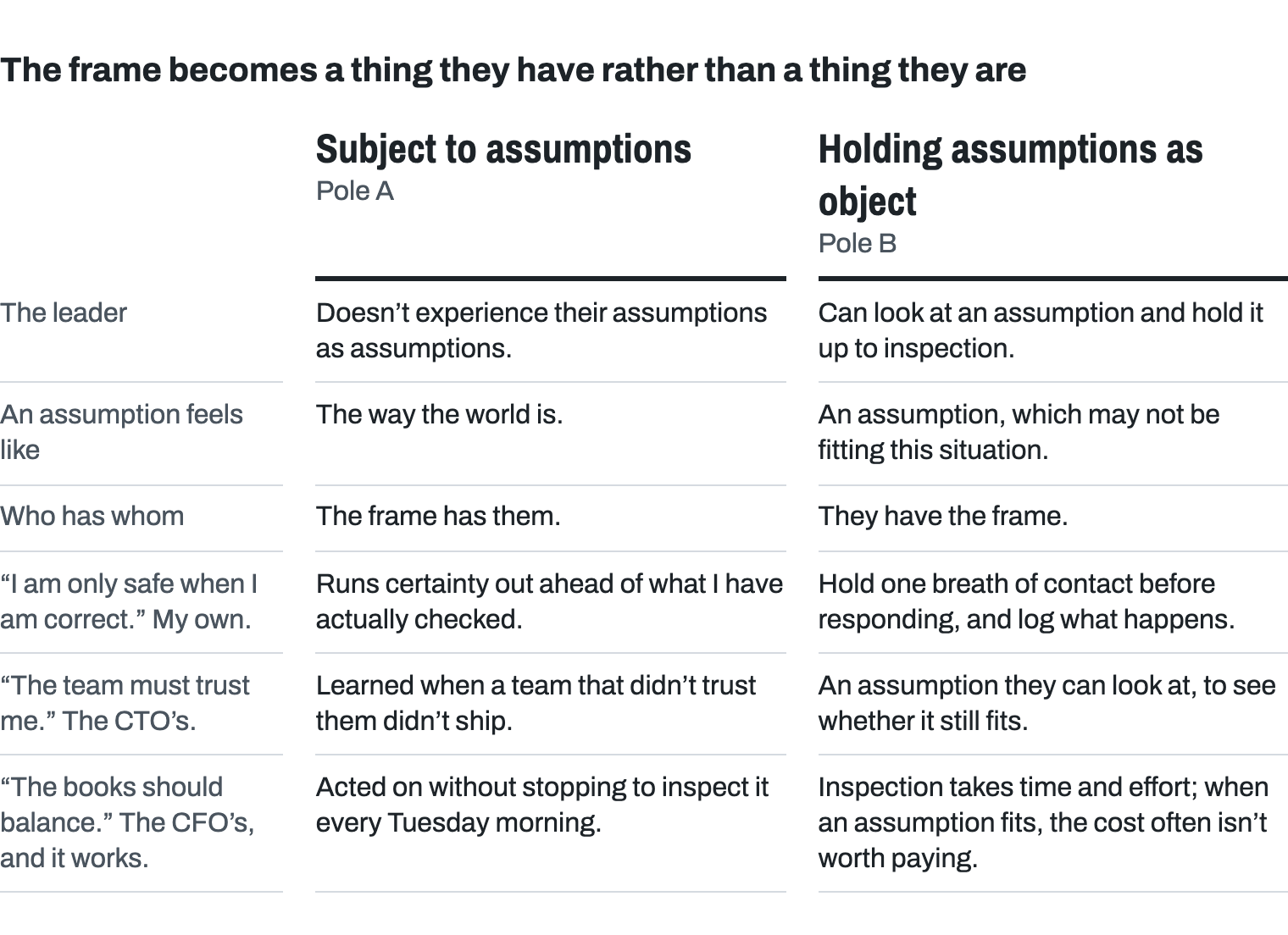
    Pole A: subject to assumptions. The leader doesn’t experience their assumptions as assumptions; they experience them as the way the world is. The frame has them.

    Pole B: holding assumptions as object. The leader can look at an assumption and hold it up to inspection. They can say that’s what I have been assuming about how this organisation needs to work, and I notice that assumption may not be fitting this situation. They have the frame.

    The frame becomes a thing they have rather than a thing they are.

    Robert Kegan, the Harvard developmental psychologist who has spent decades researching this move, names it as a structural shift in what one is subject to and what one can take as object. The Subject-Object Interview is the 90-minute interview Kegan, Lisa Lahey (his co-author on Immunity to Change) and their colleagues developed to assess where someone is on the developmental sequence; thousands of these interviews have now been run. As Kegan and Lahey describe it, greater complexity means being able to look at more of the thoughts and feelings that previously ran us. We’re always subject to something.

    Where Pole A is right

    Pole A is the structural default. Every leader is functionally subject to most of their assumptions most of the time. A working organisation depends on it.

    The CFO acts on the assumption that the books should balance, without stopping to inspect it every Tuesday morning. Inspection takes time and effort, and when an assumption fits, the cost often isn’t worth paying.

    The leader’s assumptions didn’t appear from nowhere. They were built over years, in response to specific conditions, by a self that was solving real problems. The CFO learned to be subject to the books-balance assumption because the early times in their career when the books didn’t balance were terrifying. The CTO learned to be subject to the team-must-trust-me assumption because the early times when the team didn’t trust them, the team didn’t ship. The assumptions are protective architecture. They got the leader here. Retroactive shame mistakes a protective response for a defect.

    Where Pole B is right

    Pole B is right when a recurring outcome gives the leader reason to question an assumption.

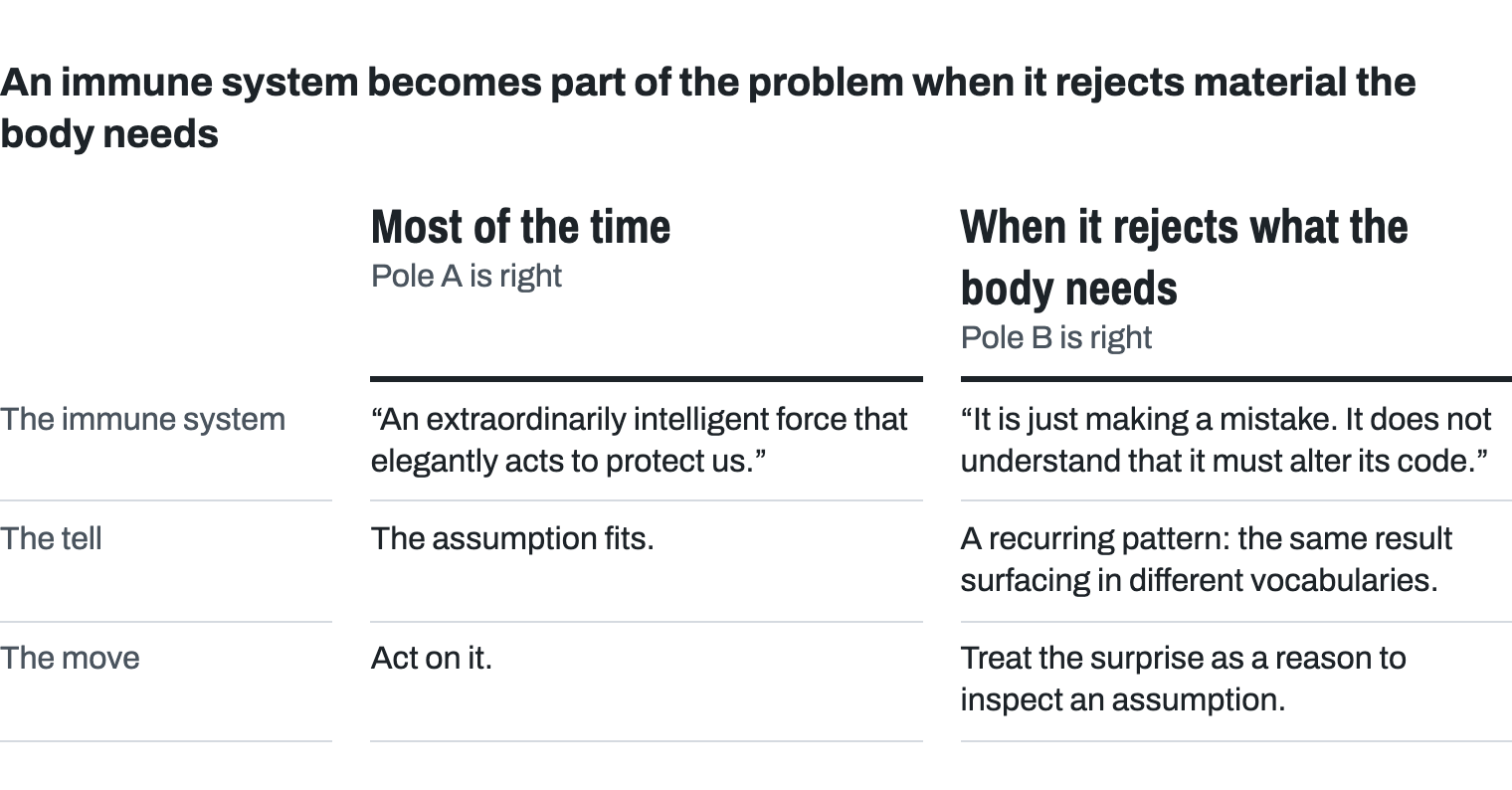
    Robert Kegan and Lisa Lahey, in Immunity to Change, use an immune-system analogy. An immune system is, most of the time, a beautiful thing: “an extraordinarily intelligent force that elegantly acts to protect us, to save our lives.” Every immunity to change can be read as an asset and a source of strength for the person carrying it. But immune systems can become part of the problem when they reject material the body needs. In Kegan and Lahey’s terms: “It is just making a mistake. It does not understand that it must alter its code.”

    The same result keeps surfacing in different vocabularies, the same conversation keeps happening with different people, and the same diagnostic keeps appearing in the quarterly review. The leader’s behaviour under pressure keeps producing an outcome that surprises them.

    The surprise is a reason to inspect an assumption, alongside what happened in the situation.

    The Immunity Map⁠—the four columns

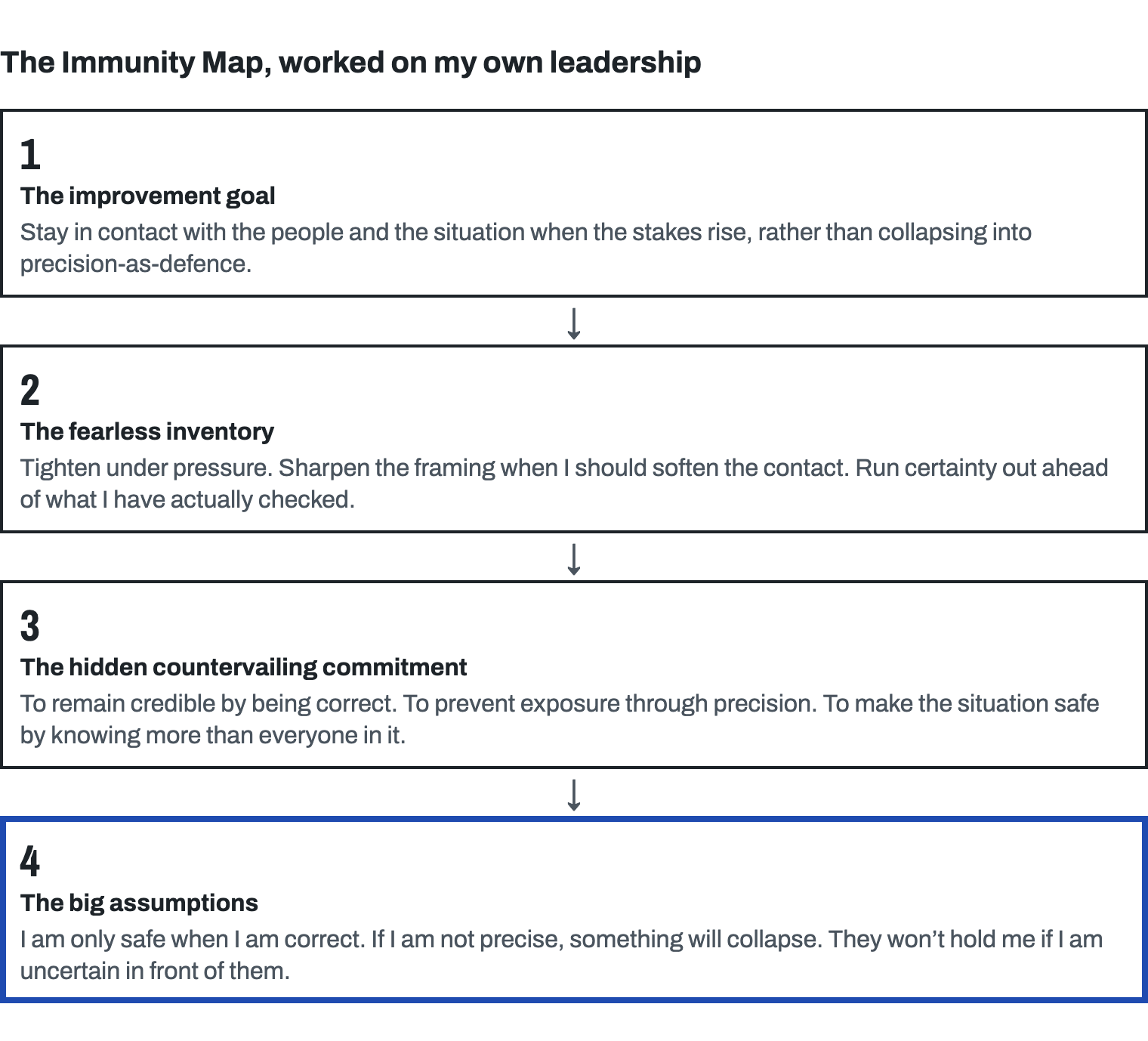
    Kegan and Lahey’s Immunity Map has four columns the leader works through in order. The worked example below is my own. Reading someone else’s map is useful; doing your own is the work.

    Column 1: the improvement goal. What you genuinely, sincerely want to do differently. Mine: stay in contact with the people and the situation when the stakes rise, rather than collapsing into precision-as-defence. Let clarity serve. Hold accuracy without sharpness.

    Column 2: the fearless inventory. The behaviours you do that work against the column-1 goal. Not what you do once in a while when you’re tired. What you do reliably. Mine: tighten under pressure. Sharpen the framing when I should soften the contact. Overshoot the audience with urgency that was meant for myself. Solution-shape a conversation that was asking for a slower kind of listening. Run certainty out ahead of what I have actually checked.

    Column 3: the hidden countervailing commitment. What you sincerely commit to that requires the column-2 behaviours. Mine: to remain credible by being correct. To prevent exposure through precision. To make the situation safe by knowing more than everyone in it. The column-1 goal asks for soft contact; the column-3 commitment requires precision as armour. Both are running in the same body at the same time.

    Column 4: the big assumptions. The assumptions that sustain the column-3 commitments. Mine: I am only safe when I am correct. If I am not precise, something will collapse. They won’t hold me if I am uncertain in front of them. As Kegan and Lahey put it: “We call them ‘big assumptions’ because they are not currently viewed as ‘assumptions’ at all. Rather, they are uncritically taken as true.”

    The exercise works when the leader can put all four columns on one page and see the assumption that links them. My column-2 behaviours do exactly what column 3 needs them to do. As Kegan and Lahey insist, the map isn’t exposing an insincere commitment behind the real one. The heart patient genuinely wants to keep living even as he reaches for another cigarette; change fails to happen because we mean both things.

    What runs after the map⁠—the continuous test

    Kegan and Lahey’s tests are safe, modest experiments, run to get information rather than to get better. My own extension makes the test continuous: the same test, moved into the moment.

    After the Immunity Map is built, the leader doesn’t now know their assumption and move on. The assumption is still operating. My own continuous test is small and specific: in conversations where I feel the precision-tightening start, hold one breath of contact before responding. The column-1 goal becomes the action; the column-3 commitment surfaces in the felt resistance to softening. The felt resistance is half the data; the other half is external: what actually happened when you softened? Log both.

    An assumption tested only against the feeling is an assumption grading its own exam.

    Repeated tests are what make the subject-to-object shift hold. Without them, the assumption tends to run the leader again.

    The chapter’s own trap⁠—subject-object duality

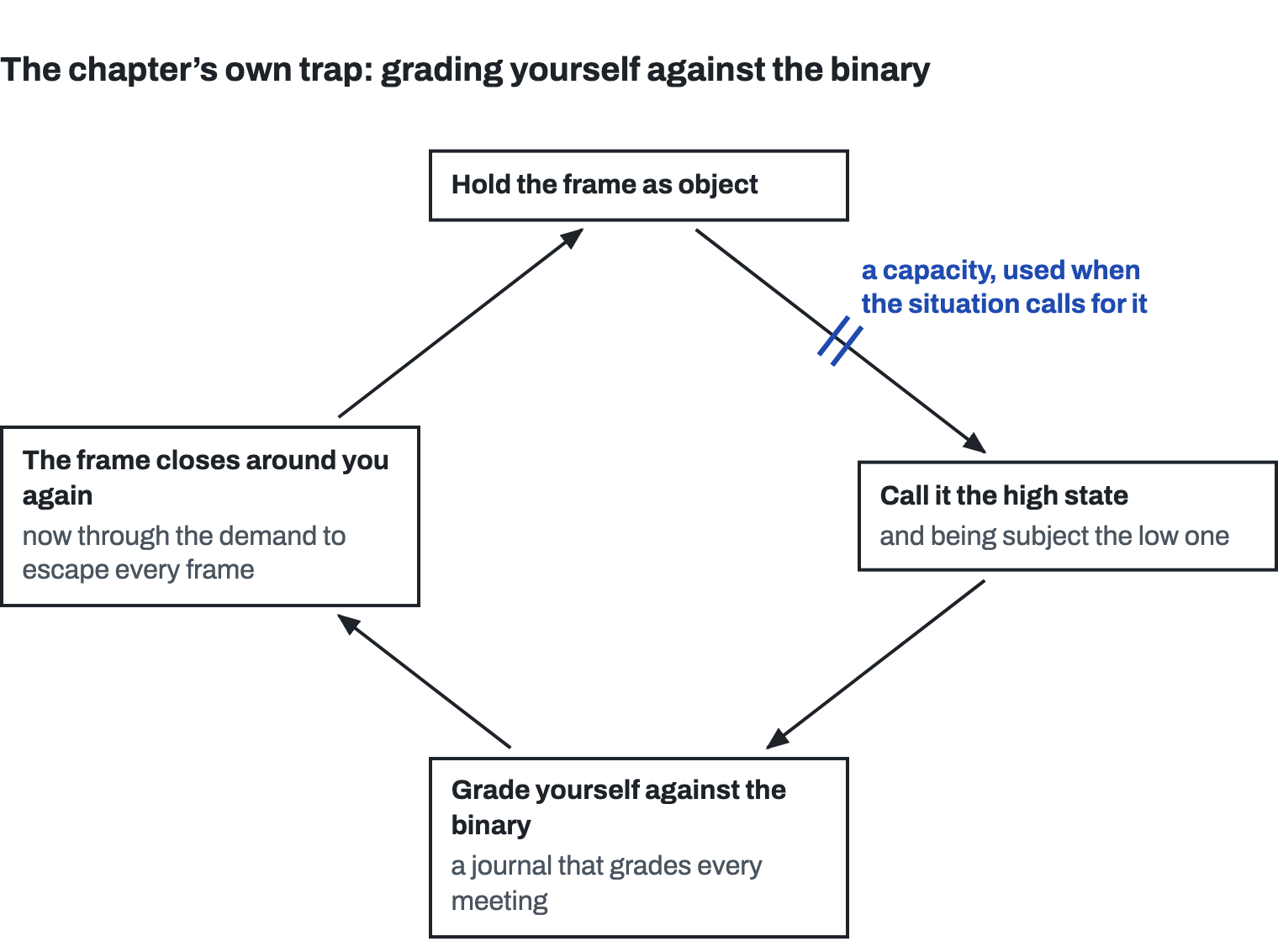
    If the leader treats holding assumptions as object as the high state and being subject to assumptions as the low state, they can start grading themselves against the binary. It shows up as a journal that grades every meeting against the binary, which is self-attack in developmental vocabulary. The frame has closed around them again, now through the demand to escape every frame.

    The move from subject to object is a capacity to use when the situation calls for it.

    Go back to the CTO in the car. What changes isn’t the partnership decision; it is that the question why do I keep saying no to this becomes available to ask, and the next call can be made on its merits rather than on the rule underneath it. The capacity lasts even as the assumptions change. I doubt the paradigm that fits today will still fit in 18 months. A leader who can take it as object can see that and adjust; a leader who has made one way of seeing part of their identity is stuck.

    In decisions

    At Pole A, the leader experiences the surprise as a thing happening to them. They name the situation as the cause without questioning what they assumed.

    At Pole B, they can ask what their own assumptions contributed. They can say I am noticing the same anxiety I noticed the last three times this came up, and the anxiety is the information. They can sit with the discomfort long enough to inspect the assumption.

    When a decision fails and the same failure has come before, there are two moves close to hand: defend the decision, or ask what assumption made it look right at the time. I have made both, sometimes in the same meeting. Questioning the assumption can mean discovering you were wrong.

    Put one recurring pattern in front of your CEO. Use several incidents where the CEO’s response surprised you by repeating itself, rather than a single incident. Anchor it in shared work: one specific decision you were both inside, with the CEO’s account asked for first⁠—what were you trying to do there?—before you offer what you saw. The four-column map from Kegan and Lahey is your guide, not your script. Better still, build your own first two columns on the same decision and put them beside the CEO’s; chapter 17’s calendar exercise is the pattern: both parties produce, both compare. Whether the CEO can hear it depends on the relationship. If the relationship is there, I suspect this is the most consequential conversation available to you. If it isn’t, start with a less charged axis and build toward this one. If the CEO declines the conversation altogether, that is information, not resistance to overcome. The offer stands, and the transformation was never yours to deliver.

    The sentence your CEO can carry to the board: “One of our biggest risks is whichever of my patterns no one around me will name.”

    The diagnostic move⁠—three questions

    Take the last time you were genuinely surprised by your own behaviour, when afterwards you sat in the car or stared at the screen and wondered what just happened. Walk through the moment and ask: what assumption was operating in me right before that? Sit with it long enough to put the assumption into words. Don’t force it; the assumption is unfamiliar to you because you have been subject to it.

    Choose one assumption you can name about how your team or organisation has to work. Write it as a sentence. Now design one safe, modest behavioural test where you act against it this week. The point isn’t to disprove the assumption. Record what it costs you to act against it and what actually happens.

    Notice what arrives in you when you read this chapter. Tightening might mean the argument fits, or overreaches, or is simply unfamiliar, or that an assumption is defending itself. Which one is a question to test against evidence, not to settle by the feeling.

    These questions need time you may not have planned to give them.

    A team-based exercise

    Walk the Immunity Map once, on yourself, before you try it with anyone else.

    Pick a column-1 goal: something you genuinely want to do differently in your leadership and haven’t been able to do, despite trying. Run the four-witness check from chapter 2’s exercise before you lock it⁠—one question, four people who know you⁠—because they can name goals and effects your own protective habits leave out. Build the columns. Take an hour or two. In my experience column 2 is easy and uncomfortable, column 3 is the one that stings, and column 4 tends to arrive last.

    Don’t share the map with your team yet. Sit with it for a week. Watch your own behaviour against the columns and notice when the column-3 commitment is operating. The continuous test starts here.

    When the team learning is ready⁠—Kegan and Lahey are emphatic that the leader has to go first, has to be visibly working on their own immunity before asking the team to do the same⁠—share the map with two people who have permission to push back. The work after that is collective, and slower than this chapter can describe.

    Going upstream

    Start with: Kegan, In Over Our Heads: the developmental theory the immunity work rests on, and the Subject-Object Interview that names the move. Kegan and Lahey, Immunity to Change: the Immunity Map and the case studies. The continuous test above is my extension.

    Further reading: Meadows, Thinking in Systems: on transcending paradigms at the top of her leverage-points hierarchy.

    Go deeper: Garvey Berger, Changing on the Job and Unlocking Leadership Mindtraps: the same ideas, written for working leaders. Heifetz, Leadership Without Easy Answers and The Practice of Adaptive Leadership: the adaptive-versus-technical distinction the developmental work rests on.


    I work with engineering leaders on exactly this kind of paradigm work, the deeper the better. If it’s live for you, I’m happy to talk: schedule a 30-minute virtual coffee at hi.chrisgagne.com.

    Some book links here are Amazon affiliate links; if you buy through them I may earn a small commission, at no cost to you.


  • Socialised vs self-authoring vs self-transforming

    Socialised vs self-authoring vs self-transforming

    Most of us have outsourced judgement to a confident voice at some point, whether the CEO, the board, a consulting deck, or the mentor who always had the right answer ready. Now the confident voice is an LLM.


    Chapter 11 began with contact before framework. This chapter names the developmental capacity that lets a leader stay in contact when a framework speaks with a confident voice, and AI makes that need hard to miss.

    🎧 Prefer to listen? This chapter is narrated in my own voice with ElevenLabs on Spotify (16 minutes).


    Three developmental stages show up in how leaders respond to confident voices.

    The three poles

    Robert Kegan mapped adult development through three plateaus that matter for leadership. His In Over Our Heads (1994) laid out five orders of consciousness, of which these three plateaus make up the adult stretch. From his review of subject-object-interview studies with random sampling, he made the empirical claim that one-half to two-thirds of the adult population appear not to have fully reached the second of the three.

    Pole A: the socialised mind. Identity is given by the surround. Relationships, institutions, and ideologies tell the leader who they are. They can’t disappoint a confident voice they are loyal to because the bond to that voice isn’t something they have; it is something they are. Parenting and apprenticeship rely on this plateau. Early careers and loyalty-based work often do too.

    They can’t disappoint a confident voice they’re loyal to: the bond isn’t something they have, it’s something they are.

    Pole B: the self-authoring mind. Identity comes from a self-chosen stance. The leader can step back from the values, relationships, and frameworks that once made them, hold them as object, and ask whether they fit the situation. They can disappoint a confident voice without losing themselves.

    Pole C: the self-transforming mind. Identity is held lightly. The leader can hold their own self-authored stance as object: this is a frame I am running; another frame would bring different data forward; here is a third. They can move among those frames without becoming indecisive because the stance holding them is itself coherent. The fraction of adults who reach it fully is small: in Kegan’s longitudinal data, rare, and never before midlife.

    Bill Joiner and Stephen Josephs, in Leadership Agility, mapped the same ground onto leader behaviour. Their five levels (Expert, Achiever, Catalyst, Co-Creator, Synergist) give us an operational account. Roughly nine in ten managers sit at or below Achiever; about one in ten are past it. Joiner and Josephs use a heroic / post-heroic distinction: Expert is mostly Pole A, Achiever is where Pole B becomes operational, and the three post-heroic levels (Catalyst, Co-Creator, Synergist) reach into Pole C. In behaviour: Pole A inherits the standard, Pole B tests it from a stance of its own, and Pole C can revise the frame that produced the standard.

    Kegan’s plateaus aren’t moods you pick for the occasion. Each “subsumes or encompasses the prior principle”, so a later mind holds the earlier ones as tools it can use. A self-authoring leader can choose patient deference when a situation calls for it; a socialised leader can’t choose a stance of their own, because they don’t yet have one to choose. So read the poles that follow as responses, each available at or below the plateau you’ve reached. When a situation asks for one above it, you’ve found your developmental edge, and the work there is structural and slow.

    Where Pole A is right

    The socialised mind is often right early in an unfamiliar domain, where the standards are established and the feedback is reliable. At that point, the alternative to deference is often confidence the apprentice hasn’t earned. Nine of us had come out of the practitioner course for LeSS, the large-scale Scrum framework, and the question was whether we should teach it to everyone else. I argued that we were by no means experts, or in any position to do it justice when teaching others, and we brought in an outside trainer instead.

    At its best, Pole A is patient deference. A leader who has taken in the standards of a craft has done something a leader who hasn’t can’t do.

    Joiner and Josephs’ Expert level carries this honour. The Expert leader is genuinely good at the technical work, holds its standards, and brings rigour to one problem at a time. Heroic in their typology means that the leader carries the work through expertise and positional authority. The level worked because the conditions rewarded it.

    Where Pole B is right

    Senior leaders now need to form and test their own stance more often than their development has prepared them to do.

    At one engagement, the confident voice in the room was mine. One developer told me later that he had been sceptical at first, perhaps my biggest sceptic, and only because his experience of Agile had been Agile in name only: a meeting every morning that was a status report to a micromanager, work handed down with the solutions already baked in, no autonomy. He held my confidence against data it didn’t answer, tested it rather than deferring to it, and updated when the practice turned out to differ from what he had seen. That is self-authoring, and the voice being rightly distrusted was mine.

    The number of confident voices has grown. The CEO, the board, the consulting deck, the latest framework, and now the AI agent. A socialised leader who can’t hold a confident voice as object hears each new voice as one more authority to follow. The voices disagree. The leader swings between them. The organisation follows.

    The AI agent gives the socialised leader a clean test: can they disagree with a confident output? A self-authoring leader can sit with an agent’s answer, test it against the situation, disagree out loud, and write the policy that governs its use. A socialised leader can’t do those things, because the confidence of the output is itself the data they are reading, and to weigh the answer they would first have to hold the very quality (its assurance) that is doing the persuading.

    The agent is also a particular kind of confident voice. Trained on the consultant-derivative corpus, it tends to hand back the paradigm already set inside the question, fluent and assured. This is the trendslop from Chapter 1: the model reaching for fashionable management language over the logic the situation calls for. It sounds certain and agrees with you. For a socialised leader, that may be the hardest voice of all to disagree with, because it can feel like breaking with the whole field at once.

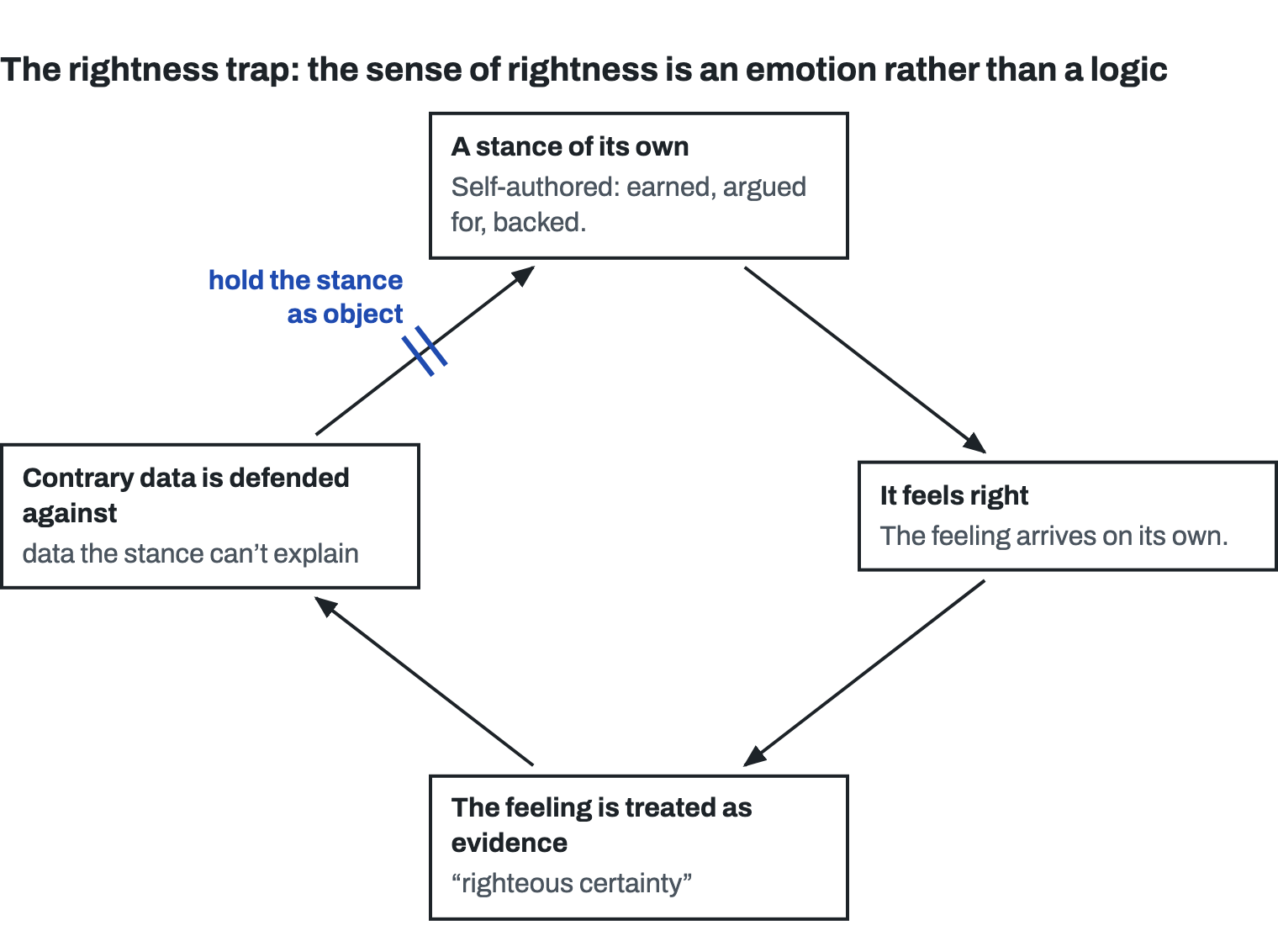
    Jennifer Garvey Berger calls the rightness trap one of her five universal mindtraps. In her account, the self-authored mind can harden into “righteous certainty”: it has found a stance of its own and starts treating the feeling of being right as evidence. As she puts it, “the sense of rightness is an emotion rather than a logic.” A leader at the self-authoring plateau has earned a real stance, yet can still defend it against data the stance can’t explain. The self-transforming plateau begins to loosen that trap.

    Where Pole C is right

    The self-transforming mind is right when conditions change faster than any one self-authored stance can last. AI is such a domain. The conditions in front of you may change again before you have finished reading this.

    A leader who can hold their own stance as object can name the frame they are running, the conditions under which it works, and the data it has pushed out of sight. I designed the team-formation workshop with no pre-assigned feature areas, on the conviction that the teams should form organically. Round One failed to produce teams. The room voted to keep my design. Round Two still struggled, so I proposed assigning features after all, in front of about thirty people and against my own conviction. It worked briefly, then we lost momentum. After a break, Round Three took form on its own and we finished with four teams meeting every ground rule. I had revised my own design in public, and then revised it back. CEOs face this often enough for Pole C to be an operating need, and the AI decade doesn’t create that requirement; it surfaces one that was already there, driving the rate of change past the lifespan of any one self-authored stance until Pole C reads as operational.

    Joiner and Josephs’ Catalyst, Co-Creator, and Synergist levels each name a different expression of self-transforming capacity. The Catalyst can shift frames on the spot during a meeting. The Co-Creator can run a working partnership in which two leaders hold mutually exclusive frames in productive tension. The Synergist reads and responds to the live situation rather than running from rehearsed strategy.

    A leader moving from Pole B to Pole C can’t do it alone. Heifetz names the holding environment that makes the work possible: all those ties that bind people together and enable them to maintain their collective focus on what they are trying to do. The developmental lineages are blunter: good company is required every step of the way. The work happens inside that company. (Chapter 11 began naming what this looks like in practice.)

    Swapping frames inside a plateau is what that workshop showed. Moving between plateaus is structural, and there are no cheap tickets to it.

    A leader inside a paradigm can’t think their way out of it.

    In decisions

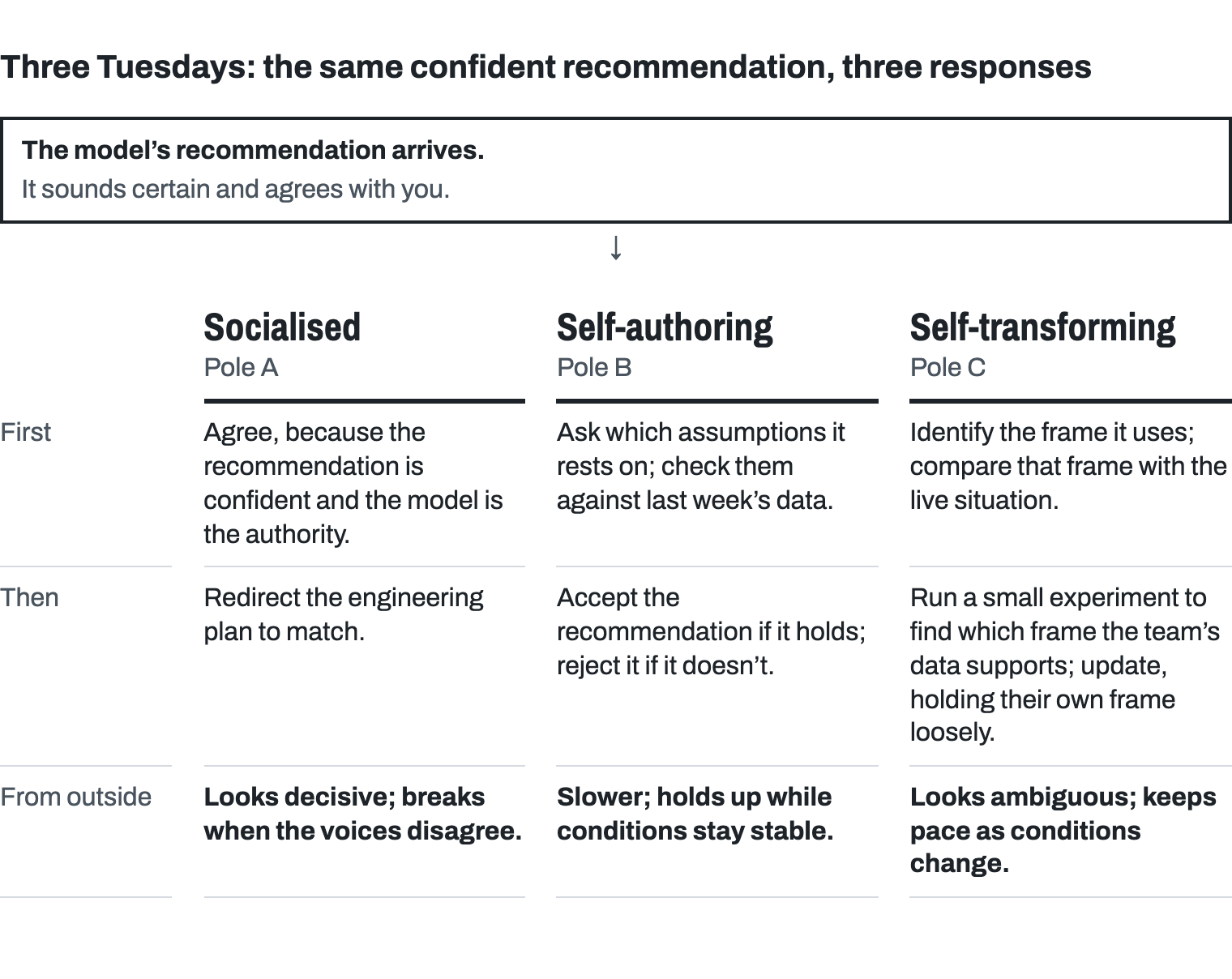
    The first mode, on a typical Tuesday: receive the model’s recommendation, agree because the recommendation is confident and the model is the authority. Receive the board’s preferred direction, redirect the engineering plan to match.

    The second mode: receive the model’s recommendation, ask which assumptions it rests on, check those assumptions against last week’s data, accept the recommendation if it holds, reject it if it doesn’t. Receive the board’s preferred direction, hold it against the engineering organisation’s actual capacity, push back where the maths doesn’t work, restate the disagreement as evidence the board needs. Receive the senior engineer’s opinion, hold it against the senior engineer’s track record on similar calls, decide.

    The third mode: receive the model’s recommendation and identify the frame it uses. Compare that frame with the live situation and with the one they have been using for the past quarter, then run a small experiment to find which frame the team’s data supports. Update, holding their own frame loosely enough to change it when the situation calls for it.

    The three Tuesdays look different. The first looks decisive but breaks when the voices disagree. The second is slower and holds up while conditions stay stable. The third looks ambiguous from outside, yet it can keep pace as conditions change. I find all three in my own decisions from the past month.

    Suppose you are the CTO or VPE preparing a decision briefing in which the board, the chief scientist, and the product team are working from three different frames. The developmental vocabulary may help you read the dynamics, but it doesn’t belong in front of your CEO unless your relationship can bear it.

    Ask your CEO: when three voices are each working from a different frame (the board’s, the chief scientist’s, and the product team’s) and none is wrong inside its own terms, what is the CEO’s move? That question tests both of you, whether either can hold the frames as object rather than pick one to be right. If your CEO can hear the question without hearing an attack, the conversation is worth having.

    If they can’t, put one page in the next decision briefing. Write each recommendation in its own plain sentence so the CEO meets three reasonable answers to the same question, rather than three camps to choose among. Keep the framework vocabulary with you. Give the CEO the page.

    The sentence your CEO can carry to the board: “The board, the science, and the product are each right in their own frame; the decision is which frame fits this quarter.”

    The diagnostic move

    One. Name a confident voice in your work this past month that you agreed with quickly, before checking the substance. The board. A lead investor. A peer. Your CEO, if you have one. A model output. The next time that voice arrives, what would it cost you (in your sense of yourself and in front of others) to disagree with it out loud?

    Two. Name a stance you have been defending in the past quarter, a position you have argued for or an instinct you have backed against pushback. Where is the data that would update it? What would it take to hold the stance as object, as a frame you are running with known conditions of applicability, rather than as the truth?

    Three. Pick the next high-stakes conversation on your calendar. What frame are the other people in that conversation working from? What frame are you working from? What third frame, neither yours nor theirs, would bring forward data the conversation has filtered out?

    The exercise: the confident-voice disappointment exercise

    Name a confident voice in your life that you have been deferring to: a CEO, a board member, a peer, a frequently-deployed AI agent, a coach. Before the first rep, read how this has gone before. What happened to the last person who disagreed with that voice out loud?

    Stage the rep accordingly. Choose the safest real disagreement available, a low-stakes call where you have substance rather than a boardroom showdown. Say it out loud. Then track what happens to your relationship with the voice and to the work the disagreement opens up.

    Debrief the rep against Chapter 2’s map. What does the result say about the assumption that kept you deferring? Run it once. Then run it again, one notch up.

    Going upstream

    In-text: Robert Kegan, In Over Our Heads, for the three orders and the one-half-to-two-thirds finding. Bill Joiner and Stephen Josephs, Leadership Agility, for the operational mapping to leader behaviour and the level percentages. Jennifer Garvey Berger, Unlocking Leadership Mindtraps, on the rightness trap.

    Also touched: Ronald Heifetz, Alexander Grashow, and Marty Linsky, The Practice of Adaptive Leadership, for the holding environment; the phrase was Donald Winnicott’s first. Robert Kegan, In Over Our Heads, again for the developmental version of the holding environment and good company is required every step of the way.

    Go deeper: Alicia Juarrero, Dynamics in Action, for intentions as attractors and the dynamical-systems reason a stance is a structural shift rather than a decision. Robert Coram, Boyd: The Fighter Pilot Who Changed the Art of War, for Boyd’s Destruction and Creation, the destroy-and-recombine cycle that keeps concept matched to reality. Donella Meadows, Thinking in Systems, for the leverage-points hierarchy and no cheap tickets to mastery.

    This chapter put the question to a confident voice outside you. The next one turns it inward, on your own quick certainty. You list five options, score them against criteria, and pick the highest. The experienced operator already knew. You were slower; whether you were any more accurate is Chapter 13’s question. Chapter 13 sorts the calls that needed your analysis from the rigour performed for no one, then gives you the cognitive science to tell earned expert intuition from bias wearing the same face.


    I work with engineering leaders on exactly this kind of paradigm work, the deeper the better. If it’s live for you, I’m happy to talk: schedule a 30-minute virtual coffee at hi.chrisgagne.com.

    Some book links here are Amazon affiliate links; if you buy through them I may earn a small commission, at no cost to you.

  • Just This

    Just This

    Eight axis chapters in; the practice underneath them all is the capacity to stay in contact with what is, rather than with the framework about it.


    Chapter 10 asked whether a failed decision is met with defence or with inquiry; this is the inquiry practice.

    🎧 Prefer to listen? This chapter is narrated in my own voice with ElevenLabs on Spotify (~20 minutes).

    This chapter grew out of an essay I wrote in May, closer to the session that prompted it.


    This chapter uses a different vocabulary than the chapters before it. The diagnostic language that has carried the axis chapters this far is itself a framework. This chapter is about what happens when you reach the edge of what any framework can do, which happens more often than we’re typically willing to admit. Naming that edge calls for vocabulary from contemplative traditions, psychotherapy, and developmental coaching alongside the operational vocabulary we have already been working with.

    Contact over abstraction

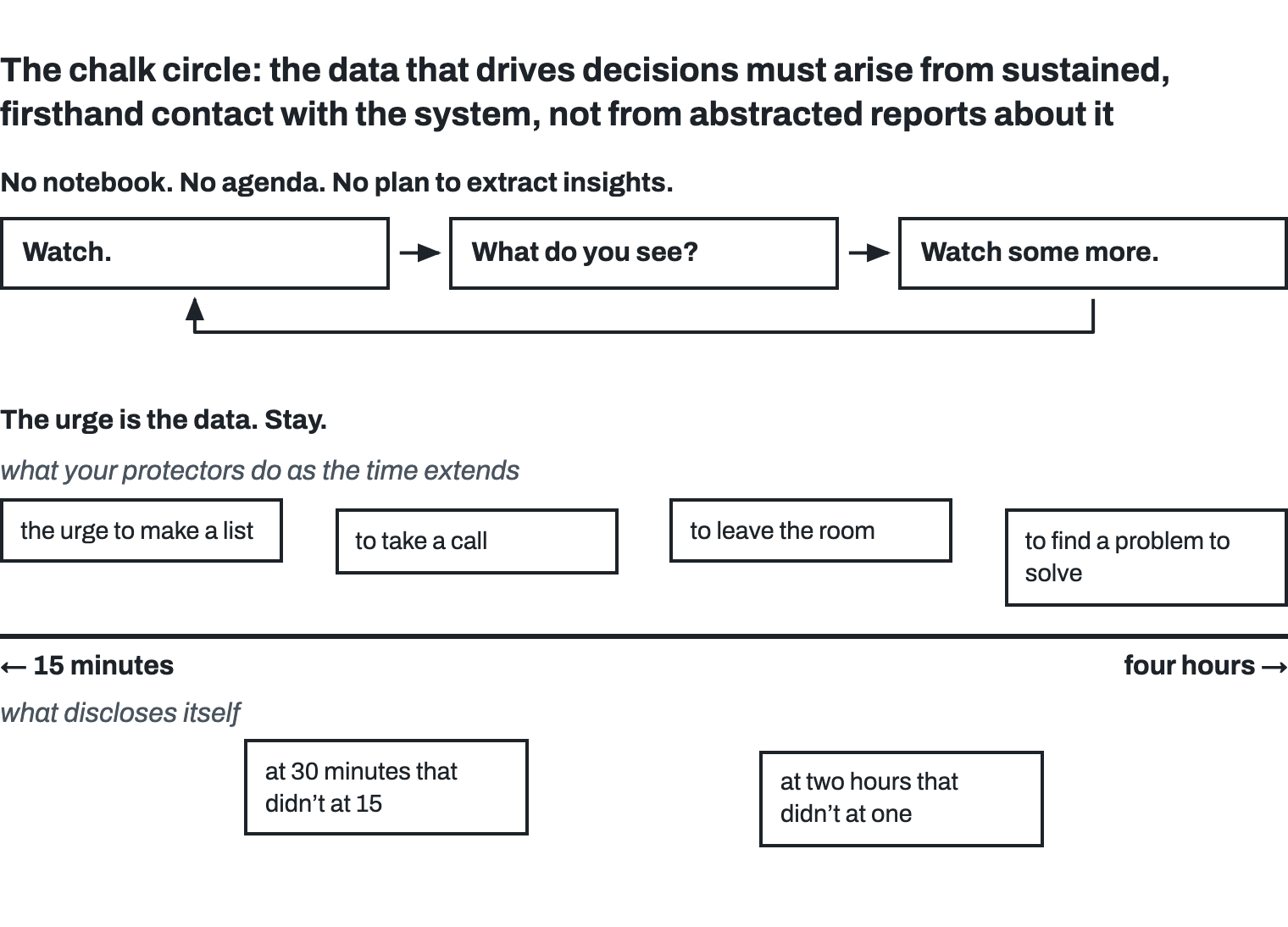
    Taiichi Ohno, an architect of the Toyota Production System, used to draw a chalk circle on the factory floor and instruct a manager or engineer to stand inside it. His direction was a single word: Watch. Hours later, sometimes a full shift, Ohno would return and ask: What do you see? The practice was to keep watching until the right sort of answer arrived unbidden. If the answer wasn’t yet ripe, his response was: Watch some more. The story is folk-canonical in the Lean tradition; I take the discipline it teaches⁠—genchi genbutsu, go and see for yourself⁠—as the same access claim Eric Ries makes operational in The Lean Startup.

    The chalk circle makes an epistemological claim: the data that drives decisions must arise from sustained, firsthand contact with the system, not from abstracted reports about it. The distinction looks subtle until a report you trusted and the floor you are standing on disagree. Plans, frameworks, models, doctrines, identities, narratives are all useful. None of them is the thing. The thing is what is actually happening in this moment, between actual people, with actual constraints, in an actual body or system.

    I read the Agile Manifesto as a contemplative document. Each of its four pairs⁠—individuals and interactions over processes and tools, working software over comprehensive documentation, customer collaboration over contract negotiation, responding to change over following a plan⁠—expresses that teaching in operational language. Contact over abstraction. Be in real-time relationship with the human, not the document about the human. The “while there is value in the items on the right” qualifier is careful and important: plans and frameworks aren’t worthless, they are held loosely, ready to dissolve back into the next moment of contact.

    Dave Snowden’s prescription for the complex domain in the Cynefin framework is probe, sense, respond. The complicated domain gets sense, analyse, respond. It’s more like poker than chess. You don’t learn what your poker opponent is holding until the betting starts; the leader can’t know the right move before direct contact, which takes time and effort. Probe, sense, respond gives organisational form to the Agile Manifesto’s preference for responding to change over following a plan.

    The best move in complex contexts is to let contact precede framework. Meet reality before meeting the structure that will make sense of reality. As Dave Snowden reminds us, have the data precede the framework. In meditation, that’s bare sense perceptions, not the mental labels that follow them. In complex product development, it’s asking “what’s your narrative about X,” not “rate X on a scale from 1-5.” In my own work, either of us can slip from contact into framework, or never reach contact at all, and much of the job is noticing the shift together and naming it. Methods, models, and certifications serve that work.

    The same teaching, named directly

    I received a coaching session from my Alētheia teacher in the middle of a confluence of several crises at once: serious family illness, client loss, partnership strain. The week before, I had been narrating it all to him somewhat clinically, telling him I was saying yes to it.

    He offered a different frame. There might not be a yes or a no at all, he suggested. There might just be a this: whatever is actually facing me. Neither chosen nor refused. Just this as the source of action. I face this. What action arises? I act. Then I face the next this. And the next.

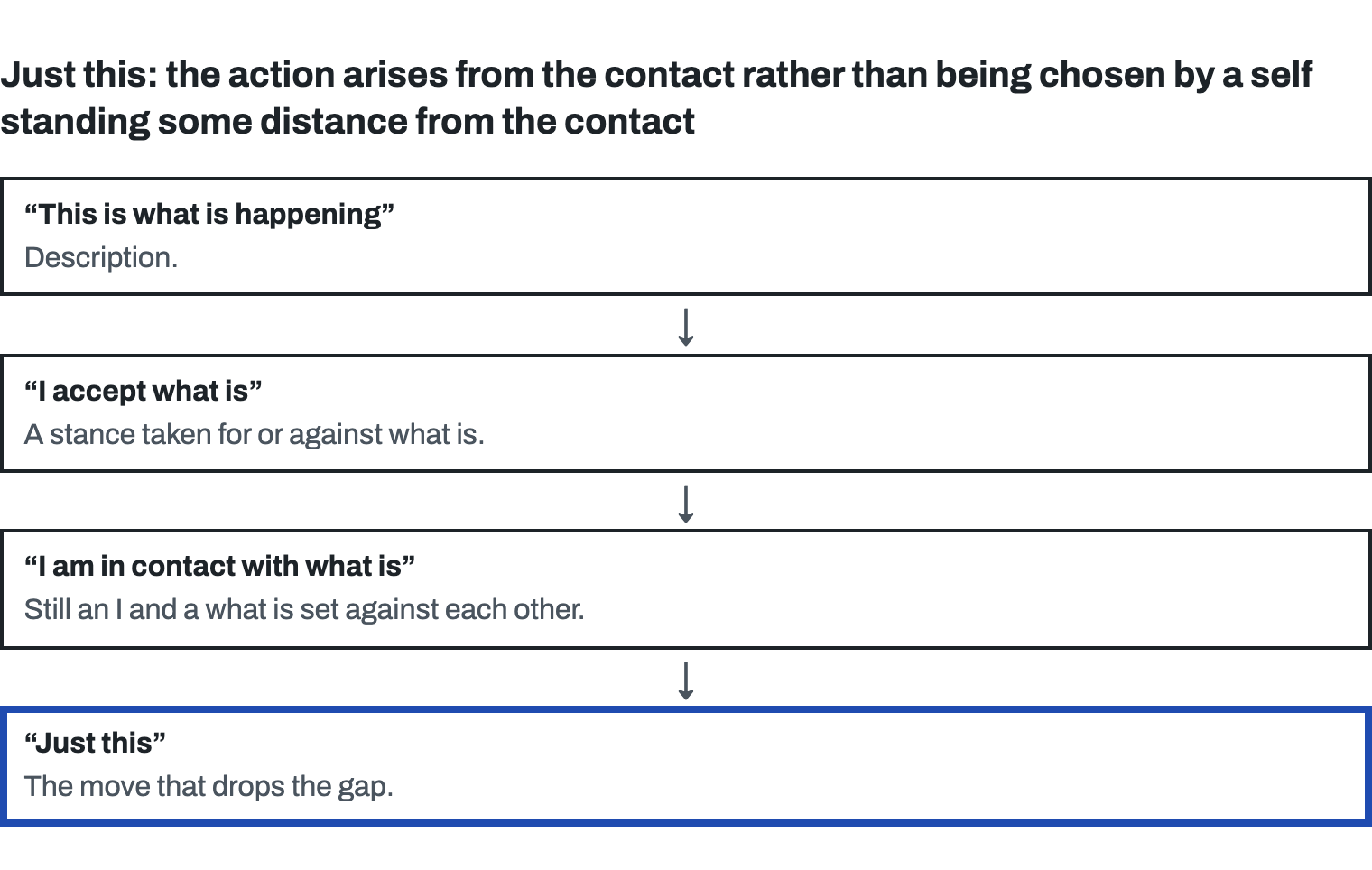
    It took me a while to feel the difference between just this and the other moves I had been making. Just this isn’t this is what is happening, which is description. It isn’t I accept what is, which is a stance taken for or against what is. It isn’t even I am in contact with what is, which still has an I and a what is set against each other. Just this is the move that drops the gap. The action arises from the contact rather than being chosen by a self standing some distance from the contact.

    The chalk circle is shikantaza in safety boots. I see a shared discipline in Ohno’s exercise and Zen practice: interrupt the filters that keep the watcher from seeing what is there, then sustain attention long enough to see more.

    The same teaching, across traditions

    I also see a related recognition in three Buddhist lineages, each in its own idiom. I draw on Buddhism because it is likely the oldest lineage to hold this recognition at its centre, and I cite it the way I cite Ohno: as testimony to be tested, not as a religion or authority to be obeyed. The Pali Canon’s Bahiya Sutta instructs a wandering ascetic: in the seen there is only the seen, in the heard only the heard, in the cognised only the cognised. When experience is left at just that, with no ‘you’ added to stand apart from it, suffering ends. That leaving-at-just-that is what I have been calling just this. The thirteenth-century Zen master Dōgen, in the Genjōkōan, frames it as two directions of motion: to carry the self outward and cast its light on the ten thousand things is delusion; to let the ten thousand things advance and disclose the self is awakening. The Tibetan Dzogchen lineage points at the same recognition with the phrase self-arising wisdom. I read all this as something both ordinary and extraordinary: what happens when one stops running every moment through one’s conditioning and filters.

    Steve Jobs named something related in the vocabulary of building products. After months in India he came back convinced that our discursive intellects were an acquired overlay, not the ground: “The people in the Indian countryside don’t use their intellect like we do, they use their intuition instead… Intuition is a very powerful thing, more powerful than intellect, in my opinion. That’s had a big impact on my work.” I read him as describing what is left to work with once you stop running every judgement through the part of the mind that reasons about the thing instead of meeting it. The paradox he embodied⁠—that the same man could trust intuition this far and still override everyone around him⁠—is its own lesson: the capacity to make contact and the compulsion to control what you find are different muscles, and it is the second one the ordeal is trying to loosen.

    In my understanding of Steve March’s developmental-coaching lineage, the leader’s path unfolds as the parts that have been running the show step back. The qualities of presence are what then show up. I see a related move in Otto Scharmer’s Theory U. Scharmer coined the word presencing, blending presence and sensing: “to sense, tune in, and act from one’s highest future potential⁠—the future that depends on us to bring it into being.” Peter Senge adopted the word for the middle phase of the U process.

    For Eugene Gendlin, a living process continues by carrying forward: when the body’s felt sense is attended to without forcing, the implicit can reorganise and a different sort of clarity can arrive, unbidden. The felt shift is what happens when the process completes a step it had held implicit until contact made the next step available. That while it took me to feel the difference between just this and the moves I had been making was a felt shift. Nothing arrived as new information.

    The same false form in both domains

    Agile and contemplative practice can fail in a near-identical way.

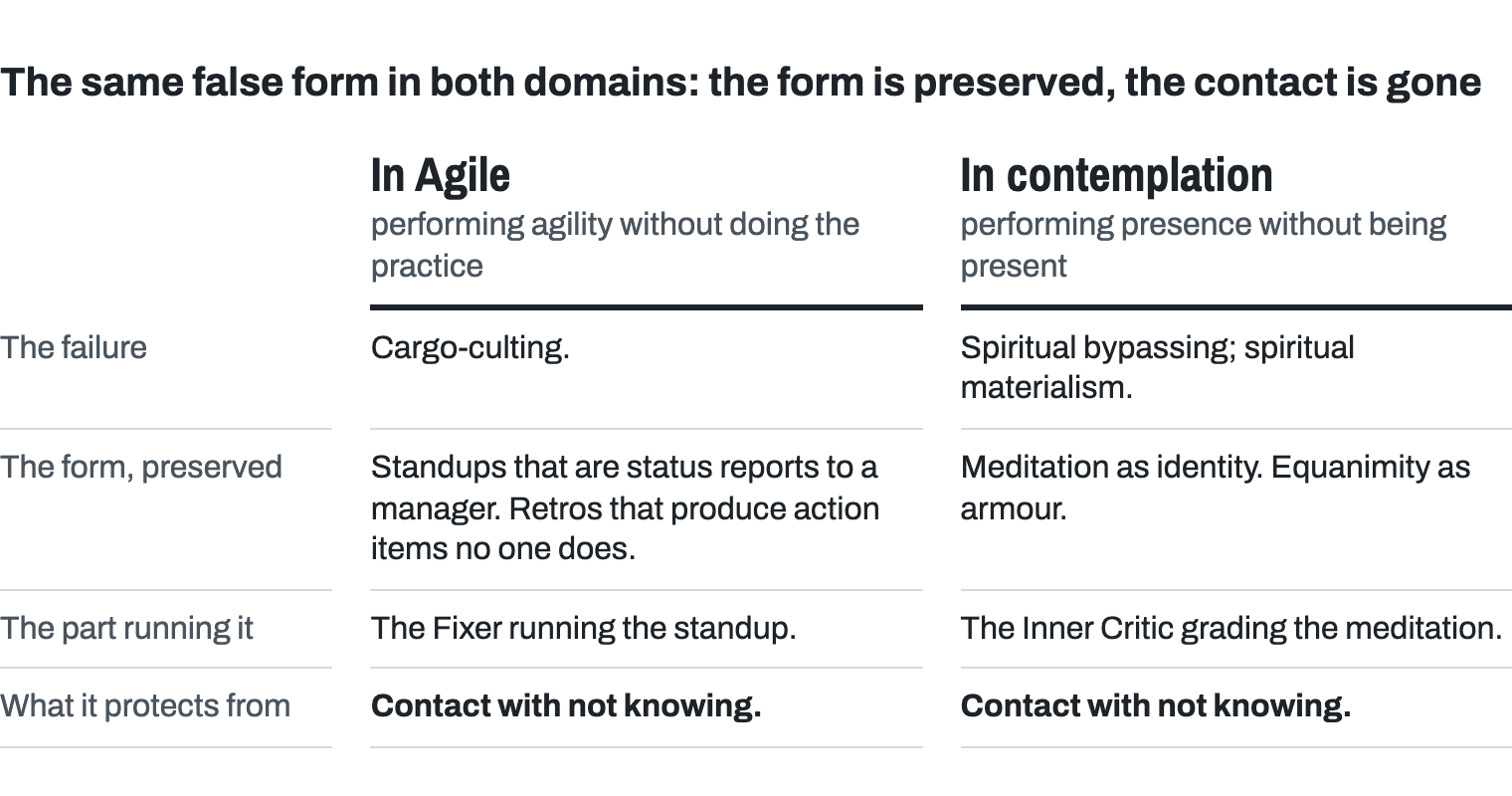
    In Agile, the failure mode is cargo-culting. Standups that are status reports to a manager. Retros that produce action items no one does. Story points as a weapon. Sprints that generate task outputs, not integrated products. The form is preserved. The contact is gone. The team is performing agility without doing the practice. The last chapter’s belief was my own version: I held the form and read every team that didn’t break through as not having held it tightly enough.

    Bureaucracy is where contact goes to die. A bureaucracy tuned to local metrics rewards the wrong move: it pays people to make their own box look good and taxes them for making contact with the system-level truth, Goldratt’s disease from chapter 8 felt from inside. I wrote a few years ago that auditing a developer’s every hour to hold them to a utilisation standard is “a dreadful, local optimization.” I saw it over and over as a coach. Backs broken to hit a date, quality traded away in a cram session, people treated as what Craig Larman, in his Certified LeSS Practitioner course, calls “meat widgets.” The structure makes contact hard and compliance easy, and people, being rational, take the easy route as we explored in chapter 6. Once the organisation measures busyness and calls it performance, the report that says we are slower because we are finally doing it right becomes a career risk.

    In contemplation, the failure mode shows up under at least two names. John Welwood coined spiritual bypassing in 1984. Chögyam Trungpa, earlier in the 1970s, named a related dynamic spiritual materialism and wrote Cutting Through Spiritual Materialism around the cure. Meditation as identity. Equanimity as armour. I’m sitting with it as a way to not feel it. The practitioner is performing presence without being present.

    In Richard Schwartz’s Internal Family Systems, both failure modes can be driven by protector parts using the practice as armour against reality. The Fixer running the standup. The Inner Critic grading the meditation. The Practice Protector keeping things light enough to never land. Schwartz’s clinical observation is that we are populated. The Manager who keeps the leader looking competent is a part. The Critic who runs the meeting in advance and the meeting again afterward is a part. The Hurt one underneath, whom the Manager and the Critic are protecting from making contact with not knowing, is also a part. What the ordeal asks to dissolve is the leader’s fusion with the part: the belief that the part running the show is the whole self. The part feels the loosening as a kind of dying; it doesn’t die. What ends is only its claim to have been the Self.

    Beatrice Bruteau gave the failure mode what I think is its sharpest contemplative form in her 1979 book The Psychic Grid, drawing on Dostoevsky’s Grand Inquisitor and Walter Kaufmann’s decidophobe. The world we know is one we collectively construct, and few of us can step outside the shared grid alone. The Inquisitor is the figure who lifts the burden of deciding for ourselves. He tells us how it is and what we must do, and we thank him for it. Any framework can become the Inquisitor when the leader agrees to obey it rather than use it: the methodology, the certification, the lineage that can’t be questioned, the app on the home screen that scores the day, the AI agent whose confident output settles the doubt. For years I worked a staged meditation path⁠—numbered stages, an elephant-path diagram, effort measured against the next stage⁠—and I ran it the way I run a delivery framework. It was perfectly designed for my parts to latch onto. I was practising from parts, and the form outlasted the contact.

    I read Bruteau as naming the relief a leader feels when a framework arrives and settles doubt. That relief disqualifies the framework from its proper work: putting the leader in contact with what is.

    Nothing wasted

    If you have spent any real time in either world⁠—Agile, contemplative, or both⁠—this chapter might sting a little: the certifications you collected, the methodologies you championed, the mindfulness app on the home screen, the retreat circuit. I don’t think that effort was wasted, even when the practice misunderstood what it was doing.

    My Alētheia teacher put this to me directly during the session that opened this chapter. In his vocabulary, we almost have to pass through a phase of practising as parts: following frameworks blindly, taking certifications seriously, believing the next methodology will be the one. For some people, McMindfulness supplies a first contact with contemplative practices, even if it never delivers what was advertised on the tin. SAFe made an organisational problem visible to me, even if it took a few rollouts to be sure. Both can become stages in finding out what the practice was pointing towards.

    What changed things was carrying one long enough to feel it stop working. I certified as a SAFe Program Consultant in 2014, the same year I was recommending shock therapy, and let it lapse about five years later. It had stopped being the thing that told me what the situation was. After that, the Inquisitor got easier to spot in each promised cure. Until that conviction lands in the body rather than the intellect, the framework keeps holding the seat. The question that finally arrives, late and unwelcome, is something like: Is this framework leading the company, or is the leader? I read my own reaction to that question as information. When it lands as a threat rather than an invitation, something is still holding the seat for me, and it is better to know that before the next decision than after it.

    The Immunity Map from chapter 2 belongs in the same conversation: a framework that serves contact when used as a doorway, and becomes another Inquisitor when used as the destination. Chapter 21 walks the Map in full on a worked example I built on myself.

    None of which is permission to stop. The work in front of you doesn’t get easier when the framework loses its glamour. It gets sharper. You just have less protection.

    The exercise: the chalk circle

    Pick a system you are responsible for. Spend an unreasonable amount of unstructured time in contact with it. 20 minutes minimum, an hour is better, four hours starts to do what Ohno was after. No notebook. No agenda. No plan to extract insights. Watch. Then watch some more. Notice what discloses itself at 30 minutes that didn’t disclose itself at 15. Notice what discloses itself at two hours that didn’t at one. Notice what your protectors do as the time extends: the urge to make a list, to take a call, to leave the room, to find a problem to solve. The urge is the data. Stay.

    Before you read on, do one thing with the same quality of attention. Pick one axis you have already met in these chapters, the one where the pole you claim and the pole you actually operate from pulled furthest apart. Take the four-column Immunity Map from chapter 2 and run it on that gap as the same staying. The Map is itself a framework; this is what using one as a doorway feels like. Column four is the one that matters here: the assumption held as fact, what would have to be untrue for you to change. Sit with what surfaces the way you sat with the urge to leave the room. When I can apply an axis cleanly to other people and feel no resistance in myself, I treat that as a clue that I am still holding it at arm’s length, a clue rather than a verdict. Come back to the axis when something in you catches.

    What’s yours to do now

    What remains is the practice⁠—in the meeting, in sitting practice, in the chalk circle, with your kid, with your dying parent, with your customer, with your code⁠—of noticing when you’ve slipped from contact into framework, and coming back.

    I am still learning just this.

    Going upstream

    The chalk circle comes down through the Lean tradition as folk-canonical Ohno; I take the access claim it teaches, genchi genbutsu, go and see for yourself, in the operational form Eric Ries gives it in The Lean Startup. The four value pairs I read as a contemplative document are the Manifesto for Agile Software Development and its 12 companion principles, held loosely the way its own “while there is value in the items on the right” asks. Dave Snowden’s probe-sense-respond, and the discipline of letting the data precede the framework, are gathered in Cynefin: Weaving Sense-Making into the Fabric of Our World. The local-optimisation disease the bureaucracy paragraph names is Eliyahu Goldratt and Jeff Cox in The Goal, worked through in chapter 8.

    The contemplative naming runs across traditions rather than through one book. The Bahiya teaching, in the seen only the seen, is the Bāhiya Sutta of the Pali Canon, Udāna 1.10, freely available in Thanissaro Bhikkhu’s translation; the two directions of motion, self carried outward versus the ten thousand things advancing, are Dōgen’s Genjōkōan, whose title Kazuaki Tanahashi renders as ‘Actualizing the Fundamental Point’; the Dzogchen self-arising wisdom belongs to that Tibetan lineage rather than to a single text. I write of these lineages as a lay practitioner reporting what the training points at, not as a teacher of them. Steve Jobs on intuition over intellect is Walter Isaacson’s Steve Jobs, p. 48. Beatrice Bruteau gives the trap its sharpest form as the Inquisitor and the decidophobe in The Psychic Grid, her 1979 book, drawing on Dostoevsky and Walter Kaufmann. On the developmental side, the leader’s path unfolds rather than gets built is Steve March’s Aletheia lineage; the word presencing is Otto Scharmer’s, coined in Theory U and adopted by Peter Senge, who credits the U to Scharmer, Jaworski, Kahane and their colleagues in Appendix 3 of the revised The Fifth Discipline.

    The two false forms share one engine. Spiritual bypassing is John Welwood’s 1984 coinage; the earlier naming of a related dynamic as spiritual materialism is Chögyam Trungpa’s Cutting Through Spiritual Materialism. The observation that we are populated, that the Fixer running the standup and the Critic grading the meditation are parts and not the whole self, is Richard Schwartz’s Internal Family Systems, most accessibly in No Bad Parts. The felt sense and the carrying forward it registers, the body knowing the next step before the conceptual mind does, are Eugene Gendlin’s, in Focusing. And the Immunity Map, the framework that is a doorway and traps as a destination, is Robert Kegan and Lisa Lahey’s Immunity to Change, walked in full in chapter 21.

    The session that opens and closes the chapter, and the just this it turned on, was lived rather than read: my own Alētheia teacher, in the vocabulary of that practice. I have kept his words close to how he said them and left them unattributed to any book, because that is where they came from.


    Coming back to contact is hardest when the framework speaks as a confident voice with the answer already in hand. I have outsourced my judgement to a confident voice before, to a CEO, and to a consulting deck the quarter before that. Now it is the model. Chapter 12 asks what capacity lets a leader disagree with a voice that confident, because the leader who can’t disappoint a confident voice can’t govern an AI either.


    I work with engineering leaders on exactly this kind of paradigm work, the deeper the better. If it’s live for you, I’m happy to talk: schedule a 30-minute virtual coffee at hi.chrisgagne.com.

    Some book links here are Amazon affiliate links; if you buy through them I may earn a small commission, at no cost to you.

  • Invisible paradigms and a practice that survives

    Invisible paradigms and a practice that survives

    A paradigm is what you look through, not what you look at.

    From inside a paradigm, the paradigm is invisible in the same way the lenses of your own eyes are invisible except when you look at their reflection in a mirror. You don’t see your lenses; you see through them. Your paradigm runs the same way: you don’t decide with it, holding it at arm’s length as a tool you can inspect; you decide through it, unseen, the way you see through a lens you have forgotten is there.

    A paradigm is made of assumptions, beliefs held long enough that they read as the way the world is. Each axis in this book names one paradigm at the scale of a single kind of decision; the paradigm that got you your career is several of them running together. When I write frame, I mean the part of a paradigm doing the looking in one situation, this meeting or that call. Identity is what got built on top of it, the self that was rewarded for seeing through that paradigm, which is why questioning the paradigm can feel like being questioned yourself.


    Chapter 1 named the identity-level change AI is laying bare for software-dependent leaders; this chapter is a practice that helps you see the paradigms you’re being asked to leave.

    🎧 Prefer to listen? This chapter is narrated in my own voice, via ElevenLabs on Spotify, about 15 minutes. Listen on Spotify →


    Intellectually agreeing that paradigms are powerful is, I suspect, the easiest thing a senior leader can do. Of course paradigms shape decisions. Of course I should be open to revising mine. Of course I surround myself with people who challenge my assumptions. I ran all three for years, and each one felt like openness and cost nothing. Agreeing in principle changes no decision; being open defers the work indefinitely; I hire challengers hands it to someone else. The paradigm hasn’t been examined. It has been complimented.

    The meta-skill

    The meta-skill to develop is the capacity to hold a paradigm as object rather than be subject to it. The axes that follow are a sampling of the paradigm dichotomies the senior leadership of software-dependent organisations is being invited to reconsider now. AI keeps reshaping the conditions, so some of the 18 will be partly obsolete in months. What outlasts the next shift⁠—and the one after that⁠—is the meta-skill itself: becoming aware of and examining our paradigms. A leader who learns to examine these 18 will know how to examine the next set, whatever shape it takes. Donella Meadows placed this meta-skill⁠—what she named transcending paradigms—at the top of her catalogue of leverage points: above paradigms themselves, above goals, above information flows.

    The 18 dichotomies aren’t independent; they share a common root in their assumptions about the work to be done. They work the way Christopher Alexander’s pattern language works: many entries, each pointing at a quality none of them names alone. Take the assumption that the work is knowable before it starts: it produces a plan treated as a commitment (chapter 7) and a team measured on how busy it is (chapter 4), two axes apart, from one root. Examine the axes one at a time and the common pattern will start to show itself; the shift, when it comes, isn’t 18 separate efforts.

    The mirror as instrument

    If the meta-skill is the capacity for awareness, this book is, like a physiotherapist’s mirror, an instrument for making a posture observable within that awareness. The posture has been held for years and gone invisible from inside; the mirror reflects it from the outside. The work of postural correction is practised over weeks and months in the situations where the old paradigm used to hold.

    One mirror is rarely enough. The role is distributed across several people who keep showing you the same pattern from slightly different angles until you can feel it yourself. The field guide is just one mirror, and the work it reflects is relational: it needs work at Block’s affective level, and people who can hold you while the old certainty loosens (a coach, a peer circle, someone at home).

    The defensive patterns the mirror catches

    Chris Argyris named the defensive routines. Most professionals, under threat or embarrassment, operate from what he called Model I, whose daily shorthand runs: win not lose, be rational, avoid upset, support others by telling them what they want to hear. Chapter 5 takes Model I, and its alternative Model II, in full.

    Defensive routines aren’t personal failings. They are the system protecting itself from data that would force a change. Argyris documented the same three-step escalation across his casework: bypass the threat, cover the bypass, then cover the cover-up.

    Concretely, the AI version is what Scott Ambler calls green shifting: status goes from red to green on the way up the ladder. The CEO is briefing the board on the AI strategy. The CTO knows the engineering team is spending more on tokens and finding less productivity gain than the board would like to hear. The bypass: in the CEO-CTO prep meeting, the gap doesn’t get named. The cover: the board deck shows cherry-picked metrics that don’t reflect the friction the team is reporting. The cover-up of the cover: when the money spent on tokens doesn’t add up, it gets framed as a training or personnel problem rather than as the data that was always there. The board sees green; the engineering reality stays out of view.

    Double-loop as the move underneath

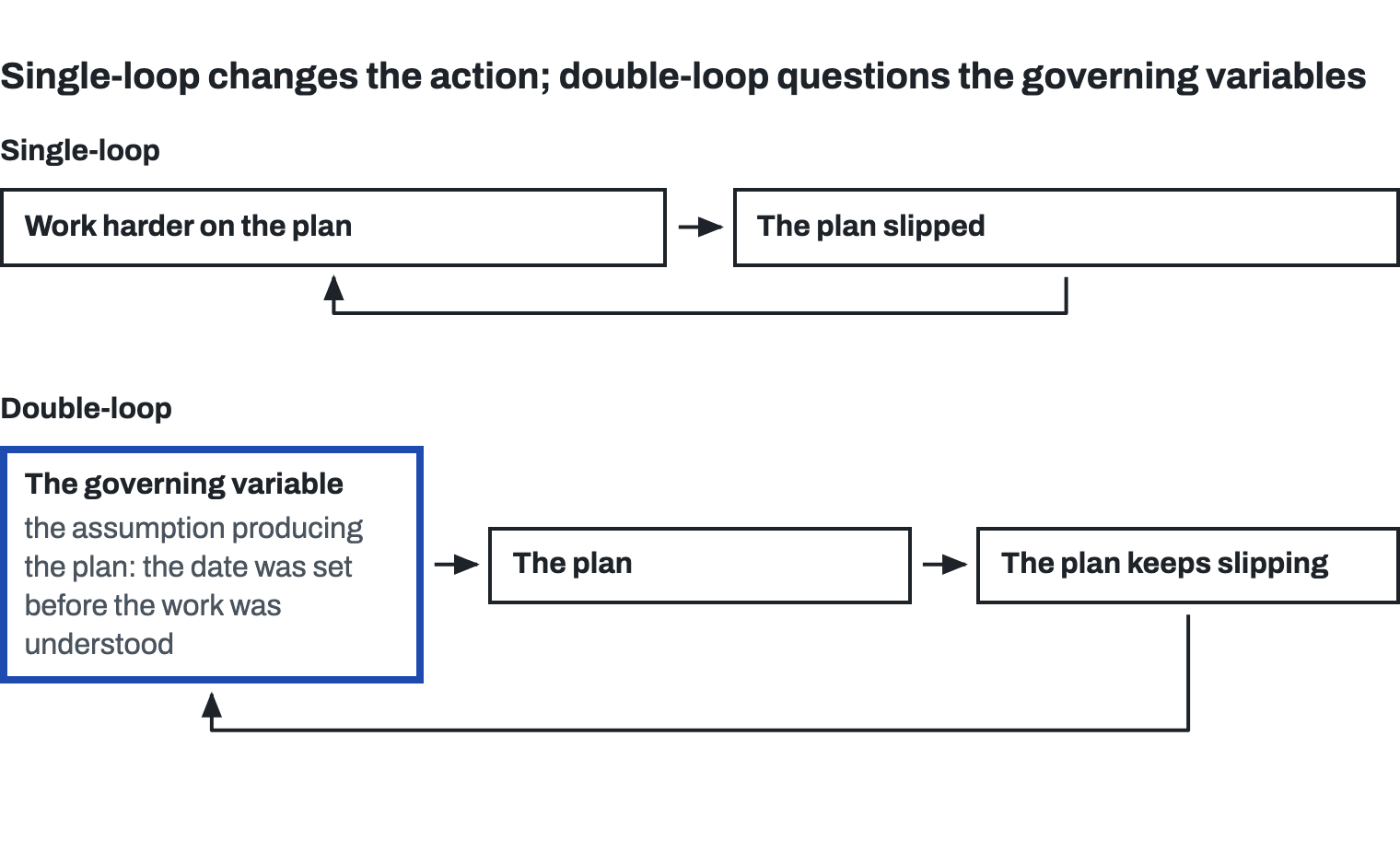
    Argyris and Schön named the move that runs underneath all of this double-loop learning. Single-loop learning changes the action while leaving the governing variables in place: the plan slipped, work harder on the plan. Double-loop learning questions the governing variables themselves: the plan keeps slipping, so what assumption is producing the plan? Usually it is that the date was set before the work was understood, and that scope can grow while the date can’t move. Question that and the next decision changes: you stop asking the team to recover the schedule and start asking who can move the commitment.

    Argyris developed the move in the consulting and organisational-learning lineage⁠—most fully in Overcoming Organizational Defenses—on the theory-in-use foundation he and Schön laid down in the 1970s. Schön on his own, in The Reflective Practitioner, locates the same move in the individual professional: reflection-in-action, the on-the-spot questioning of how the problem is framed, not just what to do next.

    A training day fails when it stays inside single-loop. The leader gets a new technique, applies it to the existing paradigm, and the existing paradigm absorbs the technique. The technique becomes another tool the paradigm uses to do the thing it was always going to do. The sequence chapter 1 named⁠—separation, dissolution, recognition, return⁠—works because it makes the governing variables themselves visible and revisable.

    The Heaths show that some gaps close after nothing more than a message redesign. Don’t Mess with Texas cut visible roadside litter in Texas by 72% in five years with no developmental work anywhere in sight: a message rebuilt until it was concrete, story-carried, and aimed at the litterer’s actual identity. So when a stated value isn’t landing, run the cheap test first: rebuild the message once in sticky form and watch what happens. If the gap closes, it was never an immunity. The chapters ahead are for the gaps that survive.

    The Immunity Map

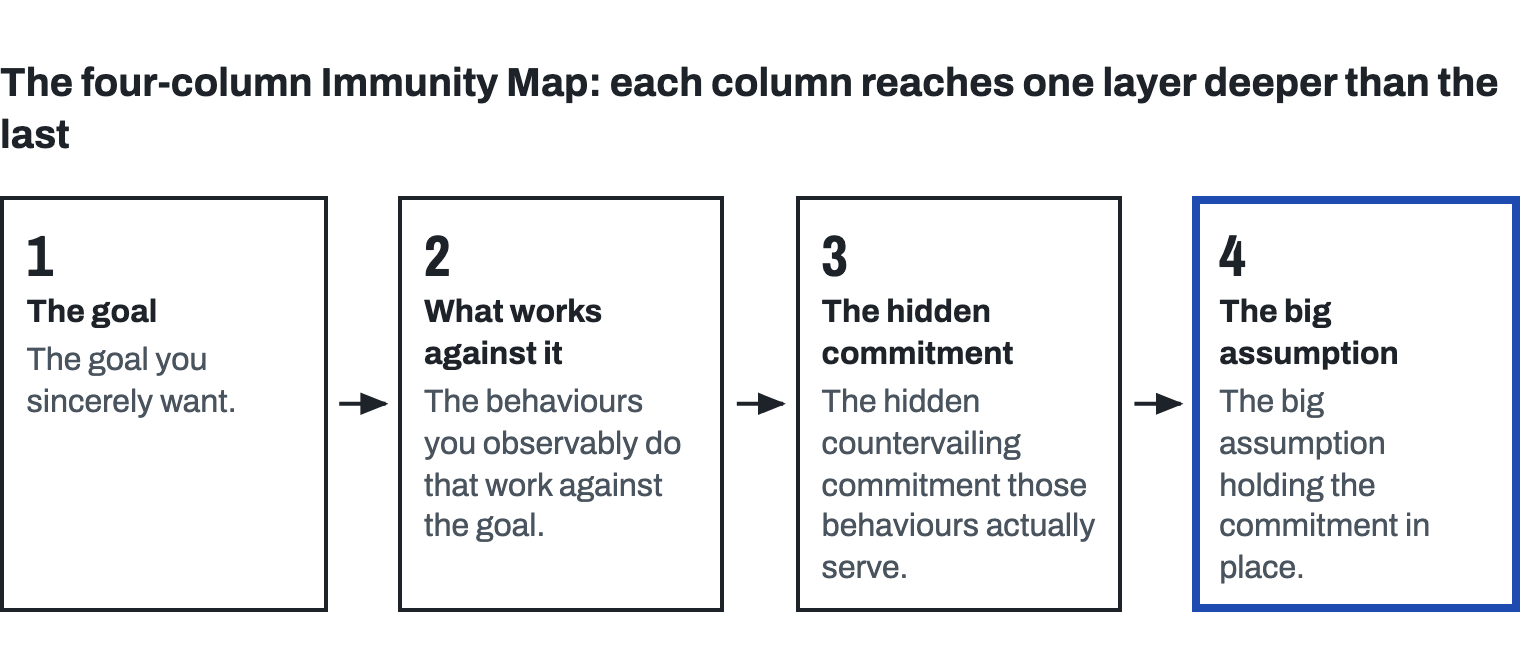
    One instrument that can help with this work is Kegan and Lahey’s Immunity Map, a four-column exercise they developed in Immunity to Change. The four columns are:

    The goal you sincerely want.

    The behaviours you observably do that work against the goal.

    The hidden countervailing commitment those behaviours actually serve.

    The big assumption holding the commitment in place.

    Without this map, the immune system runs in the dark. With it, the subject-object shift becomes possible: what the leader was subject to (the paradigm running them) becomes object (a thing they have, can look at, can choose to keep or release).

    Columns 1 and 2 are workable as a solo starter exercise, though it can be helpful to have a peer reflect your conflicting day-to-day behaviours. Columns 3 and 4 can be started alone but work best as slower, supported work. Find a coach or peer group who can sit with the hidden commitment over time. In miniature, and from my own: column 1, meet people where they are when the pressure is on; column 2, tighten instead, and sharpen the framing exactly when I should soften the contact. Chapter 21 walks all four columns on a worked example I built on myself.

    Honour the past

    Working the Immunity Map will bring up memories which can feel like personal failings. They aren’t.

    The past wasn’t wrong. On a recent call I told Steve March, my coaching teacher, that a decade of sincere meditation practice had been wasted: a staged path I had climbed as an achievement ladder, and largely ineffective for that reason. What if none of it was wasted, he asked. The life lived exactly as it has been lived up to this moment, and how it feels right now, is the doorway.

    The paradigm that got most leaders here isn’t stupid. It fit the context that rewarded it. Adam Smith’s pin factory worked because pins are identical, demand was predictable, and the work decomposed cleanly into standardised steps. Ten workers produced 48,000 pins a day; a worker alone, Smith reckoned, couldn’t have made 20, perhaps not even one. A gain running into the hundreds-fold was the prize for the right answer for an ordered domain. Our paradigm isn’t wrong; it was lifted across a domain boundary it didn’t fit (This is Krivitsky’s framing from his Org Topologies Consultant class I attended in Singapore in September 2025). The work in front of the leader isn’t to make the past wrong. The work is to make the next move wiser.

    Without self-compassion for the paradigm we are leaving, the meta-skill doesn’t develop; we collapse toward whatever pole sounds more enlightened in the current vocabulary and call it growth. You can’t rip away the past identity to get the next one; this is the same developmental move March points at, and the line I first met in Ram Dass: the whole trip occurs in an unfolding process of which we have no control. What we do have is the choice to enter it knowingly, or to spend 20 more years rejecting the entry on the grounds that we are too busy.

    What you can do this week

    Try this with a peer. Pick a goal you sincerely want to do differently in your leadership (column 1 of the Map). One check before you ask anyone for feedback, here or anywhere in this book: think of the last person who brought you bad news, and what happened to them. If the real answer isn’t anything good, the answers you get back will be polite rather than true, and that repair comes first. With the channel open, don’t lock the goal from your own read alone. Ask one boss, one peer, one direct report, and someone at home: what’s the single thing most important for me to get better at? Kegan and Lahey’s own confession is that self-picked goals, chosen without that question, produced programmes with no impact. Then spend ten minutes alone writing down the behaviours you reliably do that work against that goal (column 2). Then ask a peer who has watched you in that territory to write column 2 from their angle. Compare the two. The gap between your column 2 and theirs is the tell. The mirror does its work in that gap. Columns 3 and 4⁠—the hidden commitment and the big assumption⁠—come later, with someone who can sit with the work.

    The 18 axes that follow are this season’s contrast material, the paradigms the practice currently has to work on. What survives the next shift is the practice itself: the Map, the mirror, the double-loop move, applied across whichever axes AI puts in front of you. One habit upgrades every chapter’s diagnostic as you go: wherever question two asks what a colleague would count, don’t imagine the colleague; send the question to two people who watched, on the same scale you scored yourself. Chapter 5 turns that habit into a full exercise. Chapter 21 walks the Map in full.

    Where most leaders get stuck

    Eighteen axes is a lot to hold, and you don’t need all of them at once. Many deepen, qualify, or specialise a pattern another axis has already set down, so working one well tends to bring the others into view.

    If you are reading this as a field guide rather than cover to cover, start with the axis whose gap is costing you most, found by the rule in the next section. The other five chapters⁠—1, 2, 11, 22, and 23⁠—aren’t axes. They are the contemplative spine, and they read best in order.

    Which axis first

    Eighteen axes arrive over the coming chapters, each with its own exercise, and chapter 8 will teach the rule this catalogue must obey: improving a non-constraint changes nothing. So hold a discipline as you read. Each chapter’s diagnostic⁠—three questions, five minutes, run on last Tuesday’s version of the decision⁠—is an identification step, not a programme. If a diagnostic names an engineering table you don’t sit at, run it on the nearest one you own: sprint allocation becomes capital allocation, the incident review becomes the last board-level escalation, the contested technical call becomes the last strategy call that routed to you. If the pole you claim, the pole your team would report, and the pole the situation calls for all roughly align, that axis isn’t your constraint: read on, and let the exercise alone. Claim and report agreeing isn’t enough on its own, because you and your team can agree on a pole the situation has already moved past (chapter 3’s leader whose deck and procurement both say Pole A is the case). The first axis where any of the three diverge hard, and the divergence is costing you something this quarter, is your working axis. Do that chapter’s exercise until the gap moves, and treat the later chapters as reading while you do. If a later chapter exposes a worse gap, switch; one axis at a time means one, not whichever came first. The same discipline governs the mirror you hold up for your CEO: one axis at a time⁠—the costliest⁠—with the rest subordinated to it. A leader improving three axes at once is running the local-optimisation programme chapter 8 warns about, on themselves.

    Going upstream

    In-text: the load-bearing references named in the body. Robert Kegan and Lisa Lahey, Immunity to Change (the four-column Immunity Map and the subject-object shift, the chapter’s operational payload). Chris Argyris, Overcoming Organizational Defenses (Model I, the defensive routines, the three-step, and double-loop learning with Schön). Donald Schön, The Reflective Practitioner (reflection-in-action, the individual-professional face of the same move).

    Also touched: Donella Meadows, Thinking in Systems (transcending paradigms at the top of the leverage-points list). Chip and Dan Heath, Switch and Made to Stick (the Don’t Mess with Texas 72%-in-five-years message redesign; the sticky-form boundary test).

    Go deeper: the pattern-language frame: Christopher Alexander’s A Pattern Language (many entries pointing at a quality none names alone). The green-shifting example: Scott Ambler on status going red-to-green up the ladder. The honour-the-past ground: Adam Smith’s pin factory (the right answer for an ordered domain, lifted across a boundary it didn’t fit, in Krivitsky’s Org Topologies framing). The constraint floor under all of it: Alicia Juarrero, Dynamics in Action (real change in a self-organising system comes from altering the enabling constraints); chapter 8 works that idea in full.

    You can now hold a paradigm at arm’s length as an object; chapter 3 is where you turn that on the AI rollout you already chose. The cheap mistake was the tokens. The costly one is the org design you left in place, and it keeps compounding while the productivity layer you laid over it hides the fact that the rollout was really a reason to rebuild.


    I work with engineering leaders on exactly this kind of paradigm work, the deeper the better. If it’s live for you, I’m happy to talk: schedule a 30-minute virtual coffee at hi.chrisgagne.com.

    Some book links here are Amazon affiliate links; if you buy through them I may earn a small commission, at no cost to you.

  • Come Prepared to Die: An Engineering Leader’s Field Guide to the Leadership Paradigms AI Is Exposing

    Come Prepared to Die: An Engineering Leader’s Field Guide to the Leadership Paradigms AI Is Exposing

    Someone will soon offer your service as software, or leapfrog your large software org. Would you like that person to be you?

    Not exactly you. The old you will have to die along with the way you provide your service today. But the person who builds what replaces it can still be you: the new you.


    🎧 Prefer to listen? This chapter is narrated in my own voice, via ElevenLabs on Spotify, about 23 minutes. Listen on Spotify →


    This is neither speculation nor a forecast. As of early 2026, ElevenLabs had passed $500M in annualised revenue in the first four months of the year with about 530 people; Anysphere’s Cursor had reached roughly $2B in annualised revenue with a headcount in the low hundreds. Across the leading AI-native firms, revenue per employee ran several multiples ahead of the classical SaaS leaders. In Y Combinator’s W26 batch, Extruct AI’s breakdown counted 101 of the 199 companies building AI-native services or AI-enhanced software. By the time you read this the figures will have moved; the direction won’t. Chapter 3 walks the evidence in full; what matters is that the gap is already priced, already hiring, and already taking the market you are paid to defend as an incumbent.

    Christophe Louvion had said it to me earlier, in his usual one-line form: the LLM doesn’t have to be totally correct, it just has to work at least as well as the average human. I heard the sentence then and didn’t feel it until now.

    I didn’t have a single clarifying event. Drift, in Sidney Dekker’s sense; the boiling frog, in cultural shorthand. Wrong about frogs; folk-right about this.

    The water has been getting hotter for 50 years, more volatile, more ambiguous. AI is the rolling boil. The paradigm that got most of us our careers was survivable when conditions moved slowly and a misfit cost little. Both have changed. The gap between a paradigm that fits and one that doesn’t is wider than it has ever been, and the cost of the misfit now arrives fast. What was merely sub-optimal has become fatal.

    What was merely sub-optimal has become fatal.

    This is a field guide. Over the next 22 chapters, I’ll walk through 18 paradigm dichotomies that AI is now surfacing for the senior leadership of software-dependent organisations. Each axis chapter stands alone; the contemplative spine chapters frame the arc and read best in sequence.

    I write from where I have sat: alongside the CTOs and VPs in the engineering organisation where the AI impact landed first. This is written first for the engineering leader: the CTO, the VP of Engineering, the staff-plus engineer or architect who sees the technical reality first and carries it upward. You rarely own the full reorg, but you are usually the one holding the evidence before anyone else. The CEO is the subject of much of what follows, because the CEO owns the structure most of these paradigms are bolted to. But you are the reader, and the work starts with you, on yourself, before it is ever a conversation you stage upward.

    The 10% ceiling

    Almost every Agile transformation of the past 25 years has failed relative to what its framers intended when they wrote the Agile Manifesto. I say that from my own experience, about twenty years in this work, and from talking to fellow coaches over the last decade plus. I led transformations I am proud of, and I led others I called meaningful change at the time and now read more soberly. None have fully met my aspirations.

    The ceiling has a number. Jerry Weinberg gave it its practical form 40 years ago, a rule Alexey Krivitsky, Craig Larman, and Roland Flemm recently invoked in 10X Org: never promise more than 10% improvement, because people can fold 10% into their mental category of “no problem,” whereas anything larger would be embarrassing if the consultant actually pulled it off. The figure has held, I’d argue, because it is the boundary at which the consultant doesn’t threaten the manager’s paradigm.

    Read from the consultant’s side, Peter Block’s distinction explains the ceiling. Most consultants work at what he calls the content level: technical recommendations, frameworks, and other deliverables the manager can absorb without changing how the manager sees themselves or their organisation. There is also an affective level: trust, power, identity, the relationship between consultant and client and between leader and led. The affective level is where⁠—extending Block⁠—paradigm change has to happen. Most consultants won’t work at the affective level, and for years I didn’t either. The work makes them vulnerable, and it threatens the consultant’s position as much as the manager’s. Block names the collusion plainly: that consultants too often join the client in pretending organisations are purely rational rather than political.

    I stayed under that boundary without ever deciding to. A team I coached took work in a domain none of them knew well, against a date already written into a contract. Someone sitting entirely outside of the product R&D org classified the project as small, and the classification removed the kickoff, the regular cadence, and the backlog refinement. Stories reached ready without the people doing the work ever discussing them. Acceptance criteria described a system that didn’t match the one running. Dependencies on other departments turned up mid-build, and the product manager got status by chasing people. They hit the date without a critical defect, carried there by experienced colleagues who stepped in through the live issues, and that success belongs to the team.

    I had taught folks small batches, clear completion rules, integrated quality. Then the date approached and the completion rule became negotiable, the quality concern moved to later, the retrospective action waited behind delivery work. Training pushed one behaviour. The conditions punished it. I had spent a career naming exactly this, fixed date and fixed scope and fixed team, and never actually fixed, because the scope reversed against us far more often than it reversed our way. Every time it came up it came up as commercial necessity, which is to say it arrived as a fact nobody had to own as a choice. I treated it as a team-local process problem, because local process was the only lever I had.

    Ronald Heifetz names the same gap from the leadership-development side. Technical problems have known solutions inside current authority and expertise. Adaptive challenges require changes in people’s priorities, beliefs, habits, and loyalties. The most common failure of leadership, he writes, is applying technical fixes when the work is actually adaptive. The training was a technical fix. What the date meant was adaptive work.

    In 10X Org, Krivitsky et al. argue that the 10% improvement ceiling is no longer enough; what is needed is a step-change redesign of the organisation resulting in a “10X Org.” I wholeheartedly concur. For software-dependent organisations, Krivitsky, Larman, and Flemm’s Org Topologies and Larman and Vodde’s Large-Scale Scrum are, in my view, the most serious attempts at the redesign (not the last word on it). This book addresses the paradigm and identity layer underneath. Some paradigms must change before the most-fit strategies for the necessary organisational redesign can be considered.

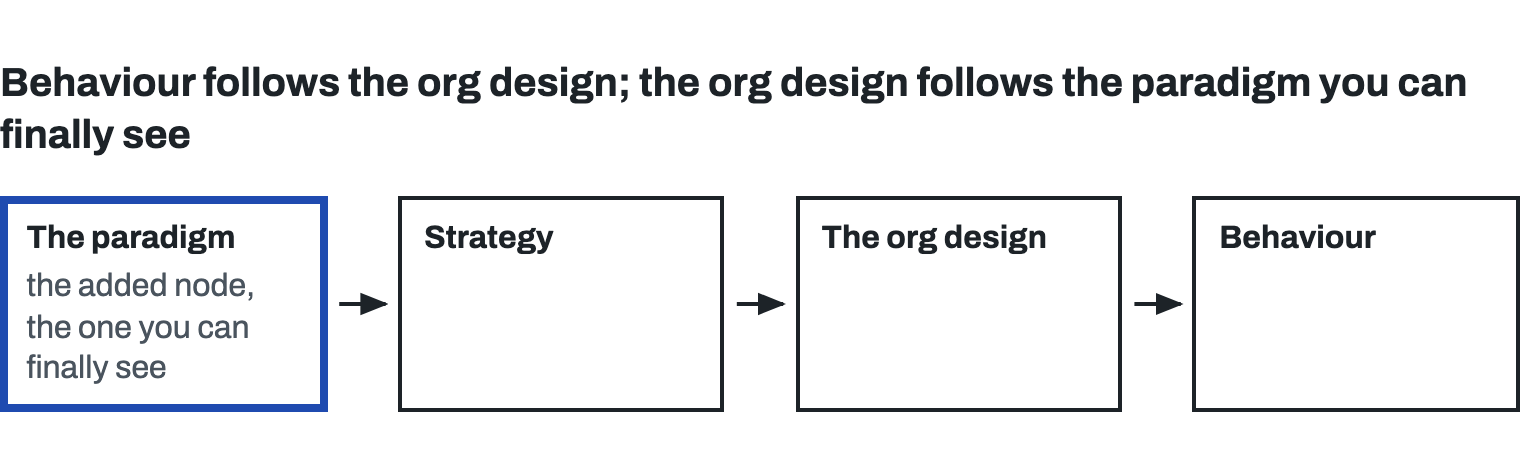
    That claim needs its counterweight, because the strongest cases in this book look as if they ran the other direction. Marquet’s submarine and the NUMMI line both changed behaviour first and let the thinking follow; Marquet’s own mechanism is named Act Your Way to New Thinking, and the knowing-doing research is blunt that acting produces knowing more reliably than knowing produces acting. Behaviour-first is real, and for the people a leader leads it is usually the cheaper, better test. But notice who ran those cases. The crew’s paradigms followed the new conditions; the captain’s had already moved. Marquet, and Toyota’s managers at NUMMI, were structure-owners who had done their own paradigm work first, and that is what let them redesign the conditions everyone else then changed behaviour inside. Behaviour-first was never the structure-owner’s own escape route, and no one upstream is going to run the experiment on them. When your own new behaviour keeps reverting, edited back to fit the old pattern, you have found what chapter 2 will name an immunity, and that is where this book’s work begins. Behaviour follows the org design; the org design follows the paradigm you can finally see.

    Why the ceiling holds

    Even if a misfit paradigm were easy to see, it’s hard to shift.

    Robert Kegan and Lisa Lahey give the gap its mechanism. Change rarely fails for lack of sincerity or willpower. It fails because we mean two things at once: a sincere commitment to the goal and a hidden countervailing commitment to self-protection, sustained by big assumptions held as fact. The leader’s paradigm is exactly this kind of immune system. It isn’t weak or sloppy. It is a brilliantly designed protective architecture, built for an organisational context that may not persist for much longer. Kegan and Lahey call the inspection step the subject-object move: the paradigm becomes available for change only when it shifts from being a thing the leader is to being a thing the leader has. Until that shift, the paradigm is invisible from inside.

    Beatrice Bruteau named the collective version of the problem in The Psychic Grid, drawing on Dostoevsky’s Grand Inquisitor and Walter Kaufmann’s decidophobe. The world we know⁠—what Bruteau calls our community conviction system—is one we collectively construct, and few of us can step outside the shared grid alone (if we can even see it). The Inquisitor is the figure who lifts the burden of deciding for ourselves. He tells us how it is and what we must do, and we thank him for it. For the CEO, the community conviction system is the Inquisitor: the board’s risk tolerance, peer CEOs’ moves, the industry analysts’ frameworks. My most rapid and successful transformation ended about a week after we concluded its three-day kickoff: the CEO, satisfied that his organisation had learned a great deal, released me and planned a “hybrid approach”, one I predicted would fold what we had built back into the prior operating framework, with more extrinsic motivation. The familiar grid lifted the burden of the new paradigm. Any paradigm or framework can become the Inquisitor when the leader obeys it rather than uses it: applies it without examining whether it still fits. By all comparisons, he was doing fine. The competitive floor was just that low… until today.

    This is how cognition works, not a moral failing. The leader’s habitual response and the situation it was built to meet had been running as a single coupled system. The historical response was the right response to its conditions. The conditions changed; the response didn’t, because the two were one thing, and one half of it is still catching up.

    I don’t pretend to know which paradigms are running you. I don’t pretend to know whether they fit your situation. Your situation determines that, not me. What I can name is the structural difficulty of seeing a paradigm at all, and the cost of failing to see and change it when the conditions have moved.

    What AI changes

    For specific shapes of task⁠—particularly writing software⁠—frontier-model releases through 2026 have been closing the gap with human knowledge workers rapidly. AI is now past the question of is it ready? and into are we ready? The readiness in question is organisational: the prevailing org design is already out of date.

    Christophe’s quote undercuts incumbents with one stroke: the LLM doesn’t have to be totally correct, it just has to work at least as well as the average human. Every paradigm and org design tuned for managing the average human worker is now under direct competitive pressure from rivals willing to let AI do much of that work at average-human quality and a fraction of the cost.

    The cost line is already visible inside the engineering chain. The CFO asks about the ROI of OpEx going to AI. Engineers most fluent with AI-native work, frustrated with the “efficient” bureaucracy in their current org, leave for AI-native competitors and frontier labs paying more. Acquisition conversations now weight the existing code’s readiness for AI. The CTO sees these signals first, the board hears them next, and by the time the question reaches the CEO as a decision to make, the market has already narrowed the options.

    Worse, most AI-sourced advice will compound the paradigm problem rather than fix it. Larman’s Laws of Organizational Behavior describe how change initiatives get co-opted: terminology gets overloaded to mean the status quo and displaced specialists become coaches who deliver the false impression that the change has been done. As a result, the published corpus on Agile, Lean, and DevOps is dominated by consultant-derivative content. When an LLM writes on these topics, it often regresses to the mode⁠—not the truth⁠—and adds a fawning persona that weakens critical thinking exactly where it’s most needed. Deploy agents at scale on that advice and you are taking it from a tool trained on the corpus that codifies the paradigm you need to leave.

    The pattern was measured, not merely suspected, in March 2026, when researchers writing in Harvard Business Review put leading LLMs through thousands of simulated strategy decisions and found they reliably reach for strategies that match fashionable management language rather than the logic a particular situation calls for. They named the output trendslop. Their fixes are prompting hygiene, and prompting hygiene is worth doing. Grounding the model in verified sources⁠—the source-audited retrieval I build and run in my own practice⁠—is my bet on the stronger fix, but only if the sources were selected correctly in the first place, and none of it reaches the paradigm the advice lands on.

    AI doesn’t solve your context-paradigm mismatch. It sells it back to you.

    That is the second of three forces. One: AI turns your existing paradigm into the binding constraint, moving the bottleneck from execution⁠—which the tools increasingly handle⁠—to the mental model the organisation was built around. Two, and sharpest: the tool, trained on the consultant-derivative corpus, sells that misfit back to you with affirmation rather than exposing it. The first force makes your paradigm the problem; the second hides it behind a fluent, agreeable voice. Three isn’t another property of the tool, but what the first two leave you holding: the only move left is change at the level of identity, and no technique reaches it in a straight line, which is why no tool, the flattering one included, can do this for you. The chapters ahead take the paradigms one at a time. This chapter is about what the three together ask of you: not a technique, but a change in who is doing the deciding.

    The aviation precedent

    The aviation version of the ceiling has been visible for decades. On 6 August 1997, Korean Air Flight 801 hit Nimitz Hill on approach to Guam. Two hundred and twenty-eight people died. Gladwell’s popular reading placed the cause inside hierarchical Korean grammar. The deeper variable was the steepness of the authority gradient that preceded the grammar: the first officer and flight engineer questioned the captain about how low the aircraft was on its approach and registered alarm as the cockpit’s automated terrain warnings sounded. Their hints and checks were the form of challenge the gradient permitted; under that gradient, graded escalation was the rational strategy, and it ran out of altitude before it ran out of steps. The first officer’s call for a missed approach came about seven seconds before the aircraft hit the hill. Read from inside the cockpit, they were doing what the system had trained and permitted.

    Facing disasters like this, aviation has spent over four decades moderating the authority gradient through Crew Resource Management. The same authority dynamics show up in retrospectives, failed product launches, unspoken concerns about a CEO’s pet project, boardrooms where everyone knew the strategy was wrong and nobody said it directly enough. Aviation couldn’t look away from the lost lives; AI is now making the boardroom toll of obsolete paradigms similarly hard to ignore.

    The work that’s needed

    What the circumstances ask of the leader is identity change, not just skill change. In my experience they’ll need more than skilful consulting and advice: company of a particular depth⁠—good developmental coaching among its forms⁠—held within a different community conviction system. The new practice holds until pressure arrives, then gets edited back into the old pattern, the way the completion rule went negotiable when the date approached. Turning that pattern from something you are into something you have is the subject-object move Kegan and Lahey name, and it can’t be run from inside the paradigm you are trying to see.

    This writing follows the arc of that change, and I am borrowing its shape from Karla McLaren, who draws on mythologist Michael Meade’s three stages of initiation. Her subject is trauma; mine is the leader’s passage, with the second stage, the ordeal, renamed dissolution. She names the structural failure mode: most modern cultures rarely complete the return. People go through the separation and the dissolution and are abandoned at the threshold of coming back. Without the reception, a person cycles between separation and dissolution indefinitely: the loop this book is trying to close.

    This chapter is the start of a separation from our dominant paradigm⁠—and identity⁠—in the midst of the transition AI is now laying bare. The dissolution is the sustained contact with what is falling away. The recognition is the moment the leader sees what they had been subject to, often with a coach figure who can stay steady with them through it. What’s left when the frameworks fall away is the return: a welcoming into a community conviction system where paradigms can be examined, not parroted.

    I am offering these paradigm dichotomies as a starting set. While most have been relevant for decades, some may be partly obsolete in months. I don’t list them with the express purpose of changing your mind about them, though that might well be useful. I list them because they are habitual pulls you can already easily recognise and use as practice for the novel contexts AI will keep surfacing.

    One move you can make this week. Take last week’s hardest decision and ask three questions of it. What did it optimise for: speed, certainty, control, looking decisive? What did it trade away to get that? And who is carrying that cost now, that you aren’t?

    The thing you optimised for without ever feeling it as a choice is the paradigm. (Say you protected your own credibility without once considering you had the option not to. That’s a paradigm running you.) Run the three questions across a handful of decisions and the pattern stops being evidence against you. It shows what’s ready to move.

    If naming it is hard, that’s the starting point, not a failure: seeing your own paradigm is the one thing you can’t fully do alone. The next chapter is the practice for it.

    As Deming put it in a line Krivitsky et al. share in 10X Org: “There is no instant pudding.” This work isn’t fast. We have influence, not control. If you have read this far, you have already taken some part of the first step. The second step is to find someone outside the pattern who can be alongside you: a peer group, a developmental coach, a supervisor, anyone who isn’t running the paradigm you are trying to see. Then build the community that will hold you as you emerge. You can’t run the subject-object move on yourself, because the thing doing the looking is the thing you are trying to look at.

    The work runs in parallel with redesigning the incumbent organisation, possibly replacing it; the structural moves I run in that redesign are documented in Org Topologies and Large-Scale Scrum, named earlier, where they scale with the size of the group.

    I agree with Krivitsky et al.: we can’t afford the 10% ceiling any longer.

    Come prepared to die: not you, but the paradigm you have been, and the identity built on top of it.

    Going Upstream

    The 10% ceiling comes from Jerry Weinberg, who set the rule in The Secrets of Consulting. Alexey Krivitsky, Craig Larman, and Roland Flemm revive it, and argue past it, in 10X Org, the book whose central wager, that the 10% ceiling is no longer survivable, this chapter takes as its own. The redesign work I point to lives in their Org Topologies Primer: Strategic Org Design and in Larman and Bas Vodde’s Large-Scale Scrum: More with LeSS. Deming’s “there is no instant pudding” reaches me through the same 10X Org.

    The content-versus-affective distinction, and the naming of the consultant’s collusion, are Peter Block’s, from Flawless Consulting: A Guide to Getting Your Expertise Used. The technical-versus-adaptive cut is Ronald Heifetz’s, with Alexander Grashow and Marty Linsky, in The Practice of Adaptive Leadership. The immunity, the competing commitment, the big assumption held as fact, and the subject-object move that turns a paradigm from a thing you are into a thing you have, is Robert Kegan and Lisa Laskow Lahey’s, from Immunity to Change; chapter 2 stays with it. That acting produces knowing more reliably than the reverse is the finding Jeffrey Pfeffer and Robert Sutton document in The Knowing-Doing Gap, and “Act Your Way to New Thinking” is L. David Marquet’s own named mechanism from Turn the Ship Around!, the submarine case I lean on. The NUMMI counterpart draws on the plant’s own culture-transformation record.

    The collective version of the trap, the community conviction system, and the Grand Inquisitor who lifts the burden of deciding for us (by way of Dostoevsky, and Walter Kaufmann’s decidophobe), is Beatrice Bruteau’s, from The Psychic Grid. That cognition is enacted, the knower and the known arising together, is the enaction thesis of Francisco Varela, Evan Thompson, and Eleanor Rosch in The Embodied Mind: Cognitive Science and Human Experience. Drift, in the precise sense I use it, is Sidney Dekker’s, from Drift Into Failure. And the arc I borrow for the leader’s passage, separation, ordeal renamed dissolution, and the return most cultures never complete, comes from Karla McLaren’s The Language of Emotions, where she is in turn drawing on the mythologist Michael Meade’s three stages of initiation.

    The corollary that AI regresses to the consultant-derivative answer rather than the truth is my own extension of Larman’s Laws of Organizational Behavior; I set it out at length in the LLM-epistemology piece. Two sources I draw on here sit outside the corpus of primary texts behind this book, and I cite them as I met them: Malcolm Gladwell’s reading of Korean Air Flight 801 in Outliers (whose hierarchical-grammar account I push back on, in favour of the authority gradient beneath it), and the March 2026 Harvard Business Review study that named “trendslop“: LLMs reaching for fashionable management language over the logic a situation calls for. Christophe Louvion’s one line, the LLM doesn’t have to be totally correct, it just has to work at least as well as the average human, I owe to him directly, in conversation.

    A paradigm is what you look through, not what you look at. So the decision you are proudest of this quarter, the AI reorg included, is the one it is hiding from you. You can’t catch that alone, any more than you can see your own eye without a mirror. Chapter 2 hands you the mirror. You run a five-minute diagnostic on a decision you already made, then send it to two colleagues who watched. Their read is data you couldn’t reach yourself.


    I work with engineering leaders on exactly this kind of paradigm work, the deeper the better. If it’s live for you, I’m happy to talk: schedule a 30-minute virtual coffee at hi.chrisgagne.com.

    Some book links here are Amazon affiliate links; if you buy through them I may earn a small commission, at no cost to you.

  • Just This: a practitioner’s meditation

    Just This: a practitioner’s meditation

    A practitioner’s meditation on the convergence of Agile and the contemplative traditions, written from inside the territory.

    This essay became Chapter 11 of Come Prepared to Die.

    The recognition

    I received a coaching session from my Alētheia teacher Steve March yesterday, in the middle of a confluence of several crises at once: serious family illness, work loss, partnership strain. It was the kind of week that some contemplative practitioners might call a Dark Night of the Soul. I was narrating it all to Steve, somewhat clinically, telling him I was saying yes to it.

    Steve offered a different frame. There might not be a yes or a no at all, he suggested. There might just be a this: whatever is actually facing me. Neither chosen nor refused. Just this as the source of action. I face this. What action arises? I act. Then I face the next this. And the next.

    It took me a while to feel the difference between just this and the other moves I had been making. Just this is not “this is what is happening”, which is description. It is not “I accept what is”, which is a stance taken against what is. It is not even “I am in contact with what is”, which still has an I and a what is set against each other. Just this is the move that drops the gap. The action arises from the contact rather than being chosen by a self standing some distance from the contact. That distinction is small on the page and load-bearing in the body.

    I spent much of yesterday evening integrating what had opened. It was only this morning that I wondered how any of this applied to what I do for a living when the connection arrived. There’s a silver lining in the insight: just this is integral to our Agile and Adaptive work.

    The Manifesto put it most directly: responding to change over following a plan.

    My sense is that the contemplative traditions and the Lean / Agile / systems-thinking traditions converge on a single epistemic claim. Contact with reality is more reliable than abstraction about reality. Plans, frameworks, models, doctrines, identities, narratives are all useful. None of them are the thing. The thing is what is actually happening, in this moment, between actual people, with actual constraints, in an actual body or system.

    Who this is for

    I can think of at least three audiences for “spirituality and tech” content. The first is the productivity audience: meditation made me thirty percent more focussed, here is your morning routine, please subscribe. That genre is well served and I have nothing to add to it. The second is the philosophical-tourism audience: Stoic memes, Bhagavad Gītā quotes on LinkedIn, an annual Esalen retreat, a Joe Rogan podcast about psychedelics. That genre is also well served, and is mostly harmless aesthetic.

    The third audience (the one I’m writing for) is the practitioner who has been doing the professional work for fifteen or twenty years, writing software, leading teams, running companies, coaching humans, AND has done enough contemplative practice to know it’s a discipline rather than a hobby. They’ve sat retreats. They’ve done Internal Family Systems (IFS) work or its equivalent. They’ve had a real moment on a cushion or in a therapy session that changed something structurally. They aren’t tourists. They’re inside the work, in both rooms, and they sense the rooms are connected without being able to say how.

    If that’s you, thank you for being here. The rest of this is for us.

    The contemplative version

    The same teaching shows up across traditions in different vocabularies. The examples below are Buddhist because Buddhism is where my direct study lies. Equivalent moves exist across Sufi, Daoist, Advaita, and Christian mystical lineages, but I trust myself to summon it from Buddhist sources and less so from the others. A few examples.

    The Buddha to Bahiya, in the Pali Canon’s Bahiya Sutta:

    “In reference to the seen, there will be only the seen. In reference to the heard, only the heard. In reference to the sensed, only the sensed. In reference to the cognized, only the cognized. That is how you should train yourself. When for you there is only the seen in reference to the seen, only the cognized in reference to the cognized, then there is no ‘you’ in connection with that. When there is no ‘you’ in connection with that, you are neither here nor yonder nor between the two. This, just this, is the end of stress.” ―Bahiya Sutta (Udāna 1.10), Thanissaro Bhikkhu translation

    Bahiya awakened on the spot. The Pali commentaries tell us he was killed by a cow shortly after. (Just this includes the cow.)

    The thirteenth-century Zen master Dōgen, founder of the Sōtō school, in the Genjōkōan:

    “To carry the self forward and illuminate myriad things is delusion. That myriad things come forth and illuminate the self is awakening.” ―Dōgen, Genjōkōan, Tanahashi translation (Enlightenment Unfolds, 2000)

    The Tibetan Dzogchen masters speak of rigpa, the recognition of awareness aware of itself, with all phenomena arising and self-liberating in it. Self-arising wisdom isn’t a special clairvoyance. It’s what arises when you stop running every moment through the part of you that decides.

    And Steve, in our session, in plain English:

    Just this.

    Different vocabularies, same teaching. Action arises from contact. Activity is parts trying to manage what they’ve abstracted. The distinction is operational, not poetic, and I trust it because I’ve watched it play out in my own life often enough to stop arguing with it.

    The Agile, Lean, and systems version

    I first read the Agile Manifesto sometime in the mid-2000s. I read its four pairs as pragmatic preferences. What I was reading, without recognising it, was a contemplative document. Each of those four pairs is the same teaching: contact over abstraction. Show me what is, not what’s been described. Be in real-time relationship with the human, not the document about the human. Contact the future as it arrives, not in advance.

    The “while there is value in the items on the right” qualifier preserves the same care Steve gave me in our session. Plans aren’t worthless. Frameworks aren’t worthless. They’re held loosely, ready to dissolve back into the next moment of contact.

    The lineage runs deeper than the Manifesto, and this is the part I find most beautiful when I sit with it.

    I came to Scrum in the mid ’00s. I started to appreciate Lean in business school as theory, then through Mary Poppendieck’s talk The Tyranny of the Plan, then through colleagues at Gorilla Nation between 2008 and 2011 who practised Lean as a stance rather than a methodology. The This American Life episode about NUMMI did more for my understanding of cultural transformation than any book had up to that point.

    There is a striking resonance between Mahāyāna Buddhist epistemology and the practices of the Toyota Production System (TPS), though evidence is thin for a direct lineage. Genchi genbutsu (go and see for yourself) reads, in that resonance, as the doctrinal claim that you cannot lead from an abstraction of the floor; you have to stand on the floor.

    There’s a specific practice I want to touch on, because it’s where the contemplative and the Lean traditions touch most explicitly. Taiichi Ohno, the architect of TPS, used to draw a chalk circle on the factory floor and instruct a manager or engineer to stand inside it. His direction was a single word: Watch. Hours later (sometimes a full shift, sometimes longer, in some accounts an entire day), Ohno would return and ask: What do you see? The question functions almost as a koan. The wrong sort of answer was the same as no answer; the practice was to keep watching until the right sort of answer arrived unbidden. If the answer wasn’t yet what Ohno had seen, his response was: Watch some more. The practice continued until the manager had perceived what could only be perceived through sustained, undefended observation: the awkward reach for a misplaced tool, the three-minute micro-stoppage, the operator’s exhausted improvisation around a bad layout, the bandage on the third operator’s hand that means this layout has been hurting people for longer than anyone wants to admit, the hidden factory beneath the visible one. This is not analogy. This is shikantaza in safety boots. The point of the chalk circle is the same as the point of the cushion: to break the cognitive filters that protect you from seeing what is actually there, and to sustain attention long enough for what is there to disclose itself.

    W. Edwards Deming’s PDSA cycle (Plan, Do, Study, Act) is a feedback loop with reality. The Study step is the contemplative move: what actually happened? Most organisations skip Study, because parts want to move “efficiently” to the next plan before reality has finished arriving. Deming’s insistence on profound knowledge (appreciation for system, theory of variation, theory of knowledge, psychology) is an insistence on contact-based learning across four dimensions.

    Dave Snowden’s Cynefin framework is the one that startled me most when I first encountered it. (I learned it from Dave’s writings and from a workshop Pat Reed taught around 2017.) In the complex domain, his prescription is probe, sense, respond. Not analyse, plan, execute. The act of probing creates the data; you can’t know the right move before contact. Just this formalised for organisational decision-making.

    Two thinkers from outside both the contemplative and the Agile lineages sharpen the point further. James C. Scott, the Yale political scientist, in his 1998 Seeing Like a State, gives the most precise account I’ve encountered of how administrative abstraction destroys the thing it tries to govern. Scott’s central concept is legibility: the way states (and increasingly corporations and platforms) reshape the world to make it readable from the centre, by simplifying it. The cadastral map. The standard surname. The plantation forest planted in straight rows for ease of harvest. Legibility makes the world manageable. It also kills the mētis, the local, situated, practical knowledge that the world actually runs on. The plantation forest looks like a forest from the air. From the soil, it’s a desert.

    Eugene Gendlin, the philosopher and psychotherapist, developed Focusing in the 1960s. Gendlin’s claim is that the body holds an “implicit knowing” he called the felt sense, which is not an emotion and not a thought, but a bodily awareness of a situation that is initially unclear and yet unmistakably there. The therapeutic move is to attend to it without forcing it into language, until it discloses what it has been holding. When it does, there is a felt shift, and the situation reorganises.

    Scott and Gendlin are pointing at the same fact from opposite ends of the scale. A complex system, whether a body or a state or a value stream, is unknowable to any individual in any explicit, propositional way. The only access available is through sustained, undefended contact. The instruments differ; the access discipline doesn’t. Even then, “there is always more than can be said.”

    Practitioners who get this in either domain develop a quality their colleagues find hard to name: steady without being detached, decisive without being rushed, confident without being certain. They aren’t running every moment through a planning function; they’re in contact, and the appropriate response is arising. Self-arising wisdom in dharma vocabulary, emergence in Agile, mētis in Scott, felt sense in Gendlin: same phenomenon, different teachers, different terms.

    The same false form in both domains

    Both traditions have a near-identical failure mode, and it’s worth naming because it’s where most practitioners get stuck (myself included, repeatedly).

    In Agile, the failure mode is ceremony cargo-culting. Standups that are status reports to a manager. Retros that produce action items no one does. Story points debated to four decimals. Sprints that generate sprint-shaped deliverables. The form is preserved. The contact is gone. The team is performing agility without doing the practice. (Most SAFe rollouts I’ve seen end up here, and I won’t pretend that’s a controversial observation among coaches who work in those environments.)

    In contemplation, the failure mode shows up under at least two names. John Welwood coined spiritual bypassing in 1984 (the noun form spiritual bypass has since won out, but the 1984 original was the gerund). Chögyam Trungpa, earlier in the 1970s, named the same dynamic spiritual materialism and wrote a whole book around the cure (Cutting Through Spiritual Materialism, 1973). Meditation as identity. Equanimity as armour. I’m sitting with it as a way to not feel it. The practitioner is performing presence without being present.

    Both failure modes have the same engine. Protector Parts (to use IFS terminology) have taken over the practice and are using it as armour against reality, instead of contact with it. The Fixer running the standup. The Inner Critic grading the meditation. The Practice Protector keeping things light enough to never land. The Optimiser turning the retro into a dashboard. (I am, for what it’s worth, intimately familiar with all four of those parts. They are helping to write this paragraph.)

    For leaders, the most common variant is a Manager Protector that projects knowledge and expertise in the face of an ultimately unknowable system, in order to keep an exiled Hurt part beneath it from making contact with the experience of not knowing. In that Hurt part’s economy, the bearer isn’t a good leader unless they can personally know and solve the problems themselves. Not knowing is intolerable, so the Protector covers it with a confident answer. The system, of course, doesn’t care about the answer. It is going to do what it is going to do.

    Ronald Purser’s McMindfulness (2019) describes the shape this takes when a contemplative tradition gets stripped down: of its ethics (right action, right speech, right livelihood), of its lineage (a teacher, a sangha, transmission), of its renunciate edge (the explicit recognition that ego-comfort is the obstacle), of its inconvenient implications (you may discover your work is harmful, your ambition is a defence, your achievements are armour). What’s left is a relaxation technique. Relaxation techniques have value. They are not what the traditions are. Steve has given me the language to put it more sharply. Working from Heidegger’s poiesis (poetic bringing-forth) and Gestell (technological enframing), Steve reframes it as the contrast between poetic-attunement and technological-attunement: a poetic-attunement practice has been pressed into a technological-attunement frame, and the frame swallows the practice.

    It also fools people. I spent over a decade practising meditation as a technology in order to get somewhere that wasn’t here. I can attest from having been inside that experience that the technology framing doesn’t deliver what the traditions offer. Anyone selling that proposition is, I suspect, ignorant of what they are selling. The deeper damage is what happens when strawberry-flavoured candy gets sold as strawberry: pretty soon the definition of strawberry gets lost. The same has happened to Agile in most of the corporate spaces I have worked in. McMindfulness calms the egoic mind, temporarily, at best. The genuine traditions are working in the opposite direction: they begin to dissolve conditioning, the root of the anxious activity.

    The same strip-down applies, almost word for word, to Agile transformations that fail. Strip Agile of its ethics (people over process, sustainable pace, real customer contact) and you get a velocity tracker. Strip it of its lineage (Lean, the TPS, the original Agile Manifesto signatories’ principles) and you get ceremony cargo-culting. Strip it of its renunciate edge (kill projects that aren’t delivering value, retire the methodology when it stops serving) and you get the waste you’re supposedly trying to avoid. Strip it of its inconvenient implications (your roadmap is fiction, your estimates are theatre, the customer will probably tell you you built the wrong thing) and you get SAFe.

    Both failures have the same shape. The framework was adopted as identity rather than held as tool. The certifications replace the work. The cure, in both domains, is identical. Notice when you’ve slipped from contact into framework, and come back. It isn’t glamorous. It isn’t certifiable. It’s the whole job.

    Nothing wasted

    If you’ve been in either room for any length of time, the diagnosis above probably stings a little. The certifications you collected. The methodologies you championed. The mindfulness app on the home screen. The retreat circuit. The frameworks you wore like coats that didn’t quite fit. None of that effort was wasted, even though almost all of it was wrong about the thing it claimed to be doing.

    Steve put this to me directly during our session, and I want to pass it on without dressing it up. We almost have to go through the phase of practising as parts, in his vocabulary. We almost have to follow frameworks blindly, take certifications seriously, believe the next methodology will be the one. (I once told a team, as a young Agile Coach, that they had to follow Scrum by the book at the start. I meant it.) McMindfulness might have been your first contact with contemplative practices, even if it never delivered what was advertised on the tin. SAFe was probably how you noticed something was wrong, even if it took a few rollouts to be sure. You almost have to go through SAFe to learn that SAFe isn’t the answer, the same way you almost have to go through McMindfulness to find out what mindfulness was actually pointing at.

    What changes things is having encountered enough of these, over enough years, in enough contexts, that you become convinced the simple cure promised by each was, in every instance, the Inquisitor again. Until that conviction lands in the body rather than the intellect, the framework keeps holding the seat. The question that finally arrives, late and unwelcome, is something like: Is this framework leading the company, or is the leader? If you can sit with that question without flinching, you are probably done with the certifications. If it lands as a threat, the certification is still doing the leading.

    None of which is permission to stop. The work in front of you doesn’t get easier when the framework loses its glamour. It gets sharper. You just have less protection.

    Why this matters

    Your inner work and your outer work share a doctrine, and the discipline becomes portable. The capacity to notice when you’ve left contact is one capacity, deployed in different rooms. The Fixer that runs your standup is the same one that runs your sit. Once you see this, you stop trying to bring meditation to work or make work part of practice. It was always one work; you just didn’t have the language.

    The frameworks become tools rather than identities. Most Agile transformations stall because the framework gets adopted as identity instead of held as tool. The same with most contemplative traditions: the practitioner becomes a Buddhist or an Alētheia practitioner and the identity replaces the practice. When you see that the framework’s only value is in serving contact, the question becomes uncomfortable. Is this practice (the standup, the sit, the kanban board, the retro) actually putting me in contact, or am I doing it because I’m a person who does it? The honest answer is often the curriculum.

    Beatrice Bruteau gave this its sharpest contemplative form in her 1979 book The Psychic Grid. Drawing on Dostoyevsky’s Grand Inquisitor and Walter Kaufmann’s notion of the decidophobe, she argues that human consciousness both craves and dreads the kind of autonomy that requires us to make our own important decisions. The Inquisitor is the figure who lifts that burden. He tells us how it is, what we must do, which side we are on, and we thank him for it. This is what Robert Kegan’s research describes structurally: drawing on the stages laid out in In Over Our Heads (1994), the broader literature suggests fewer than a third of adults reach what he calls the self-authoring mind (Stage 4), the developmental stage at which a person can hold a framework as a tool rather than be held by it as identity. A much smaller fraction reach Stage 5. For everyone below Stage 4, the framework is the self, and the question of whether the framework is in service of contact does not quite compute. Any framework can become that Inquisitor when we agree to obey it rather than use it: the methodology, the certification, the lineage we cannot question, the app on the home screen that scores our day. The relief we feel when a framework arrives and settles our doubt is the same relief Bruteau is naming, and it is precisely the relief that disqualifies the framework from doing its real work, which is to put us in contact with what is rather than to spare us from it.

    Probe, sense, respond

    For Agile teams, the move is to let contact precede framework. One way I do this is a Snowden-style narrative survey before the retrospective; the practice deserves its own post and I’ll write it elsewhere. The shape that matters here is that the team meets reality before it meets the structure that’s going to make sense of reality, not after.

    For contemplative practitioners, start asking, after a sit, was that a part going through the motions of what it thinks presence is, or did the mind settle enough to let presence reveal itself? Did I meet what was here, or did I run a technique on a problem? The honest answer is the curriculum.

    For coaches and consultants, the move that matters most is in noticing when your client has slipped from contact to frameworks (or, worse, never had contact to slip from), and naming it. That’s the whole job. Everything else (methods, models, certifications) serves that one move. This is slow work. It rarely looks like the case studies anyone publishes. But when leaders stop managing numbers and parameters and start sitting with the system (or, in Ohno’s case, standing with it), the answers begin to emerge from the system itself, rather than being imposed on it from above.

    For leaders, plans matter, vision matters, the strategic frame matters, AND none of those replace contact with what is actually happening in the building, in the code, with the customer, in the body. The capacity to hold a plan loosely, ready to update when reality demands it, isn’t a weakness. It’s the meta-skill of operating in any complex domain, which is now most domains.

    For everyone, consider standing in your own chalk circle once in a while. Pick a system you are responsible for: a team, a product, your own life. Spend an unreasonable amount of unstructured time in contact with it, with no agenda, no notebook, no plan to extract insights. Watch. Then watch some more. Ohno’s bet was that what you cannot see in fifteen minutes you will see in four hours, and what you cannot see in four hours you may see in eight. My own bet, hedged because I know how this lands in the calendars of people who run organisations, is that this is the single most undervalued practice available to a senior leader, especially now. The conditions that allow sustained contact (silence, slow time, undefended observation) are being eroded by the very technologies many of you are building, and the chalk-circle capacity has to be defended on purpose.

    A personal example

    A week ago, I was running my life on a complicated abstraction about my relationship, my work, my parents, my practice, my body. I had a plan for how the next month would go. The plan included a timeline for various pieces, a strategy for hard conversations, an account I was building of what’s wrong that included evidence, dates, and counter-arguments. I spent hours planning it with Claude.

    The plan didn’t survive the week.

    What I’m finding underneath the dissolution in the midst of it is something simpler than I expected. The next moment arrives, I’m in contact with it, and what to do is obvious. Not always comfortable. Not always pleasant. But obvious.

    The Agile name for this is emergence. The Buddhist name is appropriate response. The Tibetan name is self-arising wisdom. Scott’s name (oblique but real) is mētis. Gendlin’s name is the felt shift. Steve’s name, on a Friday afternoon in early May, was just this.

    If you’ve read this far, you probably already know what I’m pointing at. You’ve been running standups that felt mechanical, and you’ve been sitting meditations that felt mechanical, and you’ve vaguely sensed that the same thing was wrong in both rooms without being able to name it. The thing that’s wrong is: you weren’t in contact, you were in framework. Once you see that, you can’t un-see it. And once you can’t un-see it, the question that arrives is uncomfortable. If the same discipline is required in both rooms, what am I avoiding by keeping them separate?

    I don’t have a clean answer for you. I’m in my own version of that question right now. What I can offer is this. The contemplative traditions are not selling you a feature. They’re training the same capacity you’ve been trying to build into your teams: humans who can stay in real contact with what is actually happening, and act from that contact, even when it would be more comfortable to retreat into the abstraction. The training is hard, decades-long, and dissolves things you’d rather keep. It doesn’t make you more productive. It makes you more here.

    There’s no app for this, no certification, no productivity multiplier. There is only the practice, in the meeting, on the cushion, in the chalk circle, with your kid, with your dying mother, with your customer, with your code, of noticing when you’ve slipped from contact into framework, and coming back.

    Just this.

    Gratitude

    I am grateful to the teachers whose work appears in this essay or in my standing to write it: Steven March, my Alētheia teacher; my late first Buddhist teacher, whose lineage I no longer practise in; Mary Poppendieck; David Denton; Christophe Louvion; Frank Langfitt for their This American Life episode about NUMMI; Pat Reed; Dave Snowden; W. Edwards Deming; Ronald Purser; James C. Scott; Eugene Gendlin; Beatrice Bruteau; Chögyam Trungpa; John Welwood; Robert Kegan; the Buddha; Dōgen; and Taiichi Ohno.

    The success of any insight in this essay belongs to my teachers. The errors are mine.