Just This
Eight axis chapters in; the practice underneath them all is the capacity to stay in contact with what is, rather than with the framework about it.
Chapter 10 asked whether a failed decision is met with defence or with inquiry; this is the inquiry practice.
🎧 Prefer to listen? This chapter is narrated in my own voice with ElevenLabs on Spotify (~20 minutes).
This chapter grew out of an essay I wrote in May, closer to the session that prompted it.
This chapter uses a different vocabulary than the chapters before it. The diagnostic language that has carried the axis chapters this far is itself a framework. This chapter is about what happens when you reach the edge of what any framework can do, which happens more often than we’re typically willing to admit. Naming that edge calls for vocabulary from contemplative traditions, psychotherapy, and developmental coaching alongside the operational vocabulary we have already been working with.
Contact over abstraction
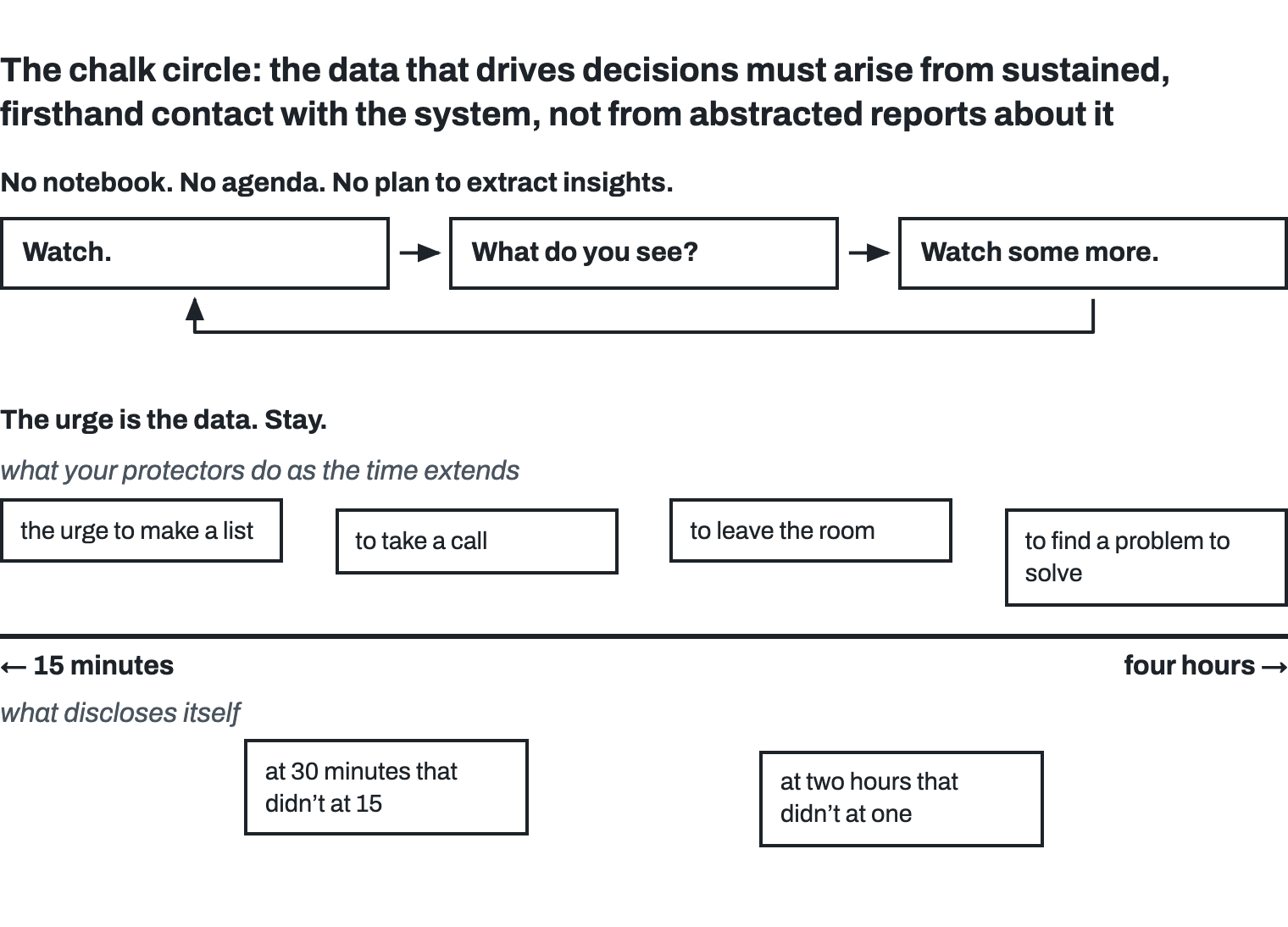
Taiichi Ohno, an architect of the Toyota Production System, used to draw a chalk circle on the factory floor and instruct a manager or engineer to stand inside it. His direction was a single word: Watch. Hours later, sometimes a full shift, Ohno would return and ask: What do you see? The practice was to keep watching until the right sort of answer arrived unbidden. If the answer wasn’t yet ripe, his response was: Watch some more. The story is folk-canonical in the Lean tradition; I take the discipline it teaches—genchi genbutsu, go and see for yourself—as the same access claim Eric Ries makes operational in The Lean Startup.
The chalk circle makes an epistemological claim: the data that drives decisions must arise from sustained, firsthand contact with the system, not from abstracted reports about it. The distinction looks subtle until a report you trusted and the floor you are standing on disagree. Plans, frameworks, models, doctrines, identities, narratives are all useful. None of them is the thing. The thing is what is actually happening in this moment, between actual people, with actual constraints, in an actual body or system.
I read the Agile Manifesto as a contemplative document. Each of its four pairs—individuals and interactions over processes and tools, working software over comprehensive documentation, customer collaboration over contract negotiation, responding to change over following a plan—expresses that teaching in operational language. Contact over abstraction. Be in real-time relationship with the human, not the document about the human. The “while there is value in the items on the right” qualifier is careful and important: plans and frameworks aren’t worthless, they are held loosely, ready to dissolve back into the next moment of contact.
Dave Snowden’s prescription for the complex domain in the Cynefin framework is probe, sense, respond. The complicated domain gets sense, analyse, respond. It’s more like poker than chess. You don’t learn what your poker opponent is holding until the betting starts; the leader can’t know the right move before direct contact, which takes time and effort. Probe, sense, respond gives organisational form to the Agile Manifesto’s preference for responding to change over following a plan.
The best move in complex contexts is to let contact precede framework. Meet reality before meeting the structure that will make sense of reality. As Dave Snowden reminds us, have the data precede the framework. In meditation, that’s bare sense perceptions, not the mental labels that follow them. In complex product development, it’s asking “what’s your narrative about X,” not “rate X on a scale from 1-5.” In my own work, either of us can slip from contact into framework, or never reach contact at all, and much of the job is noticing the shift together and naming it. Methods, models, and certifications serve that work.
The same teaching, named directly
I received a coaching session from my Alētheia teacher in the middle of a confluence of several crises at once: serious family illness, client loss, partnership strain. The week before, I had been narrating it all to him somewhat clinically, telling him I was saying yes to it.
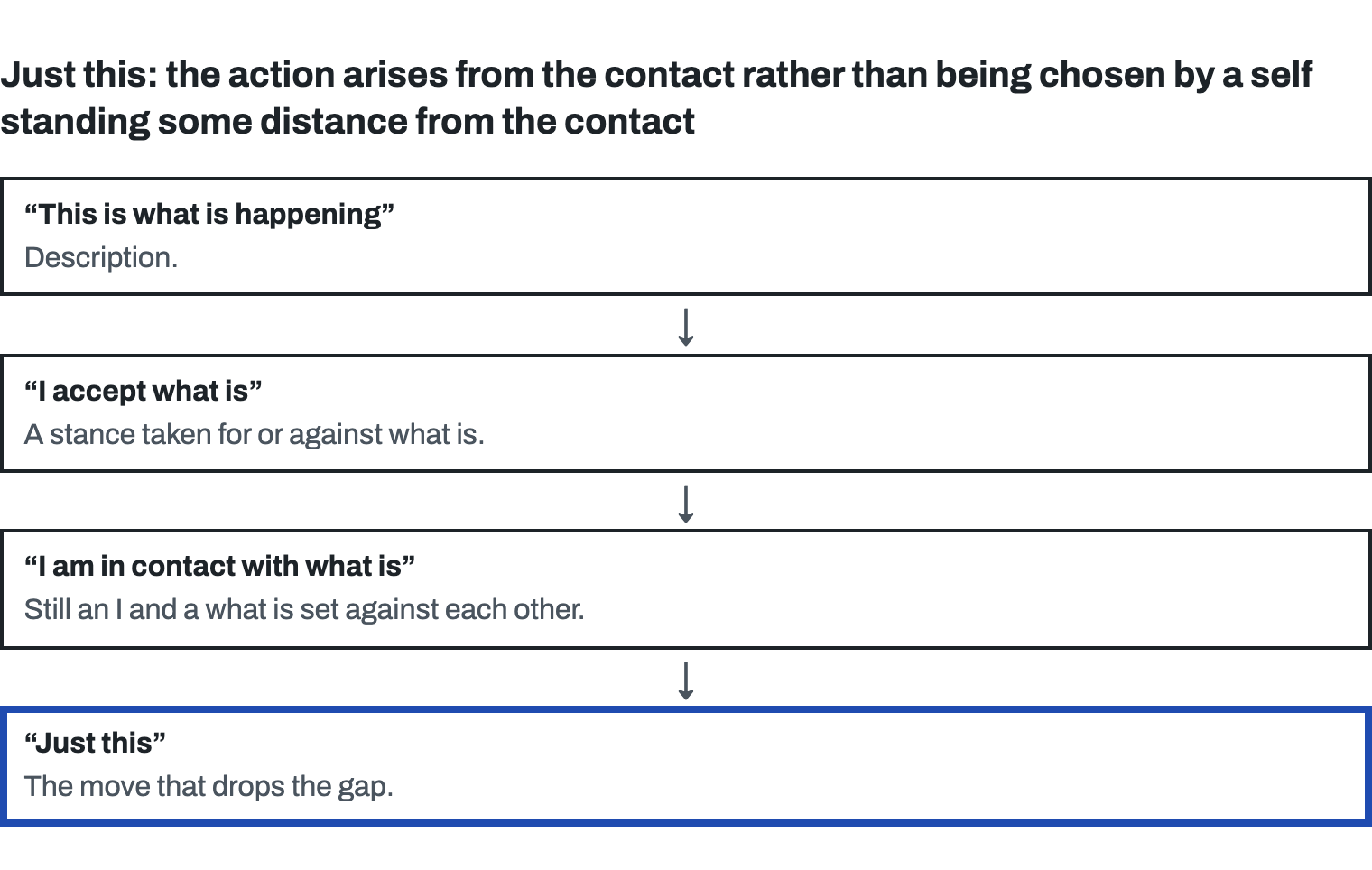
He offered a different frame. There might not be a yes or a no at all, he suggested. There might just be a this: whatever is actually facing me. Neither chosen nor refused. Just this as the source of action. I face this. What action arises? I act. Then I face the next this. And the next.
It took me a while to feel the difference between just this and the other moves I had been making. Just this isn’t this is what is happening, which is description. It isn’t I accept what is, which is a stance taken for or against what is. It isn’t even I am in contact with what is, which still has an I and a what is set against each other. Just this is the move that drops the gap. The action arises from the contact rather than being chosen by a self standing some distance from the contact.
The chalk circle is shikantaza in safety boots. I see a shared discipline in Ohno’s exercise and Zen practice: interrupt the filters that keep the watcher from seeing what is there, then sustain attention long enough to see more.
The same teaching, across traditions
I also see a related recognition in three Buddhist lineages, each in its own idiom. I draw on Buddhism because it is likely the oldest lineage to hold this recognition at its centre, and I cite it the way I cite Ohno: as testimony to be tested, not as a religion or authority to be obeyed. The Pali Canon’s Bahiya Sutta instructs a wandering ascetic: in the seen there is only the seen, in the heard only the heard, in the cognised only the cognised. When experience is left at just that, with no ‘you’ added to stand apart from it, suffering ends. That leaving-at-just-that is what I have been calling just this. The thirteenth-century Zen master Dōgen, in the Genjōkōan, frames it as two directions of motion: to carry the self outward and cast its light on the ten thousand things is delusion; to let the ten thousand things advance and disclose the self is awakening. The Tibetan Dzogchen lineage points at the same recognition with the phrase self-arising wisdom. I read all this as something both ordinary and extraordinary: what happens when one stops running every moment through one’s conditioning and filters.
Steve Jobs named something related in the vocabulary of building products. After months in India he came back convinced that our discursive intellects were an acquired overlay, not the ground: “The people in the Indian countryside don’t use their intellect like we do, they use their intuition instead… Intuition is a very powerful thing, more powerful than intellect, in my opinion. That’s had a big impact on my work.” I read him as describing what is left to work with once you stop running every judgement through the part of the mind that reasons about the thing instead of meeting it. The paradox he embodied—that the same man could trust intuition this far and still override everyone around him—is its own lesson: the capacity to make contact and the compulsion to control what you find are different muscles, and it is the second one the ordeal is trying to loosen.
In my understanding of Steve March’s developmental-coaching lineage, the leader’s path unfolds as the parts that have been running the show step back. The qualities of presence are what then show up. I see a related move in Otto Scharmer’s Theory U. Scharmer coined the word presencing, blending presence and sensing: “to sense, tune in, and act from one’s highest future potential—the future that depends on us to bring it into being.” Peter Senge adopted the word for the middle phase of the U process.
For Eugene Gendlin, a living process continues by carrying forward: when the body’s felt sense is attended to without forcing, the implicit can reorganise and a different sort of clarity can arrive, unbidden. The felt shift is what happens when the process completes a step it had held implicit until contact made the next step available. That while it took me to feel the difference between just this and the moves I had been making was a felt shift. Nothing arrived as new information.
The same false form in both domains
Agile and contemplative practice can fail in a near-identical way.
In Agile, the failure mode is cargo-culting. Standups that are status reports to a manager. Retros that produce action items no one does. Story points as a weapon. Sprints that generate task outputs, not integrated products. The form is preserved. The contact is gone. The team is performing agility without doing the practice. The last chapter’s belief was my own version: I held the form and read every team that didn’t break through as not having held it tightly enough.
Bureaucracy is where contact goes to die. A bureaucracy tuned to local metrics rewards the wrong move: it pays people to make their own box look good and taxes them for making contact with the system-level truth, Goldratt’s disease from chapter 8 felt from inside. I wrote a few years ago that auditing a developer’s every hour to hold them to a utilisation standard is “a dreadful, local optimization.” I saw it over and over as a coach. Backs broken to hit a date, quality traded away in a cram session, people treated as what Craig Larman, in his Certified LeSS Practitioner course, calls “meat widgets.” The structure makes contact hard and compliance easy, and people, being rational, take the easy route as we explored in chapter 6. Once the organisation measures busyness and calls it performance, the report that says we are slower because we are finally doing it right becomes a career risk.
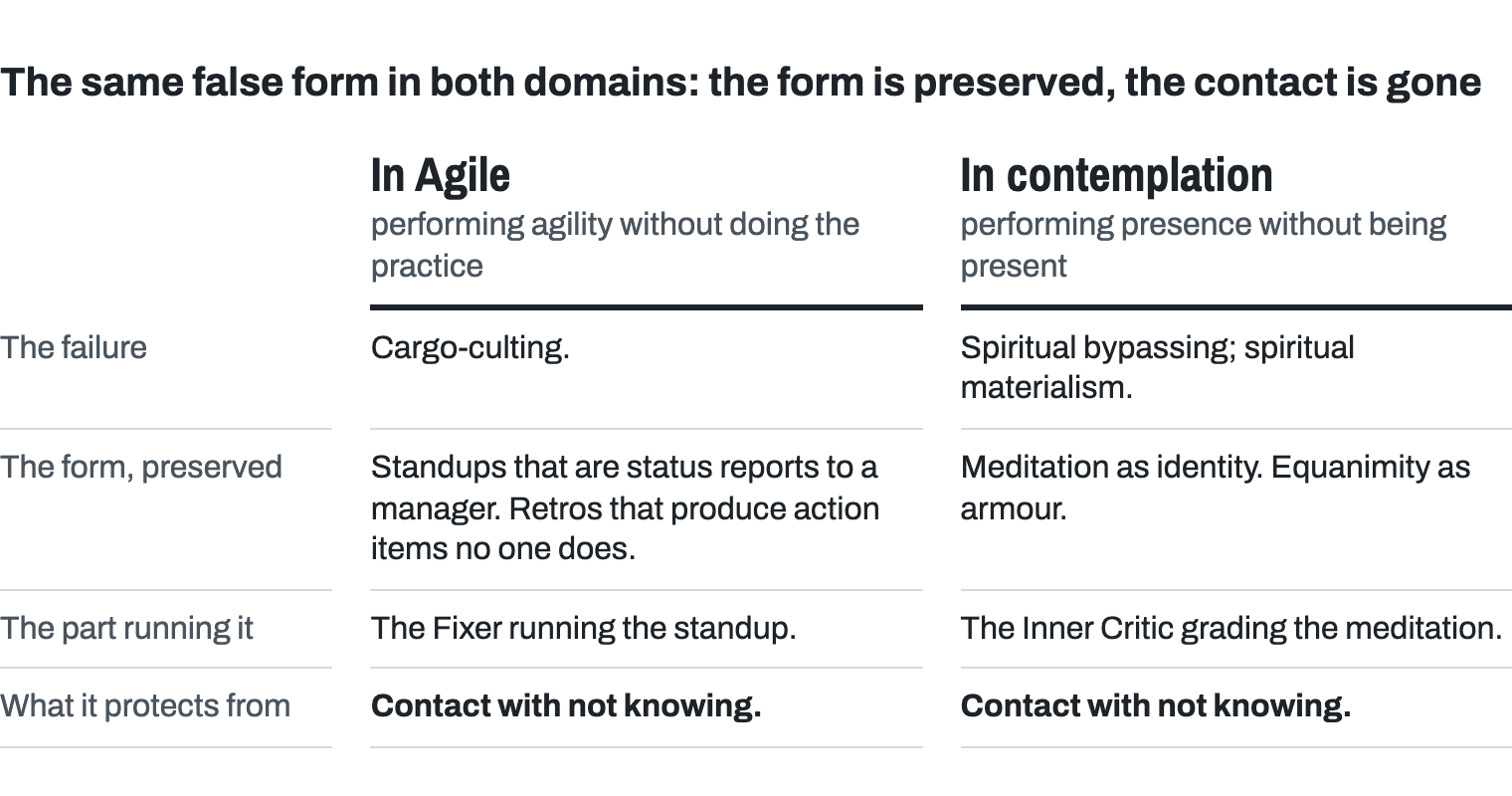
In contemplation, the failure mode shows up under at least two names. John Welwood coined spiritual bypassing in 1984. Chögyam Trungpa, earlier in the 1970s, named a related dynamic spiritual materialism and wrote Cutting Through Spiritual Materialism around the cure. Meditation as identity. Equanimity as armour. I’m sitting with it as a way to not feel it. The practitioner is performing presence without being present.
In Richard Schwartz’s Internal Family Systems, both failure modes can be driven by protector parts using the practice as armour against reality. The Fixer running the standup. The Inner Critic grading the meditation. The Practice Protector keeping things light enough to never land. Schwartz’s clinical observation is that we are populated. The Manager who keeps the leader looking competent is a part. The Critic who runs the meeting in advance and the meeting again afterward is a part. The Hurt one underneath, whom the Manager and the Critic are protecting from making contact with not knowing, is also a part. What the ordeal asks to dissolve is the leader’s fusion with the part: the belief that the part running the show is the whole self. The part feels the loosening as a kind of dying; it doesn’t die. What ends is only its claim to have been the Self.
Beatrice Bruteau gave the failure mode what I think is its sharpest contemplative form in her 1979 book The Psychic Grid, drawing on Dostoevsky’s Grand Inquisitor and Walter Kaufmann’s decidophobe. The world we know is one we collectively construct, and few of us can step outside the shared grid alone. The Inquisitor is the figure who lifts the burden of deciding for ourselves. He tells us how it is and what we must do, and we thank him for it. Any framework can become the Inquisitor when the leader agrees to obey it rather than use it: the methodology, the certification, the lineage that can’t be questioned, the app on the home screen that scores the day, the AI agent whose confident output settles the doubt. For years I worked a staged meditation path—numbered stages, an elephant-path diagram, effort measured against the next stage—and I ran it the way I run a delivery framework. It was perfectly designed for my parts to latch onto. I was practising from parts, and the form outlasted the contact.
I read Bruteau as naming the relief a leader feels when a framework arrives and settles doubt. That relief disqualifies the framework from its proper work: putting the leader in contact with what is.
Nothing wasted
If you have spent any real time in either world—Agile, contemplative, or both—this chapter might sting a little: the certifications you collected, the methodologies you championed, the mindfulness app on the home screen, the retreat circuit. I don’t think that effort was wasted, even when the practice misunderstood what it was doing.
My Alētheia teacher put this to me directly during the session that opened this chapter. In his vocabulary, we almost have to pass through a phase of practising as parts: following frameworks blindly, taking certifications seriously, believing the next methodology will be the one. For some people, McMindfulness supplies a first contact with contemplative practices, even if it never delivers what was advertised on the tin. SAFe made an organisational problem visible to me, even if it took a few rollouts to be sure. Both can become stages in finding out what the practice was pointing towards.
What changed things was carrying one long enough to feel it stop working. I certified as a SAFe Program Consultant in 2014, the same year I was recommending shock therapy, and let it lapse about five years later. It had stopped being the thing that told me what the situation was. After that, the Inquisitor got easier to spot in each promised cure. Until that conviction lands in the body rather than the intellect, the framework keeps holding the seat. The question that finally arrives, late and unwelcome, is something like: Is this framework leading the company, or is the leader? I read my own reaction to that question as information. When it lands as a threat rather than an invitation, something is still holding the seat for me, and it is better to know that before the next decision than after it.
The Immunity Map from chapter 2 belongs in the same conversation: a framework that serves contact when used as a doorway, and becomes another Inquisitor when used as the destination. Chapter 21 walks the Map in full on a worked example I built on myself.
None of which is permission to stop. The work in front of you doesn’t get easier when the framework loses its glamour. It gets sharper. You just have less protection.
The exercise: the chalk circle
Pick a system you are responsible for. Spend an unreasonable amount of unstructured time in contact with it. 20 minutes minimum, an hour is better, four hours starts to do what Ohno was after. No notebook. No agenda. No plan to extract insights. Watch. Then watch some more. Notice what discloses itself at 30 minutes that didn’t disclose itself at 15. Notice what discloses itself at two hours that didn’t at one. Notice what your protectors do as the time extends: the urge to make a list, to take a call, to leave the room, to find a problem to solve. The urge is the data. Stay.
Before you read on, do one thing with the same quality of attention. Pick one axis you have already met in these chapters, the one where the pole you claim and the pole you actually operate from pulled furthest apart. Take the four-column Immunity Map from chapter 2 and run it on that gap as the same staying. The Map is itself a framework; this is what using one as a doorway feels like. Column four is the one that matters here: the assumption held as fact, what would have to be untrue for you to change. Sit with what surfaces the way you sat with the urge to leave the room. When I can apply an axis cleanly to other people and feel no resistance in myself, I treat that as a clue that I am still holding it at arm’s length, a clue rather than a verdict. Come back to the axis when something in you catches.
What’s yours to do now
What remains is the practice—in the meeting, in sitting practice, in the chalk circle, with your kid, with your dying parent, with your customer, with your code—of noticing when you’ve slipped from contact into framework, and coming back.
I am still learning just this.
Going upstream
The chalk circle comes down through the Lean tradition as folk-canonical Ohno; I take the access claim it teaches, genchi genbutsu, go and see for yourself, in the operational form Eric Ries gives it in The Lean Startup. The four value pairs I read as a contemplative document are the Manifesto for Agile Software Development and its 12 companion principles, held loosely the way its own “while there is value in the items on the right” asks. Dave Snowden’s probe-sense-respond, and the discipline of letting the data precede the framework, are gathered in Cynefin: Weaving Sense-Making into the Fabric of Our World. The local-optimisation disease the bureaucracy paragraph names is Eliyahu Goldratt and Jeff Cox in The Goal, worked through in chapter 8.
The contemplative naming runs across traditions rather than through one book. The Bahiya teaching, in the seen only the seen, is the Bāhiya Sutta of the Pali Canon, Udāna 1.10, freely available in Thanissaro Bhikkhu’s translation; the two directions of motion, self carried outward versus the ten thousand things advancing, are Dōgen’s Genjōkōan, whose title Kazuaki Tanahashi renders as ‘Actualizing the Fundamental Point’; the Dzogchen self-arising wisdom belongs to that Tibetan lineage rather than to a single text. I write of these lineages as a lay practitioner reporting what the training points at, not as a teacher of them. Steve Jobs on intuition over intellect is Walter Isaacson’s Steve Jobs, p. 48. Beatrice Bruteau gives the trap its sharpest form as the Inquisitor and the decidophobe in The Psychic Grid, her 1979 book, drawing on Dostoevsky and Walter Kaufmann. On the developmental side, the leader’s path unfolds rather than gets built is Steve March’s Aletheia lineage; the word presencing is Otto Scharmer’s, coined in Theory U and adopted by Peter Senge, who credits the U to Scharmer, Jaworski, Kahane and their colleagues in Appendix 3 of the revised The Fifth Discipline.
The two false forms share one engine. Spiritual bypassing is John Welwood’s 1984 coinage; the earlier naming of a related dynamic as spiritual materialism is Chögyam Trungpa’s Cutting Through Spiritual Materialism. The observation that we are populated, that the Fixer running the standup and the Critic grading the meditation are parts and not the whole self, is Richard Schwartz’s Internal Family Systems, most accessibly in No Bad Parts. The felt sense and the carrying forward it registers, the body knowing the next step before the conceptual mind does, are Eugene Gendlin’s, in Focusing. And the Immunity Map, the framework that is a doorway and traps as a destination, is Robert Kegan and Lisa Lahey’s Immunity to Change, walked in full in chapter 21.
The session that opens and closes the chapter, and the just this it turned on, was lived rather than read: my own Alētheia teacher, in the vocabulary of that practice. I have kept his words close to how he said them and left them unattributed to any book, because that is where they came from.
Coming back to contact is hardest when the framework speaks as a confident voice with the answer already in hand. I have outsourced my judgement to a confident voice before, to a CEO, and to a consulting deck the quarter before that. Now it is the model. Chapter 12 asks what capacity lets a leader disagree with a voice that confident, because the leader who can’t disappoint a confident voice can’t govern an AI either.
I work with engineering leaders on exactly this kind of paradigm work, the deeper the better. If it’s live for you, I’m happy to talk: schedule a 30-minute virtual coffee at hi.chrisgagne.com.
Some book links here are Amazon affiliate links; if you buy through them I may earn a small commission, at no cost to you.