Theory X vs Theory Y
Your stated values are Theory Y. The approval thresholds, access controls, and review gates inside your function are Theory X. Your team reads the org design, not the values.
Leader-leader from chapter 17 can’t run on Theory X assumptions about workers. Unless those assumptions change, the structure pulls the protocol back to leader-follower at the next reorg.
The two poles
Pole A: Theory X. Design control structures around the worst-case employee. Oversight as the default. Trust is a reward earned through visible compliance.
Pole B: Theory Y. Design control structures around the average employee. Trust the system to handle the exceptions. Remove the obstacles, and let people do good work.
Douglas McGregor drew the distinction in The Human Side of Enterprise in 1960. More than 60 years on, most organisations still operate on Theory X assumptions even when leadership quotes Theory Y.
The web of our own weaving
McGregor’s deepest claim wasn’t that Theory X is wrong about people. It was that managerial strategy produces the workers it predicts. He called it a web of our own weaving. The leader who treats workers as untrustworthy designs controls that punish discretion. The workers learn that discretion is punished, so they stop bringing it. The leader observes the absence of discretion, concludes the original assumption was correct, and tightens the controls. The system has made its own evidence.
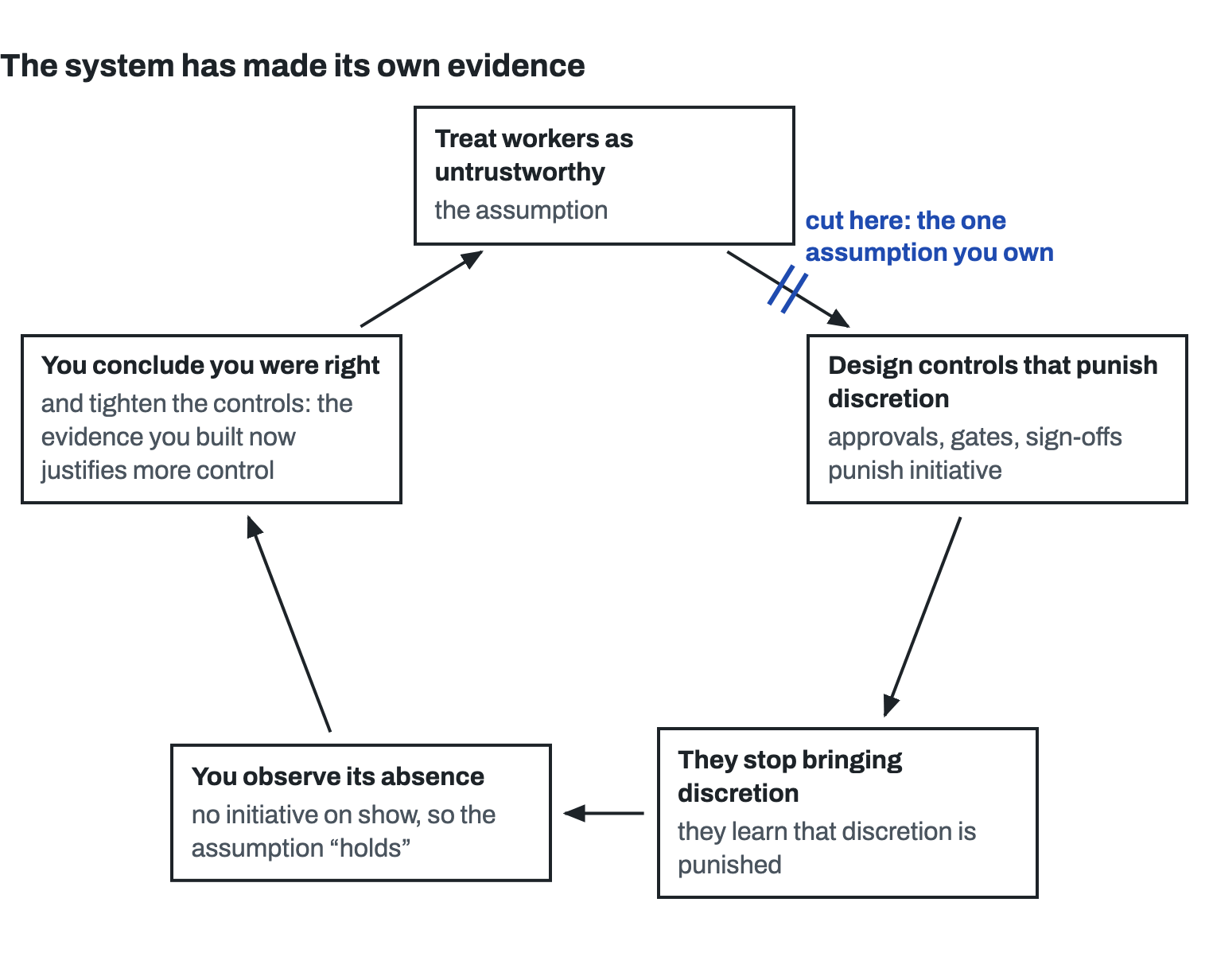
This turns the question from a values question—do you trust your people?—into a feedback-loop question: what is your org design—strategy, processes, and rewards as much as reporting lines—producing in the people who run inside it? As a values question, Theory X / Theory Y is the kind of debate the leader has every five years at an off-site and forgets by the following Monday. As a feedback-loop diagnosis, it is something the leader can read and action immediately.
Run McGregor’s loop backwards. List the behaviours your control structure is currently producing in your engineers. Then ask whether those behaviours were latent in the people or installed by the structure. In my experience the answer is some of both, and the structural share rises the longer they’ve been inside the organisation.
Where Pole A is right
McGregor named two contexts where Theory X structures genuinely fit. Both still hold today.
First: genuinely high-stakes regulated work where the cost of a single bad actor is catastrophic. This includes nuclear plant control rooms, aviation cockpit checklists, surgical theatre protocols, anti-money-laundering compliance, and pharmaceutical batch release. The structural Theory X here is the right engineering response to predictable work with tightly bounded failure modes.
Second: routine low-skill, low-discretion work where the task itself doesn’t generate intrinsic motivation and the structure is doing the load. High-turnover transactional roles and certain warehouse or contact-centre tasks fit this description, particularly where the work is the work and capability development sits outside it. Intrinsic motivation isn’t available to carry the load, so the structure has to compensate.
The error is generalising from these contexts to most knowledge work. Most knowledge work, including cross-functional work, is neither. Roles that depend on intrinsic motivation usually need Pole B, yet many inherit Pole A structures through habit rather than engineering judgement.
Where Pole B is right
Theory Y fits wherever the work depends on judgement the worker has and the control structure can’t supply. That is McGregor’s claim about knowledge work, and software-dependent organisations are where it bites hardest; run the Vodde exercise below with your teams and see for yourself.
A Theory X org design taxes the capacity the work runs on whenever the task is non-routine, the person closest to it knows more than the layer above, and the outcome depends on initiative. The engineer who must seek approval for time to refactor and the team whose every experiment routes through a change-approval board face the same constraint. The structure punishes the initiative the work needs.
Remove the obstacle and the average person does good work, because the work itself supplies the motivation the controls were trying to manufacture.
The AI shift shows how much work already depended on human judgement. As AI absorbs the routine and the rule-bound, what stays human is the judgement-heavy, initiative-bearing work where Theory Y is an economic necessity, not an emotional preference. My read is that the judgement-heavy work was always the larger share, and the Theory-X-shaped routine sitting on top of it hid how much. Strip the routine away and most of what remains needs Pole B. The leader still running Theory X org designs across that work is paying a compounding tax on the one capability the AI era requires most: judgement.
Honour the past—why Theory Y didn’t diffuse cleanly
Theory Y has had 60-odd years to spread, but it hasn’t. A leader who waves it around as the obvious correct answer still has to reckon with the question McGregor’s successors faced: Why didn’t it diffuse?
Theory Y adoption has been real but partial, often reversed by leadership succession, and dependent on conditions most companies didn’t sustain. A leader installs a Theory Y organisation design, the design produces results, the leader leaves or gets promoted, and the new leader treats the design as overhead and reverts to Theory X defaults. The workers who had developed inside the Theory Y structure now look like overpaid prima donnas to a Theory X eye.
A successor can restore the old controls faster than workers learned to use the discretion the first leader gave them. That succession pattern is what Kochan, Orlikowski, and Cutcher-Gershenfeld documented: the pipeline mostly produces Theory X operators, and the Theory Y operator is the one who has to be found.
The leader who currently runs Theory X org designs isn’t necessarily running them out of bad faith or ignorance of McGregor. They are running them because Theory X is what the system selected for, what their training reinforced, and what their predecessors left behind. The leader’s previous paradigm got them here. The past wasn’t wrong; the past fit its conditions.
McGregor also named a failure mode for the leader who thinks they’ve adopted Theory Y but hasn’t. Old wine in new bottles: relabelling Theory X with Theory Y vocabulary. He wrote of decentralisation, management by objectives, consultative supervision, and democratic leadership in his own era. The contemporary equivalent is psychological safety as a poster sitting on top of an unchanged escalation pattern, or empowerment as a slogan sitting on top of an unchanged approval workflow. Each is a Theory Y label sitting on top of an unchanged Theory X structure.
Bas Vodde’s exercise—McGregor’s diagnostic, repackaged
Bas Vodde, Craig Larman’s collaborator on Large-Scale Scrum (LeSS), teaches an exercise that catches the gap in flight. Draw a horizontal axis. Theory X to the left, Theory Y to the right. Sticky-notes above the line for observed attitudes and behaviours of fellow colleagues. Sticky-notes below the line for the organisation design the team is operating inside. The gap between the two rows is the diagnostic.
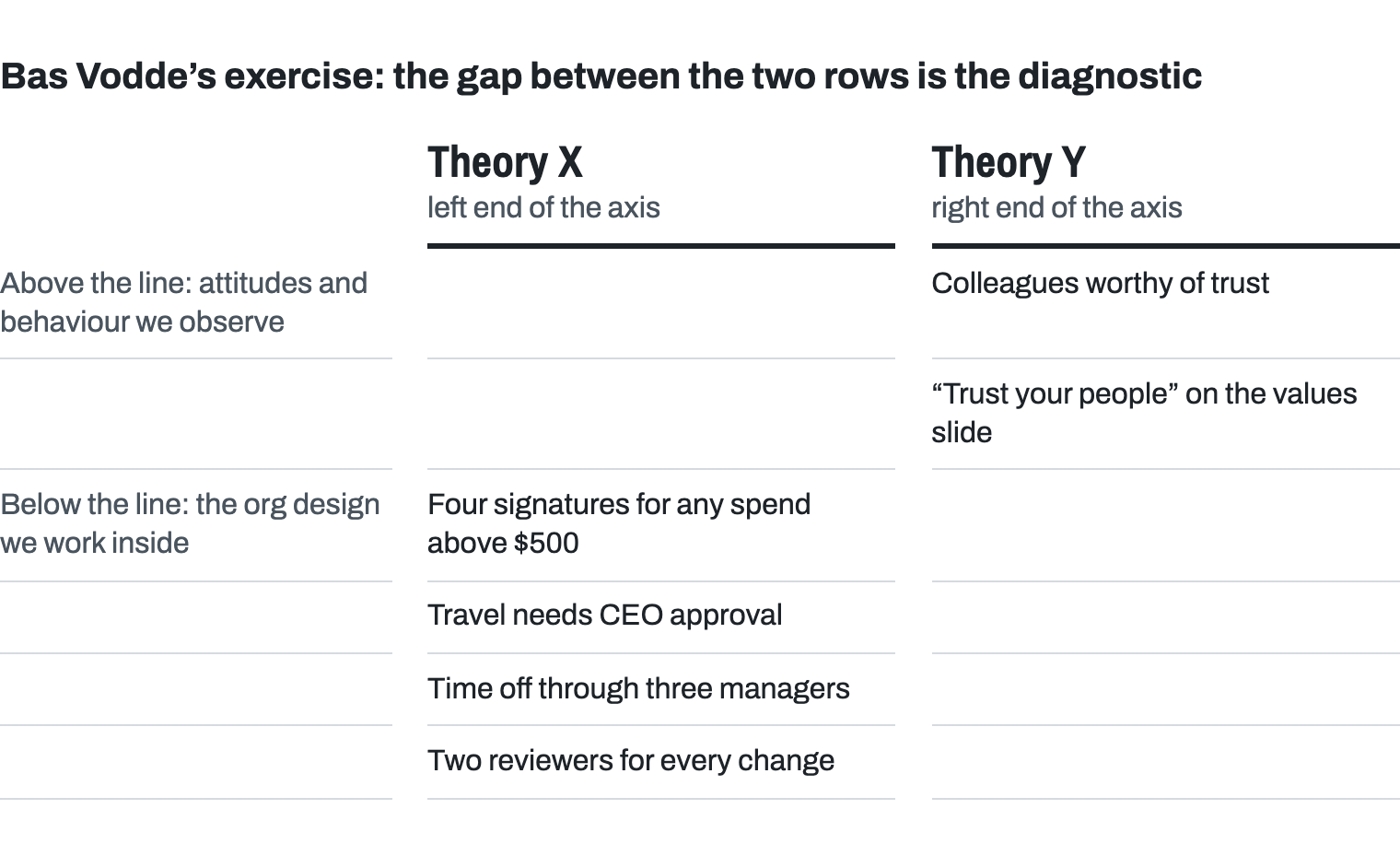
In the Vodde class I sat in on, and in my own work since, the pattern is consistent. Above the line: Theory Y. Below the line: Theory X. The leader’s values are above the line. The structure they run is below the line. Both are sincere. The team reads the structure.
The exercise works because it externalises what the leader already knows. The gap was visible to the team before the exercise; the exercise makes it visible to the leader. After that, the old account is harder to sustain.
The exercise isn’t Vodde’s invention. McGregor named the same gap in the original book and called it the lip-service Theory Y problem: the leader who quotes Theory Y while running Theory X is doing what McGregor was already cataloguing in 1960. Vodde’s contribution is the experiential packaging: the sticky-notes, the horizontal axis, the visible gap. McGregor named the diagnostic; Vodde made it teachable in 20 minutes with a pad of sticky notes.
The operating conditions Theory Y assumes
Theory Y assumes the work supplies its own motivation: that the worker chooses how to do it, that the work develops skill the worker values, and that it connects to something larger than the worker. Where those conditions hold, intrinsic motivation does most of the work the Theory X structure was trying to do. Where they don’t, no Theory X structure can fully substitute. The structure can extract compliant behaviour; it can’t extract the discretionary effort the work actually needs.
Theory Y structures don’t cause good performance, they permit it. The good performance was always going to come from the intrinsic motivation. Theory X structures suppress it; Theory Y structures stop suppressing it. From a control frame, Theory Y looks like abdication. From an autonomy frame, it looks like taking the brakes off. The Pole B leader sees it as removing the brakes.
Theory Y structures don’t cause good performance, they permit it.
The compliant, externally-motivated worker Theory X assumes and the intrinsically-motivated, autonomy-driven worker Theory Y assumes can be the same person under different structures. The surrounding structure draws out the behaviour. NUMMI is the closest thing to a controlled experiment. When the Fremont plant reopened in 1984 under Toyota’s system, over 85% of the workforce were old hands from GM Fremont, the same people the industry had called the worst workforce in the automobile industry; within three months the cars coming off the line were getting near perfect quality ratings. Bruce Lee, who ran the union local and fought to have them rehired, put the reading plainly: “I believed that it was the system that made it bad, not the people.” This is McGregor’s web of our own weaving, still being woven in approval thresholds and sign-off chains.
The coupling with leader-leader
Theory Y is what makes Marquet’s leader-leader possible. Chapter 17’s leader-leader move depends on subordinates having the orientation and motivation to act on intent rather than instruction. After years of Theory X, people have learned not to bring discretion to work. Install leader-leader at that point and they keep escalating decisions the new structure expects them to make. The confusion is learned.
The two axes are coupled. Pole A on this axis forces Pole A on leader-follower. You can’t run leader-leader on Theory X assumptions; the assumptions defeat the protocol. A Pole B move on either axis is incomplete without the Pole B move on the other.
The leader-leader chapter’s submarine case turned on exactly this: the structural change could work because the captain trusted the crew to have the orientation Theory Y predicts, and the crew rose to it. The change ran on one set of assumptions about people, held consistently enough that the structure could move.
Where Theory Y gets misread
Of the companies I have been inside, most had softened the structures with culture work and kept the underlying assumptions. I have not been inside one that rebuilt the structure around Theory Y assumptions from the ground up.
Theory Y is not a developmental destination, though it gets read as one. McGregor’s claim was that the assumptions a leader holds about workers produce the workers they predict, and that for most knowledge work those Theory Y assumptions produce a better outcome than Theory X ones.
McGregor’s account was situational. Pole A fits some situations; Pole B fits more situations than most leaders think. The developmental reading is a later overlay.
A representative case
Picture a mid-sized engineering organisation with a documented value of trust your people. The values slide is shown in every monthly all hands. The actual budget approval process requires four signatures for any spend above $500. Travel requires CEO approval. Time-off requests go through three managers. Code-review policy requires two reviewers for every change, regardless of risk profile.
A new VP of Engineering runs Vodde’s exercise in their first week. The above-the-line stickies describe colleagues worthy of trust. The below-the-line stickies describe a system of suspicion. The gap is obvious to everyone on the team and has been invisible to everyone in leadership for years.
The Pole B move takes six months. Budget authority pushes down to team leads for spend below $5K. Travel approval delegates to engineering managers. Time-off requests require only the engineer’s own calendar coordination. Code review reduces to one reviewer for low-risk changes.
In McGregor’s vocabulary, the web is now working in the other direction. The Theory X structure had been producing Theory X behaviour. The structural change permits Theory Y behaviour. The engineers haven’t changed; the structure has stopped suppressing the discretion they already had.
The AI overlay
AI tooling extends both poles. Pole A leaders use AI for monitoring and compliance: automated detection of policy violations, AI-driven approval workflows, predictive surveillance of engineer behaviour. The Pole A AI stack codifies Theory X assumptions into infrastructure. Pole B leaders use AI to extend autonomy: agents that handle the routine approvals so the human chain doesn’t bottleneck, AI assistants that make the intent-contract legible across larger teams. The Pole B AI stack codifies Theory Y assumptions into infrastructure.
Both poles can use the same tools. Their configuration tells the truth about the leader’s assumptions, so a leader genuinely unsure which pole they’re on can read it off the AI stack they have built.
Ask the model which way to configure and it leans toward the paradigm you bring it. A leader who believes people need watching will get a confident, well-sourced design for monitoring, approval gates, and surveillance, because the management corpus the model learned from is thick with exactly that. A monitoring-framed prompt tends to return monitoring designs; an autonomy-framed prompt returns autonomy designs. The tool deepens the groove.
The redesign-question argument the series opened with arrives here too. AI tooling makes paradigm-misfit cheap to deploy. The tooling is the same either way: same models, same licences. What differs is what the deployment produces in the people running inside it, and the web McGregor named now gets industrialised at AI scale, in either direction, faster than the organisation can decide which web it actually wants to weave.
The diagnostic move
Three questions for last Tuesday’s structural decision.
- Which pole was I claiming? Did I say I trust the team or that I needed to maintain controls?
- Which pole would the actual structure show? If I ran Vodde’s sticky-note exercise tomorrow, what would the gap reveal?
- Which pole does the work actually require? Most knowledge work is Pole B. The Pole A defaults are leftovers from a paradigm that fit other conditions.
CTOs and VPEs: run Vodde’s sticky-note exercise one layer up, with your CEO as co-author rather than subject—each of you holding the pen on your own rows—before you assume the gap is yours to close. Above the line, the stated values from the culture page, the values slide, and the all-hands language. Below it, three things the CEO directly controls: budget approval thresholds, headcount sign-off, and strategic hire veto. McGregor’s web works in both directions: if the CEO runs Theory X assumptions above the CTO layer through approval workflows, access controls, and budget signatures, the org design will pull back any Theory Y installation below. The gap is what your engineers read.
Ask for one small, specific structural change that brings one below-the-line item into line with the stated value. The CEO doesn’t have to redesign the organisation. They have to move one threshold. The sentence your CEO can carry to the board: “Our company runs on the org design, not the values slide.”
The exercise this week
The reflection is solo. The exercise is for the team.
Run Bas Vodde’s sticky-note exercise with your direct reports this week. 20 minutes. Draw a horizontal line on the wall. Theory X to the left, Theory Y to the right. Each person writes three sticky-notes above the line (three behaviours or attitudes they observe in the team) and three sticky-notes below the line (three structures or processes the team is operating inside). Place the stickies on the axis. Stand back and look.
Where is the gap widest? Which structure is most clearly Theory X? Which Theory X structure is doing genuine load (high-stakes risk surface, low-discretion routine work), and which is just inherited habit? What’s the smallest structural change that would let the team’s actual Theory Y behaviour stop being suppressed?
Above the line: Theory Y. Below the line: Theory X. Structures that match the value are worth strengthening.
Going upstream
In-text: Douglas McGregor, The Human Side of Enterprise: the canonical primary. A web of our own weaving, old wine in new bottles, and the lip-service Theory Y problem all live here.
Also touched: Bas Vodde, Craig Larman’s LeSS collaborator, for the above-the-line / below-the-line sticky-note exercise. The NUMMI figures and Bruce Lee’s line come from This American Life’s “NUMMI” episode (2015).
Go deeper: Daniel Pink, Drive, on the operating conditions Theory Y assumes—autonomy, mastery, purpose—and the Type X / Type I distinction; the short version is RSA ANIMATE: Drive (11 min). L. David Marquet, Turn the Ship Around!, covers the Theory Y assumptions behind the leader-leader move developed at length in chapter 17. For the empirical-diffusion question—why Theory Y reverts at leadership succession—see Kochan, Orlikowski, and Cutcher-Gershenfeld, Beyond McGregor’s Theory Y (MIT Sloan, 2003).
I work with engineering leaders on exactly this kind of paradigm work, the deeper the better. If it’s live for you, I’m happy to talk: schedule a 30-minute virtual coffee at hi.chrisgagne.com.
Some book links here are Amazon affiliate links; if you buy through them I may earn a small commission, at no cost to you.