Invisible paradigms and a practice that survives
A paradigm is what you look through, not what you look at.
From inside a paradigm, the paradigm is invisible in the same way the lenses of your own eyes are invisible except when you look at their reflection in a mirror. You don’t see your lenses; you see through them. Your paradigm runs the same way: you don’t decide with it, holding it at arm’s length as a tool you can inspect; you decide through it, unseen, the way you see through a lens you have forgotten is there.
A paradigm is made of assumptions, beliefs held long enough that they read as the way the world is. Each axis in this book names one paradigm at the scale of a single kind of decision; the paradigm that got you your career is several of them running together. When I write frame, I mean the part of a paradigm doing the looking in one situation, this meeting or that call. Identity is what got built on top of it, the self that was rewarded for seeing through that paradigm, which is why questioning the paradigm can feel like being questioned yourself.
Chapter 1 named the identity-level change AI is laying bare for software-dependent leaders; this chapter is a practice that helps you see the paradigms you’re being asked to leave.
🎧 Prefer to listen? This chapter is narrated in my own voice, via ElevenLabs on Spotify, about 15 minutes. Listen on Spotify →
Intellectually agreeing that paradigms are powerful is, I suspect, the easiest thing a senior leader can do. Of course paradigms shape decisions. Of course I should be open to revising mine. Of course I surround myself with people who challenge my assumptions. I ran all three for years, and each one felt like openness and cost nothing. Agreeing in principle changes no decision; being open defers the work indefinitely; I hire challengers hands it to someone else. The paradigm hasn’t been examined. It has been complimented.
The meta-skill
The meta-skill to develop is the capacity to hold a paradigm as object rather than be subject to it. The axes that follow are a sampling of the paradigm dichotomies the senior leadership of software-dependent organisations is being invited to reconsider now. AI keeps reshaping the conditions, so some of the 18 will be partly obsolete in months. What outlasts the next shift—and the one after that—is the meta-skill itself: becoming aware of and examining our paradigms. A leader who learns to examine these 18 will know how to examine the next set, whatever shape it takes. Donella Meadows placed this meta-skill—what she named transcending paradigms—at the top of her catalogue of leverage points: above paradigms themselves, above goals, above information flows.
The 18 dichotomies aren’t independent; they share a common root in their assumptions about the work to be done. They work the way Christopher Alexander’s pattern language works: many entries, each pointing at a quality none of them names alone. Take the assumption that the work is knowable before it starts: it produces a plan treated as a commitment (chapter 7) and a team measured on how busy it is (chapter 4), two axes apart, from one root. Examine the axes one at a time and the common pattern will start to show itself; the shift, when it comes, isn’t 18 separate efforts.
The mirror as instrument
If the meta-skill is the capacity for awareness, this book is, like a physiotherapist’s mirror, an instrument for making a posture observable within that awareness. The posture has been held for years and gone invisible from inside; the mirror reflects it from the outside. The work of postural correction is practised over weeks and months in the situations where the old paradigm used to hold.
One mirror is rarely enough. The role is distributed across several people who keep showing you the same pattern from slightly different angles until you can feel it yourself. The field guide is just one mirror, and the work it reflects is relational: it needs work at Block’s affective level, and people who can hold you while the old certainty loosens (a coach, a peer circle, someone at home).
The defensive patterns the mirror catches
Chris Argyris named the defensive routines. Most professionals, under threat or embarrassment, operate from what he called Model I, whose daily shorthand runs: win not lose, be rational, avoid upset, support others by telling them what they want to hear. Chapter 5 takes Model I, and its alternative Model II, in full.
Defensive routines aren’t personal failings. They are the system protecting itself from data that would force a change. Argyris documented the same three-step escalation across his casework: bypass the threat, cover the bypass, then cover the cover-up.
Concretely, the AI version is what Scott Ambler calls green shifting: status goes from red to green on the way up the ladder. The CEO is briefing the board on the AI strategy. The CTO knows the engineering team is spending more on tokens and finding less productivity gain than the board would like to hear. The bypass: in the CEO-CTO prep meeting, the gap doesn’t get named. The cover: the board deck shows cherry-picked metrics that don’t reflect the friction the team is reporting. The cover-up of the cover: when the money spent on tokens doesn’t add up, it gets framed as a training or personnel problem rather than as the data that was always there. The board sees green; the engineering reality stays out of view.
Double-loop as the move underneath
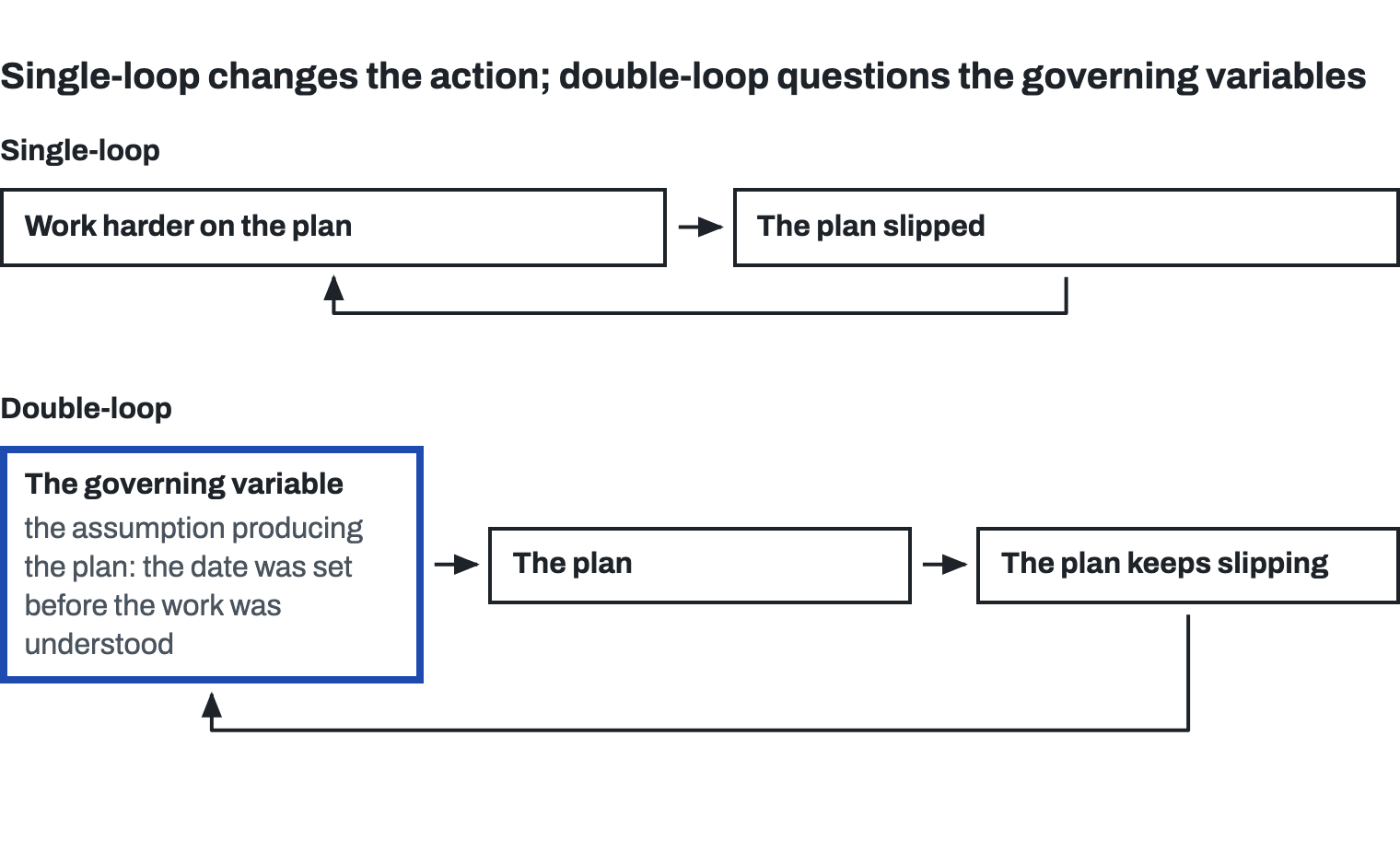
Argyris and Schön named the move that runs underneath all of this double-loop learning. Single-loop learning changes the action while leaving the governing variables in place: the plan slipped, work harder on the plan. Double-loop learning questions the governing variables themselves: the plan keeps slipping, so what assumption is producing the plan? Usually it is that the date was set before the work was understood, and that scope can grow while the date can’t move. Question that and the next decision changes: you stop asking the team to recover the schedule and start asking who can move the commitment.
Argyris developed the move in the consulting and organisational-learning lineage—most fully in Overcoming Organizational Defenses—on the theory-in-use foundation he and Schön laid down in the 1970s. Schön on his own, in The Reflective Practitioner, locates the same move in the individual professional: reflection-in-action, the on-the-spot questioning of how the problem is framed, not just what to do next.
A training day fails when it stays inside single-loop. The leader gets a new technique, applies it to the existing paradigm, and the existing paradigm absorbs the technique. The technique becomes another tool the paradigm uses to do the thing it was always going to do. The sequence chapter 1 named—separation, dissolution, recognition, return—works because it makes the governing variables themselves visible and revisable.
The Heaths show that some gaps close after nothing more than a message redesign. Don’t Mess with Texas cut visible roadside litter in Texas by 72% in five years with no developmental work anywhere in sight: a message rebuilt until it was concrete, story-carried, and aimed at the litterer’s actual identity. So when a stated value isn’t landing, run the cheap test first: rebuild the message once in sticky form and watch what happens. If the gap closes, it was never an immunity. The chapters ahead are for the gaps that survive.
The Immunity Map
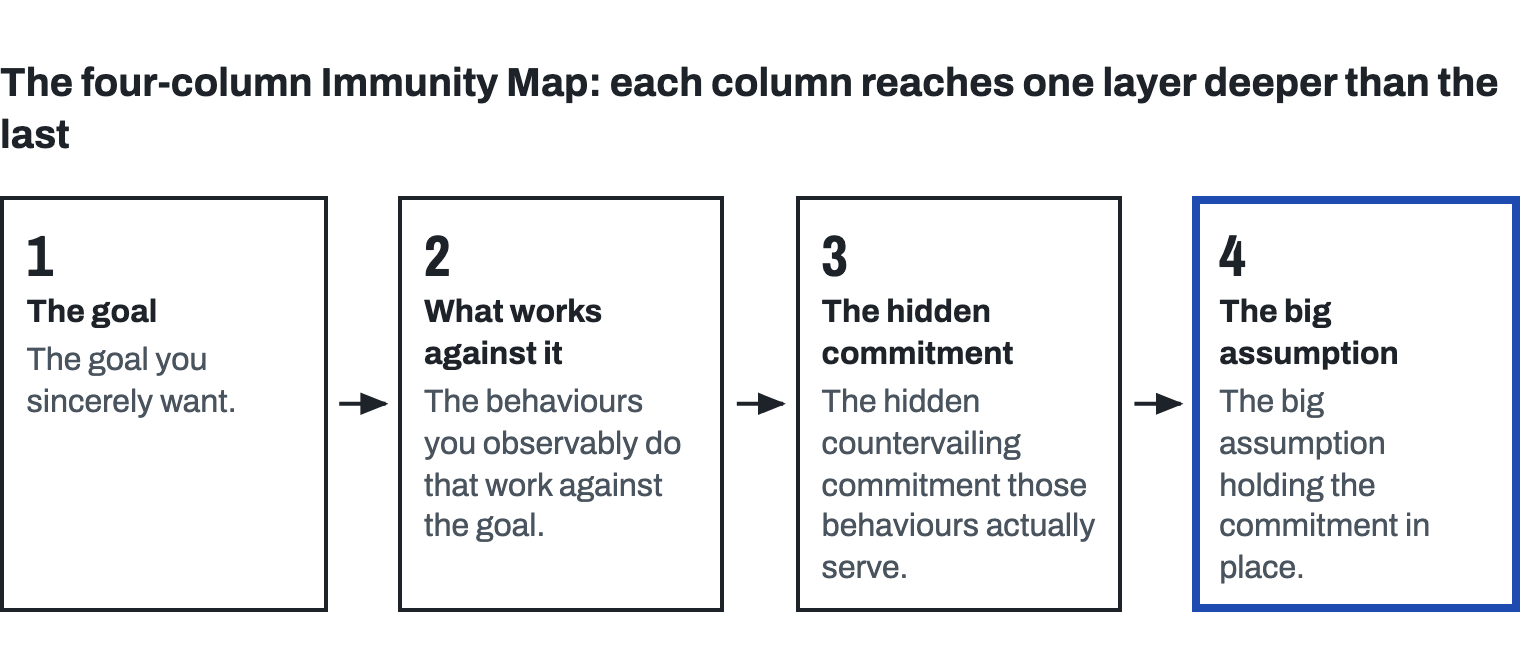
One instrument that can help with this work is Kegan and Lahey’s Immunity Map, a four-column exercise they developed in Immunity to Change. The four columns are:
The goal you sincerely want.
The behaviours you observably do that work against the goal.
The hidden countervailing commitment those behaviours actually serve.
The big assumption holding the commitment in place.
Without this map, the immune system runs in the dark. With it, the subject-object shift becomes possible: what the leader was subject to (the paradigm running them) becomes object (a thing they have, can look at, can choose to keep or release).
Columns 1 and 2 are workable as a solo starter exercise, though it can be helpful to have a peer reflect your conflicting day-to-day behaviours. Columns 3 and 4 can be started alone but work best as slower, supported work. Find a coach or peer group who can sit with the hidden commitment over time. In miniature, and from my own: column 1, meet people where they are when the pressure is on; column 2, tighten instead, and sharpen the framing exactly when I should soften the contact. Chapter 21 walks all four columns on a worked example I built on myself.
Honour the past
Working the Immunity Map will bring up memories which can feel like personal failings. They aren’t.
The past wasn’t wrong. On a recent call I told Steve March, my coaching teacher, that a decade of sincere meditation practice had been wasted: a staged path I had climbed as an achievement ladder, and largely ineffective for that reason. What if none of it was wasted, he asked. The life lived exactly as it has been lived up to this moment, and how it feels right now, is the doorway.
The paradigm that got most leaders here isn’t stupid. It fit the context that rewarded it. Adam Smith’s pin factory worked because pins are identical, demand was predictable, and the work decomposed cleanly into standardised steps. Ten workers produced 48,000 pins a day; a worker alone, Smith reckoned, couldn’t have made 20, perhaps not even one. A gain running into the hundreds-fold was the prize for the right answer for an ordered domain. Our paradigm isn’t wrong; it was lifted across a domain boundary it didn’t fit (This is Krivitsky’s framing from his Org Topologies Consultant class I attended in Singapore in September 2025). The work in front of the leader isn’t to make the past wrong. The work is to make the next move wiser.
Without self-compassion for the paradigm we are leaving, the meta-skill doesn’t develop; we collapse toward whatever pole sounds more enlightened in the current vocabulary and call it growth. You can’t rip away the past identity to get the next one; this is the same developmental move March points at, and the line I first met in Ram Dass: the whole trip occurs in an unfolding process of which we have no control. What we do have is the choice to enter it knowingly, or to spend 20 more years rejecting the entry on the grounds that we are too busy.
What you can do this week
Try this with a peer. Pick a goal you sincerely want to do differently in your leadership (column 1 of the Map). One check before you ask anyone for feedback, here or anywhere in this book: think of the last person who brought you bad news, and what happened to them. If the real answer isn’t anything good, the answers you get back will be polite rather than true, and that repair comes first. With the channel open, don’t lock the goal from your own read alone. Ask one boss, one peer, one direct report, and someone at home: what’s the single thing most important for me to get better at? Kegan and Lahey’s own confession is that self-picked goals, chosen without that question, produced programmes with no impact. Then spend ten minutes alone writing down the behaviours you reliably do that work against that goal (column 2). Then ask a peer who has watched you in that territory to write column 2 from their angle. Compare the two. The gap between your column 2 and theirs is the tell. The mirror does its work in that gap. Columns 3 and 4—the hidden commitment and the big assumption—come later, with someone who can sit with the work.
The 18 axes that follow are this season’s contrast material, the paradigms the practice currently has to work on. What survives the next shift is the practice itself: the Map, the mirror, the double-loop move, applied across whichever axes AI puts in front of you. One habit upgrades every chapter’s diagnostic as you go: wherever question two asks what a colleague would count, don’t imagine the colleague; send the question to two people who watched, on the same scale you scored yourself. Chapter 5 turns that habit into a full exercise. Chapter 21 walks the Map in full.
Where most leaders get stuck
Eighteen axes is a lot to hold, and you don’t need all of them at once. Many deepen, qualify, or specialise a pattern another axis has already set down, so working one well tends to bring the others into view.
If you are reading this as a field guide rather than cover to cover, start with the axis whose gap is costing you most, found by the rule in the next section. The other five chapters—1, 2, 11, 22, and 23—aren’t axes. They are the contemplative spine, and they read best in order.
Which axis first
Eighteen axes arrive over the following chapters, each with its own exercise, and chapter 8 will teach the rule this catalogue must obey: improving a non-constraint changes nothing. So hold a discipline as you read. Each chapter’s diagnostic—three questions, five minutes, run on last Tuesday’s version of the decision—is an identification step, not a programme. If a diagnostic names an engineering table you don’t sit at, run it on the nearest one you own: sprint allocation becomes capital allocation, the incident review becomes the last board-level escalation, the contested technical call becomes the last strategy call that routed to you. If the pole you claim, the pole your team would report, and the pole the situation calls for all roughly align, that axis isn’t your constraint: read on, and let the exercise alone. Claim and report agreeing isn’t enough on its own, because you and your team can agree on a pole the situation has already moved past (chapter 3’s leader whose deck and procurement both say Pole A is the case). The first axis where any of the three diverge hard, and the divergence is costing you something this quarter, is your working axis. Do that chapter’s exercise until the gap moves, and treat the later chapters as reading while you do. If a later chapter exposes a worse gap, switch; one axis at a time means one, not whichever came first. The same discipline governs the mirror you hold up for your CEO: one axis at a time—the costliest—with the rest subordinated to it. A leader improving three axes at once is running the local-optimisation programme chapter 8 warns about, on themselves.
Going upstream
In-text: the load-bearing references named in the body. Robert Kegan and Lisa Lahey, Immunity to Change (the four-column Immunity Map and the subject-object shift, the chapter’s operational payload). Chris Argyris, Overcoming Organizational Defenses (Model I, the defensive routines, the three-step, and double-loop learning with Schön). Donald Schön, The Reflective Practitioner (reflection-in-action, the individual-professional face of the same move).
Also touched: Donella Meadows, Thinking in Systems (transcending paradigms at the top of the leverage-points list). Chip and Dan Heath, Switch and Made to Stick (the Don’t Mess with Texas 72%-in-five-years message redesign; the sticky-form boundary test).
Go deeper: the pattern-language frame: Christopher Alexander’s A Pattern Language (many entries pointing at a quality none names alone). The green-shifting example: Scott Ambler on status going red-to-green up the ladder. The honour-the-past ground: Adam Smith’s pin factory (the right answer for an ordered domain, lifted across a boundary it didn’t fit, in Krivitsky’s Org Topologies framing). The constraint floor under all of it: Alicia Juarrero, Dynamics in Action (real change in a self-organising system comes from altering the enabling constraints); chapter 8 works that idea in full.
You can now hold a paradigm at arm’s length as an object; chapter 3 is where you turn that on the AI rollout you already chose. The cheap mistake was the tokens. The costly one is the org design you left in place, and it keeps compounding while the productivity layer you laid over it hides the fact that the rollout was really a reason to rebuild.
I work with engineering leaders on exactly this kind of paradigm work, the deeper the better. If it’s live for you, I’m happy to talk: schedule a 30-minute virtual coffee at hi.chrisgagne.com.
Some book links here are Amazon affiliate links; if you buy through them I may earn a small commission, at no cost to you.