Just this: what the organisation does with the leader who comes back
A leader comes back changed to a role built for the person they were before. The most senior leader is also the one who can build what receives that change, for themselves and for the people below them who come back changed too.
Chapter 22 named what a leader recognises in themselves; the receiving community has to be ready to hold that change.
What’s left when the frameworks fall away is the capacity to notice. This is the close of the arc: separation in chapter 1, dissolution in chapter 11, recognition in chapter 22, and now reception.
What reception actually is
A leader goes through separation and dissolution, then comes back to a role built for the person they were before. The leader has changed. The role, expectations, and surrounding system haven’t. Unless the organisation can receive what changed, the people who changed tend to slide back into their old roles or leave.
Reception is what the community does to take the changed person in.
NUMMI (New United Motor Manufacturing), the Toyota/GM joint venture in Fremont, did this on the factory floor in 1984, as recorded in This American Life episode 561 “NUMMI 2015” and in the company’s own Team Member Handbook. Toyota flew the unionised Fremont workers—the same workers GM had reputedly written off as the country’s worst automobile workforce—to Japan in groups of 30 in spring 1984. They worked alongside Toyota production workers at Toyota City for two weeks each. They saw a different way of working: workers stopping the line when something was wrong, workers being asked what they would improve, workers being helped rather than yelled at when they got behind. John Shook, the first non-Japanese employee at Toyota City and one of the architects of the NUMMI training, described how the rotations ended: a sushi party where both sides wept openly, with grizzled union veterans of 30 years on the plant floor hugging their Japanese counterparts in tears.
Sending people through an immersion was the beginning; NUMMI still had to build a workplace where they could act on what they had learned. At NUMMI that building was management’s work. In your organisation it’s yours, and the people below you who change will need it as much as you do.
NUMMI’s reception
The Team Member Handbook every NUMMI worker received on day one opened with a personal welcome letter from Tatsuro Toyoda, the company’s president, framing NUMMI as the union of proven management methods with a first-rate production workforce. The handbook defined the Team Leader role as teacher and improvement coordinator. It made mutual trust a recurring theme. In the same document that set out the policies workers would follow, NUMMI named its commitments to them—fair wages, benefits, employee development, and continuous employment—in plain language.
NUMMI put money behind its commitment to its employees. Its Reserve Fund Plan opened with the goal of making every effort to avoid layoffs. NUMMI paid 10 cents for every hour worked, up to 40 a week (about 32 cents in 2026 dollars), into a fund in each worker’s name, paid out if layoffs became unavoidable or if the worker left the company.
The dark mirror: the reception that failed
The This American Life episode also covered GM’s 25-year failure to spread NUMMI’s lessons across the rest of the company. GM intended to learn. It sent 16 rising stars—the “NUMMI commandos”—to help start NUMMI and learn the Toyota Production System. Steve Bera, one of them, recalled the energy: they came back ready and fired up, convinced they were going to do this and change the world.
Despite their study and passion, GM had made no place for what they brought home. Bera recalled that nobody at GM ever came back to the 16 of them to ask what the secret sauce was, or how the company might use it to its advantage. He quit after two years.
The Van Nuys experiment was the first serious attempt to replicate NUMMI at another GM plant, and it failed. Ernie Schaefer, the plant manager, came to locate the cause in what wasn’t there: you could see plenty that was different on the factory floor, but the one thing you couldn’t see was the system holding the NUMMI plant up, and at the time nobody grasped how large that system was.
GM plants installed andon cords (a rope along the line that any worker could pull to call a team leader, stopping the line if the problem couldn’t be fixed quickly) without the conditions that gave them meaning at NUMMI. Frank Langfitt, the episode’s narrator, noted that workers at some plants got yelled at for pulling them, and a few plants cut the cords down altogether.
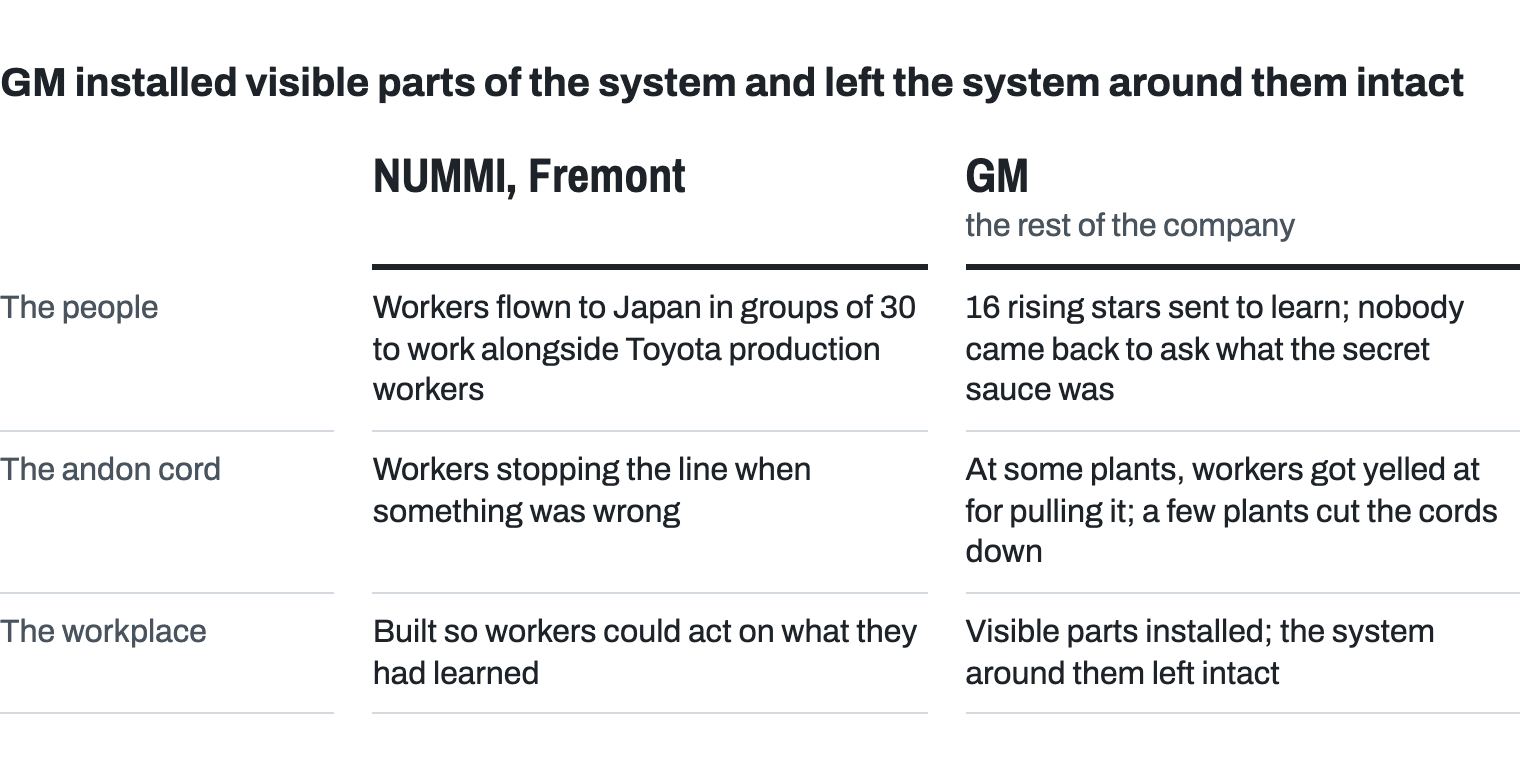
The commandos had gone through the immersion and returned ready to work differently. GM had installed visible parts of the system while leaving the system around them intact. The change stopped there. In 2009, after the 2008 recession wrecked the car market, GM went bankrupt. Mark Hogan, one of the commandos, thought that if GM had brought the system in across the board in the late 1980s, it might well have avoided bankruptcy. Toyota had taken the title of world’s largest automaker from GM the year before, and the lesson cut both ways: at a 2010 congressional hearing on Toyota’s sudden-acceleration problems, its CEO Akio Toyoda said, “We pursued growth over the speed at which we are able to develop our people and our organization.”
A leader can do the recognition work, build the capacity to hold their paradigm as object, and still return to an unchanged context. The senior team, board, and investors may continue to reward the old role.
The same story in software
Software has its own GM story, and I’ve worked inside it. A product group learns to work in cross-functional teams that take a piece of work from idea to customer, while the rest of the business stays organised by function: work split by specialty, and managers planning how fully each skill is used. Org Topologies, which chapter 1 named as one of the most serious attempts at the redesign, calls the first arrangement a Delivery Topology and the second a Resource Topology. Its authors write that where the work needs learning and adapting, a Resource Topology “fragments responsibility, slows down feedback, and amplifies coordination overhead.”
As I said my goodbyes on one engagement, one person shared not how it had gone but their worry about whether it would hold. The teams had been through two big improvements to their operating model in a short time, both of which I had supported. Another change was coming, one I expected to pull things back, and they said a third so soon would be brutal; they worried about staff retention. Someone else had already named what sat underneath: the product and the people were in a much better spot, but the rest of the company and its history wanted to fight the change and reject it, and the business was the last gear to turn. The people in product and technology had changed, but they didn’t expect the organisation to support them.
The individual leader’s change stands a far better chance in an organisation that can do what NUMMI did and GM didn’t: distribute authority and share information. In a software organisation that looks like a team that can stop a release without asking, and a backlog whose ordering everyone can see and question. The job is to build an organisation where sound judgement doesn’t depend on one changed leader staying in place.
Leaders today
The closest analogue to NUMMI’s trip might be a retreat, a coaching engagement of sufficient depth, a sabbatical with the right structure, or a small group that meets for years and holds the slow work between sessions.
The analogue needs a receiving community on the other side. Chapter 22 called this a constellation: a coach who has walked their own version of the passage, a peer walking similar territory, a witness who knows you outside the role, and a community of others doing related work. These relationships give the change somewhere to live beyond the leader’s interior.
A leader returning from the analogue needs support other people can read and act on: written intent that guides decisions when the leader isn’t there, or a policy that signals long-term commitment when next quarter’s numbers get hard.
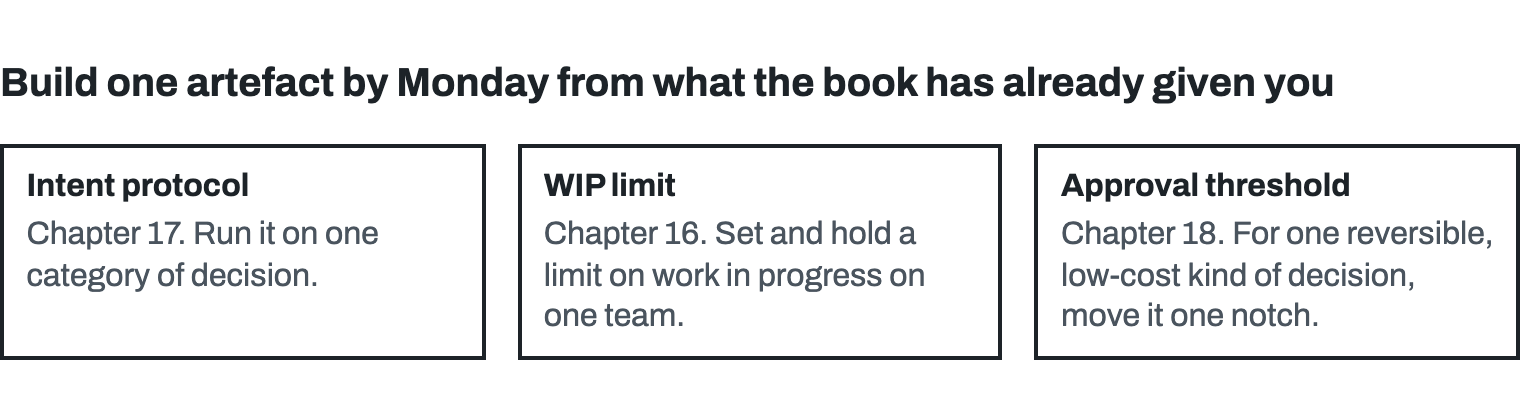
You needn’t wait for the whole constellation to assemble. Build one artefact by Monday from what the book has already given you. Run the chapter 17 intent protocol on one category of decision, or set and hold the chapter 16 limit on work in progress (WIP) on one team. Or, for one reversible, low-cost kind of decision, move chapter 18’s approval threshold one notch, and leave legal, safety, and regulatory approvals where they are.
None of it was wasted
Steve March, my Alētheia teacher, returned to the question on a call I had with him in May 2026. What if none of it was wasted?
The framework you were certified in and taught as good practice, on the promise that installing it wholesale would deliver the results it got somewhere else. The transformations you led that didn’t take. Chapter 1 has mine: years of teaching teams good practice, then watching it give way every time a fixed date came due, with no lever I could pull on the date itself.
Some choices were wrong. Some transformations failed. Yet the years inside those frameworks taught you how a framework feels from within, how identity gathers around it, and what happens when reality no longer fits. You couldn’t have learned that by skipping ahead.
The leader’s previous paradigm got them here, and respect for that history is part of moving forward. A leader who can honour what the old paradigm made possible can recognise when the context it worked for has shifted, and set it down without having to condemn the person who once needed it.
What’s left
NUMMI’s handbook carried one more thing: a framed aphorism, attributed to no one, set just before the section on the savings plan.
“If you accept an explanation without question you may have lost the chance to understand. You must learn to say ‘I don’t understand.’ In effect, this means breaking away from common assumptions.”
It asked every worker on the line for the discipline a returning leader most needs. Someone says I don’t understand, the explanation stays open, and the decision can change. A leader who can do that can govern an AI without pretending to know what they can’t know. In my own practice, the meditation cushion asks for the same move: loosen my grip on the explanation and come back to what I can see.
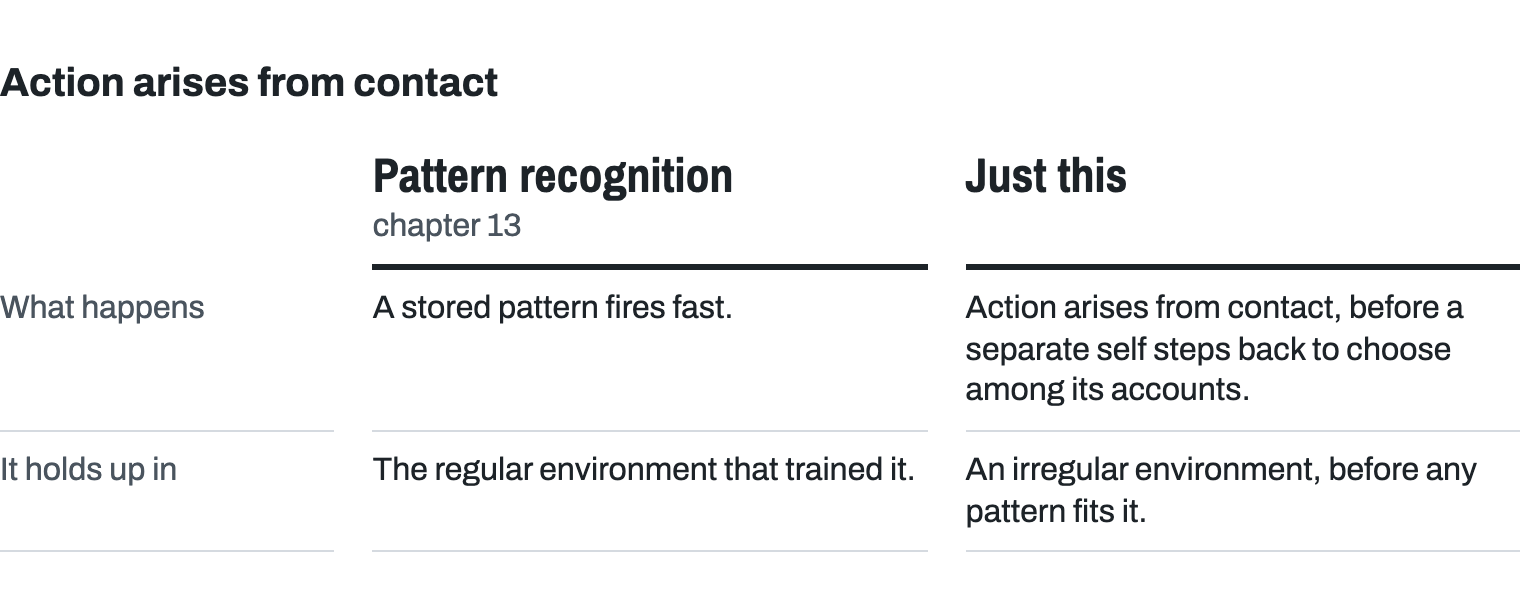
When the reception is built and the artefacts are in place, what remains is the capacity they were meant to protect. Steve March named it for me on that call in May: just this. As I understand it, action arises from contact, before a separate self steps back to choose among its accounts of what is happening.
Chapter 13’s pattern recognition is a different move. There a stored pattern fires fast, and it’s only as good as the regular environment that trained it; just this stays in contact until the situation shows itself, which is how a leader meets an irregular environment before any pattern fits it.
You stay with what you can’t yet say, and you keep staying, and at some point it shifts and shows you the next step. Eugene Gendlin, the author of Focusing-Oriented Psychotherapy, called that carrying forward. Contact with reality is more reliable than abstraction about reality. Plans and frameworks can help us stay in contact and make sense of what we find, but they can’t replace contact. Stay with what is actually happening now, between these people, under these constraints, in this body or system.
Contact with reality is more reliable than abstraction about reality. Plans and frameworks can help us stay in contact and make sense of what we find, but they can’t replace contact.
There is only the practice—in the project retrospective, on the meditation cushion, in the chalk circle on the factory floor, with your kid, with your dying parent, with your customer, with your code—of noticing when you have slipped from contact into framework, and coming back.
Over a career, that return changes the leader’s relationship with every framework. Frameworks become tools rather than identities. When defensive patterns step back, the qualities of Self named in Richard Schwartz’s Internal Family Systems model—curiosity, calm, clarity, courage among them—become available. They weren’t installed as virtues. They were there when the protectors released their grip.
Notice when contact slips into framework. Come back. The community of practice forms slowly over years.
If this work is live for you and we haven’t yet spoken, please write, or schedule a 30-minute call at hi.chrisgagne.com. I’d love to hear from you. I am one practitioner among others doing this work. Some of the practitioners I would refer leaders to are people I have studied with or worked alongside.
Thank you for reading. Thank you for the comments, the questions, the disagreements, the moments where you wrote to say that something landed. The book is better for them, and I’ll keep improving it as I learn.
Just this.
Going upstream
This chapter draws on two primary sources on NUMMI, read against each other. The reception artefacts are drawn straight from the Team Member Handbook, the document New United Motor Manufacturing issued to Fremont team members on day one in 1984: the Toyoda welcome letter, the Team Leader role defined as teacher, the Reserve Fund Plan on page 58, and the framed aphorism before the Savings Plan section about learning to say “I don’t understand.” The dark mirror, GM’s 25-year failure to spread what NUMMI proved, comes from This American Life, episode 561, “NUMMI 2015”, which carries what happened when GM installed andon cords, the NUMMI commandos, Steve Bera’s, Ernie Schaefer’s and Mark Hogan’s accounts, and Akio Toyoda’s 2010 testimony on pursuing growth faster than Toyota could develop its people. Where I quote or paraphrase either, I am reporting what the source itself records, not my memory of the story.
Resource Topology and Delivery Topology are Alexey Krivitsky, Craig Larman, and Roland Flemm’s terms, and the quoted line on what the first does to work that has to keep learning is from their 10X Org: A Manager’s Guide to Elevating Business Performance with People and AI. Ways to build these conditions in software organisations come from it and from Craig Larman and Bas Vodde’s Large-Scale Scrum: More with LeSS.
“Carrying forward”—staying with what you can’t yet say until it shifts and shows the next step—is Eugene Gendlin’s, worked out most fully in his essay “Process Generates Structures: Structures Alone Don’t Generate Process” and running underneath Focusing-Oriented Psychotherapy. The qualities that surface when the protectors unblend—curiosity, calm, clarity, courage—are named that way by Richard Schwartz in No Bad Parts: Healing Trauma and Restoring Wholeness with the Internal Family Systems Model. “Just this” is Steve March’s: he offered it on a call I had with him in May, with the names it carries in Zen (appropriate response) and Tibetan Buddhism (self-arising wisdom). I use it as a lay practitioner reporting what the training points at, not as a teacher of it. And Steve March’s question—what if none of it was wasted—came from that same call, not from a page; I record it here as his, gratefully.
Some book links here are Amazon affiliate links; if you buy through them I may earn a small commission, at no cost to you.