Recognition: what the leader sees in themselves, what recognition needs
A new self has been forming, and you can’t see all of it from the inside. Recognising it takes company.
Chapter 21 asked you to notice and question assumptions that had been running you. Continuing that work calls for a different kind of company.
If you have come this far, something in you has been moving without your full knowledge.
Recognition means noticing your own pattern before it produces the next decision, and pausing when a confident voice arrives—from a peer, a board, an AI agent—and asking whether it fits the situation.
This book follows the three stages of initiation Karla McLaren draws from the mythologist Michael Meade: separation, dissolution (his ordeal) and the return. Chapter 1 named separation and chapter 11 dissolution. I split the return in two, so this chapter is recognition and chapter 23 is reception. The 18 paradigm-axis chapters stand alone. It’s probably worth reading all 18 in time; but if two or three get you unstuck and looking at your beliefs more critically, that’s really the leap.
What you recognise about yourself
The leader at the recognition stage has walked through something they couldn’t have planned, and the walking produced a new self. Robert Kegan, the developmental psychologist, gives the mechanism in In Over Our Heads: “That which was subject becomes object to the next principle,” and the new principle “makes the prior principle into an element or tool of its system.” Put another way, what used to have you, you now have. The teenager who is their friends’ opinion of them grows into an adult who has an opinion about it, and can use it. And there is always a next one; as chapter 21 put it, we’re always subject to something.
For the leaders I’ve worked with, these recognitions have arrived in roughly this order.
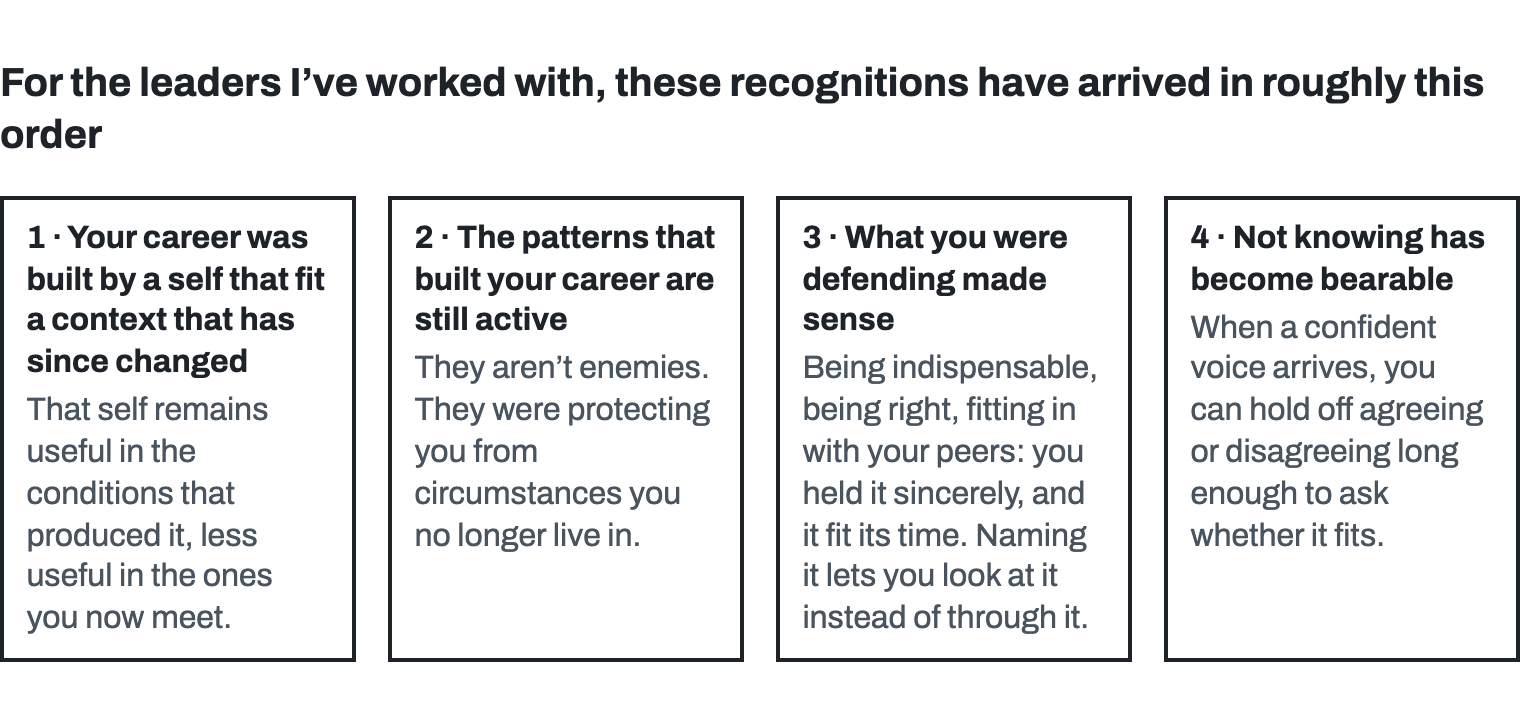
Your career was built by a self that fit a context that has since changed. That self remains useful in the conditions that produced it, less useful in the conditions you now meet. What if none of it was wasted?
The patterns that built your career are still active. Mine is the fixer. In my own coaching recordings, when someone says they don’t know if they can do this, I reassure them (“you’re doing wonderfully”) instead of meeting the uncertainty they have just put on the table. That move protects me from sitting in it at least as much as it protects them. It also solved a great many problems and built most of a career. The patterns aren’t enemies. They were protecting you from circumstances you no longer live in, and they keep acting as if those circumstances remain. They ease when someone sees them clearly with you, which willpower can’t do.
They were protecting you from circumstances you no longer live in.
What you were defending made sense. The commitment chapter 21’s Immunity Map brought up (I have been committed to remaining the person without whom this couldn’t be done) is one version; the need to be right and the need to fit in with your peers are two other common ones. Each was sincerely held and suited the conditions that made it. Naming it doesn’t make it false. It means you can look at it instead of through it.
Not knowing has become bearable. The discomfort is still there, but you no longer have to end it straight away. When a confident voice arrives (your own, a colleague’s, an agent’s), you can hold off agreeing or disagreeing long enough to ask whether it fits the situation. Of the four, this is the one I see leaders notice last.
Ask the three questions one decision at a time: Which pole did I claim? Which pole did my behaviour show? Which pole did the situation require? The shift comes when the assumptions they surface are tested, with company, as chapter 21 describes.
What shows up when the patterns rest
What shows up when the patterns step back is what Richard Schwartz’s Internal Family Systems model calls the qualities of Self: curiosity, calm, clarity, courage, a subset of its eight Cs. Schwartz’s Self, capital S, is a different claim from the new self Kegan describes. Kegan’s self gets rebuilt at each passage; the qualities of Self are what each rebuilt self finds underneath when its patterns rest. The impulse to fix arrives, and it isn’t obeyed, and a genuine question becomes possible in the space where the fix would have gone. Personally, I spent years treating calm as a trait to install. The calm and clarity that show up in certain moments aren’t exceptional performances. They are what is left when the patterns rest.
What recognition needs
The leader at this stage doesn’t need another implementation framework (a sense-making one can still help). They need company.
An executive coach is one kind of company. The work also calls for a peer, a witness outside work, and a community.
The four companions are my own grouping. The leaders I’ve watched move through recognition well had something close to all four; the ones I’ve watched stall usually had one or two and treated that as enough.
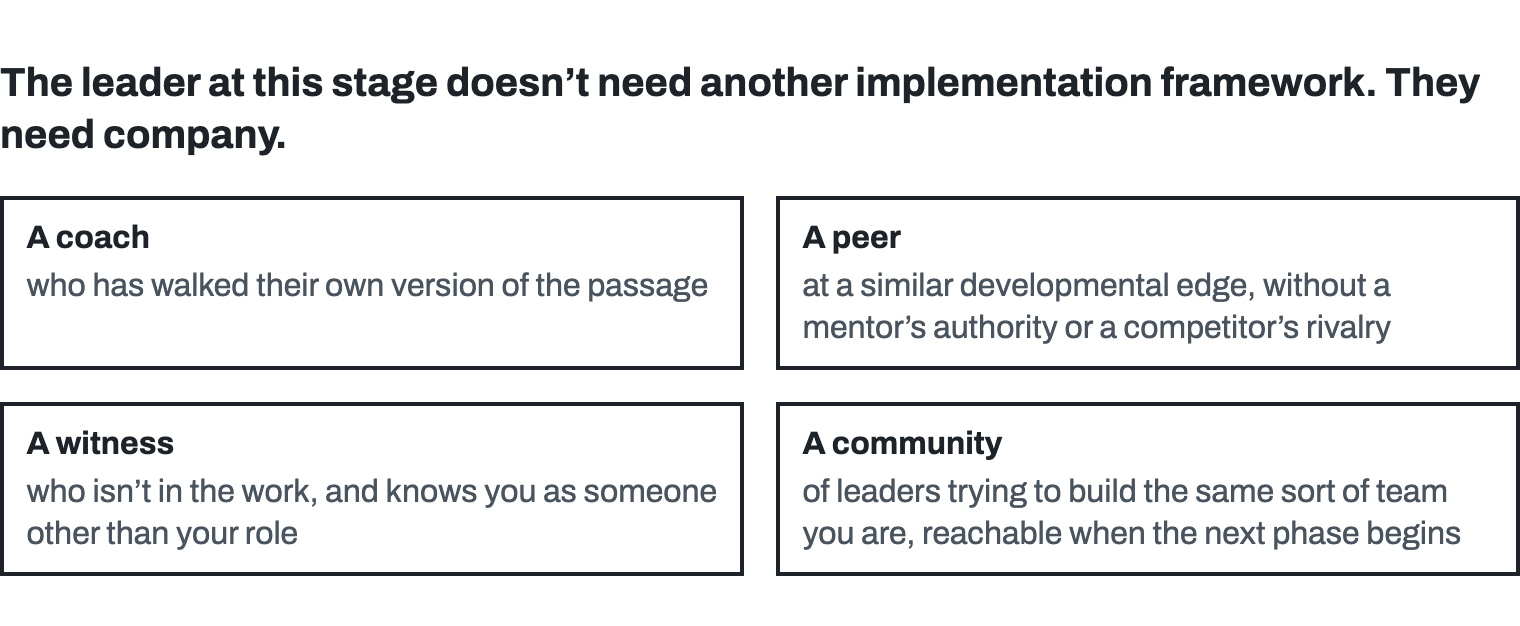
A coach who has walked their own version of the passage. A coach who has felt the dissolution of their own paradigm at some scale, worked through the trauma that the dissolution surfaced, and built the capacity to stay present while the same is happening to someone else. The coach’s lineage and training matter, and so does the supervision they themselves submit to. Without these, the coach can become an obstacle when the leader needs steady company.
A peer who has walked similar territory. This is a leader at a similar developmental edge, close enough in time and experience for straight talk about the work itself, but without the authority of a mentor or the rivalry of a competitor. Most senior leaders have had a peer like this in their career at some point; some have lost the relationship to time or circumstance and not replaced it. The peer relationship can’t be installed by HR. It is sought, recognised, and tended over years.
A witness who isn’t in the work. A friend, a partner, a long-standing relationship outside the professional context, whose presence reminds the leader that they aren’t their role. The witness doesn’t have to understand the work. The witness has to know the leader as someone other than the leader. Leaders often reach this stage and find that their relationships outside work have atrophied during the years of role-as-identity.
A community of others doing related work. This is often the smallest and hardest of the four to find: a group of leaders who are also trying to build the same sort of team you are, so you can talk about the slow work without translating it first. The group may be informal, but it has to be reachable when the next phase begins.
The recognition stage goes better with all four. Each missing kind of company puts more weight on the others. A leader with a coach and no peer has nobody who is in it at the same time; a leader with peers and no coach has nobody who has already been through their own dissolution. The count is a way of finding where the exposure is, not a prediction about who makes it through.
On the coach who can stay in it
Dave Snowden, the complexity researcher behind the Cynefin framework, has critiqued industrial-level coaching that reduces developmental frameworks to platitudes divorced from complexity. Writing in “Stairways to Heaven?” (The Cynefin Co, 17 May 2022), he holds that while coaching helps in the organisational development process, “it is neither a necessary nor a sufficient condition to enable change”. I wholly agree and make a narrower claim: coaching can provide individual, relational company within the contemplative-presencing tradition I practise, but coaching alone can’t enable organisational change. Scaling business results still starts with the leader who owns the system doing their own inner work, which can’t be scaled or delegated. At the top, nobody above them can change the system for them.
A coach brings training and experience. Developmental frameworks and the ability to notice what’s happening in the body matter, along with trauma-informed training and contemplative practice. None of it substitutes for the coach who can stay present without flinching when paradigm-death begins in the work.
They refuse to shortcut. The leader will often want the shortcut. The coach who can hold it won’t provide it. I meet the shortcut constantly in how this work gets sold: promised speed, promised certainty, a method-oriented framework offered as sufficient.
They stay in steady contact with dissolution itself. The coach has been through their own version of the passage at sufficient depth that being in contact with someone else’s doesn’t destabilise their own foundation.
They know what they aren’t for. The coach can say I’m not the right coach for you when they aren’t.
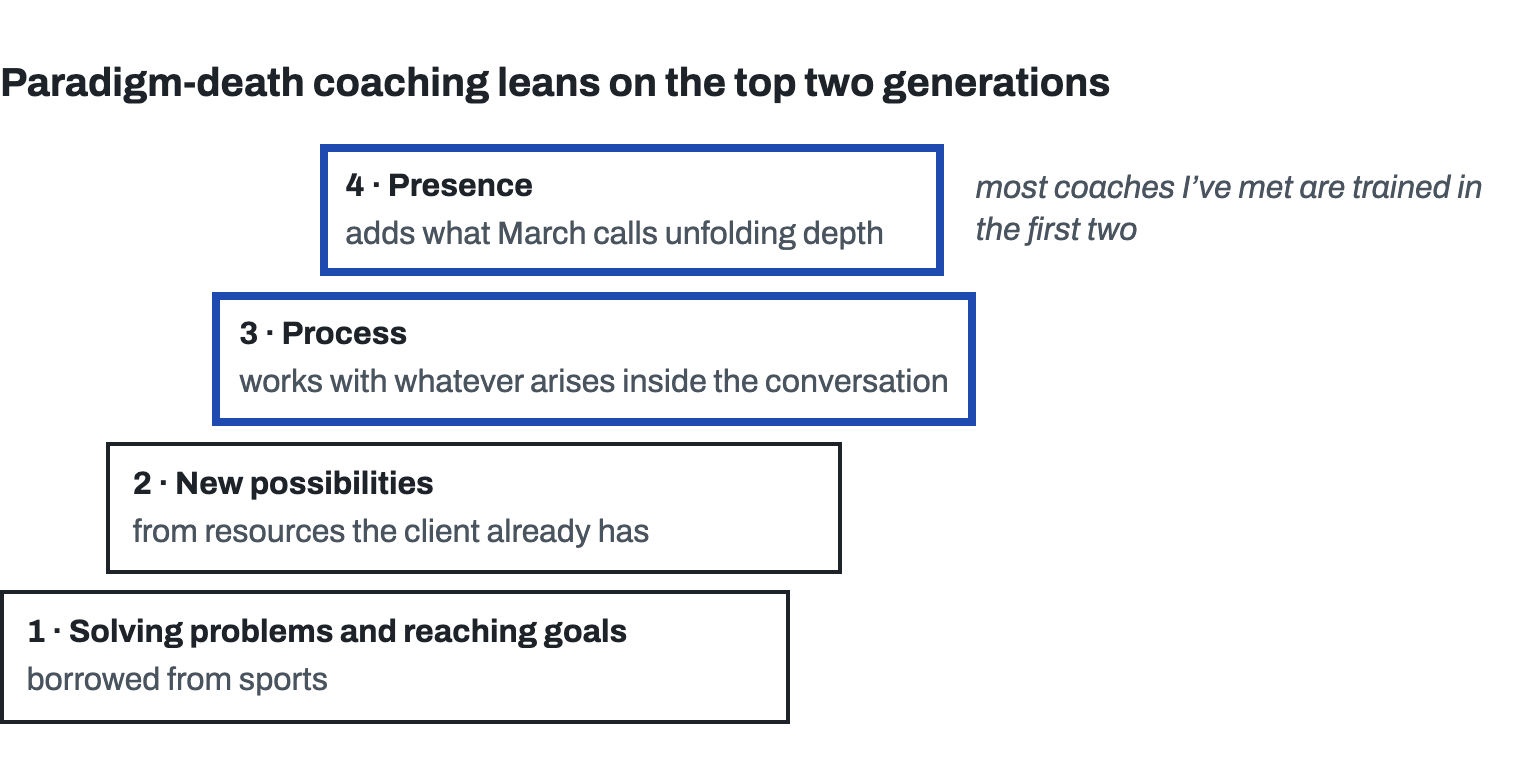
Steve March, whose Aletheia training I have come through, builds on Reinhard Stelter’s A Guide to Third Generation Coaching to distinguish coaching that helps you solve or reframe a problem from coaching that can stay present while identity and certainty come loose. The consequence of choosing the first when you need the second is that the passage gets managed instead of made: the problem gets reframed, the relief is real, and the thing that was dissolving reassembles. As March summarises Stelter, there are three generations of coaching method: the first, borrowed from sports, is about solving problems and reaching goals; the second opens new possibilities from resources the client already has; the third, process-oriented, works with whatever arises inside the conversation itself. March adds a fourth that brings what he calls unfolding depth. In my judgement—extending March and Stelter—paradigm-death coaching leans on the top two: process to work with what arises in the conversation, and presence to remain in contact with what is dissolving. Most coaches I’ve met are trained in the first two generations; fewer have training in the process-oriented third, fewer still in the presence-centric fourth. The training routes that reach the fourth vary—contemplative-clinical traditions, depth-psychology programmes, certain developmental-coaching lineages—but each trains the coach’s capacity to remain present, not only their command of method.
How to tell which coach can hold it
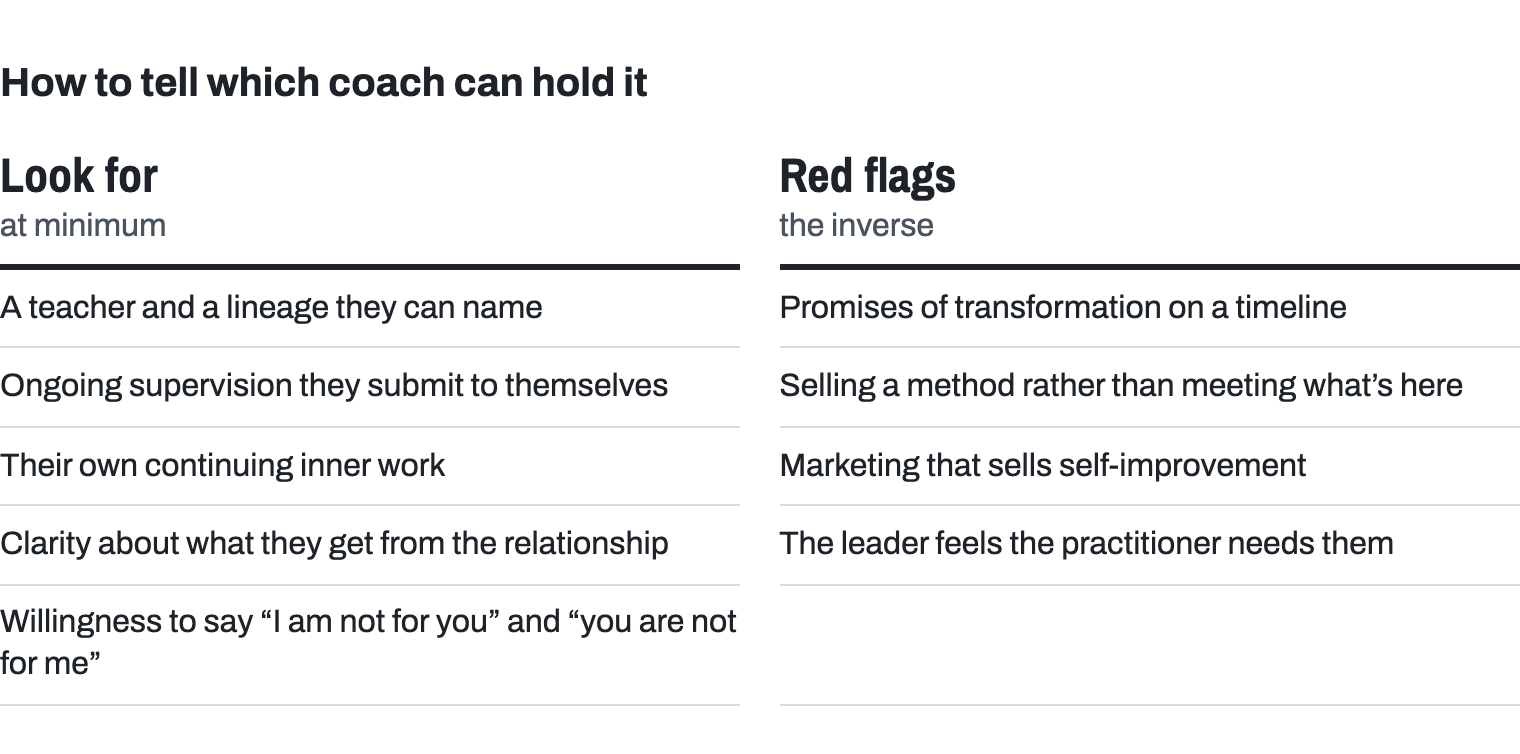
Look for these green flags.
A teacher and a lineage they can name. The lineage may be formal (a contemplative tradition, a clinical training programme, a depth-psychology school) or informal (a senior practitioner they have studied with over years). Either way, they can answer the question who taught you to do this? with a specific name and a relationship.
Ongoing supervision they submit to themselves. The work calls for an ongoing relationship with a teacher or peer who can witness the practitioner’s blind spots.
Their own continuing inner work. The distinction my lineage holds is between unfoldment (the slow growth of each quality of presence over years) and self-improvement (the acquisition of better skills, better techniques, better certifications). A trap I have been in myself is treating my own development as a self-improvement project: another certification, another method, another thing added. Ask what their most recent supervision changed in their own conduct, and listen for whether the answer is something they now do differently or something they now know.
Clarity about what the practitioner gets from the relationship. Price alone tells you little. Every coach gets something: a fee, new members for their community or movement, or the relationship itself. A low price doesn’t mean they want nothing. Ask what they get from working with you, and trust the one who answers plainly.
Willingness to say “I am not for you” and “you are not for me”. Both are real. A coach who can’t say either is selling something different from what this work calls for.
The red flags are the inverse.
Promises of transformation on a timeline. The work won’t follow an arbitrary timeline. It’s a complex unfolding process we can influence but not control, and a practitioner who promises a date isn’t doing this work.
Selling a method rather than meeting what’s here. Listen for whether they describe their steps or how they work with what you bring. A coach who runs the same method whatever arrives can’t stay with a passage nobody planned.
Marketing that sells self-improvement. Instant transformation. Become your best self. Unlock your potential. Steve March’s Aletheia training names the premise under it: a self-improvement project starts from a sense that something in you is lacking, and an economy runs on selling improvements against that lack. The idiom sells what contemplative practice spends lifetimes trying to undo.
The leader feels the practitioner needs them. A practitioner who needs the leader’s specific patronage to maintain their own practice is at risk of telling the leader what the leader wants to hear.
In my experience, these checks screen out most practitioners who can’t do this work. A poor match can slow the passage or stall it, so the leader can afford to be selective. Nobody in the coaching market enforces these checks, so the leader has to.
What’s yours to do now
Score the four as you actually have them today—coach, peer, witness, community—0 for absent, 1 for weak or lapsed, 2 for active. The witness and the peer are the ones I most often see at zero in leaders who have lived years inside the role. Don’t try to fix all four. Pick the lowest one you could strengthen this quarter and take one real step: the message you keep meaning to send, the friendship the role crowded out, the search for a coach who has walked their own version of the passage.
Contemplative-clinical traditions, depth-psychology programmes, and developmental-coaching lineages are starting points. One person may sometimes fill more than one role, but the target remains coach, peer, witness, and community. The work the book has done to this point is already part of the recognition; you have already begun.
Going upstream
The qualities that show up when the parts rest—curiosity, calm, clarity, courage—are four of the eight Cs of Self from Richard Schwartz’s No Bad Parts: Healing Trauma and Restoring Wholeness with the Internal Family Systems Model; the move I lean on is Schwartz’s, that these aren’t virtues to install but what is already present underneath the protector activity. The hidden countervailing commitment surfaced by the Immunity Map is Robert Kegan and Lisa Laskow Lahey’s, from Immunity to Change. Chapter 21 walked the same subject-to-object move in detail. The new-self mechanism, that what was subject becomes object to the next principle, is Robert Kegan’s, from In Over Our Heads.
The first three generations of coaching method are Reinhard Stelter’s, from A Guide to Third Generation Coaching, extended to a fourth generation—presence-centric depth coaching—by Steve March in the Aletheia training I have come through; the framing that paradigm-death coaching leans on the top two generations is my extension of theirs, not theirs. Dave Snowden’s critique of industrial-scale developmental coaching is his “Stairways to Heaven?” post (The Cynefin Co, 17 May 2022).
The rest of this chapter is closer to lived practice than to citation. The four kinds of company and the coach-vetting checklist are drawn from watching leaders move through the passage well or stall, and from my own years inside the work, more than from any single book. The distinction between unfoldment and self-improvement is Steve March’s, from the Aletheia training.
I work with engineering leaders on exactly this kind of paradigm work, the deeper the better. If it’s live for you, I’m happy to talk: schedule a 30-minute virtual coffee at hi.chrisgagne.com.
Some book links here are Amazon affiliate links; if you buy through them I may earn a small commission, at no cost to you.