Pushing people vs changing the conditions
The pattern is familiar to anyone who has tried to install discipline by decree. Take the Definition of Done. We agreed on it together: what “done” means for a Backlog Item, and an even higher quality bar for larger releases. I trained to it, we ran good exercises against it, and everyone left sure they could live by the new Definition of Done. And the one behaviour that mattered—a team holding that bar when the sprint clock is running out—still wouldn’t stick. Every sprint, when the review loomed and the demo had to land, the Definition of Done was the first thing to go.
Step back from that particular team and the shape is general. The Definition of Done is an andon cord, a “stop the line” mechanism. Pulling it means saying “this isn’t a quality product yet” on the afternoon the sprint review is booked and the stakeholders are already on the calendar. The answer that carries the day is the one the GM plant boss gave for years before NUMMI: get it out the door, we’ll fix it later. The person holding the bar is a blocker; the low-quality demo ships.
I’ve taught a couple of dozen two-day Agile courses over the years, and there were times I felt I was close to gaslighting people. These weren’t generic, by-the-book courses; I’d adapted the training hard to the organisation in front of me, and it was sound. The gap between even that adapted process taught in my course and the organisational reality waiting for them back on the job couldn’t have been starker, and some part of me knew it while we were playing with Lego together.
The training was pushing the behaviour. The conditions around it were punishing it. The programme was sincere, and the conditions were doing their work the whole time, often firmly in the other direction.
“The training was pushing the behaviour. The conditions were doing their work the whole time, often firmly in the other direction.”
Chapter 5 located the say-do gap inside the leader. This chapter finds the same gap built into the conditions, where working harder on the people is the wrong lever.
🎧 Prefer to listen? This chapter is narrated in my own voice, via ElevenLabs on Spotify, about 21 minutes. Listen on Spotify →
The two poles
Pole A: push people. Announce the change, run the training, hold people accountable for the new behaviour, repeat the messaging, review the scorecard, escalate when the behaviour doesn’t show up. The locus of intervention is the individual. The assumption is that people are the variable to move.
Pole B: change the conditions. Redesign the environment so the new behaviour is the easier behaviour. Identify the loop that punishes the new behaviour. Change the loop. Watch what follows. The locus of intervention is the system. The assumption is that behaviour is a property of the conditions that surround it.
Where Pole A is right
Pole A fits when the new behaviour is genuinely a matter of capability or specification, and when the surrounding conditions already reward it. Time-critical regulatory shifts. New compliance rules with specifiable steps. The introduction of a tool whose use is the change. New entrants to a craft, where the missing thing is practice and feedback, and the senior practitioners are visibly rewarded for the same behaviour. In these settings, pushing isn’t coercive; it’s teaching. The training transmits something real, and the conditions back up the teaching once the training ends.
Kotter’s eight-step change sequence—urgency, coalition, vision, communicate, empower, short-term wins, consolidate, anchor in culture—is the canonical articulation of Pole A done well. In situations where vision, urgency, and coalition genuinely shift the conditions a behaviour faces, the sequence describes the work, and the leader who runs it well moves the org further than the leader who doesn’t.
The best version of Pole A is the discipline of communicating clearly, training capably, and watching whether behaviour follows. When it does, the work is done. When it doesn’t, Pole A’s options run out, and the leader needs to consider Pole B.
Where Pole B is right
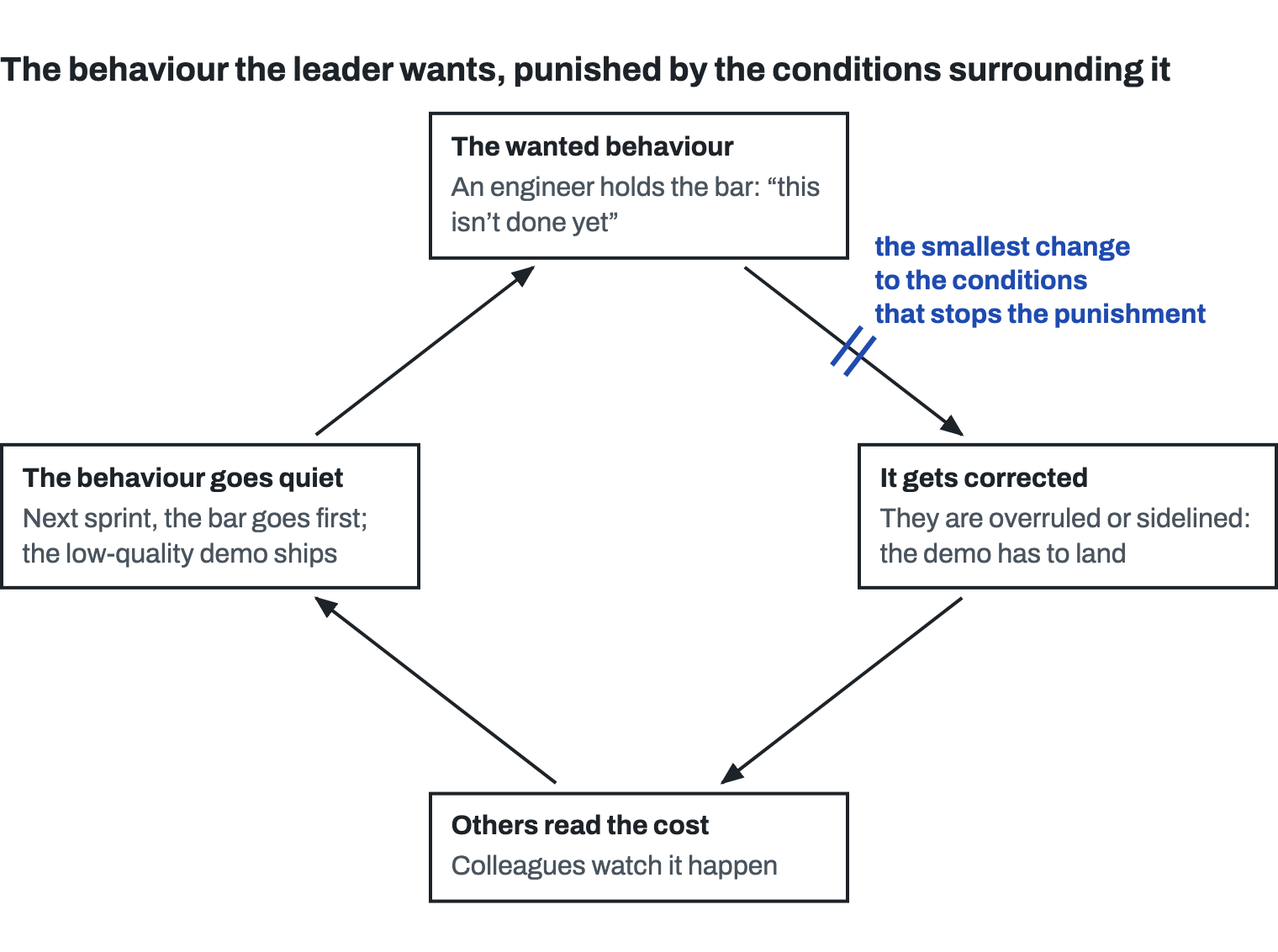
Pole B fits when the behaviour the leader wants is being punished by the conditions surrounding it. When the engineer who says “this isn’t done yet” and holds the release is overruled, sidelined, or watched being overruled by colleagues, every additional round of training pushes against the context. The training is sincere. The inertia wins. Sometimes the read arrives in a retrospective: a team names something the leader cares about that simply can’t be honoured, given the strategy, the reward system, or who reports to whom. Their skill isn’t the problem, and there may be nothing wrong with the choice to try Scrum here.
Chip and Dan Heath, in Switch, built their change model on three handles: Jonathan Haidt’s Rider and Elephant, plus the Path, their own addition. Rider: the rational planning function. Elephant: the emotional and instinctive system. Path: the situational environment the Rider is trying to steer the Elephant down. The change programmes the Heaths document invest heavily in the Rider. They write the strategy memo, make the deck, and run the all-hands. The Elephant goes unconvinced and the Path goes unredesigned, and the Elephant takes the default path because the default path is the easier one.
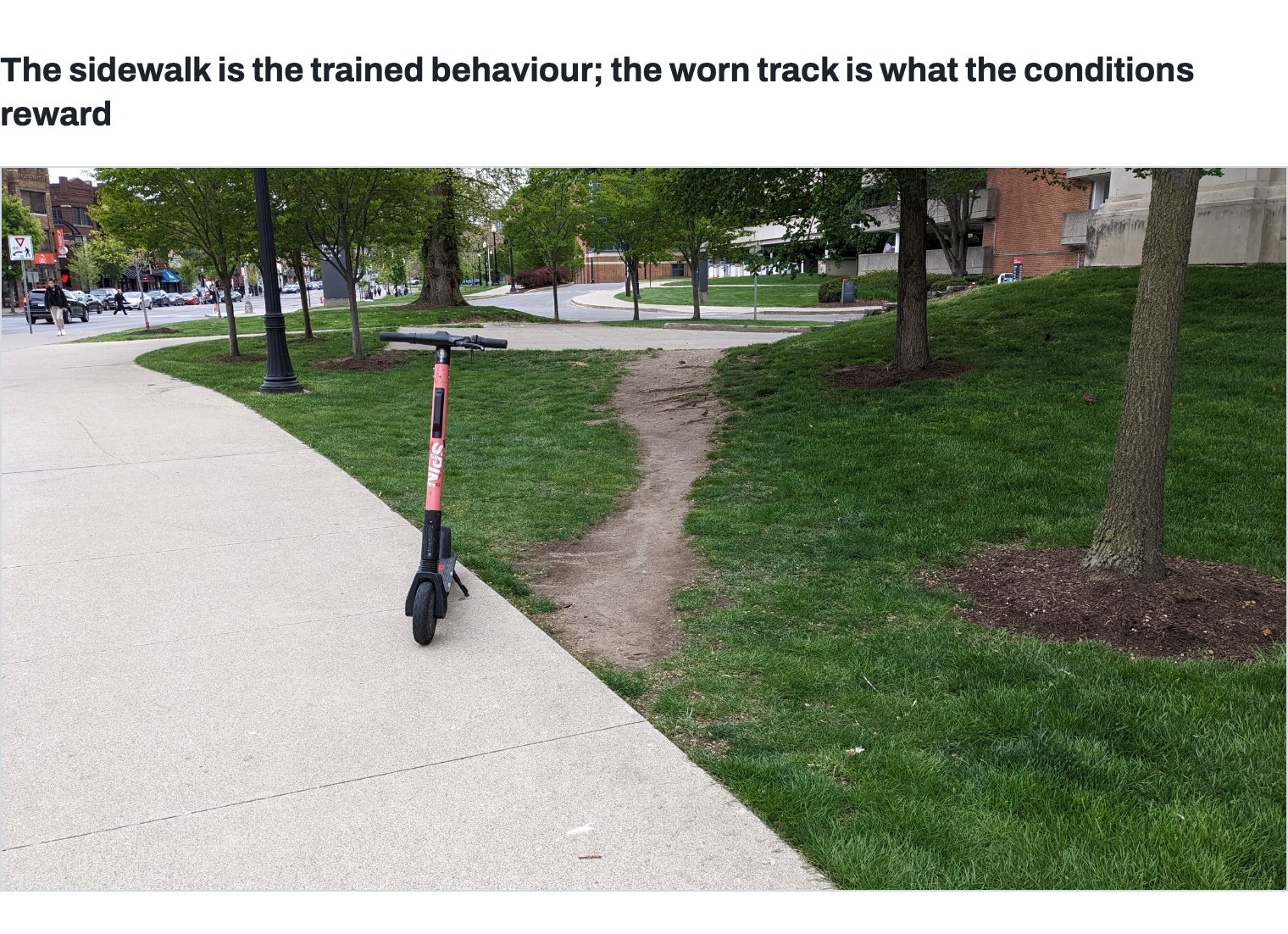
City planners lay a paved path; people cut across the grass anyway, wearing a bare track that engineers call a desire path. The sidewalk is the trained behaviour, the socialised route. The worn track through the grass is what the conditions actually reward, and no amount of signage moves the feet. It is the same gap chapter 5 named between work-as-imagined and work-as-done, pressed into the ground where anyone can see it.
The Heath brothers argue that ambiguity is the enemy, and that any change that takes hold depends on translating vague goals into concrete, specifiable behaviour. They name a counterexample from public health: the West Virginia 1% milk campaign asked people to buy 1% milk instead of whole milk when grocery shopping, not to eat healthier; market share of low-fat milk rose from 18% to 41% and held at 35% six months later. The change held because the ask was scripted: the Heaths file it under directing the Rider; what looked like resistance was a lack of clarity.
The deeper version of the move sorts the places you can intervene in a system by leverage. Parameters sit at the bottom; feedback loops in the middle; the shared mental model the system runs on sits at the top. Pushing on a parameter while that model holds the old behaviour in place is the lowest-leverage move there is: what Donella Meadows called fiddling with the details while the governing paradigm keeps producing the very behaviour the change was meant to correct. A leader mandates 20% of every sprint for paying down technical debt: a parameter. The governing paradigm underneath—velocity is the scoreboard, features are what get celebrated—is untouched, so the 20% gets reallocated to feature work the moment a deadline tightens, sprint after sprint. The formal policy changed. What the organisation actually rewards didn’t.
“The formal policy changed. What the organisation actually rewards didn’t.”
W. Edwards Deming named the same trap with a sharper word. Tampering. In his funnel experiment, a marble is dropped through a funnel onto a target; the resting point is measured; the funnel is adjusted to compensate for the last error; the marble is dropped again. Three of his four adjustment rules—two of them outright compensation, the third a chase—make the variance worse than leaving the funnel alone. The line Deming quotes approvingly from Lloyd S. Nelson in Out of the Crisis: “In the state of statistical control, action initiated on appearance of a defect will be ineffective and will cause more trouble.” Tampering is what the leader does when each missed metric prompts a new policy, a new review meeting, a new training, a new dashboard. The variance grows. The new policy meets the next missed metric. Another new policy is added. The leader is busy, the system is louder, and nothing improves.
A leader who has never heard the term is still paying for the thing. John Seddon carried the diagnosis from manufacturing into services and gave it a name worth keeping: failure demand, the demand an organisation creates for itself by failing to do something, or to do it right, for the customer the first time. In one bank case it ran at 46% of total demand; the bank had expanded from one to five call centres to handle work that was largely self-generated. The Pole-A response—train staff harder, set tighter targets, monitor more—accelerates the cycle. The Pole-B response—use value-stream mapping to find the failure-generating step, then redesign the upstream process so it stops generating failure—eliminates the self-generated waste.
Heifetz named the container in which conditions change. He called it a holding environment: “all those ties that bind people together and enable them to maintain their collective focus on what they are trying to do.” It is the structural and relational container an organisation needs when it is doing adaptive work that can’t be coerced. The leader who is trying to push behaviour through training is operating without a holding environment. Where the container exists, the sprint the team can’t finish to standard ends differently: the review slips, the stakeholder is told it isn’t done yet, and nobody’s standing drops for saying so.
The change you have been trying to make in the other person is also a condition you can change in yourself. The leader who has been trying to fix the team-lead who won’t escalate risks can ask, instead, what changes in their own system—what unspoken rule, what reflex, what protective stance—would change the dynamic the team-lead is responding to.
In decisions
Pole A leaders, on a typical Tuesday: announce the new programme; circulate the deck; book the trainings; set the scorecard; review the scorecard the following Tuesday; raise the heat on the team-leads who haven’t moved their numbers; book a coaching session for the one whose numbers are worst.
Pole B leaders, on the same Tuesday: ask what would happen to an engineer who tried the new behaviour in their team yesterday; trace the loop that would punish it; identify the smallest change to the loop that would stop the punishment; make that change; book a check-in for two weeks out to see whether the behaviour follows.
The two Tuesdays look different. The first feels more decisive. The second feels slower and less certain, and its first visible result may be weeks out, where the first produces another deck. Then the behaviour the deck kept failing to mandate starts showing up on its own, because the loop that punished it is gone. (The push-the-people reflex has a training-room cousin. In New Zealand we called it sheep-dipping: run everyone through a two-day course—a quick dunk in the bath—and Bob’s your uncle.)
A worked example. The NUMMI joint venture in Fremont, California—the partnership between Toyota and General Motors that ran from late 1984—is, I suspect, among the most cited cases in the Lean tradition for what happens when a leader changes the conditions. GM had closed the Fremont plant in 1982 with a workforce whose reputation as the worst in the American auto industry was, in the union’s own telling, well-earned. Two years later the same plant—with mostly the same workers—became one of GM’s best on quality and absenteeism, by running Toyota’s production system instead of GM’s. The artefacts changed. The structural conditions changed. A new handbook issued day one, a welcome letter from Toyoda himself, and a reserve fund that put per-hour cash behind a no-layoff intent all pointed the same way; chapter 23 walks these reception artefacts in full. The structural rewards aligned with the new behaviour. The new behaviour followed.
Chapter 3 walked Ernie Schaefer’s account of why the transplant failed everywhere GM tried it after NUMMI: GM kept asking about the floor—the assembly line, the visible practices—when the real issue was how the rest of the organisation’s functions support that system. The same point lands from the conditions side here. The visible practices—the andon cord, the kaizen card, the team huddle—aren’t the system; the conditions that surround them are. NUMMI changed workers’ paradigms by changing their conditions: chapter 1’s counterweight at factory scale. Few people inside the building can change the CEO’s conditions, and that asymmetry is why the leader has to see their own conditions first, not last.
The same asymmetry shows up in a Scrum team a generation later. At GM the workers would be fired for pulling the andon cord, so quality and safety were the first casualties. A Scrum team is taught retrospectives and pull-based flow in a two-day course, then handed back to a Release Train Engineer, a project manager under a newer title, measured on a calendar someone above them set. The andon cord lives only on the training slide. No one present has the authority to pull it.
Trace the loop, and if it closes above your authority layer—as it usually will—that puts it on your CEO’s desk, not yours. What to put in front of them is the specific loop—traced end-to-end—that punishes the behaviour you have been trying to install for the past six months. Name the moment in the loop where the CEO’s behaviour, or a structural choice the CEO owns (an approval gate, a career ladder, a reward), is the condition that closes against the new behaviour. Nothing in the CEO’s conditions has ever made this loop visible. Your job is to make it visible without blame, and to ask, before the map comes out, whether the CEO wants to see it: the contract-first rule from chapter 3. A loop the CEO agreed to examine is data. The same loop, arriving uninvited, is an accusation wearing a diagram. This is why change that only pushes up from the bottom stalls. Individual contributors and line managers can expose the loop, and they often see it first, but they can’t rewrite the approval gate, the career ladder, or the reward that closes it. Change that only pushes down from the top installs the deck without ever learning where the loop actually bites. The work has to run both directions at once: the people living inside the loop name it, and the person who owns the conditions changes them. The sentence your CEO can carry to the board: “We have been asking people to out-perform conditions we designed.”
The same loop, arriving uninvited, is an accusation wearing a diagram.
“We have been asking people to out-perform conditions we designed.”
The diagnostic move
Three questions to stay with this week. None of them require an answer in the meeting; they require a straight read of a real decision.
One. Pick a behaviour you have been trying to change in your organisation for at least six months. Programme, scorecard, training, accountability: the full Pole-A kit. The behaviour hasn’t yet moved. What would happen to a team-lead who genuinely tried the new behaviour in their team yesterday? Trace the loop end-to-end. Where does it close back on the team-lead? What does the loop reward? What does it punish?
Two. Looking at the loop you just traced, what is the smallest change to the conditions that would stop punishing the new behaviour? Not the largest change. The smallest one that would actually move the loop. The Heaths’ Switch line, paraphrased: ambiguity is the enemy; the change has to be specifiable as a concrete next move.
Three. What is the change inside your own system—the rule, the reflex, the protective stance—that would have to shift for you to make the change you just identified in question two? Naming the inner change is the same question, asked at the level the leader actually operates at.
The exercise—Rider / Elephant / Path mapping
This is a team-based exercise the leader can run with their leadership team in one 90-minute session. Pick a change initiative that isn’t sticking. Draw three columns on a whiteboard: Rider, Elephant, Path. List under Rider everything you have invested in the rational case for the change: strategy memos, decks, all-hands, the scorecard. List under Elephant everything you have invested in the emotional and instinctive case: stories of teams that have made the change well, recognition, how the change feels to the people living it. List under Path everything you have invested in changing the situational environment: structural changes, removed obstacles, redesigned rewards, new defaults, environmental cues. Compare the columns. Read your columns against what the Heaths documented across their cases, where Rider ran dense and Path nearly empty. If Rider dominates yours, test whether clarity alone is enough. If Path is thin, that is where the change has been sliding back, because most teams invest where it is rational to invest and the Path stays sloped against them. The exercise produces a small list of Path interventions to make in the next 30 days. (Framework: Heath & Heath, Switch; the mapping exercise is my own application.)
Going upstream
In-text: Chip and Dan Heath, Switch: How to Change Things When Change Is Hard, for the Rider / Elephant / Path model and the mapping exercise. W. Edwards Deming, Out of the Crisis, on common-cause variation, tampering, and the funnel experiment. Ronald Heifetz, Alexander Grashow, and Marty Linsky, The Practice of Adaptive Leadership, on the holding environment.
Also touched: John Kotter, Leading Change, for the Pole-A canon and the eight-step sequence. John Seddon, Freedom from Command and Control, on failure demand and the service-industry version of tampering: “The single greatest lever is the eradication of failure demand.”
Go deeper: Donella Meadows, Thinking in Systems, on the twelve leverage points, with transcending paradigms at the top of the ranking; the same leverage frame carries chapters 5 and 21. The holding environment runs older and wider than Heifetz: the phrase was Donald Winnicott’s first, and Robert Kegan carries the same construct into developmental work (Kegan and Lisa Lahey, Immunity to Change, on the developmental face of why change resists).
Change the conditions and the behaviour holds; keep pushing the person and it breaks the moment the deadline tightens. The hardest condition to see is the one that looks like resolve. You set a date, someone commits to it, and now the date is a promise the whole system will defend past the point where reality has already answered. Watch what happens the week the estimate slips: the response is to protect the date, not to read what the slip is telling you. Chapter 7 asks whether the plan on your wall is a commitment you owe or a hypothesis you are still testing.
I work with engineering leaders on exactly this kind of paradigm work, the deeper the better. If it’s live for you, I’m happy to talk: schedule a 30-minute virtual coffee at hi.chrisgagne.com.
Some book links here are Amazon affiliate links; if you buy through them I may earn a small commission, at no cost to you.