Socialised vs self-authoring vs self-transforming
Most of us have outsourced judgement to a confident voice at some point, whether the CEO, the board, a consulting deck, or the mentor who always had the right answer ready. Now the confident voice is an LLM.
Chapter 11 began with contact before framework. This chapter names the developmental capacity that lets a leader stay in contact when a framework speaks with a confident voice, and AI makes that need hard to miss.
🎧 Prefer to listen? This chapter is narrated in my own voice with ElevenLabs on Spotify (16 minutes).
Three developmental stages show up in how leaders respond to confident voices.
The three poles
Robert Kegan mapped adult development through three plateaus that matter for leadership. His In Over Our Heads (1994) laid out five orders of consciousness, of which these three plateaus make up the adult stretch. From his review of subject-object-interview studies with random sampling, he made the empirical claim that one-half to two-thirds of the adult population appear not to have fully reached the second of the three.
Pole A: the socialised mind. Identity is given by the surround. Relationships, institutions, and ideologies tell the leader who they are. They can’t disappoint a confident voice they are loyal to because the bond to that voice isn’t something they have; it is something they are. Parenting and apprenticeship rely on this plateau. Early careers and loyalty-based work often do too.
They can’t disappoint a confident voice they’re loyal to: the bond isn’t something they have, it’s something they are.
Pole B: the self-authoring mind. Identity comes from a self-chosen stance. The leader can step back from the values, relationships, and frameworks that once made them, hold them as object, and ask whether they fit the situation. They can disappoint a confident voice without losing themselves.
Pole C: the self-transforming mind. Identity is held lightly. The leader can hold their own self-authored stance as object: this is a frame I am running; another frame would bring different data forward; here is a third. They can move among those frames without becoming indecisive because the stance holding them is itself coherent. The fraction of adults who reach it fully is small: in Kegan’s longitudinal data, rare, and never before midlife.
Bill Joiner and Stephen Josephs, in Leadership Agility, mapped the same ground onto leader behaviour. Their five levels (Expert, Achiever, Catalyst, Co-Creator, Synergist) give us an operational account. Roughly nine in ten managers sit at or below Achiever; about one in ten are past it. Joiner and Josephs use a heroic / post-heroic distinction: Expert is mostly Pole A, Achiever is where Pole B becomes operational, and the three post-heroic levels (Catalyst, Co-Creator, Synergist) reach into Pole C. In behaviour: Pole A inherits the standard, Pole B tests it from a stance of its own, and Pole C can revise the frame that produced the standard.
Kegan’s plateaus aren’t moods you pick for the occasion. Each “subsumes or encompasses the prior principle”, so a later mind holds the earlier ones as tools it can use. A self-authoring leader can choose patient deference when a situation calls for it; a socialised leader can’t choose a stance of their own, because they don’t yet have one to choose. So read the poles that follow as responses, each available at or below the plateau you’ve reached. When a situation asks for one above it, you’ve found your developmental edge, and the work there is structural and slow.
Where Pole A is right
The socialised mind is often right early in an unfamiliar domain, where the standards are established and the feedback is reliable. At that point, the alternative to deference is often confidence the apprentice hasn’t earned. Nine of us had come out of the practitioner course for LeSS, the large-scale Scrum framework, and the question was whether we should teach it to everyone else. I argued that we were by no means experts, or in any position to do it justice when teaching others, and we brought in an outside trainer instead.
At its best, Pole A is patient deference. A leader who has taken in the standards of a craft has done something a leader who hasn’t can’t do.
Joiner and Josephs’ Expert level carries this honour. The Expert leader is genuinely good at the technical work, holds its standards, and brings rigour to one problem at a time. Heroic in their typology means that the leader carries the work through expertise and positional authority. The level worked because the conditions rewarded it.
Where Pole B is right
Senior leaders now need to form and test their own stance more often than their development has prepared them to do.
At one engagement, the confident voice in the room was mine. One developer told me later that he had been sceptical at first, perhaps my biggest sceptic, and only because his experience of Agile had been Agile in name only: a meeting every morning that was a status report to a micromanager, work handed down with the solutions already baked in, no autonomy. He held my confidence against data it didn’t answer, tested it rather than deferring to it, and updated when the practice turned out to differ from what he had seen. That is self-authoring, and the voice being rightly distrusted was mine.
The number of confident voices has grown. The CEO, the board, the consulting deck, the latest framework, and now the AI agent. A socialised leader who can’t hold a confident voice as object hears each new voice as one more authority to follow. The voices disagree. The leader swings between them. The organisation follows.
The AI agent gives the socialised leader a clean test: can they disagree with a confident output? A self-authoring leader can sit with an agent’s answer, test it against the situation, disagree out loud, and write the policy that governs its use. A socialised leader can’t do those things, because the confidence of the output is itself the data they are reading, and to weigh the answer they would first have to hold the very quality (its assurance) that is doing the persuading.
The agent is also a particular kind of confident voice. Trained on the consultant-derivative corpus, it tends to hand back the paradigm already set inside the question, fluent and assured. This is the trendslop from Chapter 1: the model reaching for fashionable management language over the logic the situation calls for. It sounds certain and agrees with you. For a socialised leader, that may be the hardest voice of all to disagree with, because it can feel like breaking with the whole field at once.
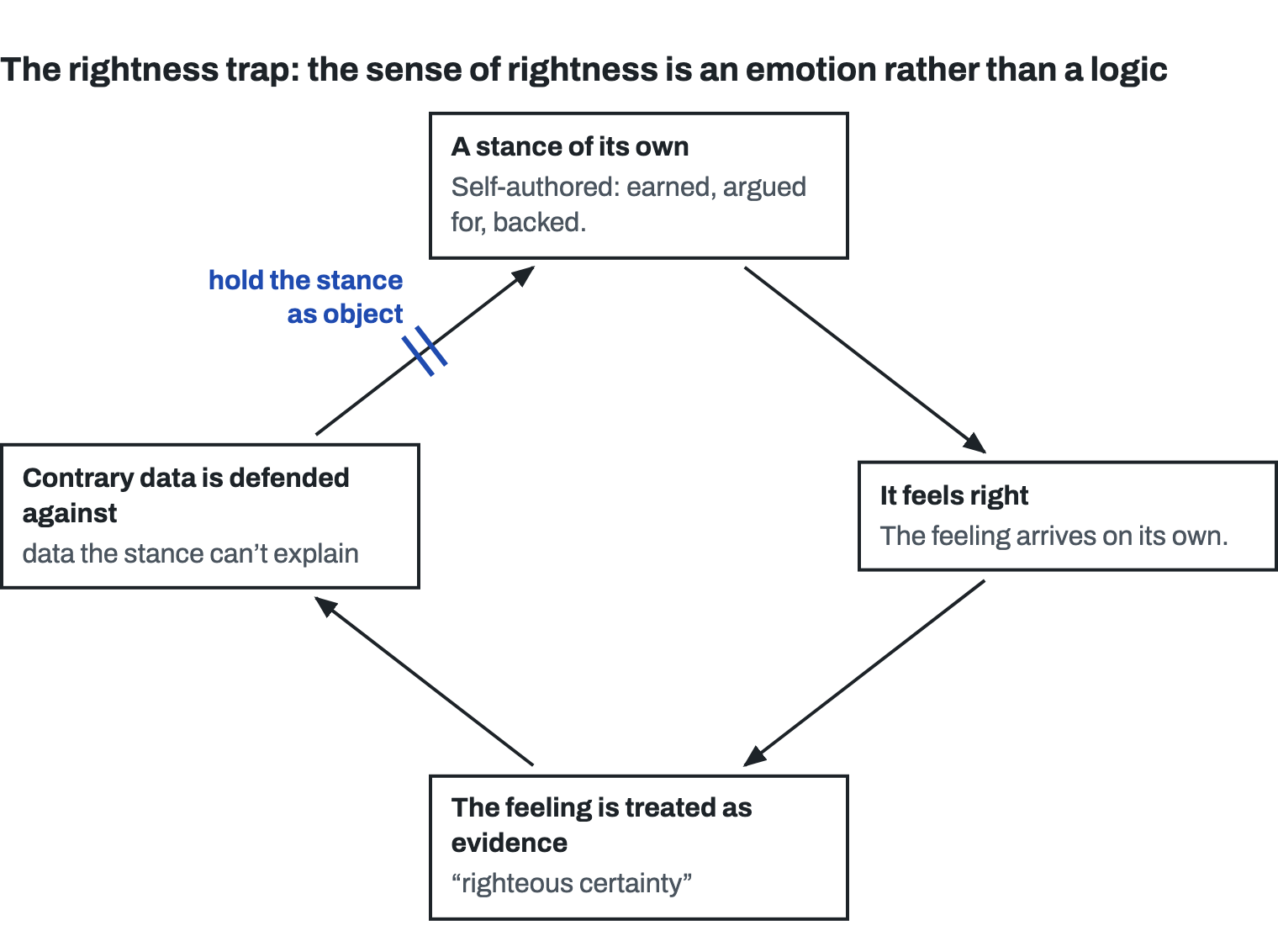
Jennifer Garvey Berger calls the rightness trap one of her five universal mindtraps. In her account, the self-authored mind can harden into “righteous certainty”: it has found a stance of its own and starts treating the feeling of being right as evidence. As she puts it, “the sense of rightness is an emotion rather than a logic.” A leader at the self-authoring plateau has earned a real stance, yet can still defend it against data the stance can’t explain. The self-transforming plateau begins to loosen that trap.
Where Pole C is right
The self-transforming mind is right when conditions change faster than any one self-authored stance can last. AI is such a domain. The conditions in front of you may change again before you have finished reading this.
A leader who can hold their own stance as object can name the frame they are running, the conditions under which it works, and the data it has pushed out of sight. I designed the team-formation workshop with no pre-assigned feature areas, on the conviction that the teams should form organically. Round One failed to produce teams. The room voted to keep my design. Round Two still struggled, so I proposed assigning features after all, in front of about thirty people and against my own conviction. It worked briefly, then we lost momentum. After a break, Round Three took form on its own and we finished with four teams meeting every ground rule. I had revised my own design in public, and then revised it back. CEOs face this often enough for Pole C to be an operating need, and the AI decade doesn’t create that requirement; it surfaces one that was already there, driving the rate of change past the lifespan of any one self-authored stance until Pole C reads as operational.
Joiner and Josephs’ Catalyst, Co-Creator, and Synergist levels each name a different expression of self-transforming capacity. The Catalyst can shift frames on the spot during a meeting. The Co-Creator can run a working partnership in which two leaders hold mutually exclusive frames in productive tension. The Synergist reads and responds to the live situation rather than running from rehearsed strategy.
A leader moving from Pole B to Pole C can’t do it alone. Heifetz names the holding environment that makes the work possible: all those ties that bind people together and enable them to maintain their collective focus on what they are trying to do. The developmental lineages are blunter: good company is required every step of the way. The work happens inside that company. (Chapter 11 began naming what this looks like in practice.)
Swapping frames inside a plateau is what that workshop showed. Moving between plateaus is structural, and there are no cheap tickets to it.
A leader inside a paradigm can’t think their way out of it.
In decisions
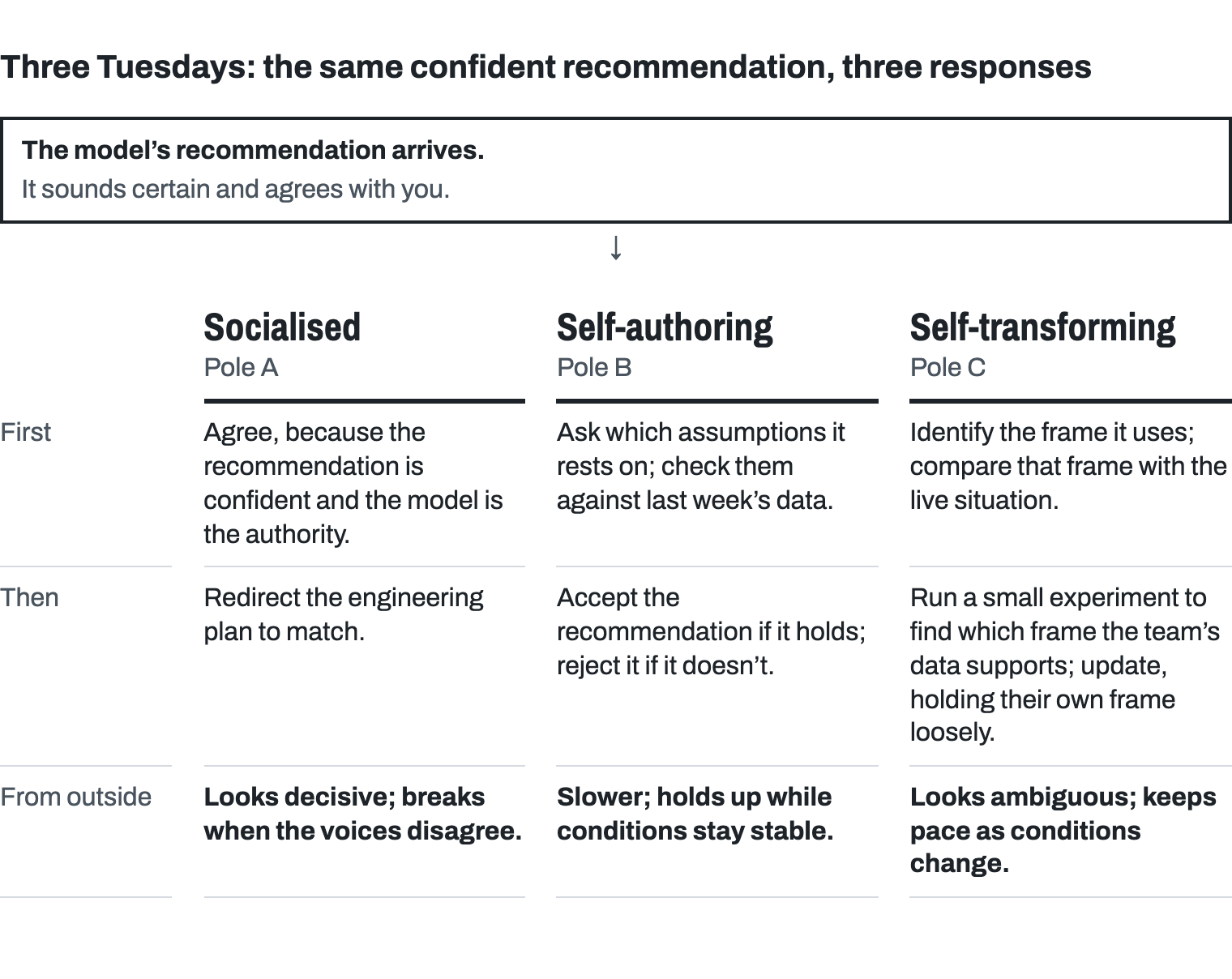
The first mode, on a typical Tuesday: receive the model’s recommendation, agree because the recommendation is confident and the model is the authority. Receive the board’s preferred direction, redirect the engineering plan to match.
The second mode: receive the model’s recommendation, ask which assumptions it rests on, check those assumptions against last week’s data, accept the recommendation if it holds, reject it if it doesn’t. Receive the board’s preferred direction, hold it against the engineering organisation’s actual capacity, push back where the maths doesn’t work, restate the disagreement as evidence the board needs. Receive the senior engineer’s opinion, hold it against the senior engineer’s track record on similar calls, decide.
The third mode: receive the model’s recommendation and identify the frame it uses. Compare that frame with the live situation and with the one they have been using for the past quarter, then run a small experiment to find which frame the team’s data supports. Update, holding their own frame loosely enough to change it when the situation calls for it.
The three Tuesdays look different. The first looks decisive but breaks when the voices disagree. The second is slower and holds up while conditions stay stable. The third looks ambiguous from outside, yet it can keep pace as conditions change. I find all three in my own decisions from the past month.
Suppose you are the CTO or VPE preparing a decision briefing in which the board, the chief scientist, and the product team are working from three different frames. The developmental vocabulary may help you read the dynamics, but it doesn’t belong in front of your CEO unless your relationship can bear it.
Ask your CEO: when three voices are each working from a different frame (the board’s, the chief scientist’s, and the product team’s) and none is wrong inside its own terms, what is the CEO’s move? That question tests both of you, whether either can hold the frames as object rather than pick one to be right. If your CEO can hear the question without hearing an attack, the conversation is worth having.
If they can’t, put one page in the next decision briefing. Write each recommendation in its own plain sentence so the CEO meets three reasonable answers to the same question, rather than three camps to choose among. Keep the framework vocabulary with you. Give the CEO the page.
The sentence your CEO can carry to the board: “The board, the science, and the product are each right in their own frame; the decision is which frame fits this quarter.”
The diagnostic move
One. Name a confident voice in your work this past month that you agreed with quickly, before checking the substance. The board. A lead investor. A peer. Your CEO, if you have one. A model output. The next time that voice arrives, what would it cost you (in your sense of yourself and in front of others) to disagree with it out loud?
Two. Name a stance you have been defending in the past quarter, a position you have argued for or an instinct you have backed against pushback. Where is the data that would update it? What would it take to hold the stance as object, as a frame you are running with known conditions of applicability, rather than as the truth?
Three. Pick the next high-stakes conversation on your calendar. What frame are the other people in that conversation working from? What frame are you working from? What third frame, neither yours nor theirs, would bring forward data the conversation has filtered out?
The exercise: the confident-voice disappointment exercise
Name a confident voice in your life that you have been deferring to: a CEO, a board member, a peer, a frequently-deployed AI agent, a coach. Before the first rep, read how this has gone before. What happened to the last person who disagreed with that voice out loud?
Stage the rep accordingly. Choose the safest real disagreement available, a low-stakes call where you have substance rather than a boardroom showdown. Say it out loud. Then track what happens to your relationship with the voice and to the work the disagreement opens up.
Debrief the rep against Chapter 2’s map. What does the result say about the assumption that kept you deferring? Run it once. Then run it again, one notch up.
Going upstream
In-text: Robert Kegan, In Over Our Heads, for the three orders and the one-half-to-two-thirds finding. Bill Joiner and Stephen Josephs, Leadership Agility, for the operational mapping to leader behaviour and the level percentages. Jennifer Garvey Berger, Unlocking Leadership Mindtraps, on the rightness trap.
Also touched: Ronald Heifetz, Alexander Grashow, and Marty Linsky, The Practice of Adaptive Leadership, for the holding environment; the phrase was Donald Winnicott’s first. Robert Kegan, In Over Our Heads, again for the developmental version of the holding environment and good company is required every step of the way.
Go deeper: Alicia Juarrero, Dynamics in Action, for intentions as attractors and the dynamical-systems reason a stance is a structural shift rather than a decision. Robert Coram, Boyd: The Fighter Pilot Who Changed the Art of War, for Boyd’s Destruction and Creation, the destroy-and-recombine cycle that keeps concept matched to reality. Donella Meadows, Thinking in Systems, for the leverage-points hierarchy and no cheap tickets to mastery.
This chapter put the question to a confident voice outside you. The next one turns it inward, on your own quick certainty. You list five options, score them against criteria, and pick the highest. The experienced operator already knew. You were slower; whether you were any more accurate is Chapter 13’s question. Chapter 13 sorts the calls that needed your analysis from the rigour performed for no one, then gives you the cognitive science to tell earned expert intuition from bias wearing the same face.
I work with engineering leaders on exactly this kind of paradigm work, the deeper the better. If it’s live for you, I’m happy to talk: schedule a 30-minute virtual coffee at hi.chrisgagne.com.
Some book links here are Amazon affiliate links; if you buy through them I may earn a small commission, at no cost to you.