Come Prepared to Die: An Engineering Leader’s Field Guide to the Leadership Paradigms AI Is Exposing
Someone will soon offer your service as software, or leapfrog your large software org. Would you like that person to be you?
Not exactly you. The old you will have to die along with the way you provide your service today. But the person who builds what replaces it can still be you: the new you.
🎧 Prefer to listen? This chapter is narrated in my own voice, via ElevenLabs on Spotify, about 23 minutes. Listen on Spotify →
This is neither speculation nor a forecast. As of early 2026, ElevenLabs had passed $500M in annualised revenue in the first four months of the year with about 530 people; Anysphere’s Cursor had reached roughly $2B in annualised revenue with a headcount in the low hundreds. Across the leading AI-native firms, revenue per employee ran several multiples ahead of the classical SaaS leaders. In Y Combinator’s W26 batch, Extruct AI’s breakdown counted 101 of the 199 companies building AI-native services or AI-enhanced software. By the time you read this the figures will have moved; the direction won’t. Chapter 3 walks the evidence in full; what matters is that the gap is already priced, already hiring, and already taking the market you are paid to defend as an incumbent.
Christophe Louvion had said it to me earlier, in his usual one-line form: the LLM doesn’t have to be totally correct, it just has to work at least as well as the average human. I heard the sentence then and didn’t feel it until now.
I didn’t have a single clarifying event. Drift, in Sidney Dekker’s sense; the boiling frog, in cultural shorthand. Wrong about frogs; folk-right about this.
The water has been getting hotter for 50 years, more volatile, more ambiguous. AI is the rolling boil. The paradigm that got most of us our careers was survivable when conditions moved slowly and a misfit cost little. Both have changed. The gap between a paradigm that fits and one that doesn’t is wider than it has ever been, and the cost of the misfit now arrives fast. What was merely sub-optimal has become fatal.
What was merely sub-optimal has become fatal.
This is a field guide. Over the next 22 chapters, I’ll walk through 18 paradigm dichotomies that AI is now surfacing for the senior leadership of software-dependent organisations. Each axis chapter stands alone; the contemplative spine chapters frame the arc and read best in sequence.
I write from where I have sat: alongside the CTOs and VPs in the engineering organisation where the AI impact landed first. This is written first for the engineering leader: the CTO, the VP of Engineering, the staff-plus engineer or architect who sees the technical reality first and carries it upward. You rarely own the full reorg, but you are usually the one holding the evidence before anyone else. The CEO is the subject of much of what follows, because the CEO owns the structure most of these paradigms are bolted to. But you are the reader, and the work starts with you, on yourself, before it is ever a conversation you stage upward.
The 10% ceiling
Almost every Agile transformation of the past 25 years has failed relative to what its framers intended when they wrote the Agile Manifesto. I say that from my own experience, about twenty years in this work, and from talking to fellow coaches over the last decade plus. I led transformations I am proud of, and I led others I called meaningful change at the time and now read more soberly. None have fully met my aspirations.
The ceiling has a number. Jerry Weinberg gave it its practical form 40 years ago, a rule Alexey Krivitsky, Craig Larman, and Roland Flemm recently invoked in 10X Org: never promise more than 10% improvement, because people can fold 10% into their mental category of “no problem,” whereas anything larger would be embarrassing if the consultant actually pulled it off. The figure has held, I’d argue, because it is the boundary at which the consultant doesn’t threaten the manager’s paradigm.
Read from the consultant’s side, Peter Block’s distinction explains the ceiling. Most consultants work at what he calls the content level: technical recommendations, frameworks, and other deliverables the manager can absorb without changing how the manager sees themselves or their organisation. There is also an affective level: trust, power, identity, the relationship between consultant and client and between leader and led. The affective level is where—extending Block—paradigm change has to happen. Most consultants won’t work at the affective level, and for years I didn’t either. The work makes them vulnerable, and it threatens the consultant’s position as much as the manager’s. Block names the collusion plainly: that consultants too often join the client in pretending organisations are purely rational rather than political.
I stayed under that boundary without ever deciding to. A team I coached took work in a domain none of them knew well, against a date already written into a contract. Someone sitting entirely outside of the product R&D org classified the project as small, and the classification removed the kickoff, the regular cadence, and the backlog refinement. Stories reached ready without the people doing the work ever discussing them. Acceptance criteria described a system that didn’t match the one running. Dependencies on other departments turned up mid-build, and the product manager got status by chasing people. They hit the date without a critical defect, carried there by experienced colleagues who stepped in through the live issues, and that success belongs to the team.
I had taught folks small batches, clear completion rules, integrated quality. Then the date approached and the completion rule became negotiable, the quality concern moved to later, the retrospective action waited behind delivery work. Training pushed one behaviour. The conditions punished it. I had spent a career naming exactly this, fixed date and fixed scope and fixed team, and never actually fixed, because the scope reversed against us far more often than it reversed our way. Every time it came up it came up as commercial necessity, which is to say it arrived as a fact nobody had to own as a choice. I treated it as a team-local process problem, because local process was the only lever I had.
Ronald Heifetz names the same gap from the leadership-development side. Technical problems have known solutions inside current authority and expertise. Adaptive challenges require changes in people’s priorities, beliefs, habits, and loyalties. The most common failure of leadership, he writes, is applying technical fixes when the work is actually adaptive. The training was a technical fix. What the date meant was adaptive work.
In 10X Org, Krivitsky et al. argue that the 10% improvement ceiling is no longer enough; what is needed is a step-change redesign of the organisation resulting in a “10X Org.” I wholeheartedly concur. For software-dependent organisations, Krivitsky, Larman, and Flemm’s Org Topologies and Larman and Vodde’s Large-Scale Scrum are, in my view, the most serious attempts at the redesign (not the last word on it). This book addresses the paradigm and identity layer underneath. Some paradigms must change before the most-fit strategies for the necessary organisational redesign can be considered.
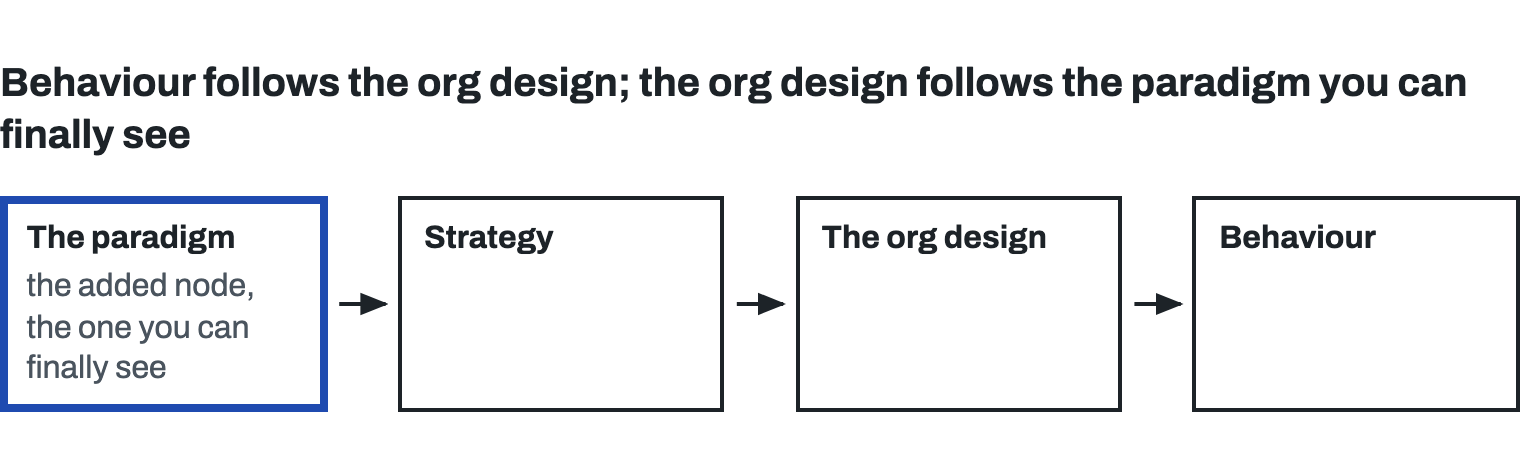
That claim needs its counterweight, because the strongest cases in this book look as if they ran the other direction. Marquet’s submarine and the NUMMI line both changed behaviour first and let the thinking follow; Marquet’s own mechanism is named Act Your Way to New Thinking, and the knowing-doing research is blunt that acting produces knowing more reliably than knowing produces acting. Behaviour-first is real, and for the people a leader leads it is usually the cheaper, better test. But notice who ran those cases. The crew’s paradigms followed the new conditions; the captain’s had already moved. Marquet, and Toyota’s managers at NUMMI, were structure-owners who had done their own paradigm work first, and that is what let them redesign the conditions everyone else then changed behaviour inside. Behaviour-first was never the structure-owner’s own escape route, and no one upstream is going to run the experiment on them. When your own new behaviour keeps reverting, edited back to fit the old pattern, you have found what chapter 2 will name an immunity, and that is where this book’s work begins. Behaviour follows the org design; the org design follows the paradigm you can finally see.
Why the ceiling holds
Even if a misfit paradigm were easy to see, it’s hard to shift.
Robert Kegan and Lisa Lahey give the gap its mechanism. Change rarely fails for lack of sincerity or willpower. It fails because we mean two things at once: a sincere commitment to the goal and a hidden countervailing commitment to self-protection, sustained by big assumptions held as fact. The leader’s paradigm is exactly this kind of immune system. It isn’t weak or sloppy. It is a brilliantly designed protective architecture, built for an organisational context that may not persist for much longer. Kegan and Lahey call the inspection step the subject-object move: the paradigm becomes available for change only when it shifts from being a thing the leader is to being a thing the leader has. Until that shift, the paradigm is invisible from inside.
Beatrice Bruteau named the collective version of the problem in The Psychic Grid, drawing on Dostoevsky’s Grand Inquisitor and Walter Kaufmann’s decidophobe. The world we know—what Bruteau calls our community conviction system—is one we collectively construct, and few of us can step outside the shared grid alone (if we can even see it). The Inquisitor is the figure who lifts the burden of deciding for ourselves. He tells us how it is and what we must do, and we thank him for it. For the CEO, the community conviction system is the Inquisitor: the board’s risk tolerance, peer CEOs’ moves, the industry analysts’ frameworks. My most rapid and successful transformation ended about a week after we concluded its three-day kickoff: the CEO, satisfied that his organisation had learned a great deal, released me and planned a “hybrid approach”, one I predicted would fold what we had built back into the prior operating framework, with more extrinsic motivation. The familiar grid lifted the burden of the new paradigm. Any paradigm or framework can become the Inquisitor when the leader obeys it rather than uses it: applies it without examining whether it still fits. By all comparisons, he was doing fine. The competitive floor was just that low… until today.
This is how cognition works, not a moral failing. The leader’s habitual response and the situation it was built to meet had been running as a single coupled system. The historical response was the right response to its conditions. The conditions changed; the response didn’t, because the two were one thing, and one half of it is still catching up.
I don’t pretend to know which paradigms are running you. I don’t pretend to know whether they fit your situation. Your situation determines that, not me. What I can name is the structural difficulty of seeing a paradigm at all, and the cost of failing to see and change it when the conditions have moved.
What AI changes
For specific shapes of task—particularly writing software—frontier-model releases through 2026 have been closing the gap with human knowledge workers rapidly. AI is now past the question of is it ready? and into are we ready? The readiness in question is organisational: the prevailing org design is already out of date.
Christophe’s quote undercuts incumbents with one stroke: the LLM doesn’t have to be totally correct, it just has to work at least as well as the average human. Every paradigm and org design tuned for managing the average human worker is now under direct competitive pressure from rivals willing to let AI do much of that work at average-human quality and a fraction of the cost.
The cost line is already visible inside the engineering chain. The CFO asks about the ROI of OpEx going to AI. Engineers most fluent with AI-native work, frustrated with the “efficient” bureaucracy in their current org, leave for AI-native competitors and frontier labs paying more. Acquisition conversations now weight the existing code’s readiness for AI. The CTO sees these signals first, the board hears them next, and by the time the question reaches the CEO as a decision to make, the market has already narrowed the options.
Worse, most AI-sourced advice will compound the paradigm problem rather than fix it. Larman’s Laws of Organizational Behavior describe how change initiatives get co-opted: terminology gets overloaded to mean the status quo and displaced specialists become coaches who deliver the false impression that the change has been done. As a result, the published corpus on Agile, Lean, and DevOps is dominated by consultant-derivative content. When an LLM writes on these topics, it often regresses to the mode—not the truth—and adds a fawning persona that weakens critical thinking exactly where it’s most needed. Deploy agents at scale on that advice and you are taking it from a tool trained on the corpus that codifies the paradigm you need to leave.
The pattern was measured, not merely suspected, in March 2026, when researchers writing in Harvard Business Review put leading LLMs through thousands of simulated strategy decisions and found they reliably reach for strategies that match fashionable management language rather than the logic a particular situation calls for. They named the output trendslop. Their fixes are prompting hygiene, and prompting hygiene is worth doing. Grounding the model in verified sources—the source-audited retrieval I build and run in my own practice—is my bet on the stronger fix, but only if the sources were selected correctly in the first place, and none of it reaches the paradigm the advice lands on.
AI doesn’t solve your context-paradigm mismatch. It sells it back to you.
That is the second of three forces. One: AI turns your existing paradigm into the binding constraint, moving the bottleneck from execution—which the tools increasingly handle—to the mental model the organisation was built around. Two, and sharpest: the tool, trained on the consultant-derivative corpus, sells that misfit back to you with affirmation rather than exposing it. The first force makes your paradigm the problem; the second hides it behind a fluent, agreeable voice. Three isn’t another property of the tool, but what the first two leave you holding: the only move left is change at the level of identity, and no technique reaches it in a straight line, which is why no tool, the flattering one included, can do this for you. The chapters ahead take the paradigms one at a time. This chapter is about what the three together ask of you: not a technique, but a change in who is doing the deciding.
The aviation precedent
The aviation version of the ceiling has been visible for decades. On 6 August 1997, Korean Air Flight 801 hit Nimitz Hill on approach to Guam. Two hundred and twenty-eight people died. Gladwell’s popular reading placed the cause inside hierarchical Korean grammar. The deeper variable was the steepness of the authority gradient that preceded the grammar: the first officer and flight engineer questioned the captain about how low the aircraft was on its approach and registered alarm as the cockpit’s automated terrain warnings sounded. Their hints and checks were the form of challenge the gradient permitted; under that gradient, graded escalation was the rational strategy, and it ran out of altitude before it ran out of steps. The first officer’s call for a missed approach came about seven seconds before the aircraft hit the hill. Read from inside the cockpit, they were doing what the system had trained and permitted.
Facing disasters like this, aviation has spent over four decades moderating the authority gradient through Crew Resource Management. The same authority dynamics show up in retrospectives, failed product launches, unspoken concerns about a CEO’s pet project, boardrooms where everyone knew the strategy was wrong and nobody said it directly enough. Aviation couldn’t look away from the lost lives; AI is now making the boardroom toll of obsolete paradigms similarly hard to ignore.
The work that’s needed
What the circumstances ask of the leader is identity change, not just skill change. In my experience they’ll need more than skilful consulting and advice: company of a particular depth—good developmental coaching among its forms—held within a different community conviction system. The new practice holds until pressure arrives, then gets edited back into the old pattern, the way the completion rule went negotiable when the date approached. Turning that pattern from something you are into something you have is the subject-object move Kegan and Lahey name, and it can’t be run from inside the paradigm you are trying to see.
This writing follows the arc of that change, and I am borrowing its shape from Karla McLaren, who draws on mythologist Michael Meade’s three stages of initiation. Her subject is trauma; mine is the leader’s passage, with the second stage, the ordeal, renamed dissolution. She names the structural failure mode: most modern cultures rarely complete the return. People go through the separation and the dissolution and are abandoned at the threshold of coming back. Without the reception, a person cycles between separation and dissolution indefinitely: the loop this book is trying to close.
This chapter is the start of a separation from our dominant paradigm—and identity—in the midst of the transition AI is now laying bare. The dissolution is the sustained contact with what is falling away. The recognition is the moment the leader sees what they had been subject to, often with a coach figure who can stay steady with them through it. What’s left when the frameworks fall away is the return: a welcoming into a community conviction system where paradigms can be examined, not parroted.
I am offering these paradigm dichotomies as a starting set. While most have been relevant for decades, some may be partly obsolete in months. I don’t list them with the express purpose of changing your mind about them, though that might well be useful. I list them because they are habitual pulls you can already easily recognise and use as practice for the novel contexts AI will keep surfacing.
One move you can make this week. Take last week’s hardest decision and ask three questions of it. What did it optimise for: speed, certainty, control, looking decisive? What did it trade away to get that? And who is carrying that cost now, that you aren’t?
The thing you optimised for without ever feeling it as a choice is the paradigm. (Say you protected your own credibility without once considering you had the option not to. That’s a paradigm running you.) Run the three questions across a handful of decisions and the pattern stops being evidence against you. It shows what’s ready to move.
If naming it is hard, that’s the starting point, not a failure: seeing your own paradigm is the one thing you can’t fully do alone. The next chapter is the practice for it.
As Deming put it in a line Krivitsky et al. share in 10X Org: “There is no instant pudding.” This work isn’t fast. We have influence, not control. If you have read this far, you have already taken some part of the first step. The second step is to find someone outside the pattern who can be alongside you: a peer group, a developmental coach, a supervisor, anyone who isn’t running the paradigm you are trying to see. Then build the community that will hold you as you emerge. You can’t run the subject-object move on yourself, because the thing doing the looking is the thing you are trying to look at.
The work runs in parallel with redesigning the incumbent organisation, possibly replacing it; the structural moves I run in that redesign are documented in Org Topologies and Large-Scale Scrum, named earlier, where they scale with the size of the group.
I agree with Krivitsky et al.: we can’t afford the 10% ceiling any longer.
Come prepared to die: not you, but the paradigm you have been, and the identity built on top of it.
Going Upstream
The 10% ceiling comes from Jerry Weinberg, who set the rule in The Secrets of Consulting. Alexey Krivitsky, Craig Larman, and Roland Flemm revive it, and argue past it, in 10X Org, the book whose central wager, that the 10% ceiling is no longer survivable, this chapter takes as its own. The redesign work I point to lives in their Org Topologies Primer: Strategic Org Design and in Larman and Bas Vodde’s Large-Scale Scrum: More with LeSS. Deming’s “there is no instant pudding” reaches me through the same 10X Org.
The content-versus-affective distinction, and the naming of the consultant’s collusion, are Peter Block’s, from Flawless Consulting: A Guide to Getting Your Expertise Used. The technical-versus-adaptive cut is Ronald Heifetz’s, with Alexander Grashow and Marty Linsky, in The Practice of Adaptive Leadership. The immunity, the competing commitment, the big assumption held as fact, and the subject-object move that turns a paradigm from a thing you are into a thing you have, is Robert Kegan and Lisa Laskow Lahey’s, from Immunity to Change; chapter 2 stays with it. That acting produces knowing more reliably than the reverse is the finding Jeffrey Pfeffer and Robert Sutton document in The Knowing-Doing Gap, and “Act Your Way to New Thinking” is L. David Marquet’s own named mechanism from Turn the Ship Around!, the submarine case I lean on. The NUMMI counterpart draws on the plant’s own culture-transformation record.
The collective version of the trap, the community conviction system, and the Grand Inquisitor who lifts the burden of deciding for us (by way of Dostoevsky, and Walter Kaufmann’s decidophobe), is Beatrice Bruteau’s, from The Psychic Grid. That cognition is enacted, the knower and the known arising together, is the enaction thesis of Francisco Varela, Evan Thompson, and Eleanor Rosch in The Embodied Mind: Cognitive Science and Human Experience. Drift, in the precise sense I use it, is Sidney Dekker’s, from Drift Into Failure. And the arc I borrow for the leader’s passage, separation, ordeal renamed dissolution, and the return most cultures never complete, comes from Karla McLaren’s The Language of Emotions, where she is in turn drawing on the mythologist Michael Meade’s three stages of initiation.
The corollary that AI regresses to the consultant-derivative answer rather than the truth is my own extension of Larman’s Laws of Organizational Behavior; I set it out at length in the LLM-epistemology piece. Two sources I draw on here sit outside the corpus of primary texts behind this book, and I cite them as I met them: Malcolm Gladwell’s reading of Korean Air Flight 801 in Outliers (whose hierarchical-grammar account I push back on, in favour of the authority gradient beneath it), and the March 2026 Harvard Business Review study that named “trendslop“: LLMs reaching for fashionable management language over the logic a situation calls for. Christophe Louvion’s one line, the LLM doesn’t have to be totally correct, it just has to work at least as well as the average human, I owe to him directly, in conversation.
A paradigm is what you look through, not what you look at. So the decision you are proudest of this quarter, the AI reorg included, is the one it is hiding from you. You can’t catch that alone, any more than you can see your own eye without a mirror. Chapter 2 hands you the mirror. You run a five-minute diagnostic on a decision you already made, then send it to two colleagues who watched. Their read is data you couldn’t reach yourself.
I work with engineering leaders on exactly this kind of paradigm work, the deeper the better. If it’s live for you, I’m happy to talk: schedule a 30-minute virtual coffee at hi.chrisgagne.com.
Some book links here are Amazon affiliate links; if you buy through them I may earn a small commission, at no cost to you.