Had by your assumptions vs having them
You’re surprised by your own pattern when it surfaces. The pattern was running you well before you saw it.
Chapter 20 ended on conflicts that persist because an assumption of your own makes the stated options seem exhaustive. This chapter takes up the capacity beneath every axis: holding your own assumptions as object rather than being run by them.
A recurring pattern can look like a single event. The CTO who said no to the partnership for the third quarter in a row and then sat in the car afterwards wondering why. The VPE who promised the board a delivery date her team had missed twice before, and believed it this time too, then met the slip with real surprise. The senior manager who promoted the wrong person again, the same wrong choice they have been making for 15 years. Eventually, the leader notices that a pattern is repeating across the events.
The two poles
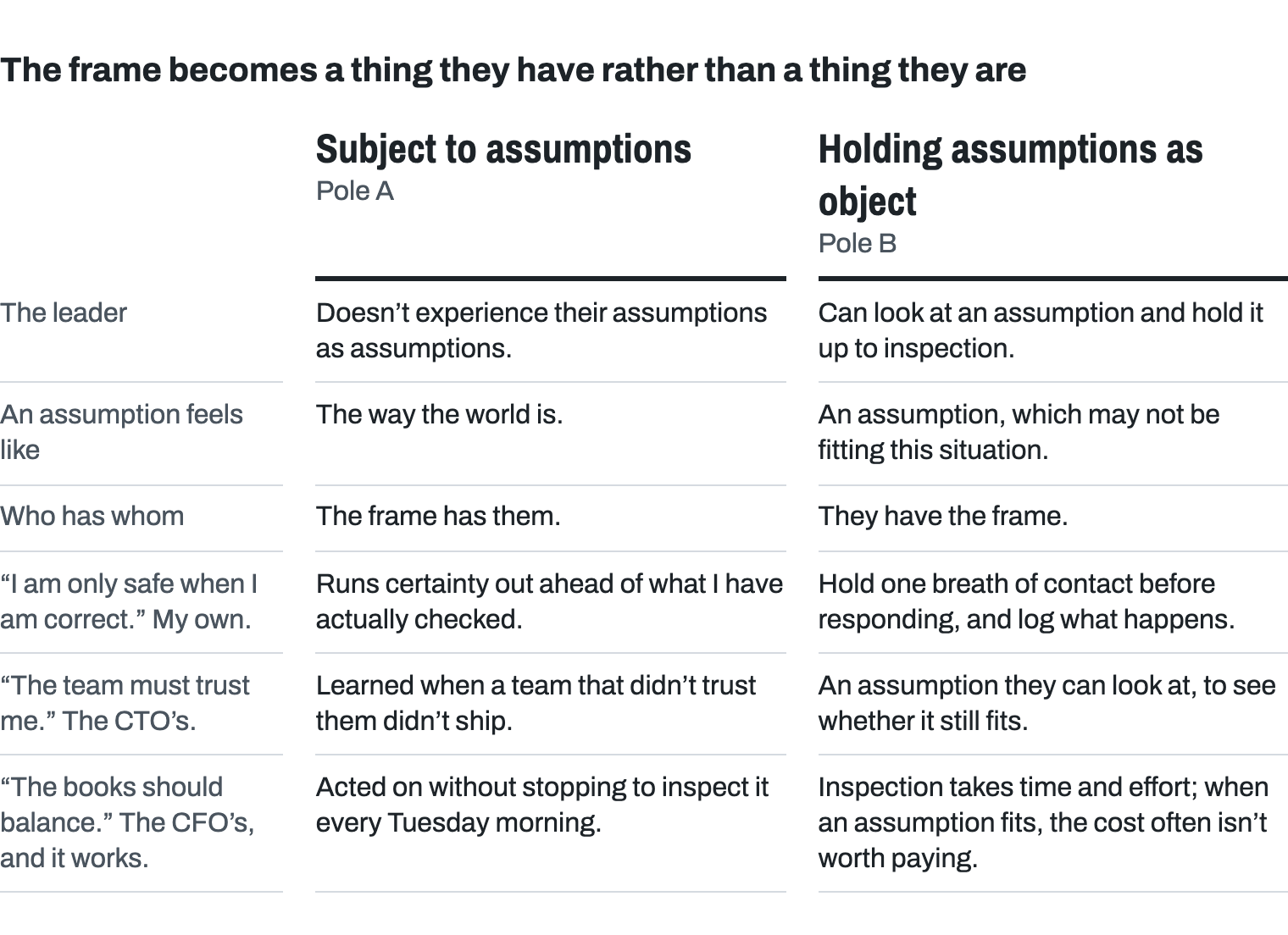
Pole A: subject to assumptions. The leader doesn’t experience their assumptions as assumptions; they experience them as the way the world is. The frame has them.
Pole B: holding assumptions as object. The leader can look at an assumption and hold it up to inspection. They can say that’s what I have been assuming about how this organisation needs to work, and I notice that assumption may not be fitting this situation. They have the frame.
The frame becomes a thing they have rather than a thing they are.
Robert Kegan, the Harvard developmental psychologist who has spent decades researching this move, names it as a structural shift in what one is subject to and what one can take as object. The Subject-Object Interview is the 90-minute interview Kegan, Lisa Lahey (his co-author on Immunity to Change) and their colleagues developed to assess where someone is on the developmental sequence; thousands of these interviews have now been run. As Kegan and Lahey describe it, greater complexity means being able to look at more of the thoughts and feelings that previously ran us. We’re always subject to something.
Where Pole A is right
Pole A is the structural default. Every leader is functionally subject to most of their assumptions most of the time. A working organisation depends on it.
The CFO acts on the assumption that the books should balance, without stopping to inspect it every Tuesday morning. Inspection takes time and effort, and when an assumption fits, the cost often isn’t worth paying.
The leader’s assumptions didn’t appear from nowhere. They were built over years, in response to specific conditions, by a self that was solving real problems. The CFO learned to be subject to the books-balance assumption because the early times in their career when the books didn’t balance were terrifying. The CTO learned to be subject to the team-must-trust-me assumption because the early times when the team didn’t trust them, the team didn’t ship. The assumptions are protective architecture. They got the leader here. Retroactive shame mistakes a protective response for a defect.
Where Pole B is right
Pole B is right when a recurring outcome gives the leader reason to question an assumption.
Robert Kegan and Lisa Lahey, in Immunity to Change, use an immune-system analogy. An immune system is, most of the time, a beautiful thing: “an extraordinarily intelligent force that elegantly acts to protect us, to save our lives.” Every immunity to change can be read as an asset and a source of strength for the person carrying it. But immune systems can become part of the problem when they reject material the body needs. In Kegan and Lahey’s terms: “It is just making a mistake. It does not understand that it must alter its code.”
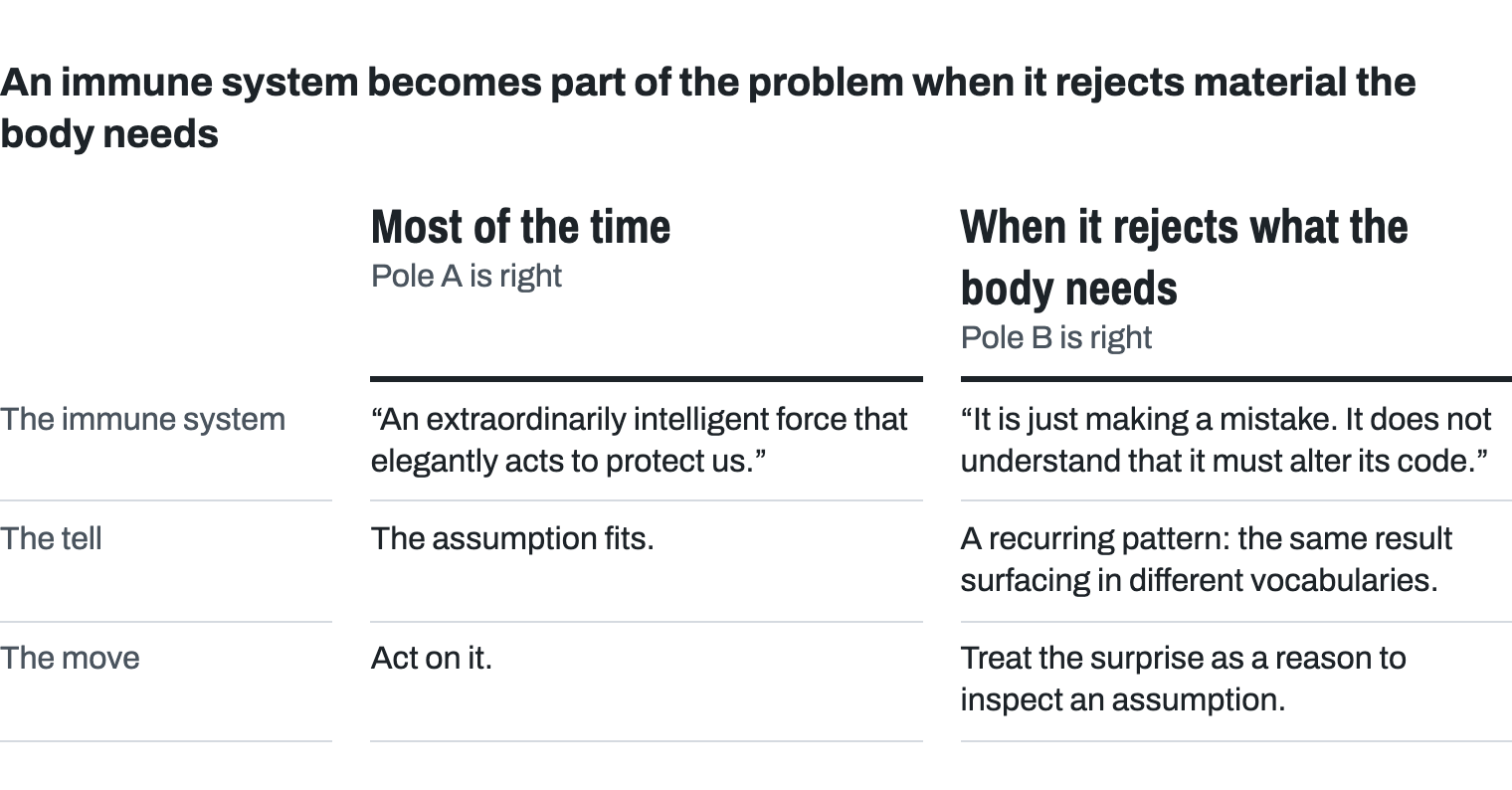
The same result keeps surfacing in different vocabularies, the same conversation keeps happening with different people, and the same diagnostic keeps appearing in the quarterly review. The leader’s behaviour under pressure keeps producing an outcome that surprises them.
The surprise is a reason to inspect an assumption, alongside what happened in the situation.
The Immunity Map—the four columns
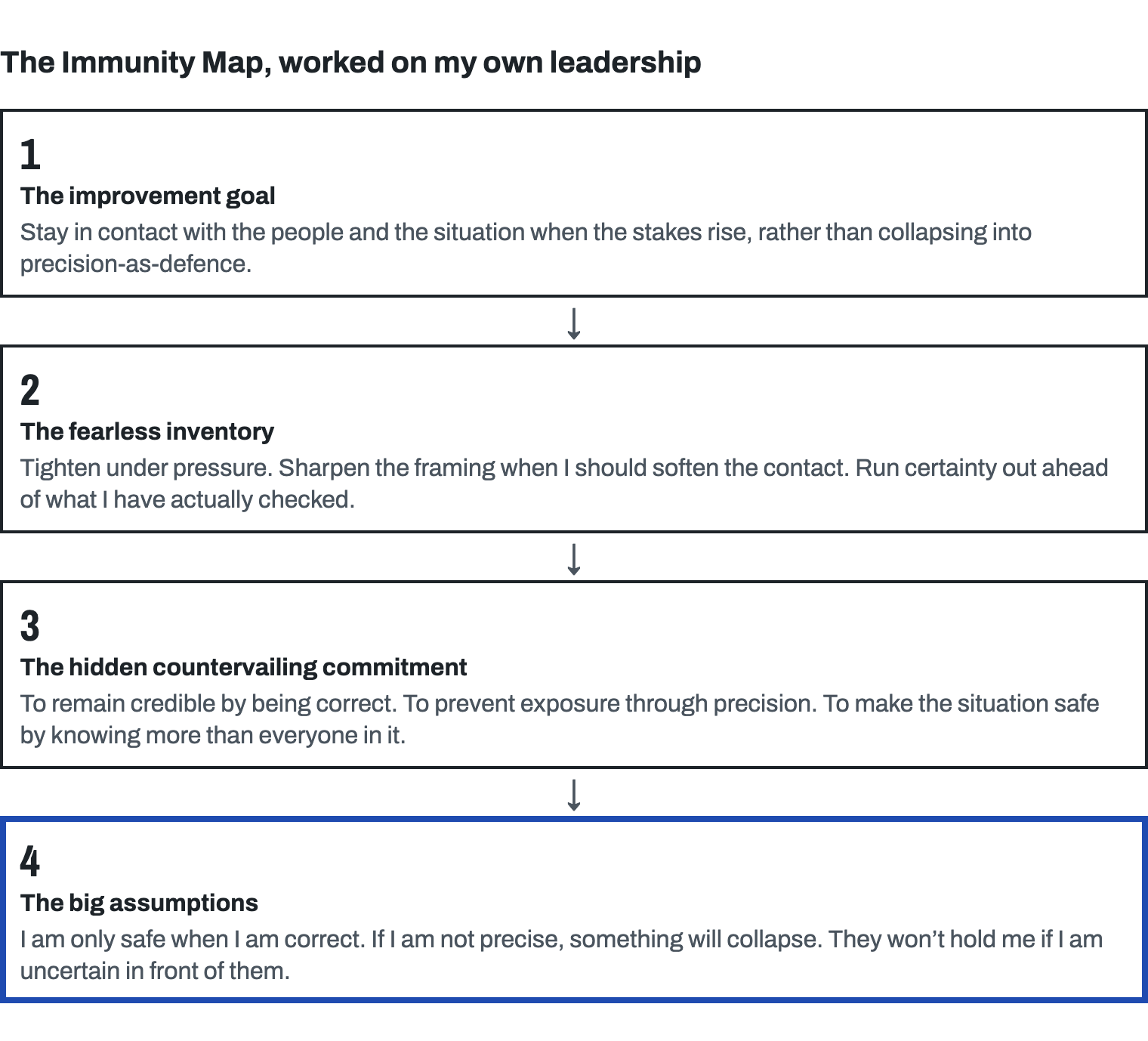
Kegan and Lahey’s Immunity Map has four columns the leader works through in order. The worked example below is my own. Reading someone else’s map is useful; doing your own is the work.
Column 1: the improvement goal. What you genuinely, sincerely want to do differently. Mine: stay in contact with the people and the situation when the stakes rise, rather than collapsing into precision-as-defence. Let clarity serve. Hold accuracy without sharpness.
Column 2: the fearless inventory. The behaviours you do that work against the column-1 goal. Not what you do once in a while when you’re tired. What you do reliably. Mine: tighten under pressure. Sharpen the framing when I should soften the contact. Overshoot the audience with urgency that was meant for myself. Solution-shape a conversation that was asking for a slower kind of listening. Run certainty out ahead of what I have actually checked.
Column 3: the hidden countervailing commitment. What you sincerely commit to that requires the column-2 behaviours. Mine: to remain credible by being correct. To prevent exposure through precision. To make the situation safe by knowing more than everyone in it. The column-1 goal asks for soft contact; the column-3 commitment requires precision as armour. Both are running in the same body at the same time.
Column 4: the big assumptions. The assumptions that sustain the column-3 commitments. Mine: I am only safe when I am correct. If I am not precise, something will collapse. They won’t hold me if I am uncertain in front of them. As Kegan and Lahey put it: “We call them ‘big assumptions’ because they are not currently viewed as ‘assumptions’ at all. Rather, they are uncritically taken as true.”
The exercise works when the leader can put all four columns on one page and see the assumption that links them. My column-2 behaviours do exactly what column 3 needs them to do. As Kegan and Lahey insist, the map isn’t exposing an insincere commitment behind the real one. The heart patient genuinely wants to keep living even as he reaches for another cigarette; change fails to happen because we mean both things.
What runs after the map—the continuous test
Kegan and Lahey’s tests are safe, modest experiments, run to get information rather than to get better. My own extension makes the test continuous: the same test, moved into the moment.
After the Immunity Map is built, the leader doesn’t now know their assumption and move on. The assumption is still operating. My own continuous test is small and specific: in conversations where I feel the precision-tightening start, hold one breath of contact before responding. The column-1 goal becomes the action; the column-3 commitment surfaces in the felt resistance to softening. The felt resistance is half the data; the other half is external: what actually happened when you softened? Log both.
An assumption tested only against the feeling is an assumption grading its own exam.
Repeated tests are what make the subject-to-object shift hold. Without them, the assumption tends to run the leader again.
The chapter’s own trap—subject-object duality
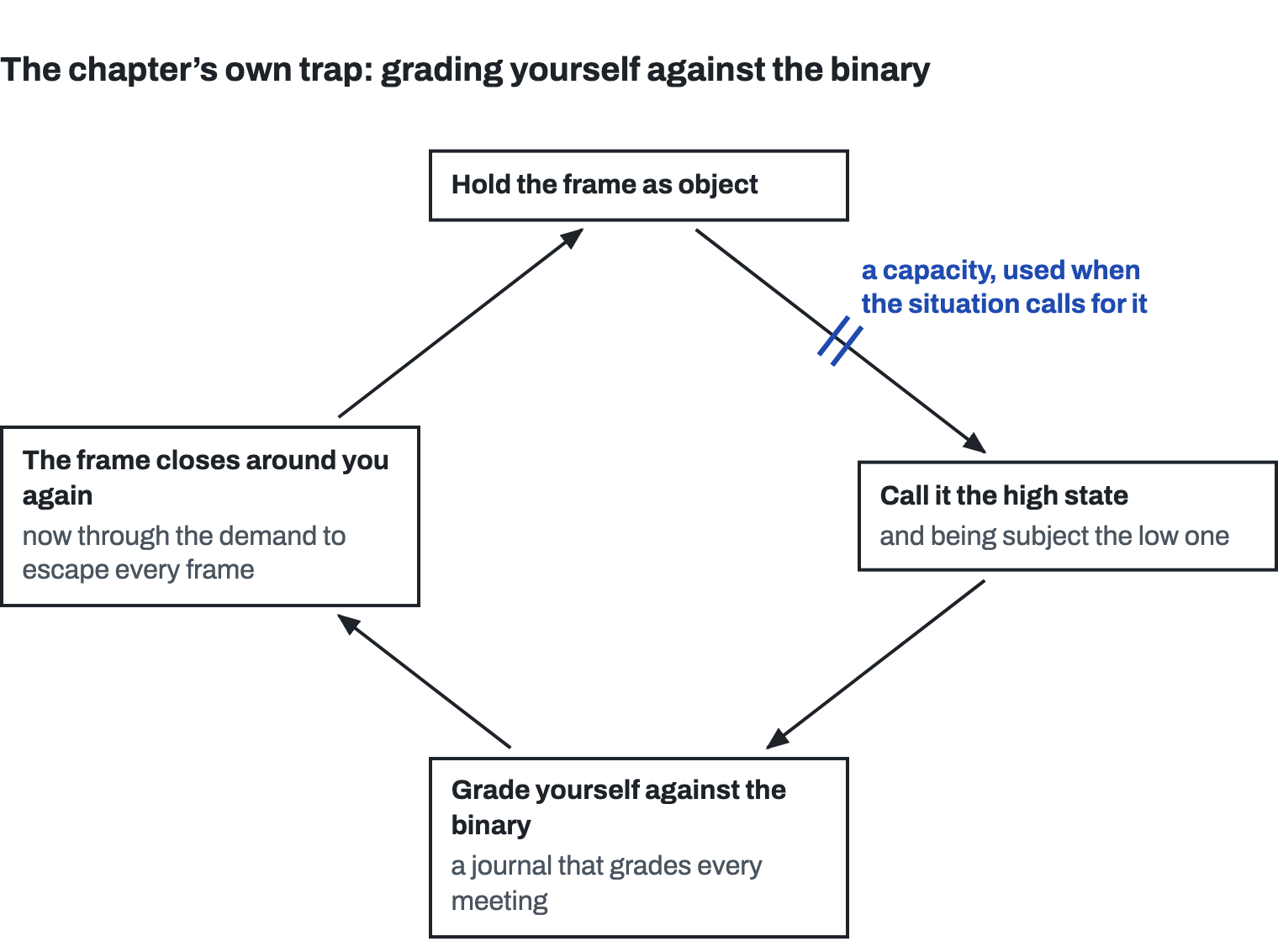
If the leader treats holding assumptions as object as the high state and being subject to assumptions as the low state, they can start grading themselves against the binary. It shows up as a journal that grades every meeting against the binary, which is self-attack in developmental vocabulary. The frame has closed around them again, now through the demand to escape every frame.
The move from subject to object is a capacity to use when the situation calls for it.
Go back to the CTO in the car. What changes isn’t the partnership decision; it is that the question why do I keep saying no to this becomes available to ask, and the next call can be made on its merits rather than on the rule underneath it. The capacity lasts even as the assumptions change. I doubt the paradigm that fits today will still fit in 18 months. A leader who can take it as object can see that and adjust; a leader who has made one way of seeing part of their identity is stuck.
In decisions
At Pole A, the leader experiences the surprise as a thing happening to them. They name the situation as the cause without questioning what they assumed.
At Pole B, they can ask what their own assumptions contributed. They can say I am noticing the same anxiety I noticed the last three times this came up, and the anxiety is the information. They can sit with the discomfort long enough to inspect the assumption.
When a decision fails and the same failure has come before, there are two moves close to hand: defend the decision, or ask what assumption made it look right at the time. I have made both, sometimes in the same meeting. Questioning the assumption can mean discovering you were wrong.
Put one recurring pattern in front of your CEO. Use several incidents where the CEO’s response surprised you by repeating itself, rather than a single incident. Anchor it in shared work: one specific decision you were both inside, with the CEO’s account asked for first—what were you trying to do there?—before you offer what you saw. The four-column map from Kegan and Lahey is your guide, not your script. Better still, build your own first two columns on the same decision and put them beside the CEO’s; chapter 17’s calendar exercise is the pattern: both parties produce, both compare. Whether the CEO can hear it depends on the relationship. If the relationship is there, I suspect this is the most consequential conversation available to you. If it isn’t, start with a less charged axis and build toward this one. If the CEO declines the conversation altogether, that is information, not resistance to overcome. The offer stands, and the transformation was never yours to deliver.
The sentence your CEO can carry to the board: “One of our biggest risks is whichever of my patterns no one around me will name.”
The diagnostic move—three questions
Take the last time you were genuinely surprised by your own behaviour, when afterwards you sat in the car or stared at the screen and wondered what just happened. Walk through the moment and ask: what assumption was operating in me right before that? Sit with it long enough to put the assumption into words. Don’t force it; the assumption is unfamiliar to you because you have been subject to it.
Choose one assumption you can name about how your team or organisation has to work. Write it as a sentence. Now design one safe, modest behavioural test where you act against it this week. The point isn’t to disprove the assumption. Record what it costs you to act against it and what actually happens.
Notice what arrives in you when you read this chapter. Tightening might mean the argument fits, or overreaches, or is simply unfamiliar, or that an assumption is defending itself. Which one is a question to test against evidence, not to settle by the feeling.
These questions need time you may not have planned to give them.
A team-based exercise
Walk the Immunity Map once, on yourself, before you try it with anyone else.
Pick a column-1 goal: something you genuinely want to do differently in your leadership and haven’t been able to do, despite trying. Run the four-witness check from chapter 2’s exercise before you lock it—one question, four people who know you—because they can name goals and effects your own protective habits leave out. Build the columns. Take an hour or two. In my experience column 2 is easy and uncomfortable, column 3 is the one that stings, and column 4 tends to arrive last.
Don’t share the map with your team yet. Sit with it for a week. Watch your own behaviour against the columns and notice when the column-3 commitment is operating. The continuous test starts here.
When the team learning is ready—Kegan and Lahey are emphatic that the leader has to go first, has to be visibly working on their own immunity before asking the team to do the same—share the map with two people who have permission to push back. The work after that is collective, and slower than this chapter can describe.
Going upstream
Start with: Kegan, In Over Our Heads: the developmental theory the immunity work rests on, and the Subject-Object Interview that names the move. Kegan and Lahey, Immunity to Change: the Immunity Map and the case studies. The continuous test above is my extension.
Further reading: Meadows, Thinking in Systems: on transcending paradigms at the top of her leverage-points hierarchy.
Go deeper: Garvey Berger, Changing on the Job and Unlocking Leadership Mindtraps: the same ideas, written for working leaders. Heifetz, Leadership Without Easy Answers and The Practice of Adaptive Leadership: the adaptive-versus-technical distinction the developmental work rests on.
I work with engineering leaders on exactly this kind of paradigm work, the deeper the better. If it’s live for you, I’m happy to talk: schedule a 30-minute virtual coffee at hi.chrisgagne.com.
Some book links here are Amazon affiliate links; if you buy through them I may earn a small commission, at no cost to you.