AI as productivity layer vs AI as impetus for org redesign
The cheap mistake is the tokens. The expensive one is the org design you left in place.
Chapter 2 named the meta-skill of holding a paradigm as an object. This chapter is your first chance to practise: use it on your AI rollout itself.
🎧 Prefer to listen? This chapter is narrated in my own voice, via ElevenLabs on Spotify, about 28 minutes. Listen on Spotify →
The two poles
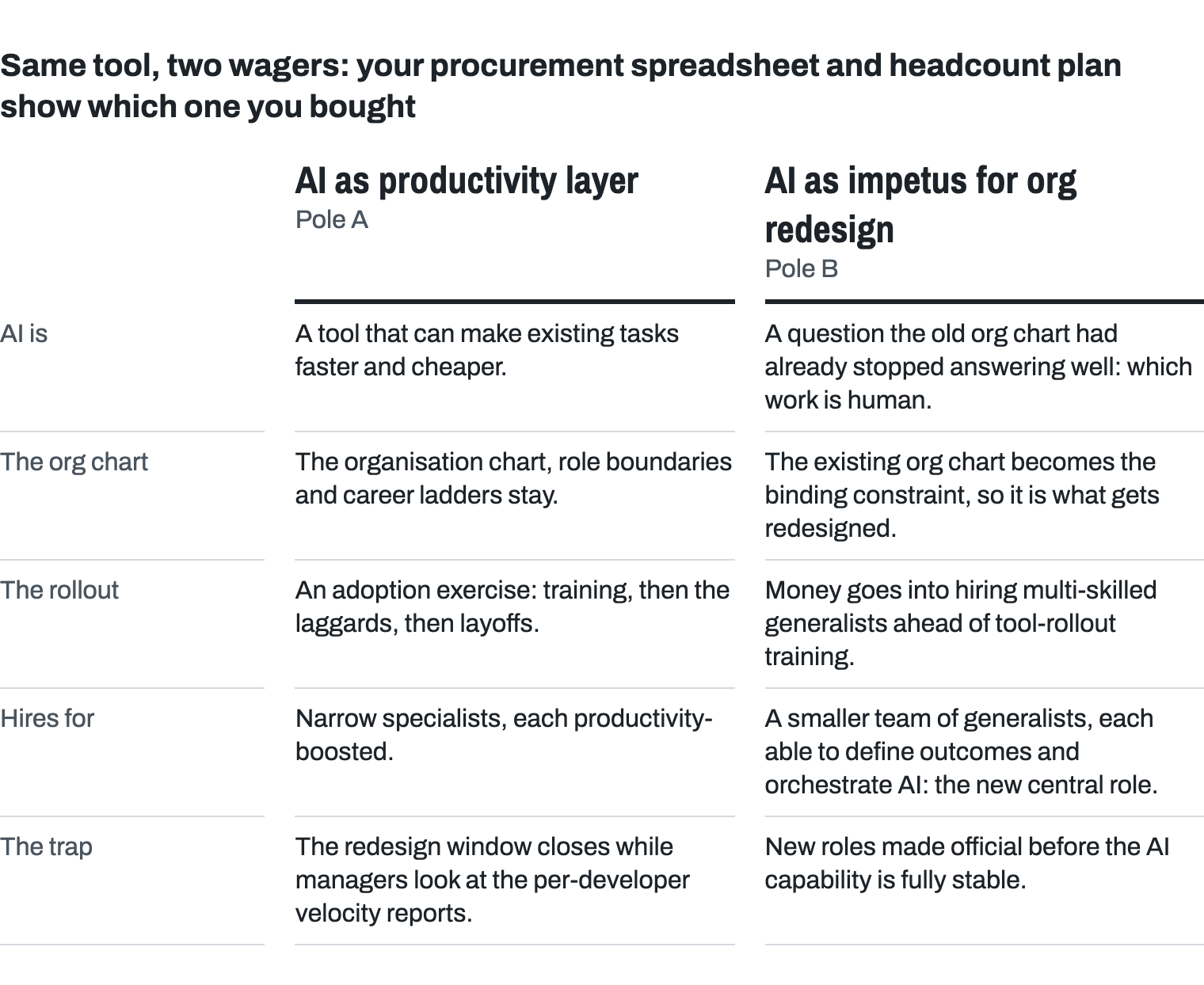
Pole A: AI as productivity layer. AI is a tool that can make existing tasks faster and cheaper. The organisation chart, role boundaries, and career ladders stay. Capable people get more done. Pole A treats AI as an adoption exercise: roll out training to start, identify the laggards, then conduct layoffs to capture the gain as a smaller team hitting the same OKRs.
Pole B: AI as impetus for org redesign. AI surfaces a question the old org chart had already stopped answering well: which work is human. Pole B hires intelligent, independent-minded, liberal-arts generalists who set their own direction, people who can define an outcome, specify the constraints, choose which work goes to AI and which stays human, and verify what comes back. Good taste now matters as much as execution skill. The specialist-scarcity logic only holds while expertise stays scarce, hard to get, and in unlimited demand for that exact skill, and Krivitsky et al. argue in 10X Org that AI dissolves exactly that. Pole B treats the generalist as the new central role.
Where Pole A is right
Pole A is right where the work is genuinely procedural, or where regulatory constraints prevent role redesign inside the planning horizon.
Pole A also fits a specific kind of work. Chapter 1 walked Adam Smith’s 1776 pin factory: identical units, effectively unlimited demand, hyper-specialisation that compounds. AI in a pin-factory context behaves like Pole A predicts: the role exists for AI to make faster and still works after AI makes it faster. The leader doing Pole-A pin-factory work and getting Pole-A pin-factory gains is doing the right thing in the right context.
The reality test for Pole A is whether the work the AI is making faster is actually pin-factory work. Most of the work running through a software-dependent organisation isn’t.
Where Pole B is right
Pole B is right wherever AI has already moved past your org chart’s design assumptions, especially where competitors are redesigning or newly forming. That describes most software-permeated (or software-vulnerable) industries right now.
Krivitsky et al. argue that nobody needs 1,000X more databases. When AI dissolves specialist scarcity, the existing org chart—not the technology budget—becomes the binding constraint. The Pole-A reflex is to consolidate—one “hyper-efficient” DBA for the whole org looks more attractive than ever—which still leaves the org chart in place, just bent the wrong way. Pole A leaders may discover two years late that their biggest cost curve was the incumbent org design itself, with token spend a rounding error against it. By then the redesign is no longer cheap, the Y Combinator startup looms larger than ever, and the window closed while managers were looking at the per-developer velocity reports. Most of what software touches now has a low barrier to entry. This context is so novel that I wonder if any prior moats will be durable unless incumbents build on them with an adaptive org redesign first.
The 10X Org operating-model material describes what the redesigned org chart looks like in practice: broader mandates, smaller teams, more outcome-orientation at the team level, less hand-off and inventory between teams. Jay Galbraith’s Star Model is underneath: strategy, structure, processes, rewards, and people have to move together. Pole A redesigns collapse to terminology and tools, leaving Galbraith’s five points largely where they were. Pole B leaders accept that the AI shift exposes all five points at once.
What the past 18 months show
10X Org made its case in the future conditional: AI-native organisations would outcompete incumbents constrained by industrial-age headcount logic. Among the leaders, that future has already arrived. Anysphere’s Cursor reportedly reached roughly $2B in annualised revenue by early 2026 with a headcount in the low hundreds. The Lean AI Native Leaderboard, on its 2025 reading, benchmarked the top ten AI-native firms at $3.48M of revenue per employee against $610K for the top ten classical SaaS companies, a 5.7x gap among the leaders. Take each figure as a timestamped illustration: the Cursor headcount, the leaderboard’s multiple, the formation rate will all move quarter on quarter. I don’t expect the direction to reverse. New formation as of early 2026 is following the same line, with roughly half of one recent Y Combinator batch building AI-native or AI-enhanced software.
The operating playbook matches what 10X Org prescribed: PM work spread across the builders, no fixed roadmap, the world changing faster than any plan can hold. Sierra’s Bret Taylor puts the incumbent failure mode in one phrase: large companies fail at AI because they are shipping their org charts. The mechanism is Conway’s 1968 law: organisations build systems that mirror their own communication structure. The case that the structure has to change first is this chapter’s, built on that law.
AI capability is jagged
Karpathy’s jagged intelligence names a paradox: the same system operating as a genius polymath in mathematical reasoning and a confused grade schooler in common-sense spatial reasoning. Tasks that feel equally hard to a human can sit on opposite sides of an invisible capability line, and you can’t know which side a task is on without trying it. The redesign question becomes which jagged edge fits which work? That question has to be asked task by task, with empirical testing, in the actual context the work runs in, and the answer changes quarterly.
Karpathy’s vibe coding names the mode; the trap is what you do with it: build by prompt, trust what comes back, forget the code exists. He frames it as floor-raising, and explicitly distinguishes it from agentic engineering, where—his words—you’re still responsible for your software just as before. The Pole-A trap is vibe-coding work that needed agentic engineering: the loose, sketch-driven build ships, and the plausible code didn’t match the actual contract.
Klarna made the same edge-misjudgement at scale, and it is one dated instance of the pattern, not the whole case: it walked back a sweeping AI-for-support move in 2025, its CEO conceding the company had leaned too hard on cost and efficiency and that quality had suffered, and it began rehiring humans for the cases where AI parity hadn’t held. The capability looked sufficient at the edge it was tested against, but the work it was actually meeting lived a few inches further in: the company had automated the cost away without automating the work.
Pole B done well holds the jaggedness explicitly. It asks, for each piece of work being redesigned: which jagged edge are we standing on, how do we test that empirically, and what is our recovery plan when the jagged edge moves?
A worked example: the inverse of NUMMI
GM tried to copy Toyota’s production system at Fremont in the 1980s through the NUMMI joint venture, sending waves of workers to Toyota City in Japan for training. The visible practices on the floor could be photographed and presumably copied in other plants. The invisible system—the supporting management functions, the supplier relationships, the relationship between the Team Member Handbook and daily work—couldn’t be seen, let alone readily transplanted into GM’s existing structure. Ernie Schaefer, the GM plant manager who later tried to replicate NUMMI elsewhere and failed, came to understand why only later, and described it on This American Life’s “NUMMI” episode in 2015:
“You know, they never prohibited us from walking through the plant, understanding, even asking questions of some of their key people. You know, I’ve often puzzled over that—why they did that. And I think they recognized we were asking all the wrong questions. We didn’t understand this bigger picture thing. All of our questions were focused on the floor, you know? The assembly plant. What’s happening on the line. That’s not the real issue. The issue is, how do you support that system with all the other functions that have to take place in the organization?”
Toyota let GM walk the plant freely because the answer GM needed wasn’t on the floor; it was in the supporting system, and GM wasn’t asking about that.
The Pole A leader is asking the GM-1985 question about AI: where on the line can we deploy this? The Pole B leader is asking the question NUMMI itself was an answer to: what does the org have to become for this to meaningfully compound?
Notice, too, how much easier Pole A is to delegate. The CEO can hire a trainer, brief the senior and middle managers, and stand up a rollout without ever changing their own week, let alone the whole org. Pole B has no such proxy. Deming put the responsibility where the systems are: management owns the systems, and therefore owns most of what goes wrong inside them. The redesign reaches the strategy and structure only the CEO owns, so it is the CEO’s own work, and far more of it. That a pole can be delegated at all is a tell that it isn’t touching the system. But in generosity to the CEO the pull toward Pole A isn’t weakness; it is the rational preference for the move you can hand off.
I find this example particularly helpful because it is a case of Pole A failing not for lack of effort or for lack of access. The GM workers were on the floor at Toyota. Toyota answered their questions. The transplant beyond NUMMI largely failed anyway, because the answers were sitting in the supporting system, not on the plant floor, and GM’s supporting system was Pole A’s supporting system. Jeffrey Liker, who has studied Japanese auto manufacturing since the 1980s, was asked on the same episode why GM’s senior management wouldn’t accept that Toyota built better cars: “I think there was pride and defensiveness. I’m proud because I’m the biggest automaker in the world. I’ve been the best. I’ve dominated the market. You can’t teach me anything, you little Japanese company.” The resistance wasn’t only passive. Dick Fuller, who ran IT at NUMMI, remembers a GM manager who toured the plant, went home, and wrote a report that amounted to “won’t work here.” “Part of that,” Fuller said, “was a threat to him. It was a threat to him to see that it was working so well.” This leads right back to Weinberg’s idea in Chapter 1: people can fold 10% into their mental category of “no problem,” whereas anything larger would be embarrassing if the consultant actually pulled it off.
Another change-agent, Jeff Weller, sent in the 1990s to convert plants, was simply thrown out of one: “I was asked in one plant to leave, because they were not interested in what I had to sell.”
The plant manager was king, and the CEO wouldn’t overrule him. The same holds now for AI inside legacy org designs: the tool is on the floor, the supporting system is the org design, and the org design keeps doing what it was built to do.
I suspect most software-dependent organisations in 2026 are still running the GM-1985 playbook: on the floor asking Schaefer’s wrong questions about AI, while the supporting system—the org chart, the career ladders, the approval gates—keeps the existing pattern intact by design.
What your last Tuesday actually shows
GM’s managers walked the NUMMI floor asking the wrong questions because they had already decided what the factory was for. The answers they got were locally correct and systemically useless. The same happens with AI procurement. You can be rigorous about what you bought and still be answering local-optima questions when the context is asking for system solutions.
I built a tool to sharpen incident learning, and it does that: it can articulate a systemic issue more precisely than most review meetings manage. What it cannot do is give a team the authority to change the conditions it has just named. The constraints that mattered were usually well out of reach of anyone in the room, or within one degree of it.
So: three questions for last Tuesday’s AI decision:
Which pole were you claiming? In the deck, the procurement memo, the rollout email, which pole did the language point toward?
Which pole would the implementation actually show? Three months out, does the team (or team-of-teams) become more adaptive, with a broader work mandate, fewer hand-offs, easier to redirect? Or just more efficient at the same work? If it is the second, Pole A delivered what Pole A promised. That describes what was chosen, and it is worth reading as data rather than as a failure.
Which pole does this situation require? This is the Cynefin question. Complex work whose consequences arrive in months calls for Pole B, the redesign. Complicated work with a stable specification makes Pole A a reasonable fit. Most senior-leadership portfolios hold some of both, so the strategic question is the proportion across the whole portfolio, one tool at a time.
The most visible gap sits between question one and question two. Leaders claim Pole B in the deck and ship Pole A in the implementation, and the team sees only the second. That gap is recoverable once you name it: you ran an efficiency play, it worked, and here is what it taught you about the redesign question underneath. The more consequential gap sits between either of those and question three. A leader whose claim and procurement both say Pole A is internally consistent, and may still be inconsistent with a context that has already moved.
The tells live in the procurement spreadsheet and the headcount plan. Pole A signs against hours-saved-per-role tools and reads efficiency dashboards, with an implicit objective of a payroll reduction that dwarfs the rise in token spend. Pole B puts its money into hiring multi-skilled generalists ahead of tool-rollout training, and makes new roles official before the AI capability is fully stable. Both are coherent. Where your three answers diverge is the next conversation to have with the CEO.
For the CTO or VPE: the decision on this axis sits at the strategy and structure layer the CEO owns. What to put in front of them is the procurement spreadsheet and the headcount plan side-by-side with the Pole A / Pole B claim in the last board deck. Put both in front of the CEO at once and ask them to read the gap. Run the same check one layer down on yourself first: do your own hiring plan and engineering ladder ship the pole your strategy deck claims? The gap lands harder upward when you have already closed it in your own house.
Before the meeting, read its history: what happened to the last person who brought this CEO unwelcome news? If the answer is bad, that pattern is the first problem, not this chapter’s. Once you’re in it, go first—disclose your own gap on the same axis, before the CEO’s—with the norm said aloud: nothing here gets used as a club, by either of us. Ask for their account before the artefact comes out. If the CEO defends the gap rather than looking at it, treat that as data rather than proof: test whether you are disagreeing about the facts, the stakes, or the frame itself. Describe what you see, flatly, then stop. As you close, end with a named decision, an owner, and a date; agreement without a date isn’t yet a win.
And if you are the CEO reading this over a colleague’s shoulder: your half is the receiving side. Ask for the story behind the deck, thank whoever went first, and hold the no-club norm yourself. The safety is real only when the most powerful person present refuses to weaponise what’s said.
The CTO’s hiring plan is where this shows up at the role level. Pole-A hiring backfills narrow specialists and adds AI tools: more frontend engineers, more backend engineers, each productivity-boosted. Pole-B hiring inverts it: a smaller team of generalists, each able to define outcomes and orchestrate AI rather than execute against a specification. By the time the redesign window closes, the Pole-A CTO has built a bench of narrow specialists AI is dissolving, and now has to retrain them, lay them off, or watch the AI-native competitor recruit them.
The question to bring is which roles in this company still depend on the narrow-specialist assumption AI is dissolving? For scale, as of early 2026 the top AI-native firms are running several multiples ahead of their classical peers on revenue per employee. This is a CEO decision about what the org is, not a technology decision about what the tools do. The sentence your CEO can carry to the board: “We have been investing in AI tools and not in the org design that makes them pay.”
An exercise: the shadow org chart
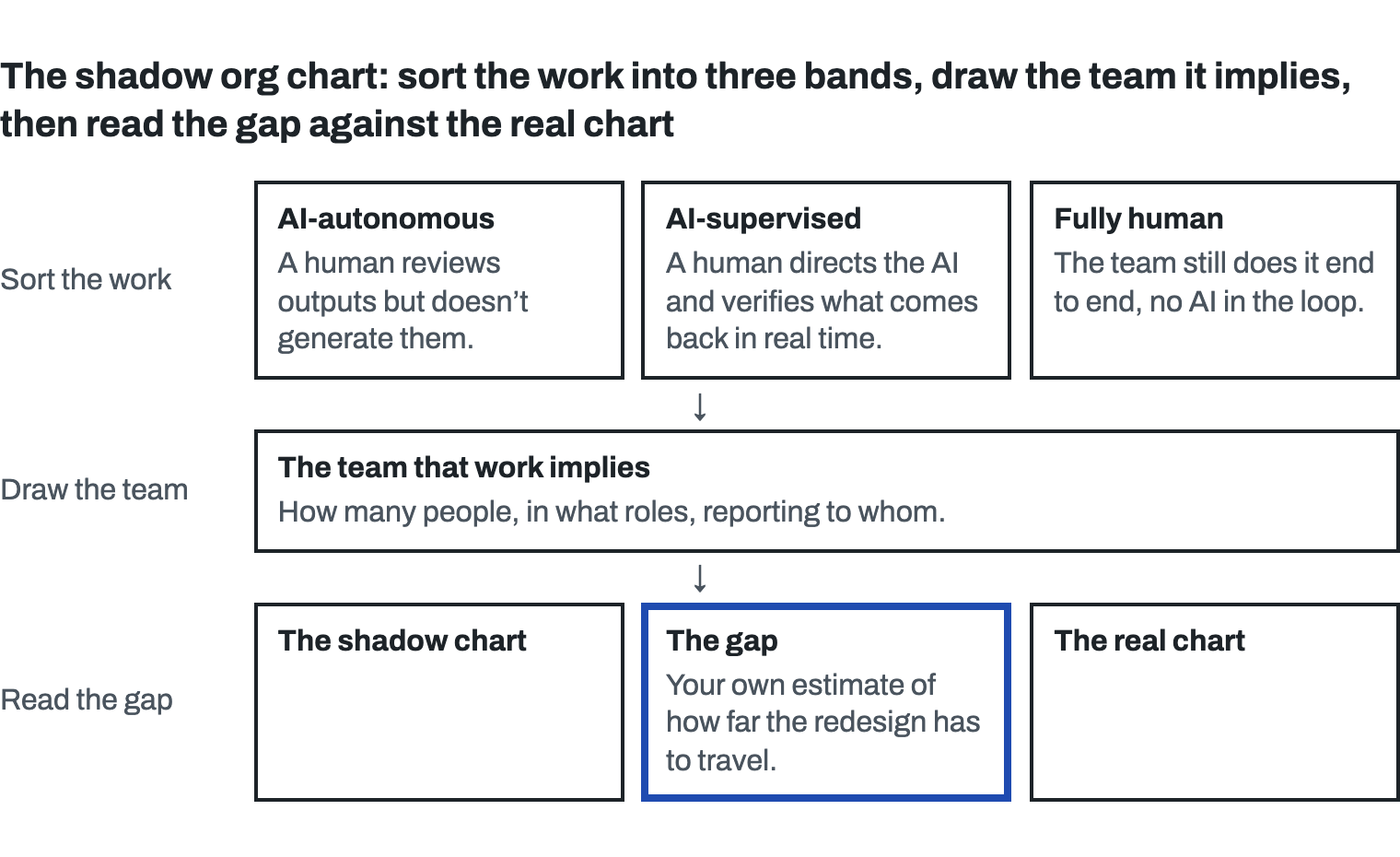
Start with a move you can make tomorrow, alone, without anyone’s permission: take one engineering team or team-of-teams and redraw it on a blank page as if AI capability had been assumed from the day the team was formed. Ignore the current titles, skill sets, and reporting lines. Sort the team’s actual work into three bands: AI-autonomous, where a human reviews outputs but doesn’t generate them; AI-supervised, where a human directs the AI and verifies what comes back in real time; and fully human. Then draw the team that work implies: how many people, in what roles, reporting to whom. Lay the shadow chart beside the real one. The gap between them is your own estimate of how far the redesign has to travel, and you built it without a meeting.
Then ask the second question. For each role that survives, what does the human job on the other side actually look like? Map it: title, career ladder above and below, hiring filter, on-ramp. Expect one of two results. Either the new role doesn’t exist yet in the org chart, and the redesign work begins in earnest. Or it exists, but sits inside a career ladder built for the old role, with progression criteria that still reward the old behaviour. Roles are downstream of strategy, structure, processes, and rewards; the map makes the downstream relationship visible. Be mindful not to lean on existing skill-based roles; consider what skilful generalists with good taste can do.
Then make it shared. Run the map a second time with the CEO against the org chart, without the team present, and name who decides what changes on the back of it and on what timeline. If the answer is the role redesigns, bring it to the team and redo the map with them: the leadership-only version is a hypothesis about work-as-imagined, and chapter 14 explains why it will be wrong about work-as-done. If the answer is the work has dissolved, that is a different conversation that doesn’t belong in this exercise. The team is owed the truth, not an exercise that arrives looking like an ambush. The solo shadow chart is yours to run tomorrow; the shared redesign is a CEO decision about strategy and structure, and the CTO carries the role-bifurcation half.
The cheap mistake is the tokens. The expensive one is the org design you left in place.
Sources for the AI buyer who wants to go upstream
In-text: Krivitsky et al., 10X Org: the structural case behind this chapter, including the specialist-scarcity claim and the nobody needs 1,000X more databases argument. The paradigm-and-identity extension is mine. The Lean AI Native Leaderboard on the 5.7x revenue-per-employee gap. Ernie Schaefer’s account of why the NUMMI transplant failed, and Jeffrey Liker on the pride and defensiveness he saw in GM’s senior management, both from This American Life’s “NUMMI” episode (2015). Andrej Karpathy’s 2025 LLM Year in Review for jagged intelligence, vibe coding, and agentic engineering, plus his Software 3.0 framing from his Sequoia AI Ascent interview. Bret Taylor on companies shipping their org charts.
Also touched: Jay Galbraith, Designing Organizations, on the Star Model: strategy, structure, processes, rewards, and people moving as one.
Go deeper: Watch. Craig Larman, Craig Larman’s Take on 10X ORG: Why He Thinks This Book Matters (5 min), names the dichotomy directly: Pole A as the cost-curve trap, where AI is cheap, always-on labour and a human who offers only a 10% improvement won’t compete; Pole B as the 10x redesign claim, with 10xOrg, Org Topologies, and Large-Scale Scrum (LeSS). Read. Org Topologies (start with their primer) on the operating-model maps that go with the redesign. On the macroeconomic frame, Daron Acemoglu and Simon Johnson, Power and Progress, and Acemoglu’s The Simple Macroeconomics of AI (2024 paper), whose “so-so automation” names the Klarna pattern above. Ethan Mollick’s Co-Intelligence for the practitioner-side empirical material and the jagged frontier framing folded into Karpathy above. Conway’s 1968 law, that organisations design systems mirroring their own communication structure, behind Taylor’s phrase. Cursor’s Head of Design Ryo Lu on how the work actually runs, in his November 2025 interview with Peter Yang, as reported by DevClass: a lot of the PM jobs are spread across the builders in the team, and no fixed roadmap because the world is changing faster and faster, there’s new models dropping every day. Further AI-native revenue datapoints: Sierra at $100M ARR in 21 months on outcome-priced agents, ElevenLabs past $500M ARR in early 2026 with about 530 people, and the W26 batch analysis counting half the companies as AI-native or AI-enhanced. Klarna’s walk-back: it had replaced the equivalent of some 700 support agents with an AI assistant before reversing in 2025.
If the expensive mistake is the org design you left in place, that same design is deciding how fast work moves through it. “Keep everyone busy” feels like responsible management. In high-variation work like software it slows the whole system down hard, and the maths that proves it takes minutes to learn. Chapter 4 shows you that curve, and where your own org chart already sits on it.
I work with engineering leaders on exactly this kind of paradigm work, the deeper the better. If it’s live for you, I’m happy to talk: schedule a 30-minute virtual coffee at hi.chrisgagne.com.
Some book links here are Amazon affiliate links; if you buy through them I may earn a small commission, at no cost to you.