Espoused theory vs theory-in-use (Model I vs Model II)
You judge yourself by your intentions. The people around you judge you by your decisions when emotions and the stakes are high. They have better data.
Every other paradigm dichotomy in this series can be self-reported into the flattering pole. Only the gap between what the leader says they believe and what they observably did—under pressure—offers data the leader didn’t already have.
Chapter 4 sat with the gap between utilisation and flow: we say we want efficiency, then keep everyone busy, and a system where everyone is busy but nothing reaches the user isn’t efficient at all. The same gap shows up inside the leader, between what they say they value and what they observably do under pressure.
🎧 Prefer to listen? This chapter is narrated in my own voice, via ElevenLabs on Spotify, about 21 minutes. Listen on Spotify →
The two poles
Pole A: espoused theory. The leader’s stated principles, values, and intentions are taken as the relevant data. When results miss the target, change the action while leaving the underlying assumptions intact. Under threat or embarrassment, what Chris Argyris called Model I governs: be in unilateral control, win rather than lose, stay rational, suppress the negative feeling. And the action that follows from those values: protect others from discomfort by telling them what they want to hear. “The problem is not me, but you,” as William Noonan renders the inner monologue in Discussing the Undiscussable.
Pole B: theory-in-use. The leader’s actual behaviour—especially under threat or embarrassment—is taken as the data. The gap between espoused and in-use is diagnostic. Under threat, Model II is the aim: valid information, free and informed choice, and the responsibility to monitor what the choice produces. Aggressive and vulnerable, in Argyris’s phrase. Strong advocacy paired with genuine inquiry into one’s own contribution. William Noonan, working in the same lineage, gives the stance four thought enablers, starting with assuming the partiality of your own view. The conversation later in this chapter, when the answer stings, runs all four.
Two of Argyris’s distinctions travel together on this axis, and it helps to keep them apart. Espoused theory versus theory-in-use is about evidence, meaning which account of you counts as the data. Model I versus Model II is about the values actually steering you. Model I is itself a theory-in-use, and it’s most people’s: when people give or hear advice, Argyris found, they have Model II’s consequences in mind, but “when they act, however, almost all act consistently with Model I.” The axis pairs the two because treating your behaviour as the data is the only way to find out which model is running.
Where Pole A is right
Pole A does real work in external communication. Principles need to be stated clearly, and an organisation needs them on the record. The values poster on the wall isn’t lying, even if it doesn’t tell the whole story. Pole A is the leader naming what the organisation aspires to. The leader who refused to state aspirations because they couldn’t guarantee perfect alignment with behaviour would be over-correcting. The stated principles are the target the organisation aims for.
Pole A also holds in the founder-vision frame. The first year of any new organisation often runs on what the founder says they intend, because in small companies it remains possible to shape culture directly. The Pole-A move there does exactly what it is supposed to do. It sets the orientation the behaviour will eventually be measured against.
This matters here because Pole A is what most leaders were trained to operate by. The MBA programme, the leadership-development workshop, the board-prep coaching all teach Pole A. The leader who came up through those teachings isn’t naïve. They are doing the discipline they were taught, which was sufficient for the contexts those teachings were built for. The test is whether the contexts the leader now meets are still those contexts.
Where Pole B is right
For the leader’s own self-assessment. For any conversation where defensive reasoning is already running and the next decision will repeat the last one unless the gap is named. Revisit one of these conversations later and you may find Pole A was running underneath your Pole B account in at least some of the territory.
Self-assessment without Pole B just restates the espoused theory and treats the restating as data. The leader who concludes from self-reflection that they are still operating from their stated values has, by definition, not done Pole B’s work. Pole B’s work begins when someone else, or some recording of the behaviour, surfaces a behaviour the leader didn’t recognise as their own.
The Argyris three-step is the daily mechanism. Under threat or embarrassment, bypass the threat. Don’t name the elephant. Then cover up the bypassing: act as if nothing was bypassed. Then cover up the covering up: treat the act of acting-as-if as natural rather than as itself an avoidance. By step three, the organisation has lost access to its own behaviour. The leader running the three-step isn’t pretending. They are skilled. The steps are automatic, while the leader remains unaware they are producing them.
This is what Argyris called skilled incompetence: people become expertly bad at uncomfortable conversations. The fluency is what makes the incompetence durable.
I suspect the most fluent skilled-incompetence partner a leader now has is a large language model. Give it one side of the story and a prompt that asks whether you were right, and its agreeable defaults do the rest: trained to please, rewarded for the answer that lands well, never tired and never embarrassed. What comes back is your own defence, polished and returned as analysis. Anthropic’s own sycophancy research found the pattern across five frontier assistants and traced it to the training signal: matching the user’s stated view is one of the strongest predictors of which answer a human rater prefers. The witness round later in this chapter exists because people flatter under threat. The model flatters faster, at scale, on demand, and it never gets uncomfortable enough to stop. It is the espoused-theory mirror the leader was already prone to, now automated and always on.
You can configure it the other way, of course. Prompt it to disagree, ground it in a corpus you trust, and it will push back all day. But a model pushing back from a source you haven’t learned to judge only gives you a confident answer pointed somewhere, with no way to tell a good direction from a bad one. Choosing the corpus the model should trust, and knowing when its disagreement is worth more than your own, is the paradigm-level judgement no configuration supplies. That judgement stays scarce.
The ladder of inference
The ladder is the cognitive mechanism running under the three-step. Argyris drew it. Others draw it with different rungs, but the shape is shared. In Rick Ross’s rendering for The Fifth Discipline Fieldbook, we observe a fragment of someone’s behaviour, select what to attend to, and add meaning to it. From the meaning we make assumptions, and from the assumptions we draw conclusions. The conclusions harden into beliefs, and we act.
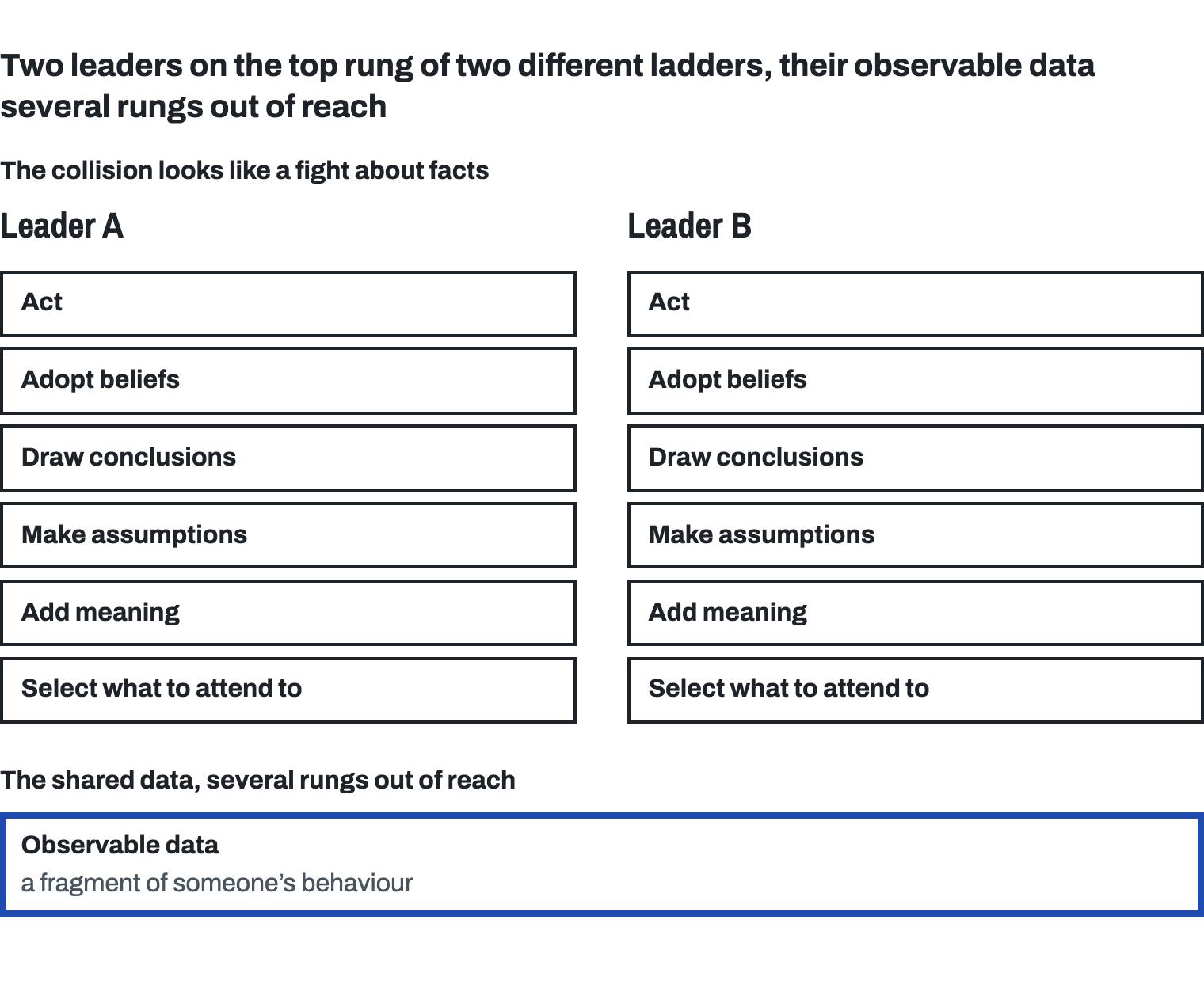
By the time we are acting, the original observable behaviour is several rungs down a ladder we built ourselves, mostly invisibly, mostly automatically. Most leadership disagreements are collisions between two leaders standing on the top rung of two different ladders, their observable data several rungs out of reach. The Pole-B move is to walk back down the ladder, name the rungs out loud, and check whether the observable data still supports the action when the meaning is exposed for inspection.
Most leadership disagreements are collisions between two leaders standing on the top rung of two different ladders, their observable data several rungs out of reach.
This is the operational discipline of the chapter, and the hardest to install. The defensive routine speeds up at the moment of threat. The ladder gets climbed faster, with fewer checks, when the stakes are higher. The Pole-B move is to slow down exactly when the leader most wants to accelerate.
Snook’s practical drift
Scott Snook’s Friendly Fire is the multi-level version of the gap, at organisational scale. Snook reconstructed the 1994 incident in which two U.S. Air Force F-15s shot down two U.S. Army Black Hawk helicopters over northern Iraq. At cockpit level, the pilots followed their training. At unit level, the AWACS crew—the airborne radar post that coordinates the air picture and the aircraft moving through it—had no procedure for the situation and ran on local norms nobody had examined. At organisational level, the helicopter detachment had never been integrated into the fighter operation: different briefings, different radios, different codes. Reading across the levels, Snook found a whole system producing what he named normal behaviour, abnormal outcome.
Snook’s term for it is practical drift, “the slow steady uncoupling of local practice from written procedure” in his words. It is the shift from work-as-imagined to work-as-done. It is what the organisation actually does, week by week, as the procedures designed for an idealised version of the work get adapted by the people doing the actual work. The gap is the organisational design. Everyone in the organisation is competent and doing their job. The system, at the cross-level, still produces a friendly-fire shootdown.
Sidney Dekker calls the same macro pattern drift into failure: complex systems slide toward the boundary of safe operation in small, locally rational steps. The same gap opens in software: the runbook nobody has followed in full since the last incident, because the incident taught everyone a faster path that never got written down. Left unexamined, the same local adaptation is what Snook watched become drift. The gap between work-as-imagined and work-as-done is the organisation’s actual operating system, and pretending otherwise is what produces the friendly-fire outcome.
Use the Kegan-Lahey Immunity Map
Robert Kegan and Lisa Lahey’s four-column Immunity Map, introduced in chapter 2, is the developmental face of this gap: a sincere commitment to a goal sitting on top of a hidden countervailing commitment to self-protection, sustained by big assumptions held as fact.
The Immunity Map isn’t a quick diagnostic the leader can knock out between meetings. It is a developmental exercise worked over weeks, and Kegan and Lahey offer the choice of company plainly: solo with their structured prompts, with a partner, or with a coach. The solo path can still be helpful, though it can also reinforce the same beliefs. The commitment is hidden from the same person trying to surface it, and a witness catches what the solo work can easily bypass. Run it alone for now if alone is what you have; but bring the columns to someone who watched you before you trust them.
The gap resists self-report: the same thinking that produced it edits the account in its favour. A witness, or a recording, is what that editing can’t reach. Listening back to recordings of my own coaching, I heard a move I’d never caught live: when a client touched something real, I sometimes went to the next question within a beat or two. My stated principle was to track and stay. The recordings showed a reflex to fix, arriving where the other person’s process looked hardest. That is why Pole B has to be relational.
The gap is a fact about how cognition is built, not a moral failing. Pole B can feel like an attack on values. Its narrower claim is that behaviour under pressure is stronger evidence of the operating system than stated values.
In decisions: last Tuesday
Pole A leaders judge themselves by their intentions, run after-action reviews on the what, and end disagreements with a winner. Pole B leaders judge themselves by recent observable interactions, run after-action reviews on the what we believed coming in, and end disagreements by asking which observable example would change the other person’s view, and whether the same example would change theirs.
The two postures look similar from outside until the moment of threat. The leader running Pole B in calm conditions sometimes slips into Pole A under pressure and doesn’t notice. The leader running Pole A in calm conditions doesn’t have the Pole B move available under pressure; it isn’t in the muscle memory. The gap-detection itself requires Pole B, which means the leader running Pole A can’t self-diagnose into Pole B without an external mirror.
This is the one axis a CTO or VPE can’t route to the CEO by forwarding a chapter, because the espoused-versus-in-use gap only surfaces in an external mirror. So open with your CEO on a recent decision where what they said they valued and what the organisation observed diverged, not on the framework. Put one specific observable example from the past quarter in front of them, described in behavioural terms, without blame, and ask a genuine question: what were you trying to do in that moment, and what did the team see? That is the witness round the chapter names. You are the witness. The sentence your CEO can carry to the board: “People follow what we did last quarter, not what we said at the all-hands.”
The diagnostic move
Three questions for last Tuesday’s hard conversation.
What was I claiming I believed about the right way to handle this? State the principle, briefly, in one sentence.
What would a colleague who watched me say I did? Not what I intended. What was observable. One sentence.
Which one would the situation actually have asked for, if I had run Pole B? A Pole B response under threat looks like I think X; I notice I’m running it confidently; what would change my mind? Was that available, and did I take it?
The gap I see most often is between question one and question two. The leader’s stated principle was Pole B. The observable behaviour was Pole A.
The exercise: the witness round
Pick three or four people who watched you make recent decisions in a territory you care about, and send them the same question. Ask it in plain behavioural terms, because they haven’t read this book and don’t think in poles: in our last three meetings about X, what did you actually see me do when the pressure was on, and did it match what I said I wanted? One sentence each is enough. Compare their answers to your own.
The gap, when it appears, is the data the leader’s self-assessment couldn’t have produced.
Pick people who watched the decisions, not people who agreed with the decisions. Pick people who are senior enough to tell you the truth, not people who will soften the answer to spare you. And pick an axis you are willing to be wrong about. The witness round on an axis the leader is determined to have already nailed produces no signal, because the leader’s response to any contradicting data will be to reject the witness, and the round will have been theatre rather than diagnostic.
One gate before you send anything: the round’s validity depends on a climate you built before you asked. Run the bad-news check from chapter 2 first—when someone brought you bad news this quarter, what happened to them?—because if the real answer isn’t anything good, the witness round will only collect politeness. Two or three items from Amy Edmondson’s seven-item psychological-safety scale, asked anonymously, give you a read on whether the channel is open: whether a mistake on the team gets held against you, and whether members can bring up problems and tough issues. Read a unanimous no-gap result as ambiguous rather than as a clean bill: it means either there is no gap, or your witnesses are afraid to tell you. A unanimous result tempts us to call the channel healthy; treat that confidence as one more reading, not as proof.
The leader who runs the witness round straight, and runs it regularly on different axes, will build a mirror for themselves that the immune system can’t fully control. To keep the mirror from decaying between rounds, give its output somewhere to live: a recurring slot in the staff meeting—what did the dissenter say this month?—or a blameless channel where near-misses and contradicting observations arrive without an invitation. The quarterly round feeds the standing structure; it can’t substitute for it.
When the answer stings
The witness round earns its keep on the day the answer is one you don’t want. This is a composed conversation, built to show the moves rather than transcribed from a single session.
The claim, from column one of chapter 2’s Immunity Map: I delegate the architecture calls. The witness’s answer might be: You ask for our recommendation, and then you re-decide it in the meeting. We’ve stopped writing the recommendations carefully, because we know they aren’t the decision.
When this lands on me, first comes heat, before any thought. Second comes the silent rebuttal, fully formed: that’s not fair, I re-decided twice all quarter, both times for good reasons, he’s conflating two different meetings. Third comes the reflex the heat is funding: explain the two meetings. That third move is the bypass. It converts the witness’s data into a charge to be answered, and the witness learns what every team learns from a defended leader: don’t say the true thing twice.
The move that holds the round open instead, in words:
“So when I asked for the recommendation on the queueing redesign and then changed it in the meeting, that read as the pattern: the recommendation isn’t the decision. Have I got that right, or would you change it?”
Paraphrase first, in their terms, low on the ladder. Then the test.
“That’s it. It’s not that you change them. It’s that we can’t predict which ones you’ll change.”
New data. Your version had the count: twice. The witness’s version had the variable: unpredictability. The defence would have argued the count and never surfaced the variable.
“I didn’t know the unpredictability was the cost. I can’t promise never to re-decide; sometimes I’ll have context you don’t. What would make that visible before the meeting instead of inside it?”
Name your own constraint plainly. Then put the design question where the information lives.
You feel the heat and hold it, then paraphrase and put it to the test. You receive the correction, and you design forward together. Running all four concedes nothing about whether you over-decide; the moves ask you to find out what the witness actually saw, which was never quite the thing the heat said was being alleged. The failure version is one move long: “that’s not what happened.” It feels like accuracy. It is where the data stops.
Going upstream
In-text: Chris Argyris, Overcoming Organizational Defenses (Model I/II, the three-step, skilled incompetence, and the ladder of inference). Robert Kegan and Lisa Lahey, Immunity to Change, for the developmental side. Scott Snook, Friendly Fire, for the organisational-level version and practical drift. Peter Senge, The Fifth Discipline Fieldbook, for Rick Ross’s rendering of the ladder.
Also touched: William Noonan, Discussing the Undiscussable, in the Argyris/Schön/Action Design lineage (“the problem is not me, but you” and the four thought enablers). Sidney Dekker, Drift Into Failure, on locally rational drift toward the boundary. Amy Edmondson, “Psychological Safety and Learning Behavior in Work Teams” (Administrative Science Quarterly, 1999), for the seven-item scale two of whose items the witness-round gate borrows. Mrinank Sharma and colleagues, “Towards Understanding Sycophancy in Language Models” (Anthropic, 2023), for the finding that five frontier assistants all run sycophantic and that matching a user’s view predicts which answer human raters prefer.
Go deeper: Charles Perrow, Normal Accidents, supplies the structural precondition: systems that are both interactively complex and tightly coupled turn small local adaptations into catastrophic outcomes. The U.S. Marine Corps MCDP-1 Warfighting supplies the doctrinal version in full: the local adaptation built in on purpose before it has a chance to become drift.
Watch: Roderic Yapp, Double-loop learning: a case study from the front-line (TEDxWandsworth, 17 min). Two front-line case studies, Afghanistan platoon houses and a mental-model challenge, that name the espoused/in-use gap directly. Companion: Chris Argyris, Chris Argyris Talks About Culture and Management (4 min). The framework’s primary author in his own voice, defining theory-in-use and running the canonical bypass the threat, cover up the bypassing, cover up the covering up sequence.
That gap between what you say you value and what you did under pressure sits in the leader. The same gap opens inside the change programmes you run. You sign the policy, deliver the training three times, stand up a scorecard, and still the one behaviour it all exists to produce, engineers flagging risk early, won’t hold. Every tightened deadline punishes it. Careful practice goes first. Chapter 6 asks what your organisation does to the engineer who stops the line the Tuesday the plan goes before the CEO.
I work with engineering leaders on exactly this kind of paradigm work, the deeper the better. If it’s live for you, I’m happy to talk: schedule a 30-minute virtual coffee at hi.chrisgagne.com.
Some book links here are Amazon affiliate links; if you buy through them I may earn a small commission, at no cost to you.