

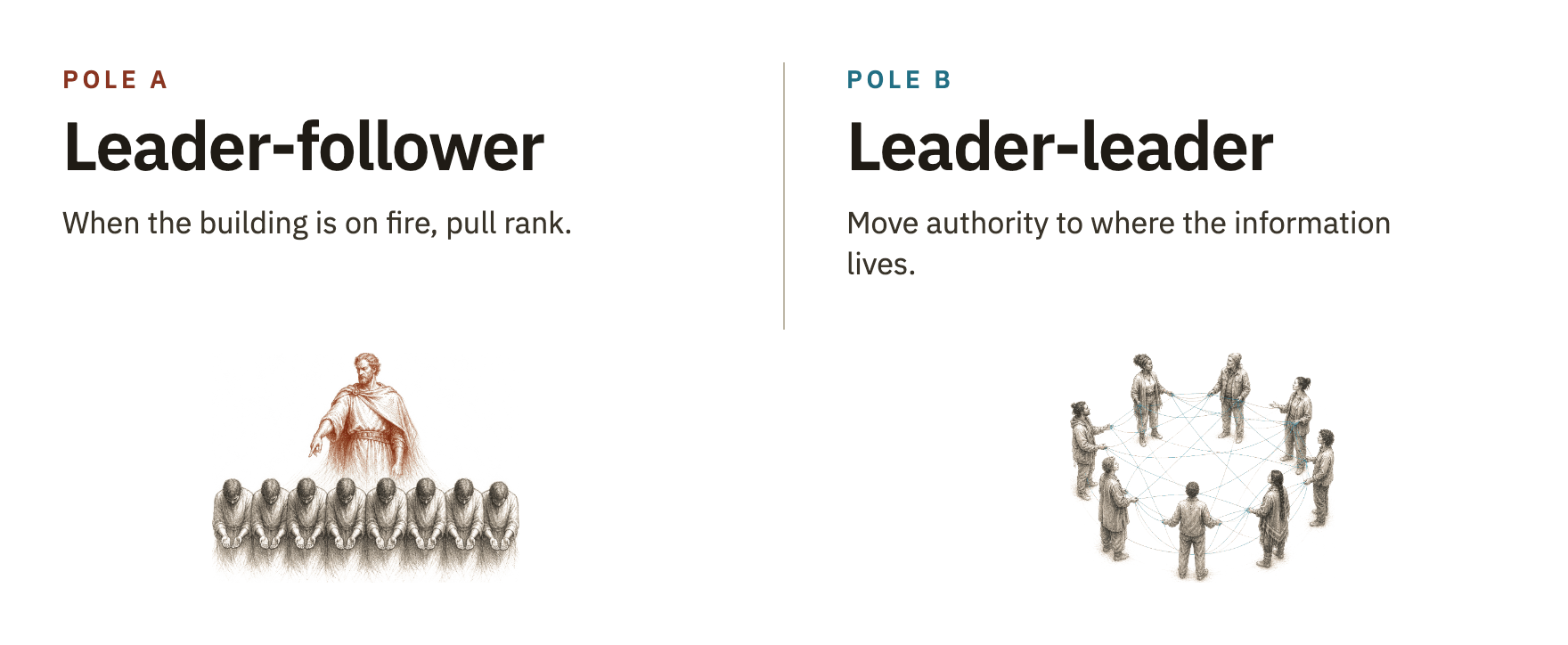
You spent Tuesday in approval meetings. You spent Wednesday wondering why your team can’t make a decision without you, and why the function still can’t ship faster. The structure is leader-follower, all the way down.
Chapter 16 named the discipline of small batches and pull. This chapter asks who holds the authority to decide what gets pulled, because most software organisations route every non-trivial decision through the senior person’s calendar.
The Tuesday calendar is the visible artefact. The Wednesday frustration is the felt consequence. Between them sits a paradigm so habitual that the people inside it usually can’t see it as a paradigm: authority lives with the senior person at each layer, subordinates seek permission, orders are detailed, and the senior person’s bandwidth is the rate limit of the whole layer below.
Marquet calls it leader-follower.
This industrial-management inheritance remains the default. I suspect most software-dependent organisations run it across at least one major function without anyone at the executive level recognising it as a paradigm rather than the way things are.
The other pole exists. David Marquet, who took command of the USS Santa Fe in 1999, a submarine with the worst retention record in the force, gives it the operational name leader-leader. Authority lives where the information lives. Subordinates state intent. The leader replies Very well. Orders carry purpose and constraints, and the team chooses the action.
Marquet was the captain. His executive officer, the XO, ran the officers; his chief of the boat, the COB, was the senior enlisted man aboard and ran the chiefs. The crew did the work. The captain’s job was to mandate the structural shift, model the language, and refuse to make the decisions the captain shouldn’t be making.
In 1998, the year before he arrived, the boat had re-enlisted three sailors out of a crew of 135. In Marquet’s first full year it re-enlisted 36, and by 2001, the last year of his command, it had earned the highest grade on its reactor-operations inspection that anyone had seen. The book’s afterword reads like a command roster: officer after officer of that wardroom went on to command submarines of their own. Santa Fe shifted from one leader and 134 followers to 135 leaders.
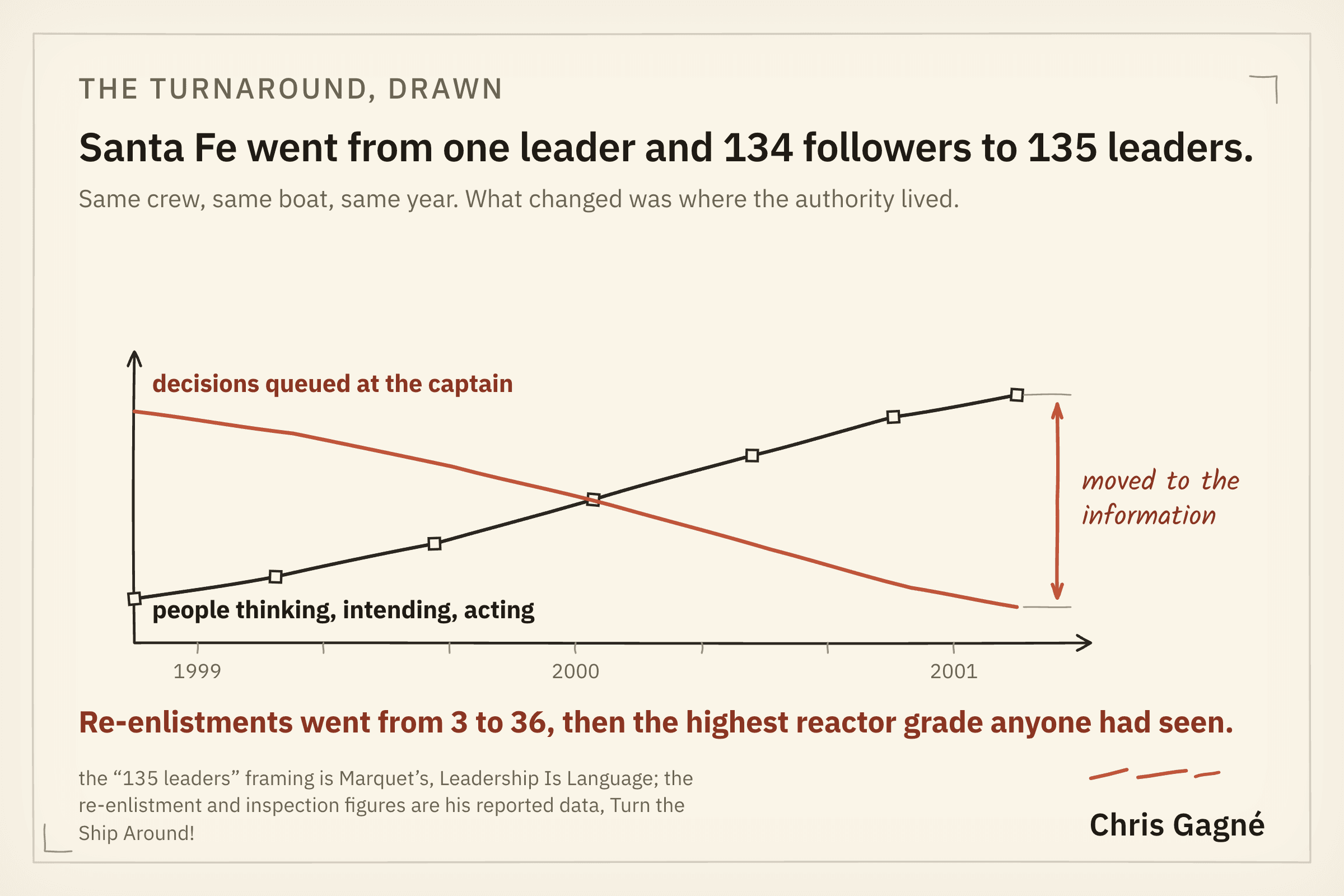
This chapter is about the move at the executive level. Marquet’s captain is the CEO. The XO and COB are the senior leadership team: the CTO, the VPE, the heads of function. The crew is the rest of the organisation.
An organisation-wide, durable shift usually requires CEO participation.
The CTO who tries alone usually produces leader-leader inside one team while the surrounding structure pulls it back at the next reorg or budget cycle. Santa Fe is the exception the In-decisions section leans on, and it took Marquet doing it from the middle.
The two poles
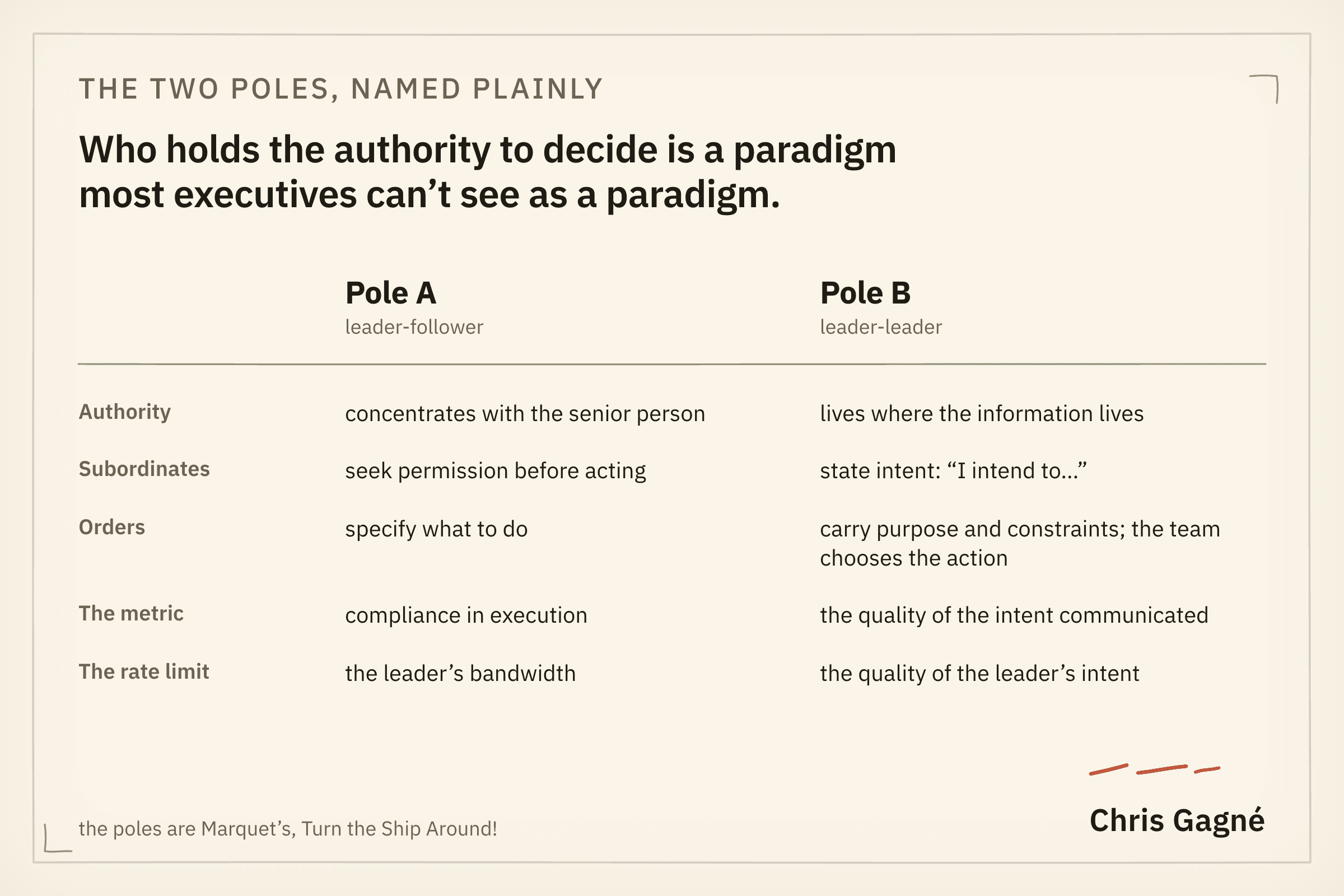
Pole A: leader-follower. Authority and decision rights concentrate with the senior person. Subordinates seek permission before acting. The leader spends Tuesday in approval meetings because the structure requires the approvals. Orders specify what to do. Compliance is the metric of execution. The leader’s working day fills with decisions that arrived at the desk because no one else had the authority to make them. The bandwidth of the leader is the rate limit of the team.
Pole B: leader-leader. Authority and decision rights live where the information lives, which is almost never with the senior person. Subordinates state what they intend to do. The leader communicates purpose and constraints, not action.
Marquet’s specific protocol is “I intend to…” The officer or sailor states what they’re about to do. The captain says Very well.
Marquet frames the shift as three replacements: trading pressure and conformity for clearly stated intent, swapping the urge to prove oneself for improving and learning, and giving up the show of certainty for openness and curiosity. Subordinates aren’t waiting to be told. They are thinking, intending, and acting. The leader contributes through the quality of the intent they communicate.
Marquet calls this moving authority to the information rather than moving information to authority.
Where Pole A fits
Pole A isn’t a mistake and fits a specific kind of situation.
Genuine emergencies. The fire on the bridge. The outage at 3 a.m. that has the customer’s revenue line on the floor. The litigation hold that requires a single decision-maker with counsel within the hour. These are the conditions Marquet himself names as the exception: “emergency situations require snap orders.” Marquet himself reserved the authority to fire weapons because he didn’t want the conscience of taking another human being’s life on anyone’s mind but his.
The vast majority of situations don’t require immediate decisions. Some do. A leader who can’t pull rank when the building is on fire is running a different failure mode.
Competence not yet built. A new team may not have the competence Marquet names as the second pillar of leader-leader. “Control without competence is chaos.” When the technical understanding needed to make a decision well isn’t yet present in the team, the leader doesn’t get to delegate decisions that depend on that understanding. The work is to build the competence. Until then, the structure holding the work sits closer to Pole A than Pole B.
Speed over quality. Some decisions need to be made now and don’t need to be optimal. The leader’s signature unblocks the work. “A little rudder far from the rocks is a lot better than a lot of rudder close to the rocks,” Marquet writes. But rocks exist, and sometimes a lot of rudder is the right move.
Respect those situations. Pole A fits them.
Much of the calendar of most senior engineering leaders, however, is filled with approval-type meetings that reflect none of the above. Those meetings come from a structure that hasn’t been redesigned for the work the team is actually doing.
Where Pole B fits now
Three changes have broadened Pole B’s fit.
First, the information has dispersed. The senior engineering leader 15 years ago could plausibly hold the whole technical surface of a small company in their head. Today, in any organisation past about 30 engineers operating across cloud, data, and AI layers, nobody holds that surface any more. The information lives where the work happens. Authority that doesn’t live there is making decisions on stale, limited data.
Second, the speed of consequence has risen. The interval between we made the decision and the consequence is visible in production has compressed from quarters to weeks and, in many cases, days or even hours. The Pole A bandwidth—every non-trivial decision queueing at the leader’s desk—was already slow when the consequence cycle was quarterly. With a daily consequence cycle, the leader can’t gate every decision and still ship.
Third, AI agents in the loop change the scaling maths of authority. A leader running leader-follower with AI agents is asking the agents to wait for approval on actions the leader isn’t equipped to judge quickly enough. A leader running leader-leader with AI agents communicates purpose, constraints, and antigoals, then lets the agents—and the humans working with them—choose the actions. The right model supplies the competency, the harness context supplies the clarity.
The quality of the leader’s intent becomes the variable that scales.
An agent does twenty minutes of work, then waits a day for the approval, because the person who has to give it moved on to something else and won’t be back until tomorrow. The gate costs twice. It costs the wait, and it costs the leader the practice: the routine calls that built the judgement now go to the agent, and the leader who kept the approval kept only the accountability. Marquet’s word for the counter-move is connect, and the psychological-safety section below is what makes it possible.
The doctrine is older
Marquet didn’t invent Pole B. He made it work inside a US nuclear submarine.
Military practice had already named the move under the heading of mission tactics: specify the mission and desired end-state, leave the action to the people closest to it, and accept that detailed plans go useless on contact while the intent survives.
Commander’s intent—a crisp statement of the goal that never specifies so much detail that unpredictable events render it obsolete—is the operational name for the language move that makes Pole B work.
Credit, blame, and visibility all centralise under Pole A. If you are being promoted on the decisions that carry your name, the case for leader-follower writes itself. John Boyd used to put the choice to his protégés as a fork in the road: you can be somebody, taking the rank and the position and the rest of what the system hands out, or you can do something, which usually costs you the first. Pushing authority down is the second road. It gives away exactly the visibility the promotion runs on.
McChrystal: the contemporary case at scale
Stanley McChrystal gives us the contemporary case for leader-leader at scale in his account of the Joint Special Operations Task Force in Iraq from 2003 to 2008, written with Tantum Collins, David Silverman, and Chris Fussell in Team of Teams.
The Task Force began as what McChrystal calls an awesome machine, a Taylorist clockwork that synchronised intelligence, operations, and analysis with assembly-line precision. It was superbly tuned for the world it had been built for. Al Qaeda in Iraq was defeating it through a network whose decentralised decisions ran at a tempo the Task Force couldn’t match.
McChrystal’s two-part response carries the same teaching at the scale of a 7,000-person organisation in active combat.
Shared consciousness: information transparency across teams, with the daily Operations and Intelligence brief eventually attended by all 7,000.
Empowered execution: decision authority pushed to the level closest to the action, under a rule of thumb McChrystal describes this way: if something supports our effort—as long as it is not immoral or illegal—you could do it.
This wasn’t the absence of leadership.
The scaling problem he names—too many decisions, too fast, with information distributed in ways the leader can’t hold—is the one AI is now laying bare inside software organisations. Authority that lives with the leader scales linearly with the leader’s bandwidth. Authority that lives where the information lives scales with the quality of the intent the leader can communicate.
Authority that lives with the leader scales with the leader’s bandwidth. Authority that lives where the information lives scales with the quality of the intent the leader can communicate.
McChrystal had five years of command inside active combat to make the move. The CEO usually has a less unforgiving deadline, but the structural argument is the same. The move is the CEO’s to make, not the CTO’s.
The cockpit-gradient story chapter 1 named via Korean Air 801 is the same move in another institution: lower the authority gradient so the first officer can call a missed approach without the captain’s permission.
The cautionary case: Snook on the fallacy of social redundancy
Delegation without the intent contract isn’t leader-leader. It is delegation theatre.
Scott Snook names the failure mode directly. The fallacy of social redundancy is the assumption that adding more people to a decision automatically adds reliability. It doesn’t. If the structure doesn’t specify how the people share information, decide, and commit, adding them adds confusion, not safety.
The leader who reads Turn the Ship Around! and concludes that the move is to stop giving orders is reading half the book. Marquet’s second pillar—competence—is the part that gets skipped. As Marquet puts it, control handed to people who lack the competence to use it well produces chaos, not leadership.
The leader-leader move depends on technical and operational understanding being present in the people closest to the work. Where years of leader-follower structure have taught people not to think, the move must develop competence while the structure shifts. This isn’t a single decision made on a Tuesday morning. It is a programme of work that takes years.
Snook’s caution is practical. A leader who delegates without the intent contract, competence-building, language discipline, and the psychological safety to exercise nominal authority produces a worse outcome than one who keeps the authority Pole B requires more discipline than Pole A.
Marquet’s mechanisms—21 specific moves
Marquet’s first book names 21 specific mechanisms that made leader-leader work on Santa Fe: eight control mechanisms (the divest-and-distribute moves), five competence mechanisms (build the technical understanding authority depends on), seven clarity mechanisms (make sure people know what we are trying to do), and a closing 21st that stands outside the pillars.
Two show how small changes rewrote authority.
Find the genetic code for control and rewrite it. Marquet’s chiefs admitted they didn’t run the ship; he asked whether they wanted to. What they came back with was a signature. A leave chit is the form a sailor fills in to ask for time off, and Navy regulations said the XO signed every one. So a junior sailor’s request for Christmas leave collected seven signatures on the way up, four along his own enlisted chain and three more from the officers above it, then travelled back down again. Fourteen steps, on a form printed with five signature lines. Marquet found one of those requests sitting in an inbox while the sailor waited to learn whether he could book a flight home. The chiefs’ proposal was to strike XO from the regulation and write in COB, which moved the last signature out of the officer chain and into their own. One word. Marquet calls that word the genetic code.
It didn’t stay one word. The chiefs could only own leave planning if they owned the watch bill, the roster that says who stands which watch and when. They could only own the watch bill if they owned qualification, the process that decides who is certified to stand each station at all. Managing leave, Marquet writes, was only the tip of the iceberg. The ship called the whole thing Chiefs in Charge.
Use “I intend to…” to turn passive followers into active leaders. Marquet’s own account is that they eventually inverted the whole arrangement: instead of one captain issuing orders to 134 men, the boat became 135 independent, committed, engaged people all thinking about what needed doing and how to do it well.
In Leadership Is Language, Marquet adds the andon cord: a preplanned pause signal, named in advance, that any team member can pull when something is off. It comes from Toyota’s assembly line, where pulling the cord lights the lantern that calls for help, the worker shifts from production to problem-solving, and the managerial discipline is to say thank you to the person who pulled it. Chapter 23 tells what happened when GM installed the cords without the conditions. Software organisations can use the same deliberate pause.
Treat the 21 mechanisms as a curriculum: 21 operationally specified drills, each tied to a named situation Marquet walked through on Santa Fe over a single tour.
The 21st is the one this book most needs and the summaries most often drop: Don’t Empower, Emancipate. Marquet’s verdict on the empowerment industry is that attempts to empower him always felt like manipulation, because the power was still being dispensed from above; emancipation recognises that the authority over your own work was never the captain’s to grant.
If you are the CTO reading this book’s sidebars as a permission structure—waiting to be authorised into leader-leader—you are running the contradiction Marquet’s first chapter names. The mirror is something you offer the CEO. The authority over your own span you take.
The enabling condition: psychological safety
Marquet’s sixth play in Leadership Is Language is connect. Without it, the other five collapse back into their Industrial-Age forms.
Connect requires what Amy Edmondson has documented for nearly three decades as psychological safety: the shared belief that the team is safe for interpersonal risk-taking.
Without it, the I intend to statement doesn’t get made because the person who would make it is calculating the political cost of being wrong. Without it, the subordinate who sees something the captain has missed doesn’t say it because the cost of being seen to question is too high.
The El Faro case study at the heart of Leadership Is Language is, in part, an Edmondson case: the third mate’s hesitant, self-diminishing, deferential, and nervous language pattern made it easy for the captain to reject the unwanted information, and the ship sank inside the next 12 hours.
Without psychological safety, the leader running leader-leader is running leader-leader on paper and leader-follower in practice. The team’s behaviour is the data, not the leader’s stated principles.
Edmondson’s toolkit for building the condition is specific enough to schedule, and it has three moves.
Frame the work: say out loud, before the work starts, what kind of work this is—how much uncertainty it carries, how interdependent it is, what failure rate is expected—because a team told the work is novel treats error as data, and a team told nothing treats error as exposure.
Invite participation: use situational humility (I haven’t run a migration like this before; what am I missing?), direct proactive inquiry at named people, and build structures—the witness round of chapter 5, the dissent slot, the pre-mortem—that make voice the default rather than an act of courage.
Respond productively: thank the messenger before judging the message, treat the failure as the system’s output before anyone’s fault, and sanction clear violations openly, because safety isn’t the absence of standards.
A mirror only does its work if the CEO can hear it. These three moves build the conditions in which hard information is received rather than rejected.
Run them on your own team first. The team deserves it, and the CEO will learn the moves by watching you survive them.
In decisions
Last Tuesday shows what the move looks like. For a CTO or VPE, two surfaces matter: the CEO’s calendar and what that calendar enables or prevents one layer below, in the CTO’s calendar, the VPE’s calendar, and the senior leadership team’s behaviour.
The CEO who runs leader-follower above the CTO often produces a CTO who runs leader-follower below: the structure inherits.
Pole A leaders’ calendars fill with approval meetings. Pole B leaders’ calendars fill with conversations that begin I intend to… The conversation is shorter than the approval meeting, more frequent, and harder to schedule, because the team isn’t waiting for the leader. The leader is reachable rather than gating.
Pole A leaders write task lists. Pole B leaders write a paragraph of purpose, a list of what must not happen, and a constraint envelope. The team writes the task list.
Pole A leaders judge themselves by whether the decision was right. Pole B leaders judge themselves by the quality of the intent statement they communicated and the quality of the conversation when intent met reality.
Pole A leaders are surprised when work stalls without them. Pole B leaders are surprised when work stalls with them, and treat the surprise as a signal.
If you are reading this as the CTO or VPE, or you are the CTO who recognised yourself in this chapter’s opening paragraph, the structural fix is at the CEO layer.
Installing leader-leader below a CEO who runs leader-follower above is the hardest version of the move, not an impossible one. Marquet’s first attempt, on Will Rogers, died exactly that death; on Santa Fe he made it stick by embedding mechanisms the structure couldn’t revert.
What the CEO controls is whether your mechanisms compound or stay local.
Put your own calendar from last week in front of your CEO, mark every approval meeting, and write one question under each: was this decision mine to make? Then do the same with the CEO’s calendar.
The conversation isn’t about their leadership style. It is about the structure the CEO’s calendar is producing one layer below.
McChrystal’s point holds: Shared consciousness and Empowered execution have to move together, and only the CEO can signal that Empowered execution now applies at the function-head layer. That signal is worth more than any number of leader-leader training programmes below it.
The sentence your CEO can carry to the board: “Authority should live where the information lives.”
The diagnostic move
Three questions to work through this week. Solo. Not for sharing.
Walk through your last week’s calendar. For each meeting where you exercised approval authority, ask: was the approval gating the work? Or was the work waiting for permission because the structure said permission was required? Count the second category. That number is the slack the structure has been hiding.
Recall the last three decisions you made under time pressure. For each, ask: did the people closest to the work have the information needed to make this decision well? If yes, ask: why was the decision yours? If no, ask: what would it take to put the information where the decision belongs?
Listen for the language your team uses when they bring you something. The phrases that map to Pole A are Request permission to…, I would like to…, What should I do about…, Do you think we should… The phrases that map to Pole B are I intend to…, I plan on…, I will… The ratio is the data. If you don’t hear any I intend to… in a week, the structure is likely running leader-follower regardless of what your stated principles say.
In the language of chapter 5, these exercises compare espoused principles with observed behaviour.
A team-based exercise
Run one of Marquet’s mechanisms with your direct reports this week. For the CEO, direct reports are the senior leadership team: the CTO, the VPE if you have one, the CFO, the heads of function.
The cleanest first move is the I intend to protocol on a single category of decision. Pick something—a senior hire, a contract above your sign-off threshold, a strategic deal, a budget reallocation, an engineering deployment that has been routing through you—and write the intent template with the team.
The phrasing must come out as: I intend to [action], because [purpose], within [constraint], unless [antigoal triggered].
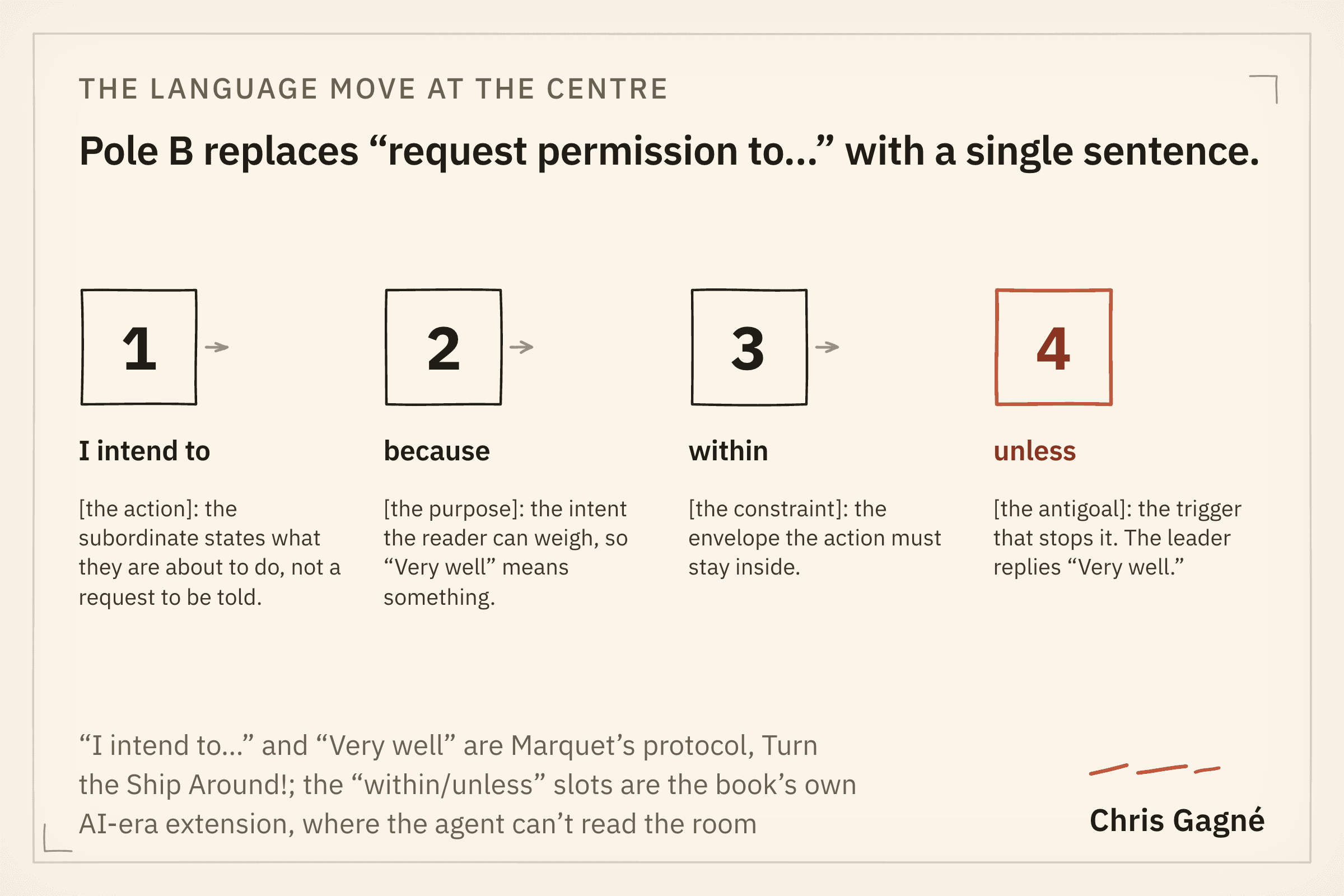
Marquet’s own protocol is the first two slots plus an invited veto; the constraint and antigoal slots are my extension for AI-era delegation, where the agent can’t read the situation.
For the next two weeks, decisions in that category arrive as I intend to statements. Your response is Very well, or—if the intent is materially off—a conversation about purpose, not a re-decision of action.
If you are the CTO reading this and the CEO isn’t yet running the protocol with you, run it down: with your direct reports, on a category you have authority over. The structural argument still works one layer at a time, even when it can’t be made org-wide until the CEO joins in.
Watch the team’s intent quality. It will be uneven at first, then improve fast if the protocol holds. Watch yourself for the urge to re-decide.
Mine has a particular shape. What I am good at is translation, and its shadow is over-carrying: becoming the one who holds the integration for everyone. Every time I do that, the room gets one more decision it does not have to make and one less it knows how to make.
The urge is information. It is the pattern that built leader-follower in you, still active. Notice it, name it for what it is, and let it pass without re-deciding.
Going upstream
In-text: Marquet, Turn the Ship Around!: the 21 mechanisms, the Santa Fe turnaround story, the operational curriculum. Marquet, Leadership Is Language: the language-as-lever distillation, El Faro as cautionary case, the six plays. Stanley McChrystal et al., Team of Teams: the contemporary case at scale, Shared consciousness, Empowered execution. Amy Edmondson, The Fearless Organization: psychological safety as the enabling condition.
Also touched: Scott Snook, Friendly Fire: The fallacy of social redundancy and the cost of delegation without the intent contract.
Go deeper: MCDP-1 Warfighting: the doctrinal source for mission tactics and commander’s intent. Robert Coram, Boyd: The Fighter Pilot Who Changed the Art of War: the Auftragstaktik lineage and Boyd’s to be or to do. Chip and Dan Heath, Made to Stick: commander’s intent in prose-accessible form for non-military readers.
I work with engineering leaders on exactly this kind of paradigm work, the deeper the better. If it’s live for you, I’m happy to talk: schedule a 30-minute virtual coffee at hi.chrisgagne.com.
Some book links here are Amazon affiliate links; if you buy through them I may earn a small commission, at no cost to you.
On paper your values are Theory Y. The approvals and review gates your function runs on may not be. Your team reads the structure, not the values.
Leave A Comment