Expert vs facilitator
You’re the last word on the technical call. You’re also the bottleneck on every material technology decision.
Chapter 18 looked at the assumptions a leader holds about workers. The role the leader takes comes next, because the expert stance reverses those Theory Y intentions at the moment of the call.
The two poles
Pole A: expert. The leader is the most senior technical authority. Problems escalate up to where the expertise is.
Pole B: facilitator. The leader’s role is to make others’ decisions possible. Expertise lives at the work.
Where Pole A is right
When the leader is genuinely the deepest expert and the call is technical. The founding CTO making the last call on a foundational architecture decision. The chief surgeon overruling on the table. The lead investigator on a specific case where the situation depends on their direct expertise. Pole A is right in those contexts.
Where Pole B is right
Almost every senior leadership context outside narrow technical-founder situations. By the time leaders reach senior roles, their expertise is usually a layer or two removed from where the work is being done. When it is that far removed, deciding anyway usually produces worse calls than the team would have made unaided.
In decisions
Pole A leaders decide contested technical calls. Pole B leaders convene the people who know and back the call they make.
Take the last contested technical decision that routed to you and ask where the fix sits: how should decisions like this route, and what would have to be true for them to stop routing to me? Most of it is inside your own function, and there it isn’t an ask at all: I intend to push architecture calls to the team closest to the system, because that is where the expertise lives; unless you see something I don’t, it starts with the next decision.
What belongs to the CEO is the part only the CEO can move: holding the function heads accountable for building the capability rather than escalating it, and authorising the change when the routing crosses your boundary. Take that part to them in the same open form: what would have to be true for the function heads to build this capability instead of escalating it? The authorisation is often a small word change, what Marquet calls a genetic-code move: changing the words the organisation runs on.
The sentence your CEO can carry to the board: “Every decision that escalates to us loses some of the context it needed on the way up.”
Schön’s reflective practitioner
I take Donald Schön’s The Reflective Practitioner as the canonical critique of technical rationality: the assumption that expertise consists of applying codified knowledge to standardisable problems. Schön found, across many professional practices, that real expert work is situational. The cases that count are the ones that don’t fit the textbook. The expert’s actual capability is reflection-in-action: thinking inside the practice and adjusting in real time to build a unique response to a unique situation.
Schön’s critique cuts hardest at the expert-as-authority model. If real expertise is situational, the senior person who decides from a distance is working with less of the situation’s live context than the practitioner who is in it. The senior person’s broader experience matters for some questions and is irrelevant for others. Pole B leaders learn to tell those questions apart.
If real expertise is situational, the senior person who decides from a distance is working with less of the situation’s live context than the practitioner who is in it.
Schön goes further with what he calls the reflective contract: a relationship in which the practitioner can admit uncertainty. The client gets a partner in inquiry rather than a vending machine for answers. The leader promoted into senior expertise can step into that contract with their team. Most of the leaders I’ve worked with don’t. The expert posture is what got them promoted, and the switch is uncomfortable in exactly the ways promotions aren’t.
Block on the consultant-leader collusion
Peter Block names the pattern that keeps Pole A in place. The content level is the technical question, the framework, the deliverable. The affective level is the relational dynamics, the power and trust in the room, and the question of who the leader takes themselves to be. For years I worked the content level too, as chapter 1 says; what I would add here is that the preference is mutual, and that is what makes it stick. Block’s word for what it produces is collusion, and calling the content-over-affect preference itself collusion is my generalisation of his pattern. The consultant gets to look smart; the leader gets to look in charge; the conditions that produced the problem stay untouched.
The leader has to make the same Pole B shift in the consultant relationship. Here, the leader sits in the consultant’s chair vis-à-vis the team. Pole A says the leader is the deepest expert present. Pole B says the leader’s role is to make the team’s existing expertise legible to itself.
In your last contested team decision, who was at the centre: you, with the answer, or the team, with the problem they own? Putting yourself there closes the immediate decision faster and takes the call out of the team’s hands, which makes the next contested call more likely to route to you.
The Scheins’ four kinds of inquiry
The Scheins’ Humble Inquiry grounded the expert-vs-facilitator argument for me for years. The same recordings chapter 5 drew on show a second pattern in the early sessions: I would explain the framework, parts theory, polyvagal, whatever fitted, while the client was still in the middle of a felt sense. What was missing was the confrontive question that would have kept them in it. Humble inquiry is the canonical question Pole B asks: the genuine question to which the asker doesn’t know the answer. It’s the right starting place, and the rest of their framework does other work.
The Scheins name four types of inquiry. Humble inquiry is the question the asker has no answer to. Diagnostic inquiry steers the conversation toward what the asker thinks is relevant: causes, feelings, actions taken. Confrontive inquiry goes further and inserts the asker’s own idea in the form of a question. Process-oriented inquiry is the question about how the conversation itself is going.
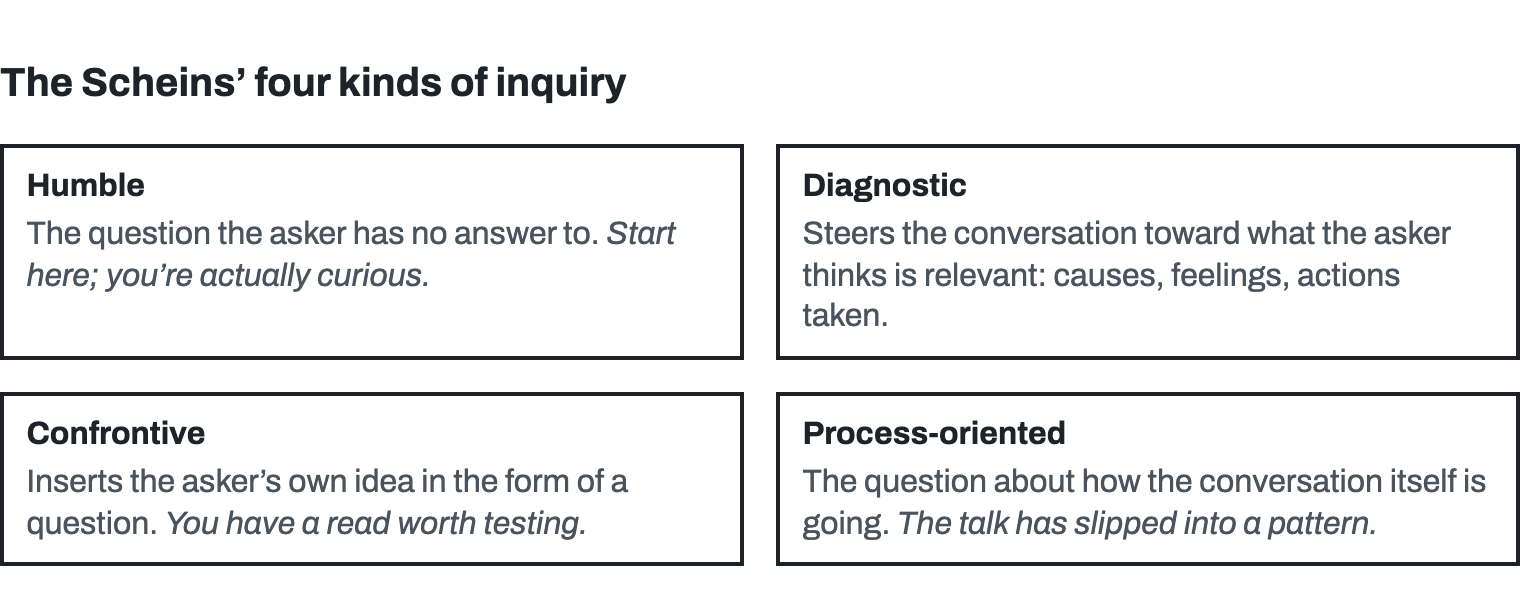
The four aren’t a hierarchy. The Pole B leader carries all four and picks among them as the situation calls. Their own counsel is to blend the helping forms with humble inquiry according to the needs of the situation and to stay conscious of the switch; their warning is that the helping forms take charge of the conversation and slide toward telling.
Ask: which kind of inquiry am I in right now, and which would best serve the situation?
Weinberg’s secrets
Jerry Weinberg names the working discipline. The 10% rule from chapter 1 applies here too: never promise more than 10% improvement. My read is that the rule holds because anything more requires moving from content to affective level, which the leader will resist. Weinberg’s real prize is the credibility of the naive question. His Golden Lock names the trap—I’d like to learn something new, but what I already know pays too well—and the seniority version is my extension: the senior person who has stopped being able to ask basic questions because appearing not to know would threaten their standing. The Pole B leader recovers the capacity to ask the question the team needs asked, even when the asking exposes that they don’t know the answer. NUMMI’s 1984 team member handbook, from the plant in chapter 18, told the people on the line the same thing: “If you accept an explanation without question you may have lost the chance to understand. You must learn to say ‘I don’t understand.’” It is a harder sentence for the person who is supposed to know.
The question costs status. Ask it anyway.
O’Neill—backbone and heart
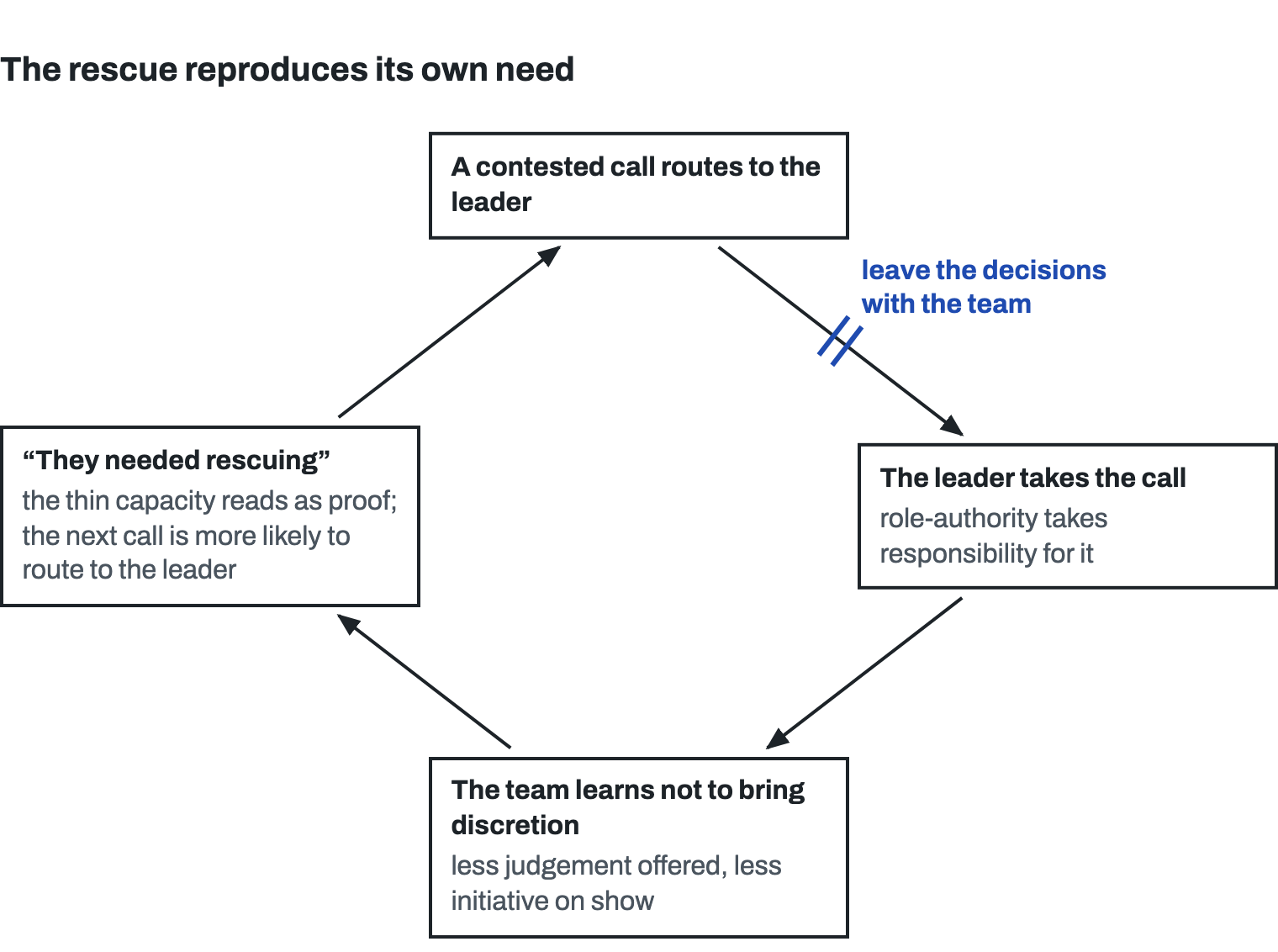
Mary Beth O’Neill draws the distinction sharper than Block does. She names two operating models for the helper: the rescue model, which puts the helper at the centre (the helper has the answer, the client has the problem, the helper fixes it), and the client-responsibility model, which puts the client at the centre (the client owns the problem, the helper supports their own work on it). Block’s collusion is the rescue model, and expertise is what excuses it. The expert-leader running the rescue model uses role-authority to take responsibility for the call. The team learns not to bring discretion; the rescue reproduces its own need.
Her title names the stance the Pole B shift asks for: backbone and heart, knowing your position and stating it clearly while staying engaged in the relationship, so the team feels met rather than processed. The harder part is holding it even when the team is waiting for the leader to decide.
Joiner’s Catalyst stage—and the levels around it
Bill Joiner and Stephen Josephs name the developmental stage the Pole B shift belongs to. Chapter 12 met their ladder from the other end; the transition that matters here is Achiever to Catalyst.
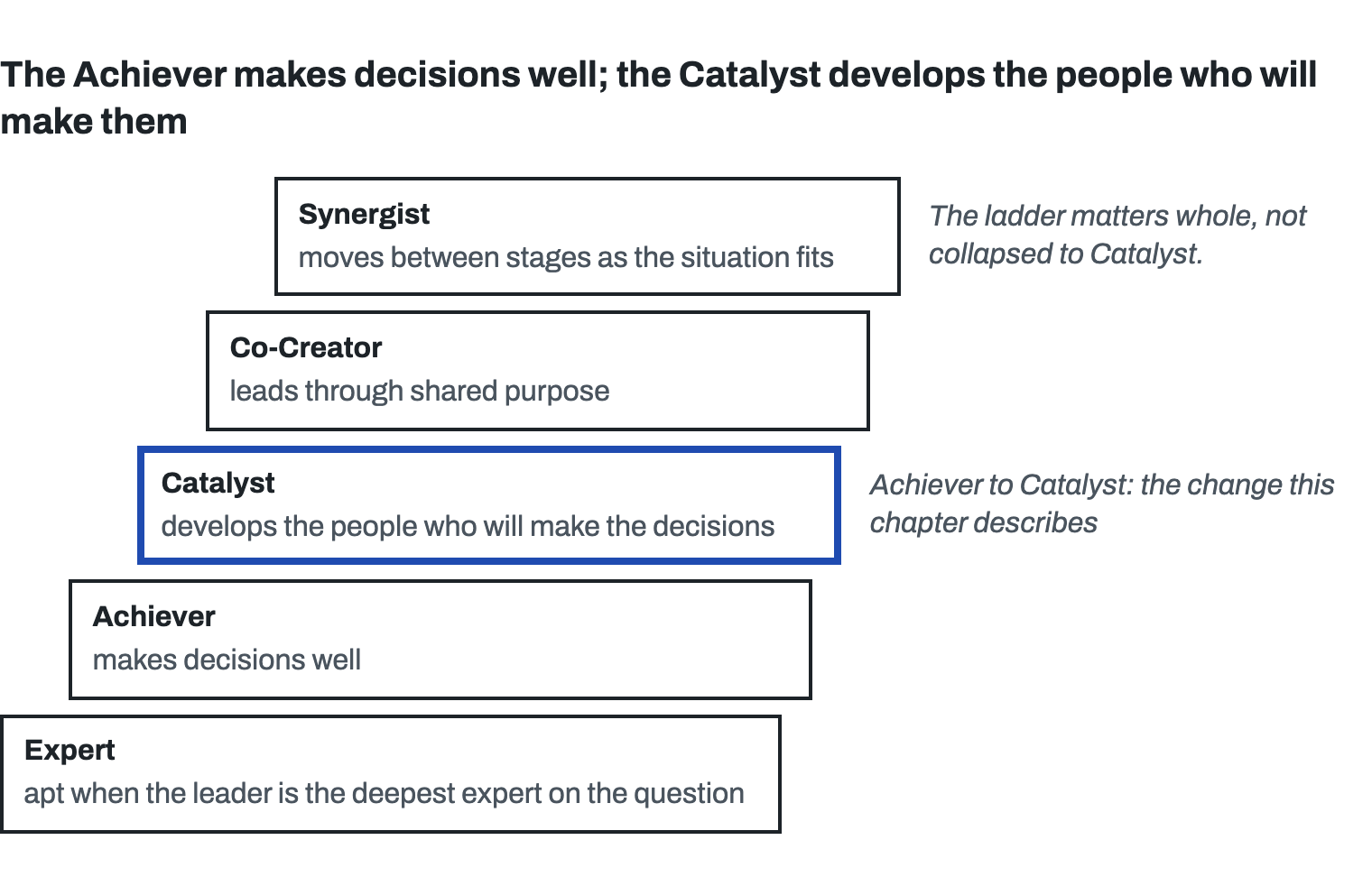
The transition from Achiever to Catalyst is the change this chapter describes. The Achiever makes decisions well; the Catalyst develops the people who will make them. That change is uncomfortable because Achiever skills are rewarded and visible, while Catalyst skills stay invisible until the team starts producing decisions the leader couldn’t have made themselves.
The Achiever makes decisions well; the Catalyst develops the people who will make them.
The ladder matters whole, not collapsed to Catalyst. The Expert stage is apt when the leader is the deepest expert on the specific question: the founding CTO on a deep technical call, the chief surgeon on the table. The error is generalising that posture to situations that need Catalyst or Co-Creator. The Synergist can move between stages as the situation fits without turning any stage into an identity.
A representative case
This is a composite of leaders I have sat across from. A senior architect gets promoted to VP of Engineering, deserved on contribution, and it is a problem in waiting. Six months in, the VP is making most of the architecture decisions for the engineering organisation, and most of their engineering managers have stopped bringing recommendations. They were promoted because they were Experts or Achievers, and nobody explained the need for them to become Catalysts.
The Pole B shift is slow. The first move is Marquet’s I intend to: the VP makes every engineering manager state intent rather than ask permission. Then the VP has to stop having an opinion on every technical call and ask the team for its recommendation without offering their own. Hardest of all, the VP has to publicly back the team’s call when it differs from what they would have done, not in the private moments where it is politically safe but in the all-hands meetings where their own credibility is on the line.
What changes if it lands is not the quality of any single call. Some will be better than the VP would have made and some worse. What changes is that the calls get made without the VP in the room, and the company can operate without them, which it could not before. The VP also gets their evenings back. Marquet names the cost of the other way in his own telling of the I intend to shift: if you are always the answer man, you can never go home and eat dinner.
The VP doesn’t stop being technically deep; they stop putting the technical depth into the seat the team is supposed to occupy.
From facilitator to practitioner
This chapter sets up the practitioner figure. The expert is the helper who knows the answer: Pole A, the technical-rationality position. The facilitator is the helper who makes the team’s answer possible: Pole B, the Catalyst-stage position. The practitioner figure that chapter 22 will name is the deepest version of the Pole B shift: the helper who can stay steady with a leader while their old sense of the job comes apart, without pushing it to a tidy resolution, when the situation calls for more than facilitation.
All three are asked to do the same thing. Step out of the content the team is responsible for. Bring the developed self O’Neill calls signature presence, the helper’s own self as the instrument that makes the team’s work possible. Hold the conditions and leave the decisions with the team.
The diagnostic move
Three questions for last Tuesday’s contested call.
- Which pole was I claiming? Did I describe my role as expert or as facilitator?
- Which pole would my actual behaviour show? Did I make the call myself or convene the people who knew?
- Which pole does the situation actually require? Unless I am genuinely the deepest expert on the specific question, Pole B.
The exercise this week
Run the convening exercise once this week. Pick a decision you would normally make as the technical authority. Set out the problem to the team in 20 minutes. Ask the team to recommend. Listen, without correcting, for the full conversation. Back the recommendation publicly, even if it isn’t what you would have done.
In my experience, the team reads your willingness to back its recommendation more than the recommendation itself. The exercise is one decision. For the next 30 days, track how many contested technical calls the team resolves without you and how many still route back.
If the recommendation is genuinely wrong on the merits—rare in my experience, but it happens—start by asking the team what evidence would change their recommendation, and share the evidence you have that they don’t. If the evidence persuades them, the team makes the better call. If it doesn’t, you have a real disagreement. In a Pole B decision, the conversation continues and the call remains with the team. In the narrow Pole A case, the leader makes the call and owns why.
Going upstream
Watch. Edgar Schein, Humble Inquiry lecture, a short talk for leaders on his own channel.
In-text: the two main works named in the body. Donald Schön, The Reflective Practitioner, on technical rationality and the reflective contract. Edgar Schein and Peter Schein, Humble Inquiry (2nd ed.), on the four kinds of inquiry, not just the humble one.
Also touched: the helper models named in the body, with full references here. Peter Block, Flawless Consulting, on contracting at the affective level and the forms of consultant-client collusion: pretending the organisation is rational rather than political, skipping the touchy contracting subjects, rushing to solutions before the problem is owned. Jerry Weinberg, Secrets of Consulting, for the named laws, the 10% rule, and the Golden Lock. Mary Beth O’Neill, Executive Coaching with Backbone and Heart, on signature presence (the coach’s own developed self as the instrument), the rescue versus client-responsibility model (a contrast she credits to her colleague Rob Schachter), and the four-phase coaching methodology of Contracting, Planning, Live-Action, and Debriefing. Bill Joiner and Stephen Josephs, Leadership Agility, on the five-stage developmental model—Expert, Achiever, Catalyst, Co-Creator, Synergist—worked at full strength, with the percentages, in chapter 12. The NUMMI line is from the plant’s own 1984 team member handbook, page 53, scanned from the Walter P. Reuther Library archive. Marquet’s answer-man line is from his 2013 Inno-Versity talk, Greatness, and not from either of his books.
Go deeper: Jerry Weinberg, More Secrets of Consulting: The Consultant’s Tool Kit, for the catalogue of named devices in his Consultant’s Self-Esteem Tool Kit, six of them inherited from his teacher Virginia Satir, the rest his own and his colleagues’. My own earlier pass at this argument is the 2018 Scrum training Agile Fundamentals: Going from Expert Individual Contributor to Humble Leader, which runs the same shift through Cynefin and Toyota’s NUMMI handbook.
I work with engineering leaders on exactly this kind of paradigm work, the deeper the better. If it’s live for you, I’m happy to talk: schedule a 30-minute virtual coffee at hi.chrisgagne.com.
Some book links here are Amazon affiliate links; if you buy through them I may earn a small commission, at no cost to you.