Compromise vs integration
You split the difference and called it fair. Next quarter, the same argument is back. What brought it back?
Chapter 19 asked who should run the decision process. Even a skilled facilitator can reach an agreement that some participants were afraid to question. Before looking for a solution, find out who can safely say what they want.
The two poles
Pole A: settle within the available options. Allocate the scarce resource or negotiate a compromise, acknowledging what each party will give up.
Pole B: change the available options. Test the assumptions that make the two positions collide and look for a solution that meets both underlying needs. The parties must be able to question whether it does.
Where Pole A is right
When the resource is genuinely fixed, dividing it is the work: this cycle’s bonus pool, one open VP seat, the headcount available before a deadline. You can still question whether those constraints hold, but a decision may be needed before they can change. Mary Parker Follett, a management thinker writing in the 1920s, argued for integration: finding a solution that meets both parties’ needs. She also recognised that this wouldn’t be possible in every conflict.
Sometimes the search for an integration costs more than it is likely to save, and a quick fair split, openly made, is worth the time it saves. A clean division can also protect a working relationship better than an optimal solution reached through a bruising process.
Where Pole B is right
Pole B is right when the underlying needs can both be met, even if the stated positions appear incompatible. In Follett’s example from the Harvard Library, she wanted to avoid a draught and another reader wanted more air. They opened a window in the empty next room. Both got what they wanted without either having to give something up.
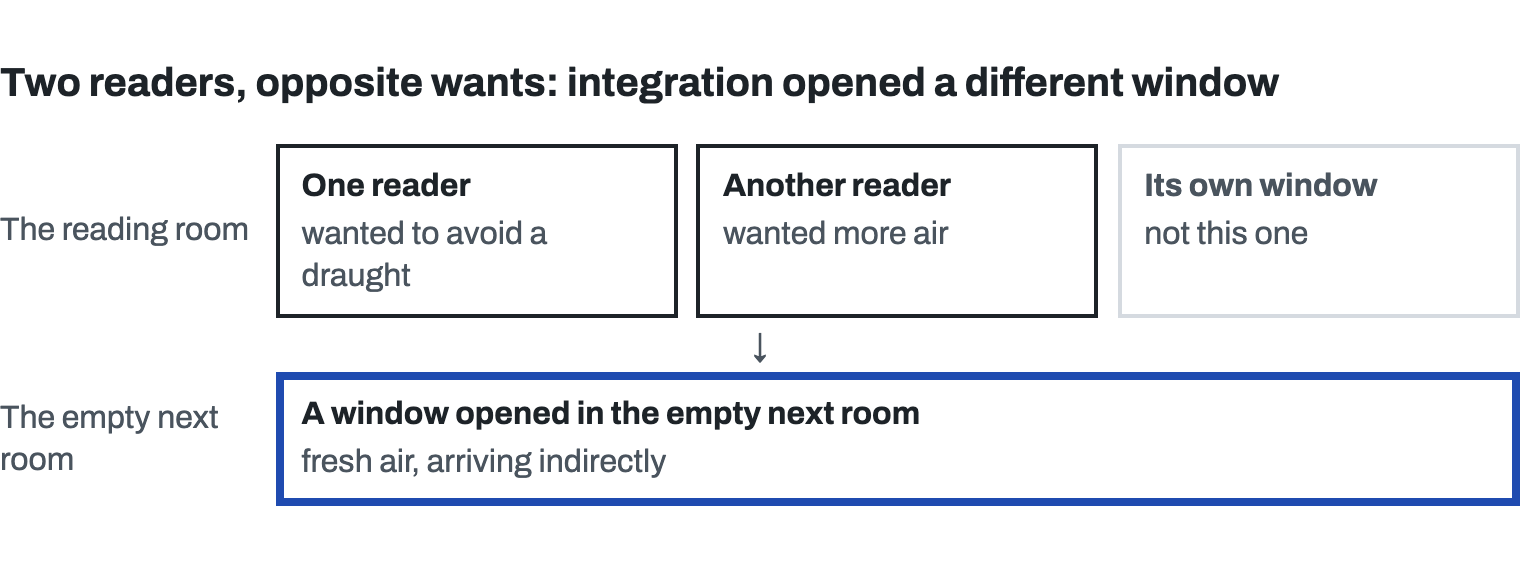
A compromise that keeps re-opening is worth examining. An unmet need may be bringing it back. The circumstances may also have changed, or the settlement may have been temporary from the start. Recurrence is a reason to investigate.
In decisions
Pole A leaders make and explain an allocation or negotiate a split. Pole B leaders look for a change that meets both needs.
Take a recurring settlement to whoever has authority over the disputed decision. That may be the compensation owner, the budget owner, or the CEO. Ask what each side actually needed and what both were assuming had to be true for these to be the only options. Then question the allocation of authority itself. Follett argues that authority belongs to the job; does the person making this call have the knowledge and responsibility the work requires?
The sentence your CEO can carry to the board: “We need to understand why these settlements keep coming back before we negotiate them again.”
Follett’s three ways
In “Constructive Conflict,” a lecture she gave in 1925, Follett asks the reader to treat conflict as neither good nor bad, “not as warfare, but as the appearance of difference, difference of opinions, of interests. For that is what conflict means—difference.” Difference is unavoidable, so the task is to use it, the way a mechanical engineer both fights friction and runs the belts on it.
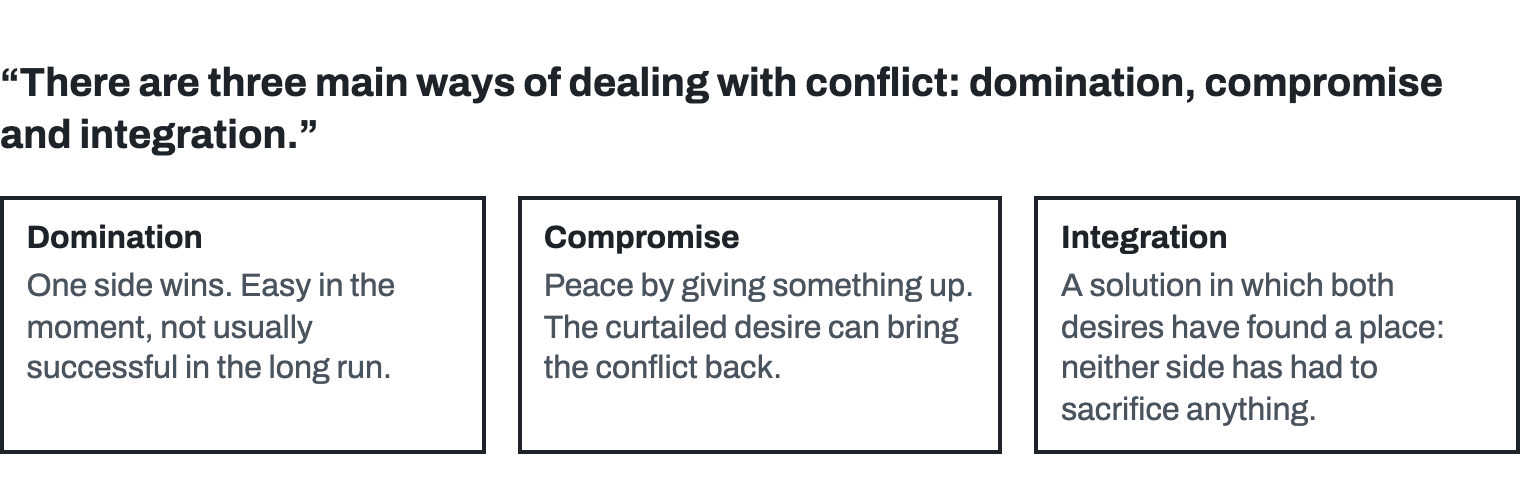
“There are three main ways of dealing with conflict: domination, compromise and integration.”
Domination is one side winning. Easy in the moment, she says, and not usually successful in the long run. Compromise is the accepted way of making peace by giving something up. Follett argues that the curtailed desire can bring the conflict back. Integration meets both needs: “when two desires are integrated, that means that a solution has been found in which both desires have found a place, that neither side has had to sacrifice anything.” “Compromise does not create,” she writes, “it deals with what already exists; integration creates something new.”
Follett begins with disclosure: “The first rule, then, for obtaining integration is to put your cards on the table, face the real issue, uncover the conflict, bring the whole thing into the open.” Then you break the demand into its parts, distinguish the declared motive from the real one, and look for a solution that serves both. Before asking people to put their cards on the table, I want to know what it could cost them.
Artificial harmony
A team can also avoid addressing the conflict at all. Patrick Lencioni calls the apparent agreement artificial harmony. It makes the work harder because people have to discover what their colleagues think after the meeting has ended.
Lencioni describes teams resorting to “veiled discussions and guarded comments” when they can’t argue openly. They feign agreement in the meeting and carry the disagreement into hallway conversations and personal attacks. A meeting with no visible disagreement and a car park full of it afterwards is a reason to ask what people couldn’t say in the room.
The power question
Who at the table can safely state a real need, refuse, appeal, or walk away? These are different capacities, and each needs a separate check.
Stating a need takes safety. Amy Edmondson’s work on psychological safety examines whether people can take interpersonal risks, including admitting a weakness or naming a problem. Lencioni’s vulnerability-based trust matters here too. Neither, by itself, gives an employee authority to refuse a decision.
Refusing takes standing. Chris Voss, the FBI hostage negotiator, writes that “‘No’ is the start of the negotiation, not the end of it.” His “No” expresses the autonomy of a party inside a negotiation. An employee also needs to know what happens if they refuse their manager. A negotiation technique can’t supply that protection.
Appealing takes a route that the other party doesn’t control. In her paper on responsibility, Follett challenges the illusion of final authority and insists that “authority belongs to the job and stays with the job.” An appeal that runs back only to the person you are appealing to isn’t an appeal.
Walking away takes material independence. Who can afford to leave this negotiation, and what would leaving cost them?
Ask who can fire each participant, cut their bonus, or deny their promotion. Who controls the minutes, the information, and the appeal? Barry Oshry built the Power Lab, a residential simulation with built-in differences in power and resources, to study how position shapes what people see. When two parties (his Ends) look to a third (the Middle) to move their competing agendas, “Ends become decreasingly responsible for resolving their own issues and conflicts, while Middle becomes increasingly responsible for resolving these.” Look especially carefully at whoever sits in that middle, and at whose needs are missing from the discussion.
Follett describes power-with as “a jointly developed power, a co-active, not a coercive power.” She argues that “genuine power is capacity” and that “you cannot confer power, because power is the blossoming of experience.” I take this to mean that integration can also strengthen people’s ability to participate in later decisions. Unequal authority doesn’t make every agreement coerced, but it does require us to examine what an apparent yes means. Someone may be unable to leave a job and still reach an agreement that meets their needs. If they can’t question the proposal without risking their livelihood, we need to address that risk before relying on their assent. An allocation requires the same care.
When a party attacks the conditions
Threats or retaliation can make a negotiation unsafe to continue. In that situation, protect people’s ability to participate before asking them to seek a joint solution.
Karl Popper’s paradox of tolerance, in The Open Society and Its Enemies, helps me think about this limit. He warned that unlimited tolerance could destroy a tolerant society, while cautioning against suppressing views that could still be challenged through rational argument and public opinion. His discussion concerns the defence of a society. Applying it to a leadership meeting is my analogy.
A colleague remaining unconvinced is insufficient evidence of bad faith. I’d ask what evidence could change their position and make my own answer available too. If they refuse to name any conditions for reconsideration, we can record that refusal and ask why. We still have to distinguish an inference about their motives from what they actually did.
Where the conduct prevents others from participating, name it and hear the response. If someone must be excluded from part of a decision, specify the restriction, its duration, and how it can be challenged. Review needs to sit with someone independent of the disputed conduct; a manager further up the same chain may not provide that. If no such route exists, acknowledge the limitation and seek one.
“They are acting in bad faith” is an easy label for a leader to abuse. Excluding someone is an exercise of power with consequences for them. I’d want the judgement open to challenge and the person making it to remain willing to reverse it.
Goldratt’s cloud
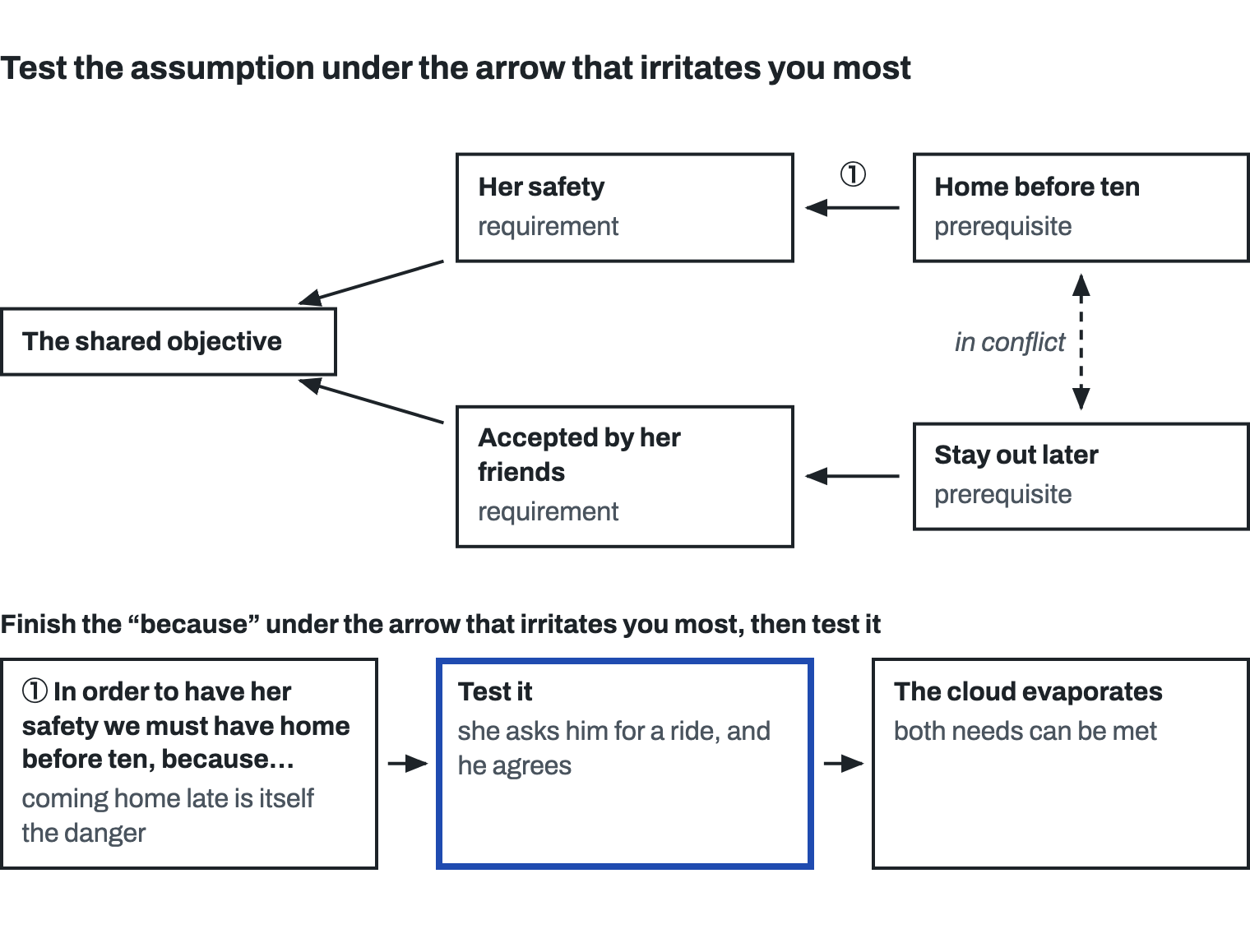
The best instrument I know for testing the conflict is Eliyahu Goldratt’s Evaporating Cloud, from his 1994 business novel It’s Not Luck. It is a diagram of five parts: a shared objective, two requirements the parties believe necessary to achieve it, and two prerequisites that appear to conflict. The assumptions connecting those parts are what you test.
When a colleague admires the cloud as a presentation technique, the protagonist answers: “this technique claims that you should not attempt to strive for a compromise. It advocates examining the assumptions under the arrows in order to break the conflict.” The practical advice is to “concentrate on the arrow that irritates you the most.” Read it aloud as a full sentence: “in order to have X we must have Y, because,” and finish the “because.” You now have an assumption you can challenge.
Goldratt teaches the tool through a teenager’s curfew. His character wants his daughter home before ten for her safety; she wants to stay out later to be accepted by her friends. The assumption connecting the early curfew to safety is that coming home late is itself the danger. Once they look at how she’ll get home, she asks him for a ride, and he agrees. Both needs can be met. The cloud helps them test what each has assumed about the conflict, including assumptions they brought to it themselves.
When the opposition is real
Sometimes no change you can make will give both parties what they need. Calling that outcome a win-win conceals the loss. A fair allocation may be the best available decision.
The person making the allocation needs legitimate authority over it. They should disclose the constraints and criteria, hear objections before the call, and explain who will go without what they wanted. Those affected need a route to challenge the decision. Candidly owning an allocation doesn’t excuse an abuse of authority; the person deciding must also be answerable for how they used it.
You can also settle provisionally while you keep looking for an integration. Check whether the formulation is poor, whether someone affected is missing, or whether the deadline arrived before a solution did. Follett stresses the intelligence and inventiveness integration requires. Failing to find one isn’t proof that none exists. Record what remains unresolved and agree when to revisit it.
Voss’s “no deal is better than a bad deal” challenges the reflex to split the difference. His approach may produce a more favourable bargain or a decision to walk away. Goldratt’s cloud asks whether both underlying needs can be met by changing an assumption. I’d choose between these approaches according to the conflict and the parties’ ability to take part.
The AI overlay
In an AI deployment, the interests to reconcile belong to the people and institutions involved. A model’s output may supply an argument worth examining, but the model isn’t another stakeholder whose needs the settlement must satisfy.
Whose needs does the tool serve, and whose work does it now read or direct? Name who chooses the vendor, writes the policy, and decides when an output becomes an action. Also ask who bears the consequences of a mistake. “The model decided” is domination hiding behind a machine. Apply all four questions to the people affected: can they state a need, refuse a proposed use, appeal an outcome, and walk away? What would each choice cost them?
A representative case
Consider two engineering leaders disputing a shared platform team’s roadmap. One needs a reliability standard held. The other needs a launch date met. The platform team has a fixed number of weeks, so the decision appears to require a trade-off. In Oshry’s terms, the platform team is the Middle, and both leaders are about to hand it their conflict.
Suppose you declare reliability “a standing standard” and announce that both needs are met, while assigning the reliability work to people outside the negotiation. The work didn’t stop eating weeks; it moved onto on-call rotations, maintenance, and the product teams who now inherit the acceptance criteria and never got a vote. Those people need to be part of the decision before you can claim to have met everyone’s needs.
Smaller batches and progressive delivery are candidates to test. Forsgren, Humble and Kim found in Accelerate that high-performing teams achieved both speed and stability. That gives these leaders reason to question the assumed trade-off, but it doesn’t establish that a change in delivery method will meet this launch date and this reliability standard.
Suppose the cloud exposes a belief that meeting the launch date requires releasing every planned feature together. Test that with the launch owner: what must be available on that date, and which capabilities can follow? Then ask the engineers whether the smaller release can meet the reliability standard within the available time, including the investment in changing delivery practices. Integration depends on both answers, with the people doing the work able to contest the estimates. If the launch genuinely requires every feature, or the reliability work still exceeds the time available, the proposed solution has failed the test.
Next quarter, suppose the same two leaders need the same senior engineer for work that can’t be shared or resequenced before their deadlines. Check those constraints with them before making the allocation. If they hold, the decision-maker must hear both leaders and explain the criteria for the call. The leader who loses needs to know what work will go undone and how to challenge the decision. A date to revisit it next cycle doesn’t replace a chance to object now.
The diagnostic move
Three questions for last week’s contested settlement.
Which pole was I claiming? Did I describe the outcome as something new that both sides won, or as a fair split, or as a firm call I made?
Which pole did the outcome actually show? Did both parties get what they came for, or did someone give something up? Who bore the loss, and could they have safely objected? An agreement staying unchallenged tells you little if challenging it would cost someone their job.
Which conflict is this really? Test the premise that makes the positions incompatible. If the constraint holds, make and explain the allocation. If you have run out of time to investigate, record a provisional settlement. Where conduct prevents people from participating, protect the process before continuing. Recurrence tells you to look again. It doesn’t tell you that you misjudged.
The exercise this week
Take one live conflict on your team that keeps re-opening. For each party, check the ability to state a need, refuse, appeal, and leave. Ask what they risk by disagreeing. Establish a protection for any risk that could prevent a straight answer. If the manager controls both the decision and the minutes, for example, arrange for participants to record objections in their own words and have them reviewed independently.
Then write the cloud. State the shared objective, each side’s requirement, and the two prerequisites in conflict. Complete the “because” sentence under each arrow and test one assumption. Ask whether the proposed change meets both needs, who must do the work, and whether those people can object. If the test fails, settle provisionally and keep looking, or explain why the remaining constraint requires an allocation.
You may leave the meeting with a tested integration, an acknowledged allocation, or a provisional settlement. Record which it is and what happens next.
Going upstream
Start with Mary Parker Follett’s Dynamic Administration, particularly “Constructive Conflict” and her papers on power and responsibility. Eliyahu Goldratt’s It’s Not Luck gives you the Evaporating Cloud and worked examples of testing the assumptions beneath a conflict.
Patrick Lencioni’s The Advantage and The Five Dysfunctions of a Team discuss artificial harmony and fear of conflict. Amy Edmondson’s The Fearless Organization examines psychological safety. Barry Oshry’s Seeing Systems shows how organisational positions shape people’s experience and behaviour. Chris Voss’s Never Split the Difference makes the case against reflexive compromise. Nicole Forsgren, Jez Humble and Gene Kim’s Accelerate reports the research on software delivery performance.
For further reading, Jeffrey Pfeffer’s Power examines organisational power. Karl Popper’s The Open Society and Its Enemies contains the paradox of tolerance; his discussion of defending a tolerant society needs care when applied to workplace decisions.
I work with engineering leaders on exactly this kind of paradigm work, the deeper the better. If it’s live for you, I’m happy to talk: schedule a 30-minute virtual coffee at hi.chrisgagne.com.
Some book links here are Amazon affiliate links; if you buy through them I may earn a small commission, at no cost to you.