

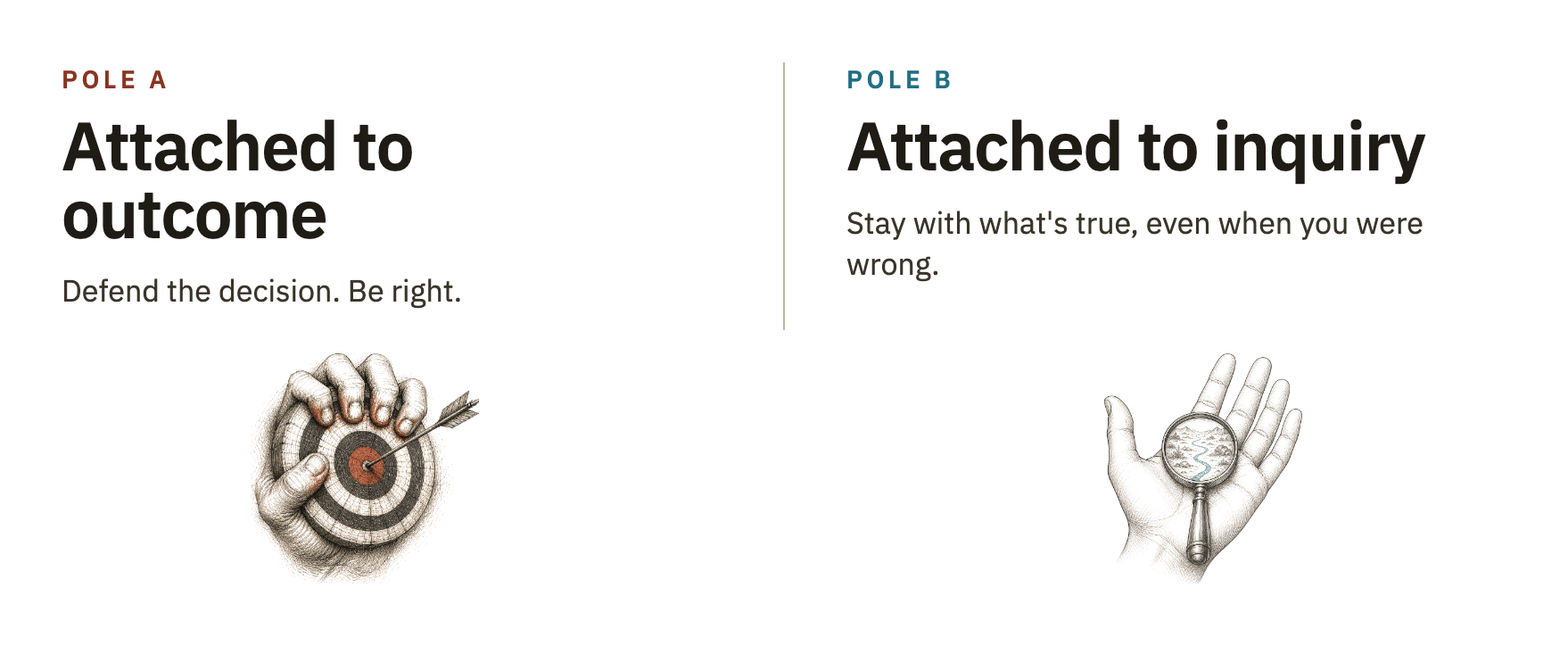
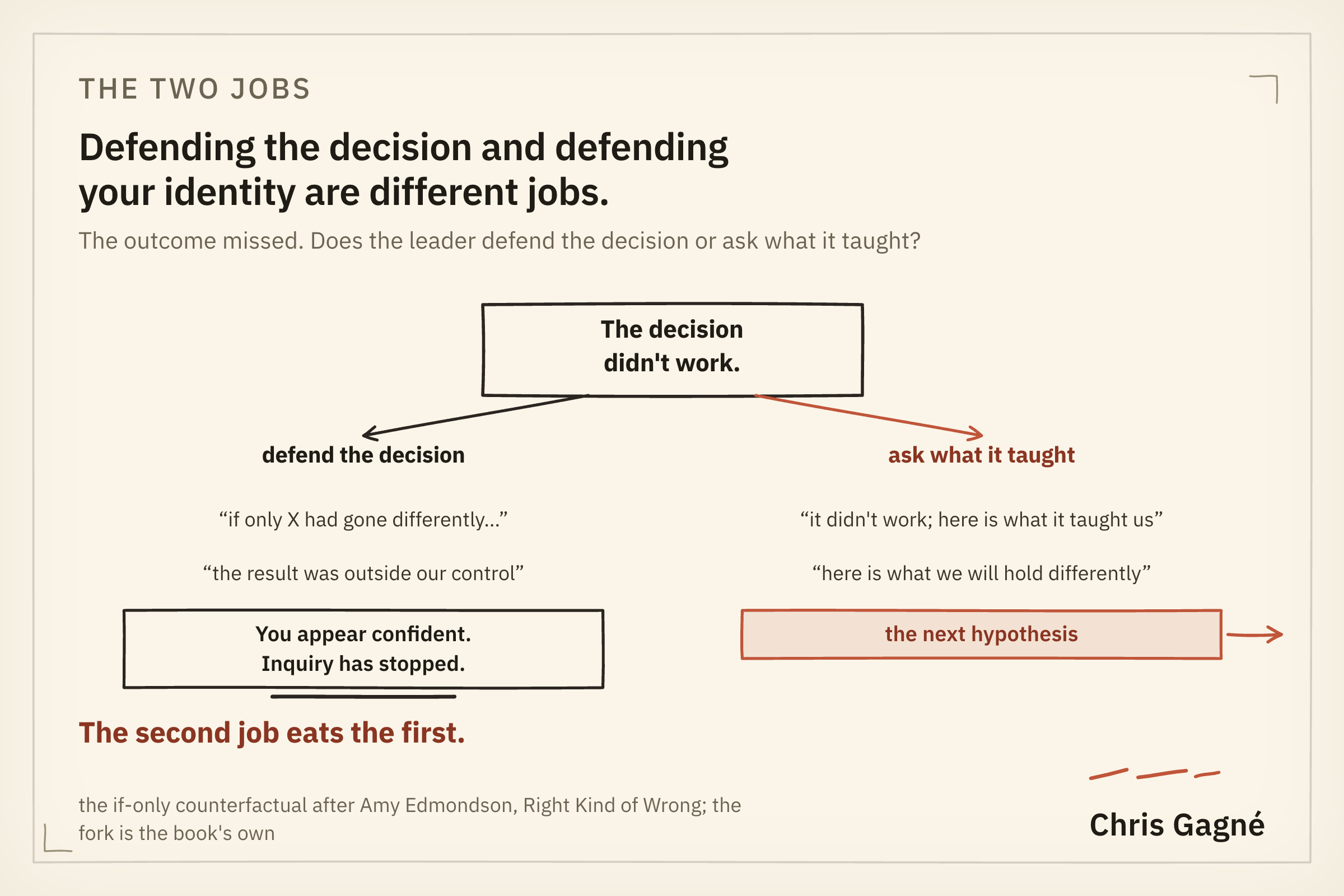
You defended a decision after it failed. But the decision was a hypothesis, and a hypothesis that fails is data. What you ultimately defended wasn’t the decision, it was your identity. Reading the result and protecting yourself are two different jobs, and the second one eats the first.
Chapter 9 made outcomes the unit of management. This chapter asks what happens when the outcome misses. Does the leader defend the decision or ask what it taught them?
🎧 Prefer to listen? This chapter is narrated in my own voice with ElevenLabs on Spotify (~17 min): https://open.spotify.com/episode/1QpwoVKbeaGZWLV5mujdsu?si=p0VyOhdgR4KlHJ14IAtuLg
The two poles
Pole A: attached to outcome. The decision must yield this result. If it doesn’t, the decision was wrong.
Pole B: attached to inquiry. The decision was a test of a hypothesis. The outcome is data. The question is what to learn from it.
This does not reverse chapter 9. Outcomes are still the unit of management; a missed outcome is exactly the signal that the decision was a hypothesis. Pole A’s error is not caring about the outcome. It is fusing the decision’s rightness—and the leader’s—to whether this particular outcome landed. The outcome is the measure; the decision is the hypothesis.
Where Pole A is right
Pole A is right when accountability requires defending the commitment. That may mean contractual delivery against a signed scope, a public commitment to investors with material implications for share price, or a regulatory commitment where non-delivery could cost the organisation its operating licence. Some crisis communication demands the same discipline: the leader may need to hold a position in public for months while the team works on the underlying problem.
The leaders I have worked with who came up in those domains had good reason to default to Pole A. Defending the commitment was their job, and the discipline they built doing it made them trustworthy enough to lead where keeping a commitment mattered. That same discipline is what built the relationships with boards, investors, regulators, and key customers where a senior leader now has standing, and none of it was waste.
Pole B depends on that trust. The senior leader does not need to apologise for having earned it.
Where Pole B is right
Pole B is right when the decision was a hypothesis dressed up as a commitment, or when defending it is doing more for the leader’s identity than for the outcome. The second case is harder to see from inside because defending commitments under uncertainty is a discipline most leaders have built over a career.
Most decisions made in complex conditions under uncertainty are hypotheses. The leader makes them with limited information and under time pressure, while the team still needs something definite to work towards. Accountability often demands the language of commitment because that language helps the team coordinate. The leader who speaks commitment in public can still be running inquiry in private.
The leader who speaks commitment in public can still be running inquiry in private.
Once the leader treats the decision as settled, inquiry becomes much harder.
Counterfactual thinking as identity-protection
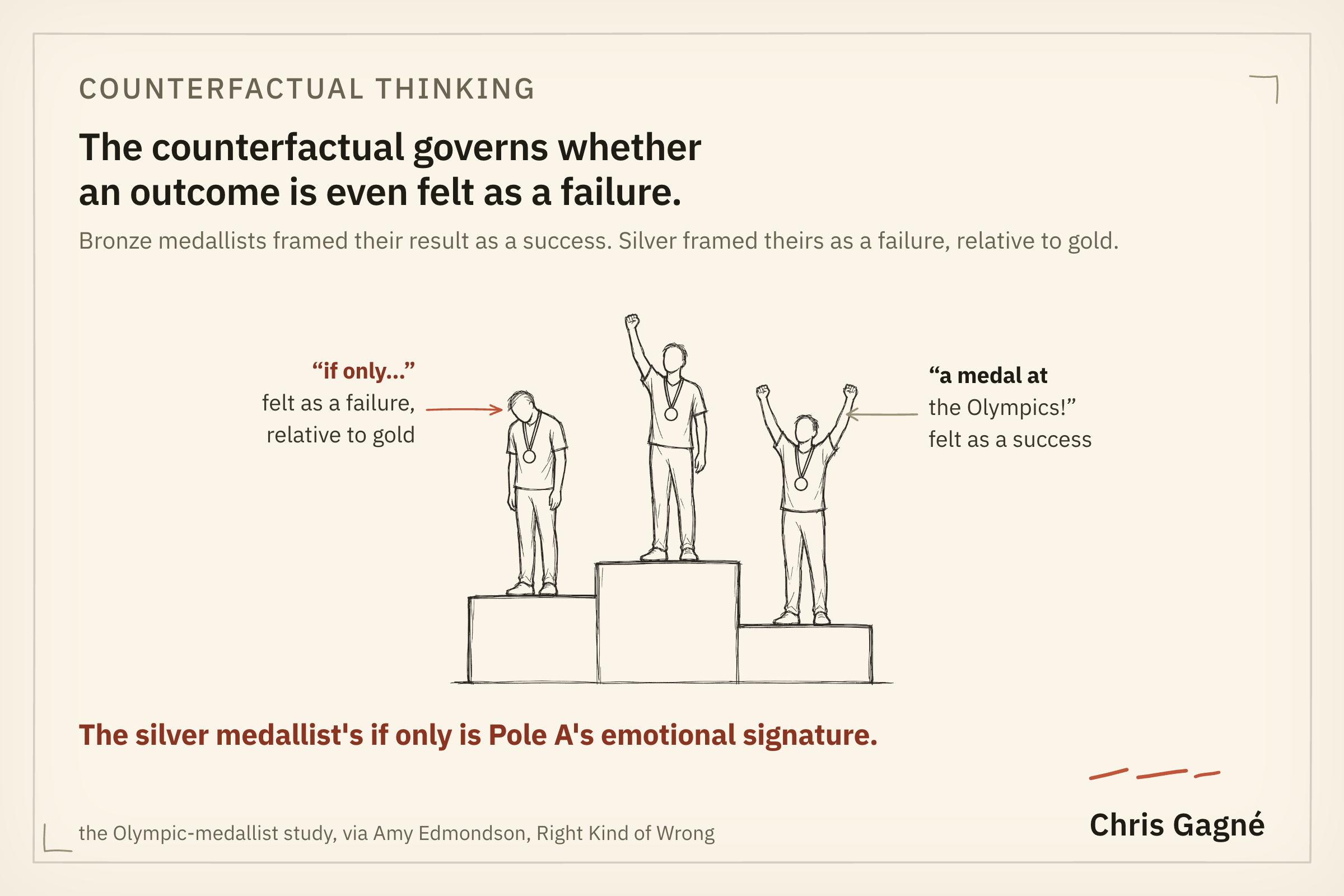
Amy Edmondson, in Right Kind of Wrong, names the cognitive habit underneath the Pole A response, drawing on a classic Olympic-medallist study. Bronze medallists framed their result as a success (a medal at the Olympics!), while silver medallists framed theirs as a failure relative to gold through what psychologists call counterfactual thinking.
The counterfactual governs whether an outcome is even felt as a failure. The silver medallist’s if only is Pole A’s emotional signature.
Edmondson calls the self-flattering version self-serving analysis: the mind generates alternative pasts where the leader was right, and generating those pasts protects identity rather than learning from the result. Internal Family Systems (Schwartz) calls that identity-protecting pattern a protector part doing its job.
Counterfactual rumination has a recognisable form: if only X had gone differently, the decision would have worked. That is Pole A running beneath a stated commitment to inquiry. A leader practising inquiry can stay with a harder account: the decision didn’t work; here is what it taught us; here is what we will hold differently.
Both responses may look similar from the outside. They feel entirely different from the inside.
Edmondson’s four criteria
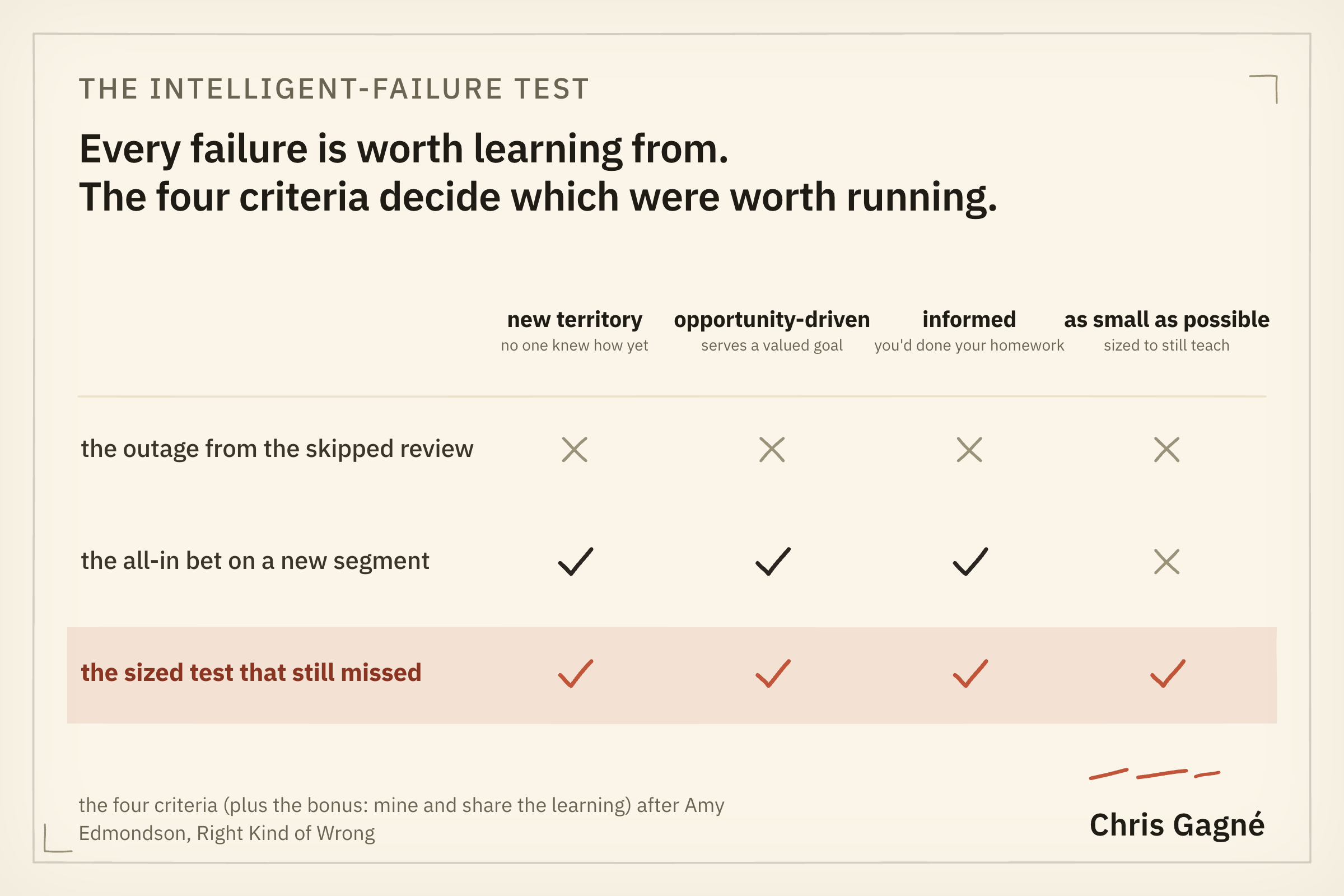
Pole B requires more than openness or humility. Edmondson teaches how to fail well. An intelligent failure meets four criteria:
It enters new territory: no one had the answer in advance.
It serves a goal worth the attempt.
It is informed by available knowledge: you had reason to believe the hypothesis could be right, not something one prior reading would have caught.
It keeps the risk as small as possible while still producing meaningful learning.
A bonus: the learning is mined and shared, so the failure doesn’t recur.
Edmondson separates intelligent failure from error: “Error implies there was a ‘right’ way to do it in the first place. Intelligent failures are not errors.” The Pole A leader who treats every failed decision as an error to be explained is using a vocabulary that doesn’t fit the work.
Edmondson’s failure taxonomy has three types:
Basic failures are caused by error in known territory.
Complex failures occur when multiple causes line up, warning signs get missed, and a recovery window closes unused.
Intelligent failures are the ones that clear those four criteria.
Every failure is worth learning from; inquiry is not reserved for the intelligent kind. What the criteria decide is narrower: whether the failure was worth running, or whether it is an avoidable mess dressed as a noble experiment. That is the line a leader has to stay honest about.
Toyota Kata: problems are jewels
Mike Rother’s Toyota Kata puts Pole B into daily lean-improvement practice. The improvement kata runs through PDCA cycles in which each obstacle becomes the next thing to learn from. “Problems are jewels” is the Toyota colloquialism: the problem is the curriculum.
The mentor asks the mentee five questions:
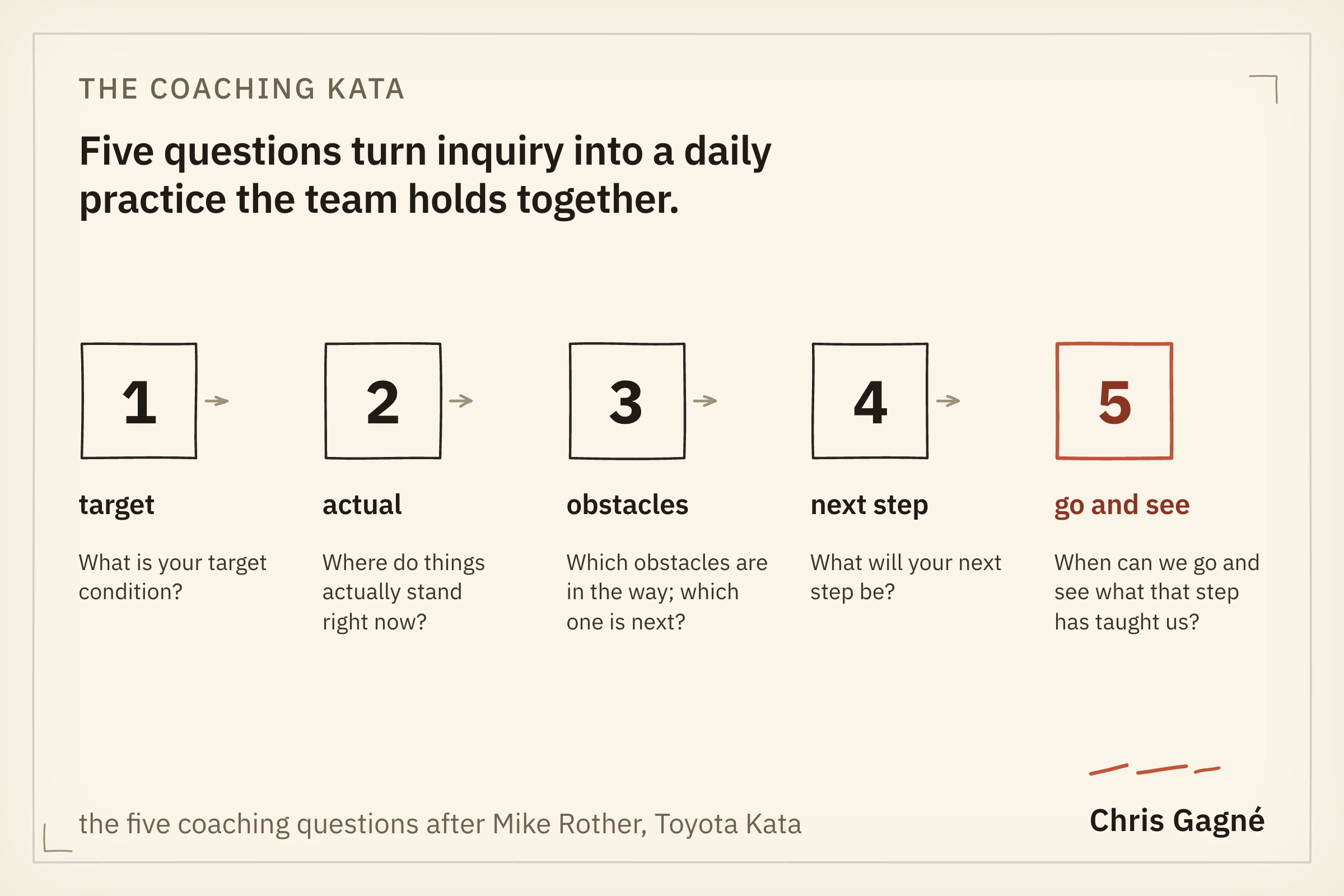
What is your target condition?
Where do things actually stand right now?
Which obstacles are now in the way of reaching the target condition, and which one are you tackling next?
What will your next step be?
When can we go and see what that step has taught us?
Question 5 is the inquiry move. The next step is an experiment with a specified learning horizon, and the next coaching cycle starts by examining what was learned.
The kata turns Pole B into a daily practice the team holds together. Inquiry no longer depends on one leader’s capacity to sustain it alone.
Embrace change, then pivot
Pole B has a precondition, and it is bigger than it first looks. The engineering half is familiar: a team that can refactor, pair, and integrate continuously does not need to defend yesterday’s design when today’s evidence contradicts it. Continuous integration makes the technical pivot cheap. AI-assisted refactoring and code generation push the cost of change lower still.
But cheap-to-change code is not enough to pivot a strategy, and the harder precondition is organisational. To pivot is to abandon work already in flight. A team running several epics at once to keep everyone busy—the high-utilisation trap from chapters 4 and 7—cannot pivot without writing all of them off at the same time, so it defends the plan instead. The team carrying one small bet can drop it and turn. Low epic-level WIP is what makes a pivot affordable; high WIP forces Pole A even when the leader wants Pole B, and no amount of continuous integration buys it back. The context keeps the team shipping yesterday’s answer after today’s evidence has disproved it because the sunk cost is too high to accept.
A pivot follows validated learning: we tested a hypothesis, the evidence came in, and the next hypothesis follows from what we learned. A board can absorb that. What it cannot absorb is “we abandoned the strategy we sold you two quarters ago.” The difference is not that the words are prettier. A pivot names a decision still under inquiry; abandonment names a retreat.
A pivot names a decision still under inquiry; abandonment names a retreat.
This is the chapter 9 move at the strategic level: we hypothesised X would produce Y; we learned Z; the next hypothesis is W. The board still gets its number, the same trade chapters 7 and 9 made.
The protector part’s job
When a failed decision threatens a leader’s identity as competent, the Defender protector part generates counterfactuals and attributes the result to factors outside the leader’s control. The leader appears confident. Inquiry has stopped.
The Pole B move is to recognise the Defender part, name what it is defending, and ask it to step back and give space so the rest of the leader’s judgement can engage the evidence. That is the work the next chapter—Just This—takes up directly. The harder, identity-level part starts there. A leader who is actually confident, sure of the value they bring, can be wrong now and then and interrogate their own decisions without waking the Defender.
A representative case
Picture a Series A founder who has committed publicly to a particular customer segment (the commitment is in the deck the investors funded). Six months in, customer-acquisition cost in that segment is twice the model’s projection and the success metrics are trending the wrong way, while the team has begun landing customers in an adjacent segment where the numbers are far better.
Across a series of leadership meetings, the founder defends the original selection with increasingly sophisticated arguments. Everyone else can see the pattern. The founder believes they are rigorously defending a hypothesis the team has not yet sufficiently tested.
The intervention usually comes from outside. In a one-on-one, an outside coach asks, what would it cost you to publicly update the strategy? The real answer names the cost: the founder’s identity as the leader who picked the right thing, and the investors who will read the update as the founder was wrong. Over several weeks, the founder works through that cost and updates the strategy in a board memo, describing the change as a pivot informed by six months of validated learning. The pivot language gives the board a way to absorb the change.
The board’s response surprises the founder. They are relieved; they had been wondering when the founder would name what the metrics had shown for two quarters. Two quarters of visible warning signs, and the update remained unmade. In Edmondson’s terms, the founder nearly squandered a recovery window.
Honour what was honest in the original defence. The founder was also doing part of the job well: holding the strategy through enough friction to test it. A genuine commitment and the Defender were operating on top of each other. Updating both lets the founder enter the next decision with judgement and identity intact.
The diagnostic move
Three questions for last Tuesday’s post-mortem.
Which pole was I claiming? In the language I used about the failed decision, did I describe it as a hypothesis we tested, or as a commitment we kept (or failed to keep)?
Which pole did my response show? When the evidence came in, did I generate alternative pasts where the decision would have worked, or did I stay with what the evidence taught us?
Which pole does the work require? If the accountability frame genuinely requires defending the commitment in public, Pole A is defensible. If the public commitment is being used to keep you from treating the decision as a live hypothesis, the Defender is running.
The failed-decision post-mortem is where this choice bites hardest at the top. If you sit in the CTO or VPE chair, have the private conversation with the CEO. Bring one specific decision from the past quarter that didn’t work and ask, not what went wrong but what hypothesis were we testing, and what did we learn?
Ask it in private first. If the CEO can work through the learning in a one-on-one, they can carry it into the board conversation.
If the Defender is running strongly, drop the diagnosis and ask the question that gives it space: what would make updating this strategy safe to say out loud? The answer is data. The sentence your CEO can carry to the board is, “We learn at the rate we can say a decision didn’t work.”
We learn at the rate we can say a decision didn’t work.
There is an aggregate version of this. Chapter 7’s optimum failure rate says cheap experiments should fail about half the time. A team whose bets almost never fail is not excellent; it is only running experiments it already knew would pass, and those teach nothing. A failure rate near zero is Pole A in the language of excellence.
The exercise
Apply the Toyota Kata five questions to your next stuck decision. Pick a current open question where you have been defending the position you committed to two months ago, then walk through the questions with a coach or peer who isn’t invested in the answer: target condition, actual condition, obstacles, next step, and the question that does the work, when can we go and see what we have learned?
If you can’t specify a date by which the next step’s learning will be visible, you are still running Pole A. The honest Pole B answer specifies the learning horizon.
A companion move is the decision audit. Take a recent decision that didn’t work. Did you defend the decision or refine the model? Name your response out loud to someone you trust enough to disagree with you. The harder, identity-level work starts there.
Going upstream
In-text: Amy Edmondson, Right Kind of Wrong, on the four criteria for intelligent failure, the three failure types, and the counterfactual-thinking pattern; Mike Rother, Toyota Kata, on problems are jewels and the five coaching questions.
Also touched: The protector named here as the Defender is Internal Family Systems language (Richard Schwartz, No Bad Parts); the Just This instalment works it directly.
Go deeper: Kent Beck, Extreme Programming Explained, on embrace change and the continuous-integration discipline that makes pivoting cheap; Eric Ries, The Lean Startup, on the pivot and validated learning; the overproduction the Lean tradition names (Taiichi Ohno through Beck and Ries) for inquiry shipped on top of an architecture that can’t support it.
Watch. Astro Teller, The unexpected benefit of celebrating failure (TED, 16 min). Kill-and-pivot stories from Alphabet’s X: bonuses paid to everyone on teams that chose to kill their own projects, from pairs to groups of thirty-plus.
Ten chapters in, the tools have become something to grip, and the grip tightens with every one you add. Every framework in this book becomes a trap the moment you obey it instead of using it.
Chapter 11, Just This, asks you to notice that reflex before choosing a tool. The one you reach for first may already be telling you what to see, before you have met the situation actually in front of you.
Leave A Comment