

Executive summary
Think of a physiotherapist. They don’t fix your back. They put a mirror in front of you, show you the exact posture you’ve been holding for fifteen years, and say: “notice you’re doing that? that’s why you’re in pain.” The pattern was invisible from the inside. Once it’s visible, the work is small corrections, practised many times, especially under load. This piece is that kind of mirror.
NB. The dichotomies below are mostly not original to me; the curation and the synthesis are. I name teachers in each entry and link to their work so you can go upstream when something resonates. If this mirror surfaces something worth working, the people whose names appear in the Watch and Read lines are where I’d send you next. Or me—this is the work I do.
When senior leaders see the operating paradigms they have been running on, the calls they make under pressure stop surprising them. With that, the response that better fits the new situation becomes available. The work I do with leaders suggests most are running paradigms they cannot see, built for problems the firm no longer has, in territory the paradigms weren’t built for. AI is the most visible driver of the changing context, but not the only one. The piece below offers a mirror for seeing what’s running underneath: 28 observable decision-level dichotomies, written as prompts to compare what you say you believe to what you actually do.
This is the canonical long-form treatment of the work; a shorter, axis-by-axis article series will follow for readers who want to take it in smaller doses.
Who this is for, who it isn’t. This is for senior leaders of software-dependent firms whose situation-mix has shifted toward complex, unpredictable work: long-term survival under uncertainty, AI-era operating-model threats, leading technology-driven market disruption. You might suspect the mindset that got you where you wanted to be yesterday isn’t fitting what your new context needs today, or you might find yourself in the midst of a crisis. It isn’t a leadership-style typology, a developmental ladder, or a self-administered test. You are not broken and do not need fixing; you are simply running on paradigms that fit a context you have since left. If your work is genuinely and predominantly Complicated/Ordered (regulated compliance, financial close, structural engineering, mature manufacturing on a stable specification), the classical management paradigms are possibly sufficient. That said, almost no senior role in a software-dependent firm is purely Complicated/Ordered anymore: take thirty minutes anyway, and notice how much the circumstances have shifted underneath you.
The diagnostic question. Most knowledge work has been Complex/Unordered for decades: the territory where the answer isn’t knowable in advance, only discoverable by probing (Dave Snowden’s Cynefin, defined more fully in “The frame” below). What changed is the cost of mismatch. The Complicated/Ordered habits—the classical management toolkit, built for work where experts can analyse the problem to a known good answer—could carry a slow-moving firm through a Complex/Unordered situation as long as the consequences of being slightly wrong arrived slowly too. With AI accelerating the consequences and reshaping the substrate, the gap between the leader’s habitual response and what the situation actually requires now compounds in months rather than years. So the diagnostic question is: my role has been Complex/Unordered all along; is my habitual response still fitting now that the cost of mismatch is, for a growing number of firms, terminal?
On Chegg’s May 2023 earnings call, CEO Dan Rosensweig named ChatGPT as the threat to new-customer growth; they launched CheggMate, their OpenAI-built tutoring product, the same month. Three years later the market cap is down roughly 99% from its 2021 peak, headcount has fallen from ~3,200 to under 600, and the Q1 2026 homework business is down 57% year-on-year. They posted their first profit in two years by cutting costs faster than revenue fell. Awareness was not the limiting factor; the org could not redesign around the substrate shift in time.
The three most important paradigm dichotomies for most readers in 2026. If you read nothing else, read these:
- Entry 1, AI as superficial productivity layer vs AI as substrate for org redesign. The dichotomy that decides whether the firm’s AI investment compounds or runs out as a local productivity uplift that doesn’t translate to revenue.
- Entry 6, Utilisation vs flow. The dichotomy that decides whether AI speeds your system up or just relocates the queue.
- Entry 11, Espoused theory vs theory-in-use. The dichotomy that decides whether your stated principles survive contact with your last three decisions under pressure.
The six paradigm axes and the two poles. Each axis asks where your operating reflex sits. Pole A is the move that often feels like leadership; Pole B is what the Complex/Unordered contexts reward most. Both poles have bounded applicability, neither is correct for all contexts. The question is whether your habitual response fits the situations you actually meet.
Change: how this leader produces change.
- 1. AI bolted onto the existing organisational design, or the organisational design entirely reconsidered around AI.
- 2. Announce the change programme and run training, or redesign what surrounds the behaviour so the new move is the easier move.
- 3. Write the strategy and roll it out, or design the conversation that produces the strategy.
- 4. Ship a directive, or ship a question and an open week.
- 5. Send people on courses, or block thirty minutes a day for coaching at the work.
Optimisation: how this leader reads the unit of value and the shape of waste.
- 6. Keep everyone fully utilised, or keep queues and lead times short.
- 7. Penalise plan variance, or plan a hypothesis and an experiment.
- 8. Set efficiency targets per function, or find the one constraint and subordinate everything to it.
- 9. Celebrate the launch, or celebrate the customer succeeding three months later.
- 10. Long roadmaps and/or Planning Intervals, or continuous flow, WIP limits, and pull.
Knowledge: what this leader treats as legitimate knowledge.
- 11. Judge yourself by your intentions, or judge yourself by your last three decisions under pressure.
- 12. Project certainty, or voice a hypothesis and the test that would falsify you.
- 13. Run the checklist, or trust the experienced operator.
- 14. Standardise across business units, or protect what the local team already knows how to do.
- 15. Convene more analysis when stuck, or pause and check what the experienced operator already senses.
Authority: how this leader reads power, decision rights, and their own role.
- 16. Fill coordination channels with approvals, or fill them with “I intend to…”
- 17. Decide where the formal power is, or decide where the tacit knowledge actually lives.
- 18. Get the work out of people, or get out of people’s way.
- 19. Be the hero, or build up your successors.
- 20. Cascade the OKRs down the org, or redesign decision rights so the org can move without you.
- 21. Open with the answer, or open with a question you don’t already know the answer to.
- 22. Be the deepest expert in the room, or convene the people who know.
Causation: how this leader reads the relationship between events and their causes.
- 23. Find the deviator who failed, or close the gap between the work as imagined and the work as done.
- 24. Count incidents, or study what works well (not just what broke).
- 25. Tell one clean story, or hold several stories at once.
Self: how this leader reads their own identity, capacity, and developmental edge.
- 26. Hold the role as who you are, or hold it as what you’re currently doing.
- 27. Be surprised by your own pattern when it surfaces, or name the anxiety driving it.
- 28. Defend the decision after it fails, or refine your mental models after they fail.
15 minutes today. Look back at the six axes above. For each axis, notice which pole you sit closer to. Where you sit on the first pole, ask: where did this assumption come from, and is it still fitting the work you actually do now? That alone will be enough to start the noticing the rest of the article is built around.
If the 15-minute pass surfaces something worth more than a glance, continue reading and work the two-week protocol in How to use this mirror at the end.
Why a mirror, and why now
Jennifer Garvey-Berger puts it plainly: “We get so used to our patterns that we can forget what the situation calls for and just rely on our own habits.” That is the diagnostic problem this mirror addresses.
A senior leader who has read this far is still left with a practical question. Which paradigm am I actually running? The intellectual answer is almost always the flattering one. The honest answer lives in last Tuesday’s meeting, in the calls I made under pressure when nobody was watching me make them.
This mirror is ultimately meant to be used in conversation: with a coach, a trusted peer, a few witnesses willing to compare what you say to what they actually saw you do.
It shows you what habit has hidden from you. The change is the small correction—repeated under load—in the conversations that follow. One mirror is rarely enough; like a physiotherapist’s, the role is distributed across several people who will keep showing you the same pattern from slightly different angles until you can feel it yourself. You’ll need at least a consultant who understands the paradigms and a developmental coach who can help you through the change; these are rarely the same person.
The frame: the situation-mix in your role has shifted
Snowden’s Cynefin distinguishes five kinds of situation:
- Clear. Best practice, fixed constraints, self-evident cause and effect.
- Complicated. Good practice via expert analysis, knowable causal relationships, governing constraints.
- Complex. Exaptive practice via probing, enabling constraints, emergent and dispositional behaviour (which is interestingly something an LLM also embodies).
- Chaotic. Novel practice, no effective constraints.
- Confused. Knowing which domain you are in is itself the question.
Cynefin is a sense-making framework for assessing situations, not for typing leaders. The same leader routinely meets situations in all of those domains and is asked to respond to each.
The diagnostic question this piece works with is therefore not “which domain do you operate in.” It is: has the situation-mix in your role shifted toward Complex/Unordered work, and does your habitual sense-making mode fit the situations you now meet?
For most senior leaders in software-permeated firms, the answer to the first half is plainly yes. Strategy under genuine uncertainty, leadership transitions, cross-functional change, AI-era organisation redesign, talent dynamics, market position under technological disruption: these are all Complex/Unordered. This has been true for most knowledge workers for decades. The classical management toolkit was built for Complicated/Ordered work—regulated compliance, financial close, structural engineering, mature manufacturing—and remains right in that domain. The trouble starts when a Complicated/Ordered habit meets a Complex/Unordered situation and treats it as if the answer were knowable.
Ronald Heifetz puts the same diagnostic in a different vocabulary:
- Technical problems have known solutions accessible through current authority and expertise: forecast, plan, hold the plan as the basis for accountability; when results slip, take more direct control or buy the answer.
- Adaptive problems require changes in values, beliefs, roles, or relationships, and no single action controls the outcome: run safe-to-fail experiments, hold the group in productive disequilibrium, let pattern emerge.
Heifetz’s adaptive-vs-technical and Snowden’s Complex/Unordered-vs-Complicated/Ordered are similar diagnostics at different scales; every entry below is a slice of the larger question: what does this leader do when the response that used to work no longer fits the situation?
Watch. Two videos frame the rest of the article:
- Jennifer Garvey-Berger, Making Sense of Complexity — an introduction to Cynefin (4 min): for the situation-classification half.
- Ronald Heifetz, Fireside Chat with Ron Heifetz: Origins of Adaptive Leadership & Solving Complex Problems (Cambridge Leadership Associates, 9 min): for the adaptive-vs-technical half.
A worked example: Theory X vs Theory Y
I learned this exercise from Bas Vodde. Draw a horizontal axis. Theory X to the left (workers cannot be trusted, require coercion and control), Theory Y to the right (work can be as natural as play, people seek responsibility and meaning). Sticky-notes above the line are people’s observations of their colleagues’ attitudes and behaviours. Sticky-notes below the line are observations of the organisational context they’re operating inside. The gap between the two rows of sticky-notes, when it appears, is the data:
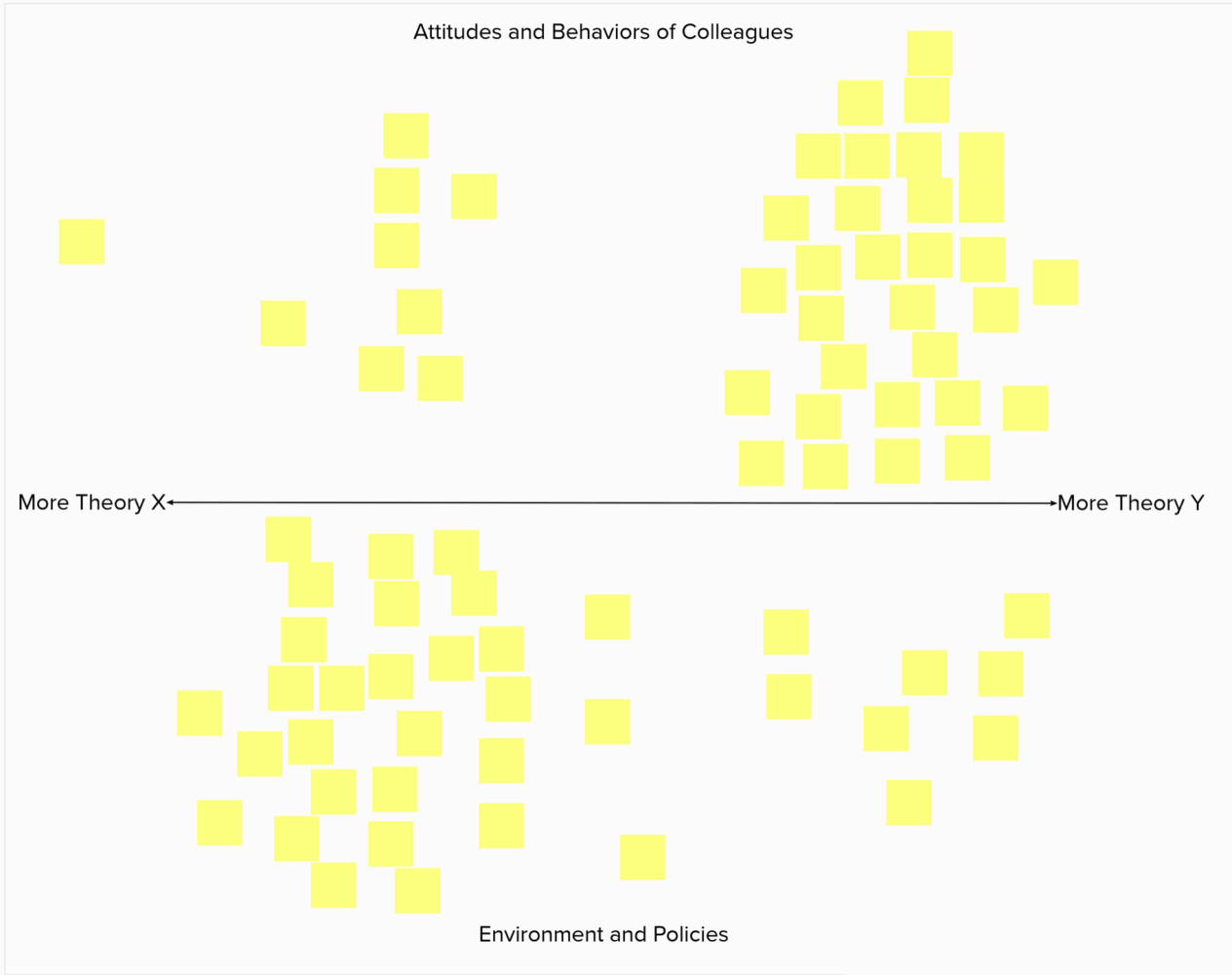
- Pole A, Theory X. Design control structures around the worst-case employee; oversight as the default; trust as a reward earned through visible compliance.
- Pole B, Theory Y. Design control structures around the average employee; trust the system to handle the exceptions; remove obstacles and let people do good work.
- Where Pole A is right. Genuinely high-stakes regulated work where the cost of a single bad actor is catastrophic: nuclear plant control rooms, aviation cockpit checklists, surgical theatre protocols, anti-money-laundering compliance. The structural Theory X is not a failure of trust; it is the right engineering response to a Clear- or Complicated-domain risk surface in a low-variance context.
- Where Pole B is right. Most creative work, most knowledge work, genuinely Complex cross-functional decisions, almost any role where intrinsic motivation is doing the real work.
- What it looks like in decisions. Pole A leaders write detailed approval workflows for spending below $5k. Pole B leaders set a budget and let the team allocate.
- Source. Douglas McGregor.
The larger mirror
Here are all 28 paradigm dichotomies, sorted into six roughly-organising axes.
Change: how does this leader read and produce change?
1. AI as productivity layer vs AI as substrate for org redesign.
- Pole A. AI is a tool that makes existing roles faster, cheaper, or more leveraged. The organisation chart, role boundaries, and career ladders stay; capable people get more done. Pole A treats AI as adoption.
- Pole B. AI is a substrate that re-shapes which work is human and which is not. The valuable human role broadens rather than narrows: the builder, or skilful generalist, who can define an outcome, specify the constraints, choose which work goes to AI and which stays human, and verify what comes back. The narrow specialist’s economic logic—expertise is scarce and demand for it is unlimited—is the assumption AI dissolves. Pole B treats AI as redesign and treats the generalist as the new load-bearing role.
Pole A is right where the work is genuinely procedural, the regulatory or domain constraints prevent role redesign within the planning horizon, or the firm is buying time to learn what to redesign. Pole B is right wherever the planning horizon is shorter than the rate of capability change in the AI substrate, or where competitors are already redesigning.
In decisions: Pole A leaders sponsor AI-rollout programmes inside existing job families and ask “what’s the productivity uplift?”; Pole B leaders ask “which work is now human, which is now AI-supervised, which is now AI-autonomous, and what does the role—if any—on the other side actually look like?” They accept that the answer reshapes the entire organisation’s strategy, process, people, structure, and rewards. The traps on both sides are different. Pole A leaders may well discover two years late that their biggest cost curve was the incumbent org design itself, not tokens. Pole B leaders get the org design right (adaptive topology, broadened mandates, smaller teams of builders) but might bet specific designs on AI capabilities that aren’t yet stable, and have to walk those back.
The builders carrying the substrate shift in the firms I see doing it well tend to share a profile: high pattern-recognition across domains, liberal-arts-educated as much as they are technically trained, comfortable holding business, technical, and human-systems vocabulary in the same sentence. They are noticeably less patient with the status quo than average. The org-design literature names the role (multi-learning, M-shaped, expert generalist) but undersells how specific the profile is. Hiring for it is harder than hiring for the role it replaces.
Watch. Craig Larman, Craig Larman’s Take on 10X ORG: Why He Thinks This Book Matters (5 min). Names the dichotomy directly: Pole A as the cost-curve trap (“AIs cheap as dirt, 24/7, no vacation, humans won’t compete by suggesting ‘hire me, I’ll make you 10% better'”), Pole B as 10x redesign rather than 10% improvement, with 10xOrg, Org Topologies, and LeSS. Companion: the Reinertsen video from entry 6 for the flow-economics half.
Read. Org Topologies (start with their primer) and 10xOrg on org-design at AI-substrate scale; Jay Galbraith, Designing Organizations (Star Model) on the model that underpins much of Org Topologies and 10xOrg; and Reinertsen, The Principles of Product Development Flow, on what happens to flow and cycle time when the speed of individual process steps changes faster than the surrounding system.
2. Pushing people vs changing the conditions.
- Pole A. Produce change by force of will: announce the programme, run the training, hold people accountable for the new behaviour.
- Pole B. Produce change by shifting what surrounds the behaviour: the path (incentives, friction, information flow) and/or the operating system (the meaning-making that produces the behaviour in the first place). Pole B has two flavours: environmental design (change the situation, behaviour follows) and developmental work (change the mindset, behaviour becomes durable). Change the organisation design and the behaviours will also change.
Pole A is right in time-critical regulatory or competitive shifts where the new behaviour is specifiable and adoption speed is the binding constraint. Pole B is right whenever the change is adaptive rather than technical, or whenever Pole A compliance reliably decays the moment pressure relaxes.
In decisions: Pole A leaders announce programmes and run training; Pole B leaders redesign the environment so the new behaviour is the easier behaviour, and accept that the deeper version of the work is developmental, takes much longer than scheduled, and treats early relapse as “not yet” (in Heath & Heath’s frame from Switch, drawing on Carol Dweck) rather than as failure. Training is still valuable—especially when it transmits difficult-to-document embodied wisdom—just not sufficient.
Watch. Dan Heath, Leading a Switch (10 min).
Read. Heath & Heath, Switch; Donella Meadows, Thinking in Systems, on leverage points; Robert Kegan, In Over Our Heads; Kegan & Lahey, Immunity to Change, on praxis.
3. Content vs process.
- Pole A. Get the right answer; convince others; the decision itself is the work.
- Pole B. Get the right way of deciding; the quality of the process determines the quality and durability of the decision.
Pole A is right when the answer is genuinely knowable and the legitimacy of the decision is not at stake: the technical call on a deployment rollback, the regulatory interpretation, the budget reallocation inside an already-agreed envelope. Pole B is right when the decision will be implemented by people who weren’t in the room and whose ownership of the decision is what makes it stick, which is most systemic decisions.
In decisions: Pole A leaders write the strategy and roll it out; Pole B leaders design the conversation that produces the strategy.
Watch. Roger Schwarz, Smart Leaders, Smarter Teams (4 min): the leader as architect of how the team thinks together, not just decider of what gets decided.
Read. William Noonan, Discussing the Undiscussable; Edgar Schein, Process Consultation Revisited; Schwarz, Smart Leaders, Smarter Teams.
4. Mandate vs invitation.
- Pole A. Authority issues the requirement; people comply.
- Pole B. Authority articulates purpose; people enrol or commit; compliance is the floor, not the goal.
Pole A is right when speed is binding and the cost of partial enrolment is acute. Pole B is right when the work depends on enrolment for any durability.
In decisions: Pole A leaders ship a directive; Pole B leaders ship a question and an open week.
Watch. Peter Senge, On Shared Vision (2 min): on the compliance-to-commitment ladder and why a vision has to be talked about with people, not told to them. Companion: Frederic Laloux, 1.2 What truly drives you? (Thought for top leaders) (10 min) on speaking from the why rather than mandating the what. The University Hospital CEO story shows the exact moment a leader stops mandating concepts and resistance vanishes.
Read. Senge, The Fifth Discipline, on the seven attitudes-toward-a-vision spectrum; Laloux, Reinventing Organizations, on the advice process; Heifetz, The Practice of Adaptive Leadership.
5. Training vs practice.
- Pole A. Episodic, off-site, formal; the classroom is the venue.
- Pole B. Daily, embedded in work, mentor-mentee at the gemba; the workplace is the venue.
Pole A is right when the content is genuinely transferable from classroom to context and the transfer overhead is low: compliance certifications, language fluency, formal credentialing requirements, software platform onboarding for stable tools. Pole B is right when the content lives in the situated work and the classroom abstraction loses most of what matters: coaching skills, judgment under uncertainty, leadership behaviour under threat, and almost any capability the leader cares about in their senior people.
In decisions: Pole A leaders send people to courses; Pole B leaders block thirty minutes a day for coaching cycles at the work.
The exception worth naming: well-designed games, simulations, and case-based kata are training in venue but Pole B in substance. They transmit the tacit pattern-library—the mētis—that “sage on the stage” classroom abstraction usually can’t carry. Donald Schön’s practicum, Gary Klein’s recognition-primed decision simulation work, and Ikujiro Nonaka’s socialisation mode in SECI all name this third space. The diagnostic isn’t the venue; it’s whether the content is codified or situated.
Watch. Mike Rother, Toyota Kata (10 minutes) (11 min).
Read. Rother, Toyota Kata; Amy Edmondson, Right Kind of Wrong; Schön, The Reflective Practitioner, on the practicum; Klein, Sources of Power, on RPD simulation; Nonaka & Takeuchi, The Knowledge-Creating Company, on socialisation in SECI.
Optimisation: what is the unit of value, and how does this leader read waste?
6. Utilisation vs flow.
- Pole A. Keep resources busy; idle capacity is waste; efficiency reports are the management metric; manage cost first.
- Pole B. Throughput is the goal; queues are the enemy; capacity margin is a feature, not a bug. As utilisation climbs toward 100%, queue time dominates cycle time and small upsets in arrivals cascade into long delays.
Pole A is right in genuinely fixed-throughput operations with stable demand and homogeneous work: call centres on routine queries, very mature manufacturing lines. Pole B is right in any system with variable demand, heterogeneous work, or genuinely }Complex/Unordered prioritisation.
In decisions: Pole A leaders allocate every engineer to a project and ask “are you fully booked?”; Pole B leaders protect slack, accept idle time at non-constraints, and ask “what are my queue lengths” as a leading indicator of lead times.
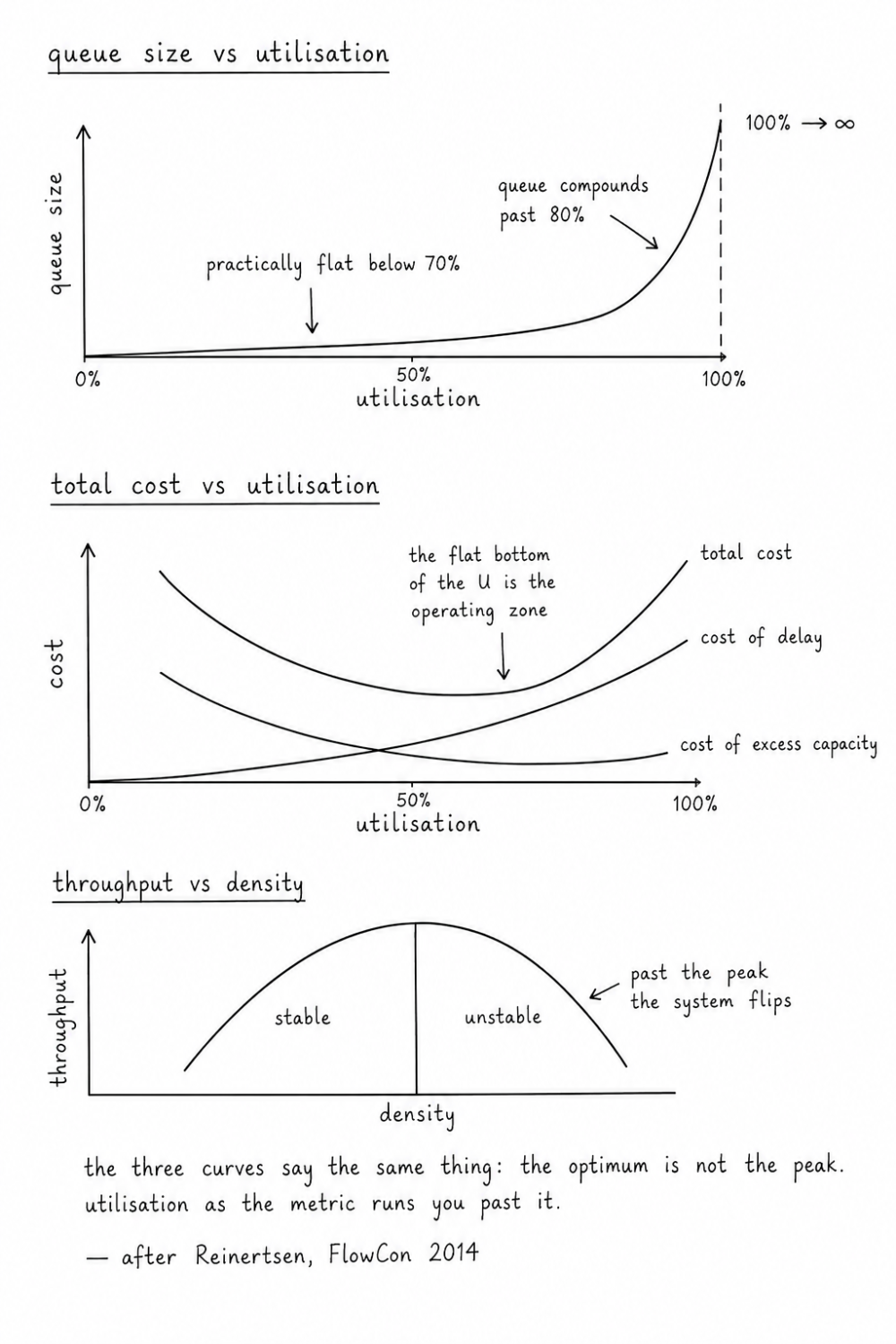
Watch. Henrik Kniberg, The Resource Utilization Trap (6 min). Recommended if you have the time: Don Reinertsen, The Logic of Flow: Some Indispensable Concepts with slides (33 min).
Read. Reinertsen, The Principles of Product Development Flow; Eliyahu Goldratt, The Goal; Daniel Vacanti, Actionable Agile Metrics for Predictability.
7. Plan as commitment vs plan as hypothesis.
- Pole A. Strategy as document, vision as destination, plan as commitment; decide early, execute against the commitment; variance is failure.
- Pole B. Strategy as verb; set direction, find adjacent possibles; treat each plan as a hypothesis with an expected outcome; check; act on the difference; “cross the river by feeling the stones.”
Pole A is right when the planning horizon is shorter than the rate of change, the cost of changing the plan is high, and accountability requires commitment. Pole B is right when none of those is true.
In decisions: Pole A leaders penalise plan variance and demand a guarantee; Pole B leaders demand a hypothesis and an experiment, update the plan, and treat the update as evidence the strategy is working.
Watch. Mary Poppendieck, The Tyranny of “The Plan” (60 min, transcript also available on LinkedIn; this is canonical and well worth the time).
Read. Poppendieck, Lean Software Development and Leading Lean Software Development; Reinertsen, The Principles of Product Development Flow; Snowden citing Henry Mintzberg, The Rise and Fall of Strategic Planning; Klein, Sources of Power, on the premortem; Rother, Toyota Kata, on schedule-as-hypothesis citing Novalis via Popper.
8. Local optima vs system constraint.
- Pole A. Improve each department on its own metrics; the whole will improve as a sum.
- Pole B. Identify the one constraint that limits the whole, exploit it, subordinate everything else to it. “A system of local optimums is not an optimum system; it is a very inefficient system.”
Pole A is right only when the system genuinely decomposes: independent product lines, separate geographies, decoupled value streams with no shared constrained resource. But most systems leaders think decompose don’t. The resources, the people, the queue capacity, the management attention all run through shared bottlenecks the org chart hides. In manufacturing—a Complicated/Ordered domain—Goldratt demonstrates that local efficiency improvements on non-bottleneck resources reduced plant throughput, by pushing more work onto the bottleneck and consuming time that couldn’t be recovered. W. Edwards Deming’s funnel experiment proves the same point for stable production processes: tampering with common-cause variation makes the variance worse, not better. The claim isn’t restricted to Complex/Unordered work; it holds anywhere events depend on prior events and demand has variability, which is nearly every system a senior leader actually meets.
In decisions: Pole A leaders set utilisation targets per function; Pole B leaders ask “which one resource, today, is governing how fast the whole system can move?” and protect it.
Watch. Goldratt, Lectures: Thinking Globally (10 min). Companion (constraint physics): Theory of Constraints (TOC) 3 Bottle Oiled Wheels Demonstration (5 min).
Read. Goldratt, The Goal; Deming, Out of the Crisis, on common-cause variation and the funnel experiment; Senge, The Fifth Discipline.
9. Output vs outcome.
- Pole A. The unit of management is units shipped, features released, work completed.
- Pole B. The unit of management is customer progress, market position, mission impact.
Pole A is right when output and outcome have been demonstrated to track each other tightly in the relevant domain: a sales organisation on a mature product where deals booked do convert to revenue, a fulfilment operation where units shipped equals customer demand met, a regulatory pipeline where filings submitted equals approvals secured. Pole B is right whenever the firm is producing more output and getting worse outcomes, a common pattern in feature-factory product organisations and in any system where the output metric has become the goal rather than the proxy.
In decisions: Pole A leaders celebrate the launch; Pole B leaders celebrate the customer using the thing successfully three months later.
Watch. Jeff Patton, Output vs Outcome & Impact (11 min).
Read. Clayton Christensen, Competing Against Luck (Jobs to Be Done); L. David Marquet, Leadership Is Language; Reinertsen, The Principles of Product Development Flow.
10. Batch and push vs single-piece and pull.
- Pole A. Aggregate work into larger units to amortise setup costs; schedule and dispatch work to resources based on forecast; central plan governs.
- Pole B. Reduce batch size; resources pull work when they have capacity; demand signal at the customer end governs upstream.
Pole A is right when setup costs are genuinely fixed and high, forecast accuracy is high, and the cost of inventory is low (classical EOQ logic in mature physical operations). Pole B is right in any context where setup costs can themselves be reduced and the learning rate matters, or where forecast accuracy is low.
In decisions: Pole A leaders schedule long roadmaps and allocate capacity by Planning Interval; Pole B leaders ship continuously, set WIP limits, and let teams pull from a ruthlessly prioritised and pruned backlog.
Watch. Kniberg, High WIP vs One Piece Flow Example (7 min); Reinertsen, GOTO 2012 Interview on flow (24 min). Companion (short hook): Reinertsen, Economics of Batch Size and the “Father-Egg” Story (4 min).
Read. David J. Anderson, Kanban; Reinertsen, The Principles of Product Development Flow; Poppendieck, Lean Software Development.
Knowledge: what does this leader treat as legitimate knowledge?
11. Espoused theory vs theory-in-use (Model I vs Model II).
- Pole A. The leader’s stated principles, values, and intentions are taken as the relevant data; when results miss, change the action while leaving the underlying assumptions intact. Under threat or embarrassment, Model I governs: win not lose, be rational, avoid upset, support others by telling them what they want to hear; the four social virtues that quietly underwrite organisational defensive routines. “The problem is not me, but you.”
- Pole B. The leader’s actual behaviour, especially under threat or embarrassment, is taken as the data. The gap between espoused and in-use is the diagnosis. Under threat, Model II governs: grant legitimacy to others’ views, assume partiality of one’s own, attribute positive intent, acknowledge impact and contribution. “Aggressive and vulnerable”: strong advocacy paired with genuine inquiry into one’s own contribution.
Pole A is right for external communication: stated principles need to be stated clearly, and an organisation needs them on the record. Pole B is right for the leader’s own self-assessment, and for any conversation where defensive reasoning is already running and the next decision will repeat the last one unless the gap is named. Most leaders, by their own report later, find Pole A was running underneath their Pole B account in at least some of the territory.
In decisions: Pole A leaders judge themselves by their intentions, run after-action reviews on the what, and end disagreements with a winner; Pole B leaders judge themselves by their last three observable interactions, run after-action reviews on the what we believed coming in, and end disagreements by asking which observable example would change the other person’s view, and whether the same example would change theirs. This dichotomy is the load-bearing wall of this mirror: every other entry can be self-reported into the flattering pole, and only the gap between espoused and observed produces signal the leader didn’t already have.
Watch. Roderic Yapp, Double-loop learning: a case study from the front-line (TEDxWandsworth, 17 min): two front-line case studies, Afghanistan platoon houses and then a mental-model challenge, that name the espoused/in-use gap directly. Companion: Chris Argyris, Chris Argyris Talks About Culture and Management (4 min). The framework’s primary author in his own voice, defining theory-in-use and running the canonical “bypass the threat, cover up the bypassing, cover up the covering up” sequence.
Read. Noonan, Discussing the Undiscussable, in the Argyris/Schön/Action Design lineage; Argyris, Overcoming Organizational Defenses; Schön, The Reflective Practitioner; Senge, The Fifth Discipline; Edmondson, The Fearless Organization, on situational humility.
12. Certainty vs honest uncertainty.
- Pole A. Strong, confident, resolute positions communicate competence; doubt is weakness.
- Pole B. Lack of certainty is strength; certainty is arrogance. Think out loud; voice context and hunches; invite challenge; make 90% confidence interval predictions and audit calibration after.
Pole A is right in genuine emergencies—Chaos in Cynefin terms—where projected confidence is the team’s anchor and the cost of paralysis exceeds the cost of being wrong. Pole B is right almost everywhere else, especially in low-validity decision domains where confidence tracks coherence of story rather than quality of evidence.
In decisions: Pole A leaders make point predictions and defend them; Pole B leaders advance positions with the test that would falsify them.
Watch. Julia Galef, Why you think you’re right — even if you’re wrong (TED, 12 min). Companion: Kathryn Schulz, On Being Wrong (TED, 18 min).
Read. Marquet, Leadership Is Language, on “Think Out Loud”; Daniel Kahneman, Thinking, Fast and Slow, on confidence as coherence of story; Doug Hubbard, How to Measure Anything; Garvey-Berger, Unlocking Leadership Mindtraps, on the rightness mindtrap; Galef, The Scout Mindset.
13. Analysis vs recognition.
- Pole A. The right answer comes from listing the options, comparing them against criteria, and choosing the best. Deliberate analysis is what makes a decision defensible.
- Pole B. The right answer comes from recognising the situation as one the experienced operator has seen before, generating one workable course of action, and mentally simulating it forward. Pattern-recognition is what makes a decision fast and, in the right conditions, reliable.
Pole A is right when the environment is irregular, feedback is delayed or absent, the stakes are high enough that the decision will be publicly justified, or the operator is not yet experienced enough for Pole B to be trustworthy. Pole B is right when the environment is regular enough that experience has built trustworthy patterns and feedback is rapid enough to keep those patterns calibrated: emergency response, surgical theatre, deployment rollback, anything an expert has done a thousand times. Klein and Kahneman, who spent years disagreeing about whether expert intuition was real, eventually agreed: it is real where the environment is regular and feedback is rapid, and it is unreliable everywhere else. That joint conclusion is the diagnostic for which pole fits.
In decisions: Pole A leaders introduce a checklist or formal review where stakes are high and feedback is poor; Pole B leaders trust the experienced operator’s first reasonable option and notice when the situation has slipped outside the territory the operator’s experience covers.
Watch. Kahneman, Thinking Fast vs. Thinking Slow (Inc. Magazine, 7 min). Companion: Klein, Introduction to NDM and RPD (9 min).
Read. Klein, Sources of Power; Kahneman, Thinking, Fast and Slow, on the Kahneman-Klein agreement.
14. Codifiable vs situated knowledge.
- Pole A. Knowledge that matters is universal, codified, decomposable, teachable as formal discipline; standards, documentation, and knowledge-management systems are the organisation’s memory.
- Pole B. Most operating knowledge is local, implicit, and held by practitioners: James C. Scott’s mētis, Nonaka’s tacit knowledge, the river pilot’s feel for the one harbour. Mentor-mentee transmission and shared experience are the real infrastructure.
Pole A is right where the work is genuinely procedural, the knowledge is genuinely codifiable, and personnel turnover is high enough to need it. Pole B is right wherever a work-to-rule strike would halt the operation, which is almost everywhere outside fully automated processes.
In decisions: Pole A leaders standardise practices across business units and invest in documentation; Pole B leaders ask the local team what they already do that the standard fails to capture, protect it, and invest in senior staff coaching junior staff at the work.
Watch. Rother, Toyota Kata (11 min). Humourous example: Exact Instructions Challenge (7 min).
Read. Venkatesh Rao, A Big Little Idea Called Legibility (essay, ~20 min); Scott, Seeing Like a State; Nonaka & Takeuchi, The Knowledge-Creating Company, on the SECI model; Rother, Toyota Kata.
15. Knowing vs sensing.
- Pole A. Information is gathered, analysed, decided upon; the cognitive faculty is the relevant tool.
- Pole B. The body knows before language does; felt sense, presence, embodied attunement are signal, not noise.
Pole A is right when the situation is tractable enough that analysis converges and the body’s signal is dominated by cognitive bias. Pole B is right when the situation is intractable, analysis has converged on a position the body finds suspect, and the suspicion is data.
In decisions: Pole A leaders convene more analysis when stuck; Pole B leaders pause, attend to body, name the discomfort, and let the next move emerge.
Watch. Eugene Gendlin, Focusing (Nada Lou archive, 12 min). Gendlin himself on felt sense: “the body has its own take on what’s going on… more subtle, more intricate… you walk by the familiar feelings… one more step.”
Read. Gendlin, Focusing; Otto Scharmer, Theory U; Steve March, Aletheia coaching at integralunfoldment.com.
Authority: how does this leader read power, decision rights, and the leader’s role?
16. Leader-follower vs leader-leader (and the orders that go with each).
- Pole A. Authority lives with the leader; subordinates seek permission and report status; orders are detailed, control is by supervision, deviation is failure.
- Pole B. Authority lives where the information lives; subordinates state intent and act, the leader replies “Very well”; orders are intent, purpose, constraints, and antigoals, with subordinates choosing the right action as conditions change.
Pole A is right in genuine emergencies where time-to-decision is the binding constraint and command structure is what is being practised, or where the right action is precisely specifiable and the cost of unauthorised initiative is high. Pole B is right almost everywhere else, including most of what looks like an emergency, and especially where the right action depends on local conditions.
In decisions: Pole A leaders’ calendars fill with approval meetings and they write detailed task lists; Pole B leaders’ calendars fill with conversations that begin “I intend to…” and they write a paragraph of purpose and a list of what must not happen.
Watch. Marquet, “Greatness” (Inno-Versity) (10 min).
Read. Marquet, Turn the Ship Around!; Reinertsen, The Principles of Product Development Flow, on Marine Corps mission orders; Poppendieck, Lean Software Development, on Auftragstaktik.
17. Hierarchy vs network.
- Pole A. Information flows up, decisions flow down; the org chart is the operating system.
- Pole B. Information flows where it is needed; decisions are made where the information is; the org chart is one of several views.
Pole A is right where regulatory accountability or genuine command structure requires it: defence, regulated finance, certain public-sector contexts. Pole B is right almost anywhere else, including in regulated industries where the structure has been kept for inertial reasons.
In decisions: Pole A leaders re-org by redrawing reporting lines; Pole B leaders re-org by changing meeting cadence, information flow, and decision rights. Steve Jobs named the Pole B move plainly at D8 2010: Apple is “organised like a startup… run by ideas, not hierarchy.”
Watch. Gitte Frederiksen, Great Leadership Is a Network, Not a Hierarchy (TED, 12 min). Companion: Stanley McChrystal, Listen, Learn… Then Lead (TED, 16 min).
Read. McChrystal, Team of Teams; Laloux, Reinventing Organizations; Reinertsen, The Principles of Product Development Flow.
18. Theory X vs Theory Y. See the worked example above. Pole A is right in two distinct contexts: genuinely high-stakes regulated work with catastrophic-bad-actor risk (pharmaceutical batch release, nuclear plant control rooms, anti-money-laundering compliance, aviation cockpit procedure), and routine low-skill, low-discretion work where the task itself doesn’t generate intrinsic motivation and the structure is doing the load (high-turnover transactional roles, certain warehouse or contact-centre tasks where the work is the work and capability development sits outside it). Pole B is right in most knowledge work, most cross-functional work, and most situations where intrinsic motivation is doing more of the load than the control structure can see.
Watch. Dan Pink, RSA ANIMATE: Drive — the surprising truth about what motivates us (11 min).
Read. McGregor, The Human Side of Enterprise.
19. Hero vs steward.
- Pole A. The leader’s authority and competence drive the team; subordinates execute; the leader takes personal credit for success and personal responsibility for failure; the organisation orbits the leader’s competence.
- Pole B. The leader retains final authority but creates highly participative teams; builds capacity that outlives them; the test of leadership is what happens after they leave.
Pole A is right in genuine crisis where personal visibility holds the team together, and is over by the time the crisis ends. Pole B is right almost everywhere else.
In decisions: Pole A leaders close debates by deciding, accept extension after extension because the organisation “needs them”; Pole B leaders close debates by surfacing the disagreement and inviting the team to decide, and measure success by their successor’s competence.
Watch. Marquet, How Great Leaders Serve Others (TEDxScottAFB, 18 min). Companion: Peter Anderton, Great leadership comes down to only two rules (TEDxDerby, 17 min).
Read. Marquet, Turn the Ship Around!, on “don’t be missed after you depart”; Jim Collins, Good to Great, on Level 5 leadership; Joiner & Josephs, Leadership Agility.
20. Orange vs Teal.
- Pole A. Organisation as machine; meritocracy, MBO, KPIs, R&D, balanced scorecards; effectiveness as the yardstick.
- Pole B. Organisation as living system; self-management, wholeness, evolutionary purpose; sense-and-respond rather than predict-and-control.
Pole A is right in tractable, stable industries with well-understood competitive dynamics: regulated utilities, mature consumer staples, infrastructure with predictable demand. Pole B is right in industries undergoing genuine technology-driven disruption where the planning horizons no longer track the disruption rate, which is most software-permeated industries right now.
In decisions: Pole A leaders run quarterly cascades of OKRs; Pole B leaders run quarterly listening practices to “what the organisation wants to become.”
Watch. Laloux, 2017 CEO Summit talk (30 min).
Read. Laloux, Reinventing Organizations.
21. Telling vs asking.
- Pole A. The leader’s job is to know the answer and communicate it clearly. Effective leadership is articulate direction; effective change is handing the team the answer, the plan, the playbook.
- Pole B. The leader’s job is to surface the information needed for good decisions. Ask questions to which you do not know the answer; let the team find the answer; develop capability, not just compliance.
Pole A is right when the leader genuinely knows the answer, the team genuinely does not, and either the cost of getting the answer wrong is high or the team genuinely lacks the prerequisite skill and the cost of failure is high. Pole B is right whenever the leader is acting from confident position on a question the team is closer to than the leader is, or whenever the leader is solving problems faster than the team can grow into.
In decisions: Pole A leaders open meetings with a position statement and shorten meetings by deciding faster; Pole B leaders open with “What’s on your mind?” and lengthen meetings by asking the five Toyota Kata questions, accepting that the team’s answer may be better than theirs.
Watch. Michael Bungay Stanier, How to Tame Your Advice Monster (TED, 14 min).
Read. Schein, Humble Inquiry; Stanier, The Coaching Habit; Rother, Toyota Kata.
22. Expert vs facilitator.
- Pole A. The leader is the most senior technical authority; problems are escalated up to where the expertise is.
- Pole B. The leader’s role is to make others’ decisions possible; expertise lives at the work.
Pole A is right when the leader is genuinely the deepest expert and the call is technical: the founding CTO making the last call on a core architecture decision, the chief surgeon overruling on the table, the lead investigator on a specific case. Pole B is right when the leader’s expertise is a layer or two removed from where the work is actually being done, which is almost every senior leadership context outside narrow technical-founder situations.
In decisions: Pole A leaders are the technical decider on contested calls; Pole B leaders convene the people who know and facilitate the call they make.
Watch. Schein, Humble Inquiry (lecture, 21 min).
Read. Joiner & Josephs, Leadership Agility; Schein, Humble Inquiry.
Causation: how does this leader read the relationship between events and their causes?
23. Deviation vs conditions.
- Pole A. When work goes wrong, the explanation is a deviation: from procedure, from competence, from intent. The fix clarifies the standard or addresses the deviator. “Human error” is a sufficient diagnosis.
- Pole B. Real work continually adjusts to underspecified conditions; the gap between work-as-imagined and work-as-done is where both safety and risk live. Failure is the unexpected combination of normal variability; “human error” is a symptom of that gap, not a diagnosis.
Pole A is right in tractable Complicated/Ordered failures: a broken bearing, a software null-pointer exception, a structural calculation error, an individual whose behaviour was genuinely reckless. Pole B is right in any incident where the failure was the unexpected combination of normal variability, which is most of what goes wrong in Complex/Unordered work.
In decisions: Pole A leaders write performance-management documents, root-cause reports, and policy clarifications; Pole B leaders go to the gemba (the Japanese term for “the actual place”, where the work happens), ask “what surprised you? where did you have to improvise?”, and change the system people are operating within.
Watch. Sidney Dekker, Safety Differently (2018 lecture, 33 min). Software-native companion: John Allspaw, How Your Systems Keep Running Day After Day (DevOps Enterprise Summit 2017, 33 min).
Read. Cook, Allspaw, Woods et al., The Stella Report; Dekker, Drift Into Failure and The Field Guide to Understanding Human Error; Erik Hollnagel, Safety-I and Safety-II; Todd Conklin, Pre-Accident Investigation; Scott, Seeing Like a State; Deming, The New Economics, on variation.
24. Safety as absence vs safety as presence. This is a corollary of entry 23, framed at the level of metrics and investment rather than incident analysis.
- Pole A. Safety is the absence of events; the fewer accidents, incidents, and near-misses, the safer the system. Safety investment is insurance against accidents.
- Pole B. Safety is the presence of defences, the ability to succeed under varying conditions. Safety investment is investment in productivity.
Pole A is right in tractable systems with stable specifications: the lost-time injury rate on a mature manufacturing line, the field-failure count for a long-standing physical product, the audit-finding count on a stable regulated process. Pole B is right in intractable socio-technical systems where work-as-done routinely adjusts to conditions work-as-imagined did not anticipate: a software platform under continuous deployment, a clinical service operating with staffing variability, anything where the absence-of-events metric stops moving while everyone reports getting away with more than they used to.
In decisions: Pole A leaders count injuries; Pole B leaders ask “how are we able to do this work well 999,999 times out of a million, and what do we need to preserve about that?”
See also. The sources under entry 23, Dekker’s Safety Differently and Allspaw’s How Your Systems Keep Running, both teach this dichotomy at the metrics-and-investment level too.
Read. Hollnagel, Safety-I and Safety-II.
25. Simple stories vs multi-causal stories.
- Pole A. Beginning-middle-end arcs with clear heroes, villains, and lessons.
- Pole B. Several stories simultaneously about the same event; the discomfort of multiple frames as the data, not as a sign that the analysis is incomplete.
Pole A is right when the audience needs to act and the action is genuinely unambiguous: the all-hands message after a successful product launch, the board narrative on a clean quarter, the customer communication after a single root-cause incident with a documented fix. Pole B is right whenever a confident single-cause story is being constructed under conditions the data does not support: most strategic narratives, most multi-quarter performance explanations, most post-incident reviews where “human error” was offered as the answer in the first 24 hours.
In decisions: Pole A leaders narrate quarterly results as a story of decisions made; Pole B leaders narrate them as a story of conditions encountered, with several versions on offer.
Watch. Garvey-Berger, Mindtraps — Simple Stories (5 min). Companion: Tyler Cowen, Be suspicious of (simple) stories (TEDxMidAtlantic, 16 min): names the narrative fallacy directly and argues for “the mess” (multi-causal reality) as the alternative to single narrative. “Every time you tell yourself a good-vs-evil story, you’re lowering your IQ by 10 points.”
Read. Garvey-Berger, Unlocking Leadership Mindtraps; Dekker, The Field Guide to Understanding Human Error, on authentic stories over accurate stories.
Self: how does this leader read their own identity, capacity, and developmental edge?
Every other dichotomy is mediated by the leader’s relationship to themselves. The developmental literature drawn on here (Kegan, Lahey, Garvey-Berger, Joiner) has decent measurement reliability for trained scorers, modest construct validity, and contested predictive validity. The dichotomies below name observable behavioural patterns rather than relying on staging interpretations to do the diagnostic work.
26. Socialised vs self-authoring vs self-transforming.
- Pole A. Identity is given by the surround: role, profession, expectations.
- Pole B. Identity is a self-chosen stance; the leader can hold their own values against pressure from valued others, and the role they hold is one expression of who they are, losable without the self being lost.
- Pole C. Identity is held lightly; the leader values their own frame and watches for the data that would refute it.
Pole A is the right response in some contexts: early-career apprenticeship, certain professional-formation contexts, communities of practice where the work depends on shared identity. Pole B is what most senior leadership roles structurally require. Pole C is rare and not necessary for most roles, but is the right fit in the most VUCA situations where holding any paradigm too long is itself the risk: what Meadows called transcending paradigms, the highest leverage point in her hierarchy.
In decisions: Pole A leaders cannot disappoint valued authorities on behalf of their own judgment, and cannot imagine succession because the role is doing the identity-work; Pole B leaders can disappoint valued others, and treat succession as an explicit part of how they hold the role; Pole C leaders can disappoint themselves on behalf of evidence that contradicts their judgment. A three-pole entry; the gap between A and B is usually more salient than between B and C.
Identity-given-by-surround is the structural failure mode AI exposes most cleanly. Pole A leaders cannot distinguish good from plausible: the LLM’s confident prose lands in the same register as the voices that shaped their expectations. They accept what the model tells them to do not because they’re naïve but because they have no felt sense of what fitting would mean; the model’s output is just another voice from the surround. Pole B leaders feel the dissonance when a confident output doesn’t fit the situation, and slow down. Pole C leaders treat every model output as a hypothesis to be tested against evidence the model couldn’t have seen. The leader who cannot disappoint a confident voice cannot govern an AI either.
Watch. Kegan, The Further Reaches of Adult Development (The RSA, 20 min): Kegan himself walking socialised → self-authoring → self-transforming.
Read. Kegan, In Over Our Heads; Joiner & Josephs, Leadership Agility; Garvey-Berger, Unlocking Leadership Mindtraps; Heifetz, The Practice of Adaptive Leadership.
27. Subject to assumptions vs object of assumptions.
- Pole A. The leader’s frame is what they look through; it is invisible to them.
- Pole B. The leader can look at their own frame; they can hold it up to inspection.
Pole A is the structural default; every leader is functionally subject to most of their assumptions most of the time, and a working organisation depends on the leader operating from a frame rather than constantly inspecting one. Pole B is right where the situation is already telling the leader their frame is not fitting (results recurring, conversations repeating, the same diagnostic appearing in different vocabulary each quarter). The diagnostic move is the noticing in those moments, not the constant inspection.
In decisions: Pole A leaders are surprised by their own pattern when it surfaces; Pole B leaders can name the anxiety that drives the behaviours they keep noticing in themselves.
Watch. Kegan, An Evening with Robert Kegan and Immunity to Change (Boston College OD Network, 14 min). Opens with the 14-frogs-on-a-log puzzle (gap between deciding and doing) and names the immunity-to-change framework. Walks through identifying big assumptions, then lands on “being able to look at the whole thing”: the subject-object move on one’s own frame.
Read. Kegan, In Over Our Heads; Kegan & Lahey, Immunity to Change.
28. Attached to outcome vs attached to inquiry.
- Pole A. The decision must yield this result; if it does not, the decision was wrong.
- Pole B. The decision was a test of a hypothesis; the outcome is data; the question is what to learn from it.
Pole A is right when the decision was a genuine commitment to a specifiable outcome and the accountability frame requires defending the commitment. Pole B is right when the decision was a hypothesis dressed up as a commitment, or when defending the commitment is doing more work for the leader’s identity than for the outcome.
In decisions: Pole A leaders defend the decision after it fails; Pole B leaders refine the model after it fails.
Watch. Astro Teller, The unexpected benefit of celebrating failure (TED, 16 min). Kill-and-pivot stories from Alphabet’s X: vertical farming, cargo blimp, self-driving cars (the supervised model failed, the team switched to fully autonomous). “We bonused every single person on teams that ended their projects.” Closes on “enthusiastic skepticism is optimism’s perfect partner.”
Read. Rother, Toyota Kata, on “problems are jewels”; Reinertsen, The Principles of Product Development Flow; Edmondson, Right Kind of Wrong, on intelligent failure.
How to use this mirror
The fifteen-minute version, named at the top, is enough on its own: look back at the six axes, notice where you sit on the left, and ask where those assumptions came from and whether they still fit. If the noticing surfaces something that wants more than a glance, the two-week version below is built for that. Four movements, four calendar slots, about two weeks end-to-end.
Movement 1, the reading pass. About 1 hour, today. Read the essay through once and flag the three or four entries that strike you on first pass as most provocative for your current situation. Then sample the embedded videos and essays under the Watch/read lines for those entries; most are 5-15 minutes, a few are longer. Notice which of your initial flags shift, drop, or sharpen once you’ve watched the videos or read the excerpts for those entries. The settled list is what you take into Movement 2. The point of this step is to keep this mirror itself from doing too much of the work; the sources are doing the teaching, and your first read should reflect what you actually find when you let them.
Movement 2, the dichotomy walk. 20 minutes alone, this week. Take your settled three or four entries into solo work. For each, ask three questions: which pole am I claiming?, which pole would my last three decisions in this territory actually show?, which pole does the situation I am facing actually require? The third is the Cynefin discipline: the situation determines the right pole, not the leader’s preference. The first two are the espoused/theory-in-use discipline (entry 11, the load-bearing wall). The interesting territory is wherever those three answers diverge. Write down what you find; you will need it for Movement 3.
Movement 3, the witness round. Send by Friday; one-week response window. Send the same three or four entries to three or four people who have watched you make recent decisions in the territory. Ask them which pole they observed in your last three decisions. One sentence each is enough. Compare to your own answer from Movement 2. The gap, when it appears, is the diagnostic.
Movement 4, the conversation. 45 minutes with a coach, the week after. Take the gap to a coach and work it: make visible the operating pattern that is already happening, and make the next decision a choice rather than a reflex. The achievable end state is one sentence you can say out loud: “On entry N, my espoused pole is X, my observed pole is Y, and the situation usually calls for Z.” If you do not yet have a coach who works at this depth, finding one is the work; this mirror is built for that conversation, and the conversation is what makes this mirror do anything other than sit on the page.
A staff-runnable variant. For a leadership team rather than an individual: same four movements, no coach. Movements 1 and 2 stay solo. Movement 3 is the team being each other’s witnesses on a single shared entry (entry 1 is a strong first choice). Movement 4 becomes a 30-minute conversation about the gaps that surfaced: what each person’s espoused pole was, what their last three decisions in this territory actually showed, and what the situation the team is facing actually requires. Run on one entry per fortnight. The team’s situation, not the facilitator’s, determines what each conversation produces.
What this mirror does, and what it doesn’t
This mirror makes the operating paradigm observable. It does not, on its own, change it. The change-work is the conversation that follows. The mirror is the first step of that work, not a substitute for it.
Three things you might do next.
- If one entry hit hard: send it to one peer who has watched you make recent decisions in that territory, and ask them which pole they observed. One sentence is enough. That single exchange will tell you more than another read of the article will.
- If you want the larger argument: read the companion essay, Come Prepared to Die: Your Paradigms Were Survivable. AI Makes Them Lethal. This mirror is the first step of the work that essay names. For a taste of what transcending paradigms entirely looks like, take a look at Just This.
- If you want to talk: flick me a note on LinkedIn, or visit hi.chrisgagne.com. If you do not yet have a consultant and/or coach who works at this depth, finding one is the work.
Some book links are Amazon affiliate links. If you buy through them I earn a small commission at no cost to you. Primary-source citations (papers, reports, articles) link to the original or to free archives.
Originally published on LinkedIn, 18 May 2026.
Some book links here are Amazon affiliate links; if you buy through them I may earn a small commission, at no cost to you.
Leave A Comment