Come Prepared to Die: Your Paradigms Were Survivable. AI Makes Them Lethal.
This essay grew into a book. Come Prepared to Die is now out in full, all 23 chapters: on LinkedIn in the Come Prepared to Die newsletter and here on the blog under Come Prepared to Die. What follows is the original essay the book grew from. Subscribe to either to hear what comes next.
TL;DR: The paradigms most organisations run on were survivable when machines couldn’t replace people. AI changes that. Almost every transformation of the past several decades has been structurally capped at what the leader’s paradigms permit, and the paradigms that got leaders here—Theory X, utilisation, plan-tyranny, and others—are now lethal rather than merely sub-optimal. The work that’s needed is coaching of a particular depth—rooted in presence and refusal to shortcut—held inside a support community, rather than more consulting or more AI on top of the existing paradigm, because leaders at the level of paradigm-death are moving through a rite of passage that can’t be done alone.
NB: I am standing on the shoulders of many giants and this essay is a small increment upon them. Most of this work isn’t original in isolation, but I believe the synthesis is.
1. The slow dawning
I didn’t have a single clarifying event. It was drift, in Dekker’s sense. The cultural shorthand is the boiling frog: wrong about frogs, folk-right about this.
The clearest event came a few weeks ago. I gave Claude a piece of work that would have taken me several months: regenerating around 350 reference documents I maintain, using a nine-pass ingestion protocol that audits each output against the original source. A day and a half later it was done.
Christophe Louvion had said it to me in his usual one-line form a bit earlier: the LLM doesn’t have to be totally correct, it just has to work at least as well as the average human. I heard the sentence then and not yet felt it until now.
I have spent much of my life relying on intellect and ways of seeing the world for protection in a volatile, uncertain, complex, and ambiguous world. Now, faced with my vulnerability—our vulnerability—I am left with a choice: keep trying the same approach and die of exhaustion, or give up and attend to what is here. I wrote about that side of the passage in Just This, also on LinkedIn, earlier this month.
Like most of us, I have been here before in smaller versions. Serious adverse childhood experiences. A father, diagnosed with cancer, whom I couldn’t visit for most of his last two years because of New Zealand’s COVID-era travel restrictions. Each of those was a death and rebirth in its own way.
My life at the moment is a crucible of a chrysalis. This isn’t a phase I can exit by reading the right things or seeing a therapist for a year or two. It requires a change in identity.
My Alētheia coaching teacher, Steve March, put it in larger terms on a coaching call this month. Sometimes we get lazy, he said, because we think tomorrow will look more like yesterday than something different. Six months from now, a year from now, we may be living in a different sort of world.
I’ve also started to read Thomas Moore’s Dark Nights of the Soul: A Guide to Finding Your Way Through Life’s Ordeals, in which he posits that these moments are more like a stage in alchemy than an obstacle to happiness. This has been unusually steadying.
The version of the recoil I have been living is the experience of waking on an ordinary morning to discover that the world has fundamentally shifted and appears the same. The not-knowing is the anxious thing. There is nobody I can turn to who has been in this context before, because none of us have. It’s time for us frogs to jump out of the boiling pot. The water has been getting hotter for decades—more volatile, uncertain, complex, ambiguous—and AI is the rolling boil.
Some version of that context is probably what brought you here, whether you are in crisis or have the foresight to see one coming. I’ve come to see the work of transforming organisations and the work of transforming lives as one question.
2. The 10% ceiling
Almost every Agile transformation of the past 25 years has failed relative to what its framers intended. I have a 20-plus-year career in this work. I led transformations I am proud of, and I participated in or led others I called meaningful change at the time and now read more soberly. None have fully met my aspirations. In some, it might be that the only real success was inoculating the rank-and-file leadership I could access against cargo-cult behaviours, even if I couldn’t shift the broader organisation.
Craig Larman noted in his Certified LeSS Practitioner (CLP) course that where transformation does (rarely) succeed, it lasts at most seven years before a change in executive leadership rewinds it. If a transformation looks like it has lasted longer than that, I suspect the vocabulary survived and the work went back.
Most consultants work at what Peter Block calls the content level: technical recommendations, frameworks, deliverables the manager can absorb without changing how the manager sees themselves or their organisation. There is also an affective level: trust, power, identity, the relationship between consultant and client and between leader and led. The content level is where consultants are trained. The affective level is where paradigm-change has to happen. Most consultants won’t work at the affective level because it threatens the consultant’s position as much as the manager’s. Consultant and manager collude on keeping it that way. Block names the collusion: too often we collude with the client in pretending that organizations are not political but solely rational.
Ronald Heifetz, later with Linsky and Grashow, names the same gap structurally. Technical problems have known solutions inside current authority and expertise; adaptive challenges require changes in values, beliefs, roles, and relationships, and the most common failure of leadership is applying technical fixes when the work is actually adaptive. The 10% ceiling is what consulting does when it stays inside technical mode and the work is adaptive.
Robert Kegan and Lisa Lahey give the gap its mechanism. Change rarely fails for lack of sincerity or willpower. It fails because we mean both things at once: a sincere commitment to the goal, and a hidden countervailing commitment to self-protection, sustained by big assumptions held as fact. The leader’s paradigm is exactly this kind of immune system: a brilliantly designed protective architecture, built at a time that may no longer fit.
Jerry Weinberg turned the boundary into practical advice: Never promise more than 10% improvement, because most people can successfully absorb 10% into their psychological category of “no problem.” Anything more, however, would be embarrassing if the consultant succeeded. The figure has held for forty years, not because it is empirically calibrated, but because it is the boundary at which the consultant doesn’t threaten the manager’s paradigm.
Alexey Krivitsky, Craig Larman, and Roland Flemm, in their excellent 10X Org, return to Weinberg’s rule and argue we can’t afford the ceiling any longer. I think they are right.
Eli Goldratt, in The Choice, made the cognate cut 27 years after Block. He named four obstacles that keep people from clear thinking. People believe reality is complex; conflicts are a given; other people are to blame; they already know. These are paradigm-level obstacles, not technical barriers better methods could remove. Goldratt’s working assumption, what he calls Inherent Simplicity, is that reality, any part of reality, is governed by very few elements, and that any existing conflict can be eliminated, if the person looking is willing to set aside the four obstacles. Almost no leader is. The four obstacles are how the leader’s paradigm protects itself.
The aviation version has been visible for decades. Gladwell’s popular reading of Korean Air Flight 801 placed the cause inside the Korean language’s grammaticalised speech levels. The harder reading that the NTSB stopped short of is that linguistic deference made the gradient more visible without causing it. The cockpit voice recorder shows the first officer and flight engineer questioned the captain about the glideslope and registered alarm at the GPWS callouts, but never escalated to a clear directive. They were correct on the merits, and tentative in the framing. The first officer finally called for a missed approach about seven seconds before the aircraft hit Nimitz Hill. The crash killed 228 people; one further survivor died later.
The deep variable was the steepness of the authority gradient, not the grammar. Aviation has spent four-plus decades engineering the gradient down through Crew Resource Management. Knowledge-worker organisations mostly haven’t, which is why the same dynamic still shows up in retrospectives and failed product launches, in unspoken concerns about a CEO’s pet project, and in board rooms where everyone knew the strategy was wrong and nobody said it directly enough. Amy Edmondson’s nearly three decades of psychological-safety research document the boardroom version of the gradient.
The cockpit’s authority gradient is the same ceiling Block, Heifetz, and Kegan-Lahey describe. The cockpit version has been investigated, regulated, and partly fixed; lives so visibly at stake make complacency hard. The boardroom version hasn’t meaningfully changed. The diffuse, statistical harm of a misfit paradigm at scale isn’t as visceral as a plane crash, even when its aggregate cost is larger. Visible mortality forced aviation to engineer the cockpit’s gradient down. Mortality, in indirect and slower form, is now visible in the boardroom too. AI is what is making it as visible as a plane with all of its engines on fire, the early smouldering not recognised soon enough because the plane still flew.
Thus, almost every transformation of the past several decades has been structurally capped at the boundary the leader’s paradigm permits. The cap held whatever the execution or the method (Agile, Lean, DevOps), because the leader’s paradigm couldn’t be approached, and the consultants in the room either couldn’t—or wouldn’t—approach it.
Almost every transformation of the past several decades has been structurally capped at the boundary the leader’s paradigm permits.
3. Some misfit paradigms
A help-desk operation can run on Theory X with utilisation targets and not be in crisis, even if it is a pale shadow of what is possible. The paradigms below break down in complex knowledge work, which turns on ambiguity, learning, and human judgement. These were the right paradigms when the water was cooler, when the work was more predictable, the customers more uniform, the timelines longer. The water has been heating for fifty years; AI is the moment it boils. Mary Poppendieck named several, plan-tyranny most pointedly. Each is still operative inside most organisations I work with. To declare them as immutable or a commercial reality is practically a thought-terminating cliché.
Theory X. Douglas McGregor’s distinction between Theory X (workers can’t be trusted; require coercion and control) and Theory Y (work can be as natural as play; people seek responsibility and meaning) is 66 years old. Most organisations still operate on Theory X assumptions even when leadership quotes Theory Y. Bas Vodde taught me an exercise in his CLP course that catches this in flight. Draw a horizontal line. Theory X to the left, Theory Y to the right. Sticky-notes above the line for people’s instincts and behaviours, below for the structure and processes they are operating inside. In our course, we all saw lip-service Theory Y, structural Theory X. I’ve not seen an exception yet.
High utilisation, compounded with hyper-specialisation. Donald Reinertsen’s The Principles of Product Development Flow gathers half a century of queueing theory to show that keeping everyone busy makes everything slower. High utilisation produces queues, queues produce delay, delay produces variability, variability produces yet more queueing. The 10x organisation literature and Org Topologies catalogue the second half of the same dysfunction. Treating people as interchangeable resources—meat widgets, in Larman’s words—slotted into functional silos, produces dependencies, hand-offs, and waiting times. The coordination cost scales worse than the labour cost it was meant to optimise. Hyper-specialisation creates more queues for value to flow through, and on Reinertsen’s queueing curve a queue at 95% utilisation is about 25 times the length of one at 55%.
The tyranny of “the plan.” Mary Poppendieck named this one and I haven’t found a better name for it. PERT charts were invented for the Polaris submarine programme in the late 1950s, not because PERT worked, but because Rear Admiral Raborn needed something he could show Congress to keep an eight-year programme funded across multiple election cycles. Harvey Sapolsky’s 1972 history of the programme confirms the bureaucratic reading: the technical officers bypassed PERT, the contractors considered it worthless, and the charts functioned as a façade for the funders. The façade became the doctrine, and a generation of project-management training, PMI’s included, was built on top of it.
You decompose the work, sum the estimates, and, as Poppendieck puts it: bingo, there’s your schedule. You manage to it. When reality predictably diverges, the planning paradigm has only one reading ready: someone failed to try hard enough. The alternative reading, that the plan was merely a hypothesis and the divergence is useful information, isn’t structurally available. Variance-from-plan is the signal; conformance is the definition of success; and the harder people try to execute a wrong plan, the less the organisation learns about why it is wrong. This is Theory X dressed up as project management.
Other paradigms warrant the same examination, this list isn’t exhaustive. One is the smart-technocrat reflex. Konosuke Matsushita warned Western managers that “the intelligence of a few technocrats … has become totally inadequate to face these challenges.” AI now offers an industrialised version of the same paradigm. Others are leader-follower hierarchies and the assumption-of-conflict between management and workers, along with the myth of the heroic individual and the bonus and incentive cultures that crowd out intrinsic motivation. The lineage runs from Senge through Argyris, Schein, Kegan, and Heifetz. Each of these paradigms was named in books still in print long before AI, and AI now turns it terminal.
Donella Meadows placed the power to transcend paradigms at the top of her catalogue of leverage points, above paradigms themselves, above goals, above information flows. She wrote: there are no cheap tickets to mastery. You have to work hard at it, whether that means rigorously analyzing a system or rigorously casting off your own paradigms and throwing yourself into the humility of Not Knowing.
These paradigms aren’t wrong everywhere. Most have contexts where they fit. If a leader ran one for 30 years, it’s because the context rewarded it. Alexey Krivitsky, Craig Larman, and Roland Flemm cemented the historical case for me via the canonical example, foregrounded in 10X Org: Adam Smith’s pin factory (1776), where ten workers using division of labour produced 48,000 pins a day against a solo baseline of between one and twenty pins per worker, by Smith’s estimate a gain of 240 to 4,800 times. The reason it worked is that a pin factory operates in a low-variability environment. Every pin is identical to the last, so hyper-specialisation and high utilisation compound into vast productivity rather than into queues. Mary Poppendieck made the matching point about service work: in manufacturing, variation is the enemy; in service, variation is required because customer expectations differ .The paradigms were lifted across a domain boundary they didn’t fit.
When the underlying paradigm remains the same, performance drifts back toward the old baseline. Those paradigms got most leaders their careers, and they worked in cooler water.
4. Why the ceiling holds: paradigm-change is identity-death
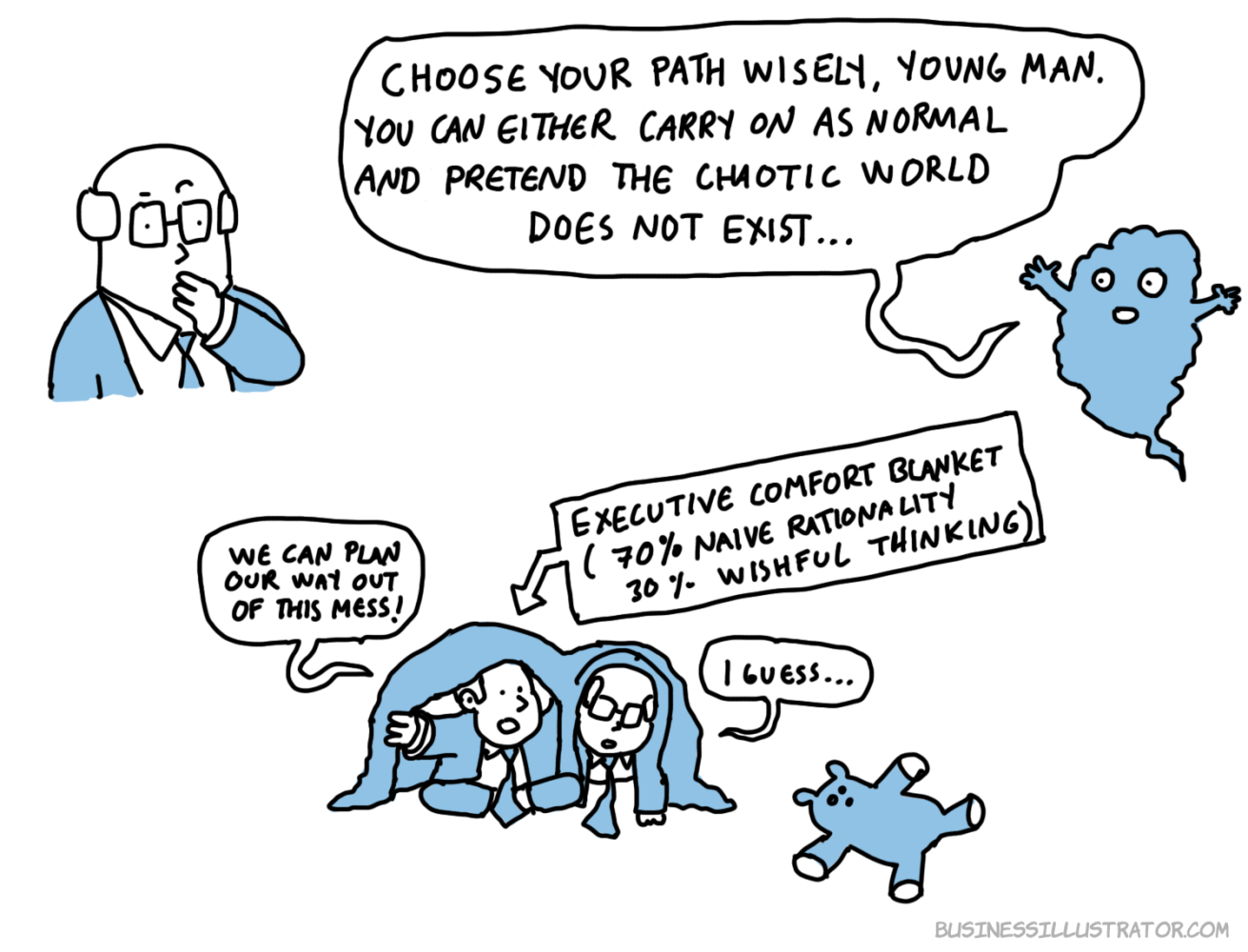
The leader can see the catalogue intellectually and still doesn’t change. Ram Dass gave the reason in Be Here Now, 55 years ago. In the process you must die. This is not a physical death, but it is the end of the world as we know it.
Changing one’s paradigm is deeply vulnerable because it is a shift at the identity level for most of us. If I am not the leader with the answer, am I powerless? The paradigm is the conventional self. To change it, even partially, is something close to ego-death. Serious contemplative practitioners can take years to intellectually understand they aren’t their thoughts, and even longer to embody it. Asking a senior leader to do the same on a fixed “transformation project” timeline in the midst of their daily work isn’t a practical ask.
The self that built the career and the self the paycheque pays are both held together by the collection of paradigms and thoughts we call ourselves. Jennifer Garvey-Berger names the same trap directly: shackled to who you are now, you can’t reach for who you’ll be next. Ram Dass said the same in Be Here Now: it’s only when caterpillarness is done that one starts to be a butterfly. And that again is part of this paradox: you cannot rip away caterpillarness. The whole trip occurs in an unfolding process under which you have no control. Chris Argyris named it in cognitive terms in the 1970s: single-loop learning changes behaviour while leaving the underlying assumptions intact, and the assumptions don’t move because they are the self.
W. Edwards Deming named the pace bluntly: this work is not fast and it cannot be bought, only facilitated. The same lineage carries another line: come yourself, or send no one. It’s associated, possibly apocryphally, with Deming’s reply to the Nashua Corporation CEO who asked to learn his methods through a delegate. The structural point holds either way. Most leaders will send someone, often their VPs. The transformation never quite arrives, because the ultimate leader didn’t.
The CEO is running paradigms that aren’t fit for what AI is making general. This is structural. The conviction is communal: most of their peers think identically. Beatrice Bruteau named this in The Psychic Grid: the world we know is one we collectively project, and few of us can step outside the projection alone. The leader got to the corner office doing what they are doing, and by all comparisons they are doing fine, because the floor is just that low.
5. What AI actually changes
Related reading:
- Case Study: Leadership in the AI Era and the… (LinkedIn)
- Das Arroganz-Prinzip: On the leaders who narrate AI… (LinkedIn)
- The Most Understated Reality in AI Governance Programs (LinkedIn)
The capability picture
The actuarial reality. Self-driving cars make mistakes, but they make fewer than humans on average, even when the mistakes they do make look horrifyingly dumb by human standards: two different brands of driverless cars drove into clearly marked wet cement. No human driver paying attention does this. By January 2025, Waymo had logged 56.7 million rider-only miles, with an 85% reduction in suspected serious-injury crashes and a 96% reduction in injury-involving intersection crashes versus aligned human benchmarks (Kusano et al., Traffic Injury Prevention, 2025). The actuaries know what they are looking at. LLMs are at the same threshold for cognitive work. “Computer” was a human job title for over 300 years before machines inherited the word. Christophe saw it with AI and many others are catching up.
The augmentation cost. Lisanne Bainbridge named this in 1983: automation takes the easy parts of the operator’s task and leaves the hard parts unsupported, then asks the operator to step in when the system fails. The operators most degraded by automation are the ones expected to catch what it misses. A healthy person chooses an electric scooter for short distances because it’s faster with less effort. They lose the muscles and the cardiovascular fitness, then the proprioceptive intelligence, then ultimately the sense of their own embodied capacity. Twenty years on, the scooter is no longer a choice; the body can’t make the trip. We are doing this with cognition, deliberately, at scale. Lee and colleagues at Microsoft Research and Carnegie Mellon, in an early-2025 survey of 319 knowledge workers, found confidence in AI tracked inversely with critical thinking. An MIT Media Lab team running EEG sessions on LLM-assisted essay writers (Your Brain on ChatGPT, 2025, n=54) recorded reduced neural connectivity, poorer recall of the writers’ own prose, and homogenised output among heavy users. A 666-person study by Gerlich in Societies the same year found AI-use frequency inversely correlated with critical-thinking scores, sharpest among the youngest. These studies measure averages. For a smaller group of users who treat AI as a thinking partner with critical engagement—who push back, ask for sources, and refuse first answers—the opposite may hold. The displacement of cognition likely tracks the manner of use, not the tool.
The paradigm picture
Universalisability. Most AI commentary ducks it. Imagine a single firm that has built extraordinary value by replacing knowledge workers with agents. Its position is stable, profitable, and defensible, which makes it locally optimal. It’s the fabled 1-person, $1B company. Now universalise it, so that every firm does the same. In aggregate, the workers have no wages to acquire the extraordinary value the firms are producing. The firms have built a position that destroys the conditions for their own continuation.
Kant’s categorical imperative—act only according to that maxim whereby you can at the same time will that it should become a universal law—is also a stress-test for how a position holds when universal. The corporate AI position fails the test, and I suspect most leaders deploying it know it fails. The game theory says they must attempt it anyway. Each firm is acting rationally; the aggregate is collectively suicidal. Hemenway Falk and Tsoukalas formalised this as a fallacy-of-composition with a demand externality in The AI Layoff Trap (arXiv, March 2026). The same pattern shows up at the supplier level: a handful of frontier-model providers concentrating strategic power across the entire knowledge-work economy, with each firm rationally choosing dependency and the aggregate producing a single chokepoint no firm intended to create. It has the structure of every commons collapse, and it’s happening now in the most consequential industry in the world. The leaders who weather this best are the ones who can hold, simultaneously, that they must compete and that the competition has a destination none of them want to arrive at.
Each firm is acting rationally; the aggregate is collectively suicidal.
The disintegrated moral structure. When IBM was the dominant computing firm, it held a moral floor: the line attributed to a 1979 IBM training slide, A computer can never be held accountable, therefore a computer must never make a management decision. That floor has been honoured in most large firms for most of my professional life. The floor has disintegrated. Daron Acemoglu’s The Simple Macroeconomics of AI (2024) gives the disintegration a quantified line: the bad-task externalities of AI (manipulation, deepfake, security-arms-race revenue) could appear to raise GDP by about 2% while reducing welfare by roughly 0.72% in consumption-equivalent terms. The figures are small, but they show GDP rising while welfare falls. The floor held when machines couldn’t replace people. Now they can, partially.
LLMs drown out the source on leader paradigms. Two of Craig Larman’s laws of organisational behaviour apply directly to what AI is now industrialising. Corollary 2 is the broad claim: any change initiative will be reduced to redefining or overloading the new terminology to mean basically the same as status quo. Corollary 4 is the specific mechanism: displaced managers and single-specialists become “coaches/trainers” for the change, frequently reinforcing the terminology hijacking in their writing. My own corollary, built on Larman’s laws and worked through over a few years: the original insights of any change movement, Agile, Lean, DevOps, were always a small minority of the corpus, and the training data is dominated by that consultant-derivative watering-down. When an LLM writes on these topics, it regresses to the mode, not the truth. If almost everyone writing about Scrum Masters is describing project managers, the model will define a Scrum Master as a project manager, no matter what Sutherland and Schwaber intended. Chris Argyris and Diana McLain Smith named the human analogue in the 1980s: defensive routines persist because we support others by telling them what they want to hear.
AI sells the leader-context-paradigm mismatch back to you. (Also appears as pull quote.) The model codifies the dominant worldview and feeds it back to this particular leader with affirmation, in the precise places where critical thinking is most needed. Most leaders deploying agents at scale are buying a tool that codifies the paradigm they need to leave, with a fawning persona that promotes continued usage rather than critical thinking.
I’ve tested this directly. Asking Claude “what is Agile?” produces consultant-derivative ceremonies-and-frameworks. Even when I asked for research, Claude told me the question didn’t require it. So I built a different retrieval architecture (soon to be open-sourced under MIT) that pre-projects source references onto specific task domains at ingestion, under a nine-pass protocol with a source-only audit gating every output. Asking the same model the same question—this time grounded in that library—produced something else entirely: Agile as a learning discipline, grounded in the Poppendiecks, anchored to Theory Y via Larman, with the AI-era constraint migration named explicitly.
AI sells the leader-context-paradigm mismatch back to you. (Also appears as pull quote.)
The mētis ceiling. James Scott’s distinction between techne (codifiable, transferable, formalised knowledge) and mētis (situated, practical, implicit, partly tacit knowledge) marks another structural limit. Every functional organisation runs on more mētis than its leaders know. The LLM can’t acquire mētis because mētis isn’t in the corpus. Tooling-side discussions of this limit have run since 2023. At the paradigm level, mētis is a structural ceiling on how much paradigm-misfit AI can mask before the system starts to fail. Current discussion of context and harness engineering is correct as far as it goes; the harder question is whether any harness can be sufficient if it can’t contain the human’s mētis. I don’t think it can. The AI optimist’s answer is that mētis will eventually be encoded; pressed, the optimist admits we don’t know how, and the encoding might not survive being made explicit. Following Eugene Gendlin, I am less swayed: you can say and think a lot for years, knowing all the while that you aren’t touching what is implied. What does a strawberry taste like? It can manipulate text about the felt sense; it can’t register the implicit in its own body, because it has no body.
Why the productivity-overwhelm objection doesn’t escape the ceiling. The strongest objection is that AI productivity gains will be so large, with some forecasts running to 100x, that the firms displacing workers can absorb the political backlash with the wealth they capture. Harry Holzer documents that demand effects have historically absorbed automation-driven productivity gains across the Luddites, 1950s computerisation, and China outsourcing; forecasters consistently underweight the income-and-spending response. (Daniel Vacanti shows arrival rate routinely exceeds completion rate in real organisations, partly because adding capacity induces its own demand.) Put together, an AI productivity gain just clears the present backlog. It doesn’t displace the workforce that was generating, prioritising, and resolving the work in the first place. The displacement story confuses output volume with employment ceiling. Any one of the paradigm shifts catalogued above (abandoning utilisation, breaking hyper-specialisation, treating plans as hypotheses) could, I think, produce a comparable gain on its own. The AI-only equilibrium doesn’t hold against the same queueing economics that broke the utilisation paradigm. (If knowledge-worker labour displaces faster than the political economy can absorb, though, we’ll be in a crisis larger than any single firm can handle, and none of this matters at the system level. That’s its own essay.)
6. The work that is needed
Steve March offered a frame on a recent coaching call: what if none of it was wasted, including the years inside the misfit paradigms, the transformations that didn’t take, and the decades of running a playbook that no longer fits? The path is fits and starts, mistakes, steps backward. The life lived exactly as it has been lived up to this moment is the doorway. There is no other.
The slow work is the catch and, paradoxically, the opportunity: a once-in-a-career window for the leaders who can refuse the false quick win and let caterpillarness happen.
On the practitioner side, the diagnostic craft survives the passage: named-pattern recognition, harness work that runs without me in the room, frameworks that let mid-tier authors do leadership-grade systemic learning. What doesn’t transfer to the harness is the rest: two solid days of in-person workshop with a team produces something in their bodies and in the room between them that no agent can reproduce in years of asynchronous work. What passes between people in the room isn’t made of words, and the agent works only in words.
The figure
We are still mentors and diagnosticians, still in the trades we have spent careers learning, and we are also coaches who can hold presence through a rite of passage.
Dave Snowden has critiqued industrial-level coaching that reduces vertical-development frameworks to platitudes divorced from complexity, and insists coaching is neither a necessary nor a sufficient condition to enable change at the organisational level. The work I am pressing here isn’t at the organisational level Snowden is critiquing. It is at the individual leader level, relational, particular, and refuses scaling.
What is needed, at the individual leader level, is real therapeutic and contemplative-developmental practice applied to paradigm-death rather than to personality, as support for unfolding that the consulting role doesn’t provide.
Three things are required: a coach of particular depth, a support system to hold you through the passage, and peers aligned with the new paradigms that will sustain your shift. A coach of particular depth doesn’t solve the dying or replace what is being lost. It takes someone who has themselves gone through these paradigm shifts, or who never carried the outdated paradigms in the first place. They bring practical skill and the things skill can’t carry, and refuse to shortcut what can’t be shortcut. The right coach can hold the whole human, mind, body, spirit, through the passage. The support system is broader: friends, family, community, anyone who can be present with you as you dissolve and re-coagulate. The peers are specific: people already living from the new paradigms, whose presence makes the shift feel inhabitable rather than theoretical.
Steve March, building on Reinhard Stelter, names four generations of coaching method (see The Unfolding of Alētheia Coaching, 2018); coaching at the level of paradigm-death requires the top two: process to move through the experiential field as it shifts, and presence to remain in contact with the dissolution itself. Most coaches—and I mean coaches, not Agile coaches—are trained at the first three generations. Fewer have training in the contemplative fourth. I often work at the fourth.
The org design sibling
Crossing the passage is necessary, not sufficient. Even when a leader has done the work, the organisation can’t readily change. Build a parallel organisation alongside the legacy one: Galbraith’s Star Model—structure, rewards, people, strategy, and process—all realigned, all from day one. Larman and Vodde made the case for this in Large-Scale Scrum (LeSS). The aim is for the parallel organisation to eventually replace the existing one, which is why most large organisations can’t tolerate it. If the company doesn’t create a parallel organisation for its line of business, a Y Combinator startup will create a perpendicular one: running across its assumptions, claiming the same customers from a different vector entirely. Krivitsky, Larman, and Flemm’s 10X Org (2026) takes the argument forward into AI-era operating-model and topology design. 10X Org works on strategy and structure; what I’m adding is the paradigm work. Paradigms must change first.
The rite of passage
Karla McLaren, in The Language of Emotions, draws on mythologist Michael Meade to name three indigenous stages of initiation: separation from the known world, ordeal, and recognition-and-welcome-back. Modern non-indigenous cultures rarely complete the welcome-back. We send people through separation and ordeal and abandon them at the threshold of return. Trauma cycles between separation and ordeal indefinitely until the welcome-back happens. The ordeal also humbles us, so we can drop our hardened patterns.
The closest modern industrial example I know is NUMMI. Toyota taught its Production System to GM through the NUMMI joint venture from December 1984 onwards, with full transparency. (GM had closed the Fremont plant in 1982; NUMMI reopened it two years later as the joint venture.) Ernie Schaefer, the GM plant manager who later tried to replicate NUMMI elsewhere and failed, said it plainly. They never prohibited us from walking through the plant, understanding, even asking questions of some of their key people. I’ve often puzzled over that, why they did that. And I think they recognised we were asking all the wrong questions. We didn’t understand this bigger picture thing. All of our questions were focused on the floor. The assembly plant. What’s happening on the line. That’s not the real issue. The issue is, how do you support that system with all the other functions that have to take place in the organisation? The visible practices on the floor could be copied. The invisible system couldn’t be transplanted into GM’s existing structure.
What GM did right at NUMMI itself, before the failed replications, was the trip. In the Frank Langfitt account in This American Life episode 561, John Shook recalls the goodbye sushi parties at the end of the Japan training rotations: “We had a party, of course. A sushi party… And people were crying on both sides. You had union workers, grizzled old folks that had worked on the plant floor for 30 years, and they were hugging their Japanese counterparts, just absolutely in tears.” The GM workers had been sent away (separation). They had worked alongside Toyota counterparts in a different paradigm for weeks (ordeal). They returned home changed, to a community that received them as changed.
The receiving community at NUMMI was prepared in artefacts too: the Team Member Handbook every worker received on day one opened with a personal welcome letter from Tatsuro Toyoda, defined the Team Leader role operationally as teacher and improvement coordinator, and made mutual trust and the irreplaceability of human judgement recurring themes in its policy pages.
Most leaders who need this passage today will need an analogue of the trip, though not necessarily a geographical one: a retreat from day-to-day work; sustained immersion in a different paradigm with skilled accompaniment; return to a community prepared to receive them as changed. It’s a protected space for dissolving and re-coagulating, a chrysalis. As Ram Dass put it in Be Here Now: it’s only when caterpillarness is done that one starts to be a butterfly. From inside the chrysalis, what is happening is indistinguishable from dying. And it is dying. My hope is that placing this in the ether nudges some leader’s fate closer to the chrysalis.
Few of us in the consulting field are training for the combination this passage requires. The capacity to take one’s own paradigm as an object of inquiry, the developmental shift Kegan describes as the move from the self-authoring mind to the self-transforming mind, his fourth order to his fifth, isn’t common. The lineages this work draws from, contemplative and developmental, aren’t new. The Tibetan teachings on dying go back centuries. What may be new is bringing them into the organisational practice called in when a leader’s paradigm needs to change.
7. The practitioner: trauma-informed, dark depth, prepared to die
I am writing this from inside my own version of the passage. My stepmother is in the ICU, following open-heart surgery and a heart attack that would have killed her had she not already been in a hospital visiting a friend. My mother is in memory care. And yet, alongside all of this, there is some fundamental well-being here. The practice is doing what the practice does.
I am writing this on LinkedIn deliberately. I want leaders considering this work, and practitioners who might join me in the field, to be able to find me. What I want most is an ongoing partnership with leadership willing to examine and shift their paradigms with me.
Practitioners who have been through significant trauma and done the work to clean it up have the kind of dark depth Moore writes about in Dark Nights of the Soul. In a room where the leader’s paradigm is starting to die, that depth gives the capacity to be in contact with the pain rather than look for an exit. I am not trying to change the pain or make it go away. I am learning to experience it as it is, and to meet the self-arising wisdom that comes with contact with all phenomena. The room needs that contact more than anything technical I’ve studied. Steve March frames the same requirement in Alētheia: the coach must do their own inner work, follow the vertical thread of each quality, work through their own blockages, before they can be of use to a client doing the same.
There is an emotional distance baked into the consultant-leader relationship. Not my circus, not my monkeys. The leader pays the consultant for knowledge; the relationship has a bit of the guru flavour to it, and the smart-technocrat reflex is what that flavour curdles into. My goal is to be a dear, close friend who genuinely loves and feels deep compassion for the leader and has no change agenda for them, other than to help meet their normal human psychological needs as they unfold in the midst of this crisis. I am not going to lecture. I am going to hold your hand and walk with you as someone you can get messy with. Companionship in this passage gets beyond the politics. This work is so complex none of us can do it alone. Improv jazz takes skill, but the music lives in forgetting we exist as virtuosos. The playing is reading the room, hitting the right notes at the right time, watching the bassist and the drummer, as a skilful peer rather than a conductor. I have my own musical themes to add. Please jam with me.
John Welwood named spiritual bypassing in 1984: meditation as identity, equanimity as armour, I’m sitting with it as a way to not feel it. Steve names the same limit in Alētheia as the Self-Improvement Trap: practice used instrumentally to manage what arises, rather than to meet it.
There is no instant pudding, as Deming said. The passage isn’t fast, nor do we ultimately have meaningful control.
Next, find the skilful coach who can be in the room with you, and build the community that will hold you as you emerge. You can’t be that coach to yourself. The Mahayana and Alētheia schools agree: this work is relational. Nobody is liberated alone. Find the coach, or be the coach in someone else’s passage. Either is good work.
I have no idea where any of this is going. This whole essay could be moot in six months, as Steve suggested it might be. I don’t know what to do more than anyone else. I am still learning just this.
May we treat the recoil as an invitation rather than something to be coached out of. May we hold the part of us that built the old paradigm with the same care the work teaches. May we help each other up every time we stumble.
Come prepared to die.
If you’d like to talk, flick me a note here on LinkedIn. To book directly, visit hi.chrisgagne.com.
Some book links are Amazon affiliate links. If you buy through them I earn a small commission at no cost to you. Primary-source citations (papers, reports, articles) are linked to the original or to free archives.
Originally published on LinkedIn, 8 May 2026.
Some book links here are Amazon affiliate links; if you buy through them I may earn a small commission, at no cost to you.