Spend the time you save: AI, resilience, and the people you can call
My kickoff keynote for the Nelson AI Sandbox Vibe-athon at NMIT, 13 November 2026: each slide, followed by what I said with it, lightly edited for reading.
Kia ora koutou. Thanks to NAIS, to NMIT for the room, and to the volunteers who set all this up.
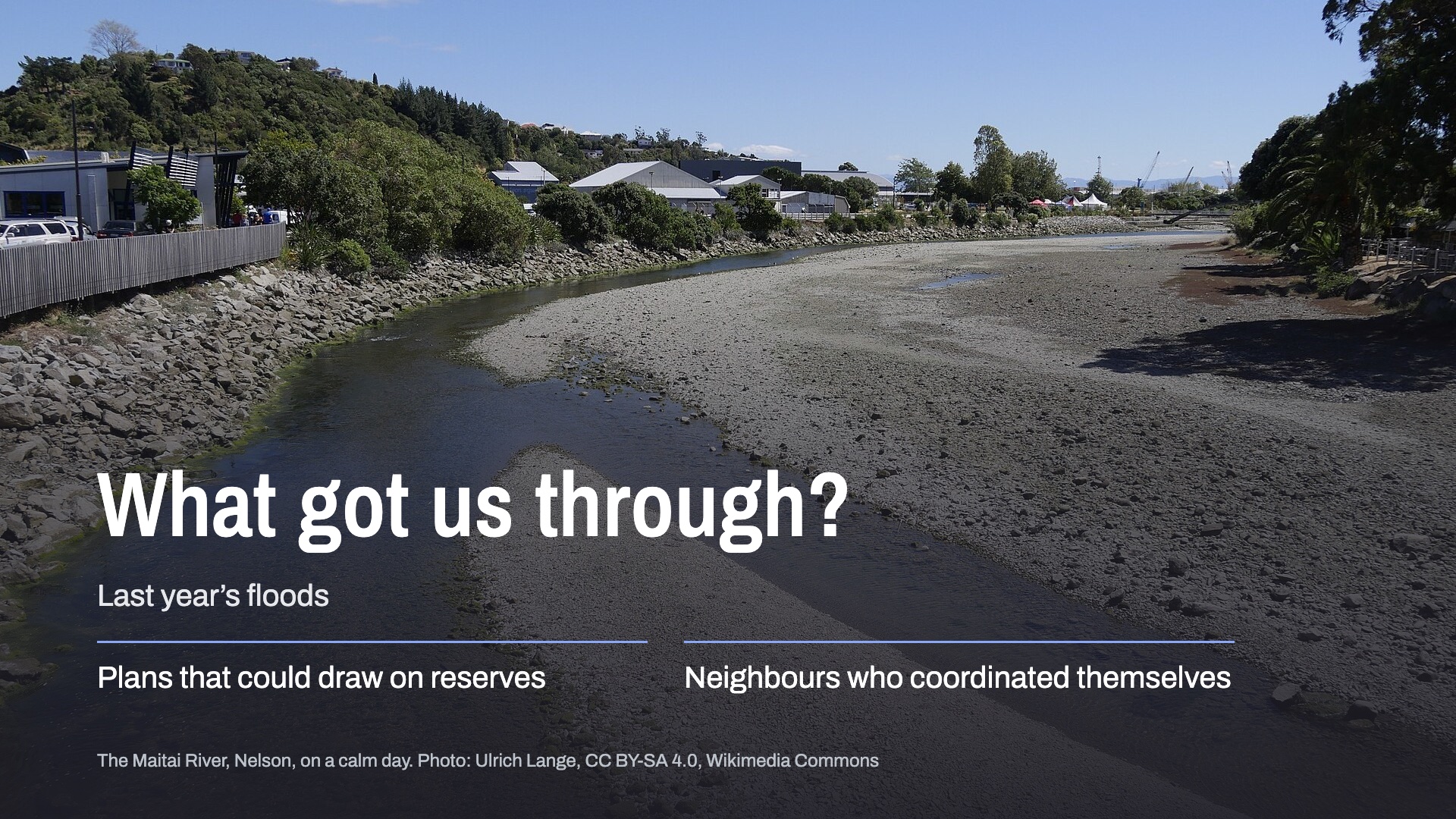
Think back to last year’s floods, and what got us through.
The emergency plans did, and some of the people who wrote them might be in this room. Those plans worked partly because they could draw on reserves: people, money and gear held back for exactly this, not kept busy every day.
And then there were the neighbours, friends and strangers with a ute. Mostly they didn’t wait for a central organiser or anyone’s permission. They coordinated themselves: they talked to each other, and they helped.
Hold on to both of those, reserves and people coordinating themselves. They both come back. Before I say anything else, I want you to pick something.
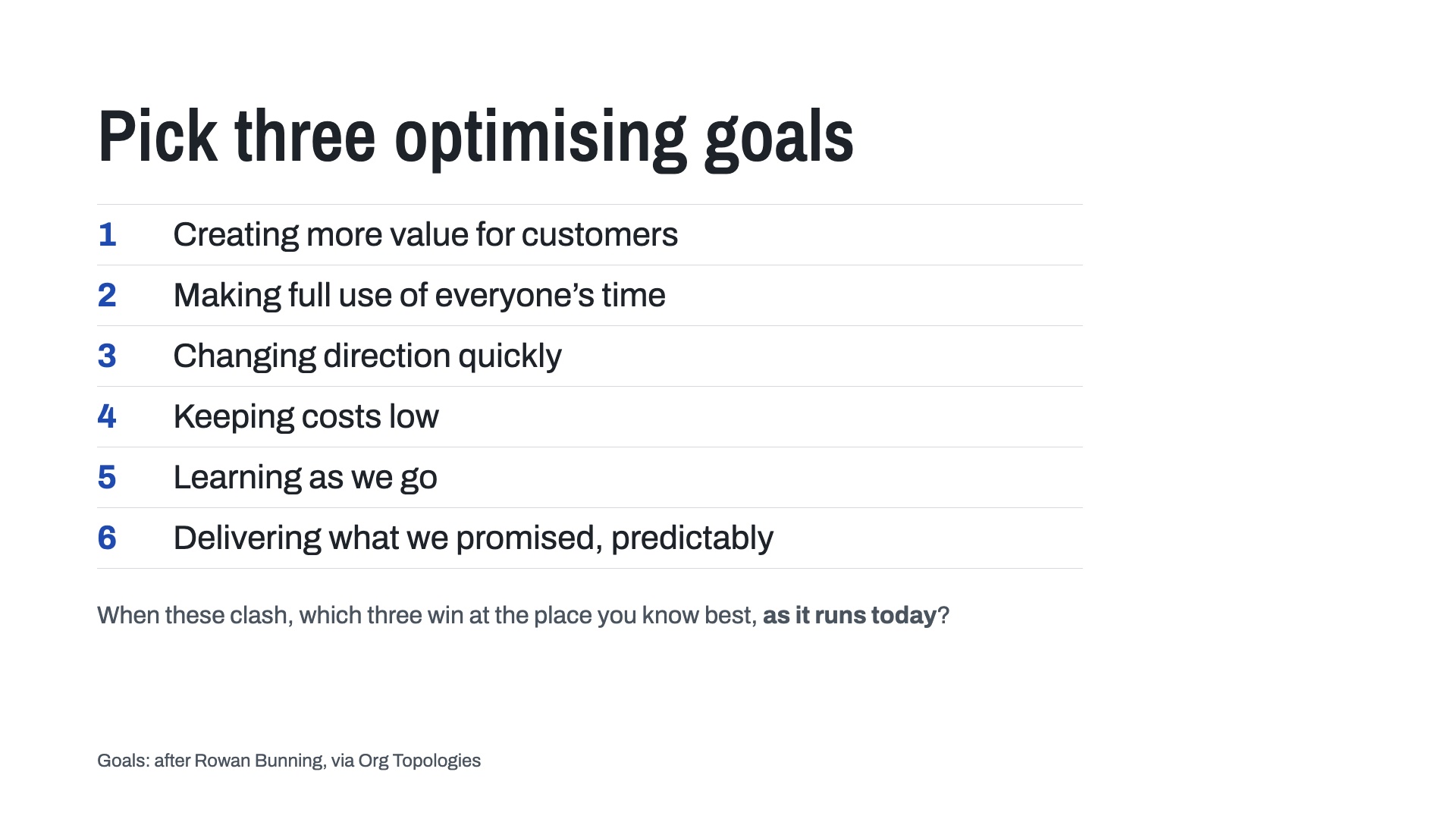
Think of the business or team you know best: where you work, a club or team you’ve been part of, or your last job. Above are six optimising goals: things a place like that can aim for. They clash, all the time. When they do, which three win there? Not the ones you’d like to win. The ones that actually win, as it runs today.
Pick three before you read on.
Now, how many of your three are even? Hold on to that number. Don’t worry about why yet. We’ll come back to it.
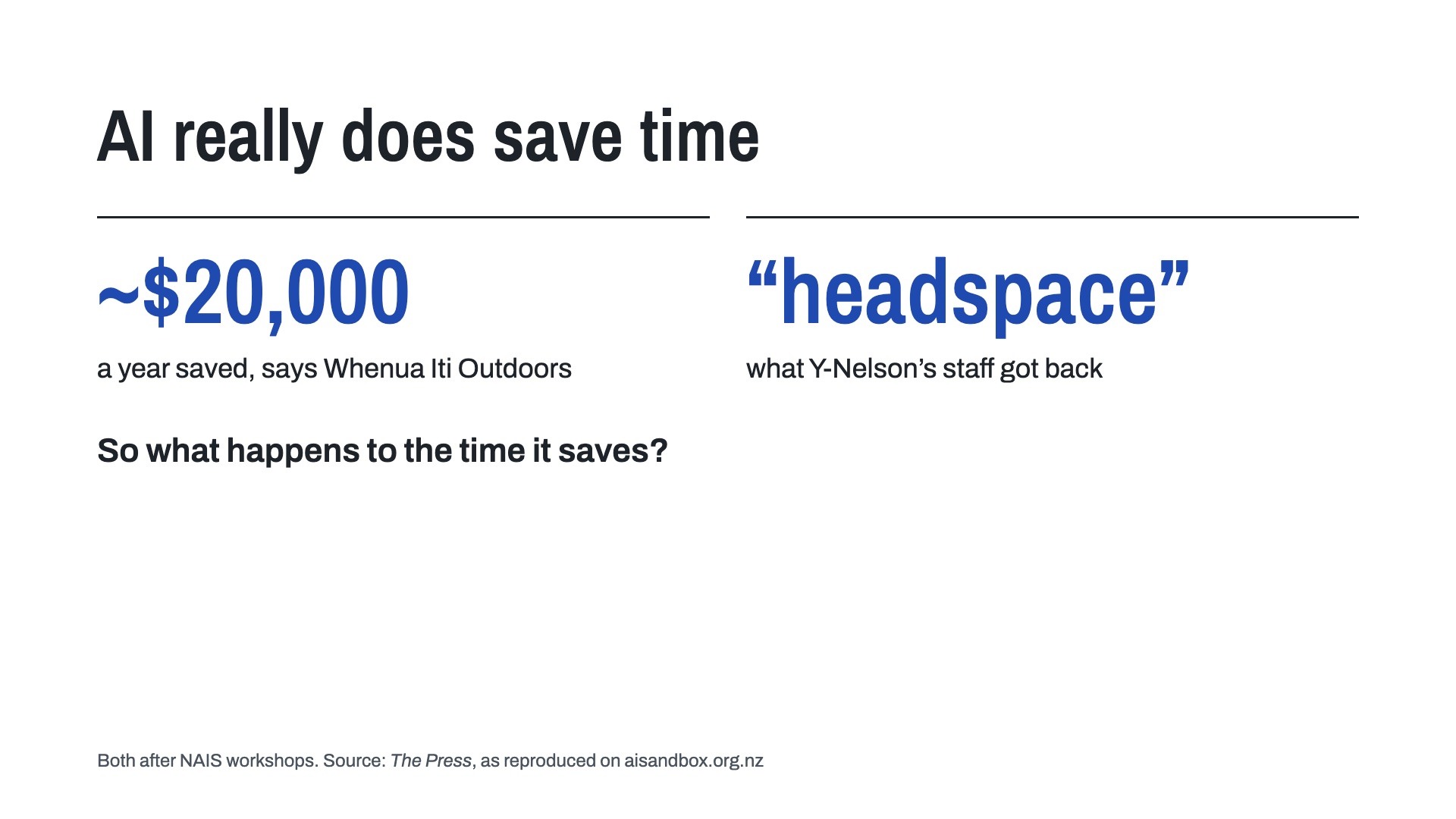
Let’s start on NAIS’s home turf, because this stuff works. After NAIS workshops, Whenua Iti Outdoors told The Press AI saves it about $20,000 a year. Y-Nelson’s staff said it gave them more headspace.
Notice those are two different kinds of gain. Whenua Iti saved money. Y-Nelson got time back for the work that matters.
Whatever you run, a business, a charity or a team, what you’re really after is net value: what you deliver, minus what it costs. You can raise it by cutting costs, or by delivering more. And we’re so used to treating what we deliver as fixed that cost becomes the habitual lever we reach for. AI makes that reflex faster.
So the question isn’t whether AI saves time. It’s what happens to the time it saves.
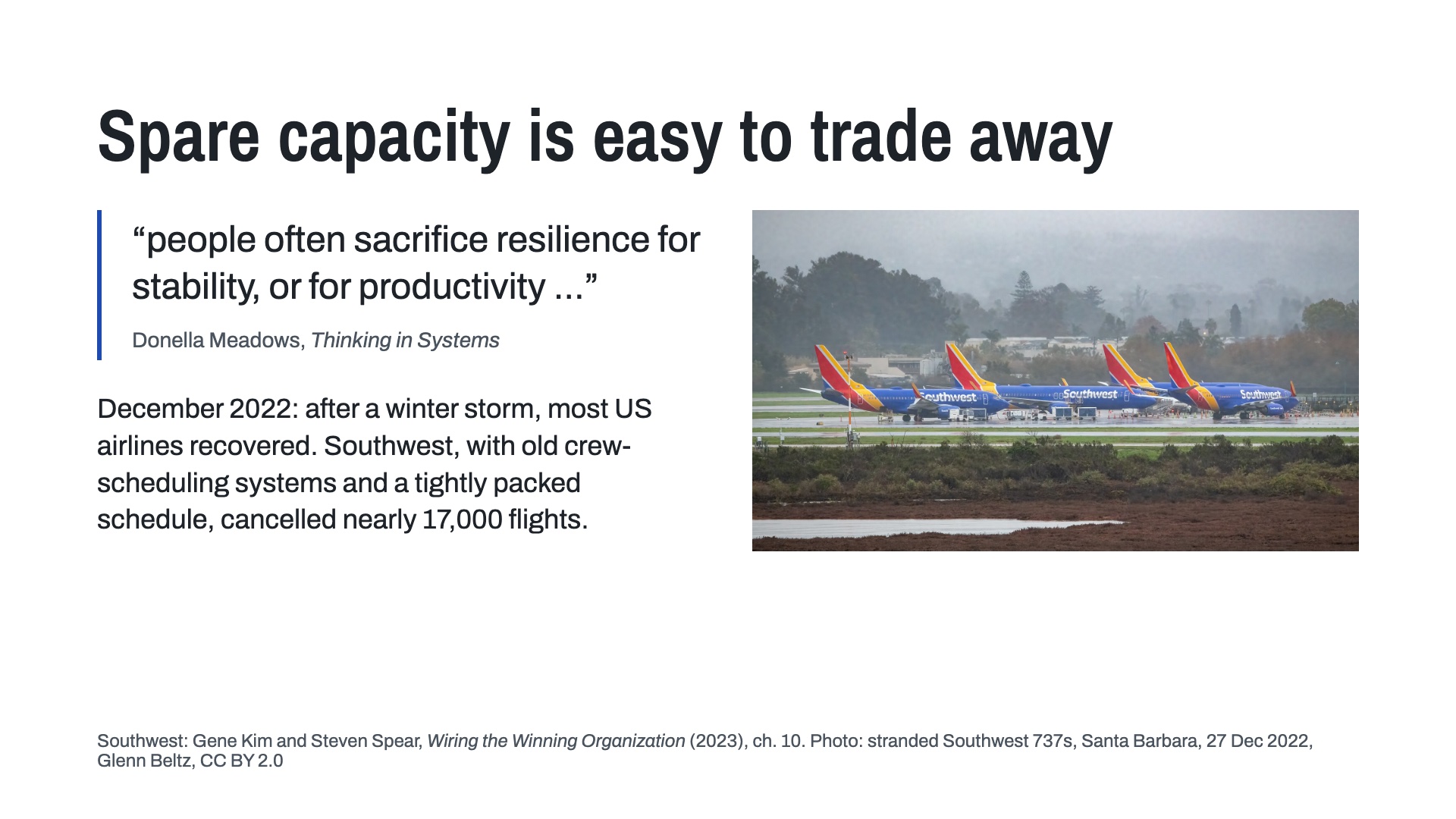
When you chase productivity, spare capacity is the first thing that looks like waste: the slack you need when something changes or goes wrong. Donella Meadows, a systems thinker, put it plainly: people often sacrifice resilience for stability, or for productivity. Resilience is hard to see until you need it.
A real case. December 2022, a huge winter storm swept across the US. In three days, airlines cancelled over 6,000 flights. As it passed, most airlines got back to normal. Southwest didn’t. It kept getting worse. Its crew scheduling lost track of where its pilots were, and it ended up cancelling nearly 17,000 flights.
The photo is Santa Barbara on the 27th. On a normal day there’s rarely more than one of those planes on the ground. There are four, some stuck since the 23rd.
The scheduling system had reportedly been waiting for an upgrade for nearly 30 years, and the schedule was packed so tight it had become brittle. Its own pilots’ union said it struggled with nearly any disruption. The spare capacity had gone years before the storm.
Here’s another airline that kept it on purpose.
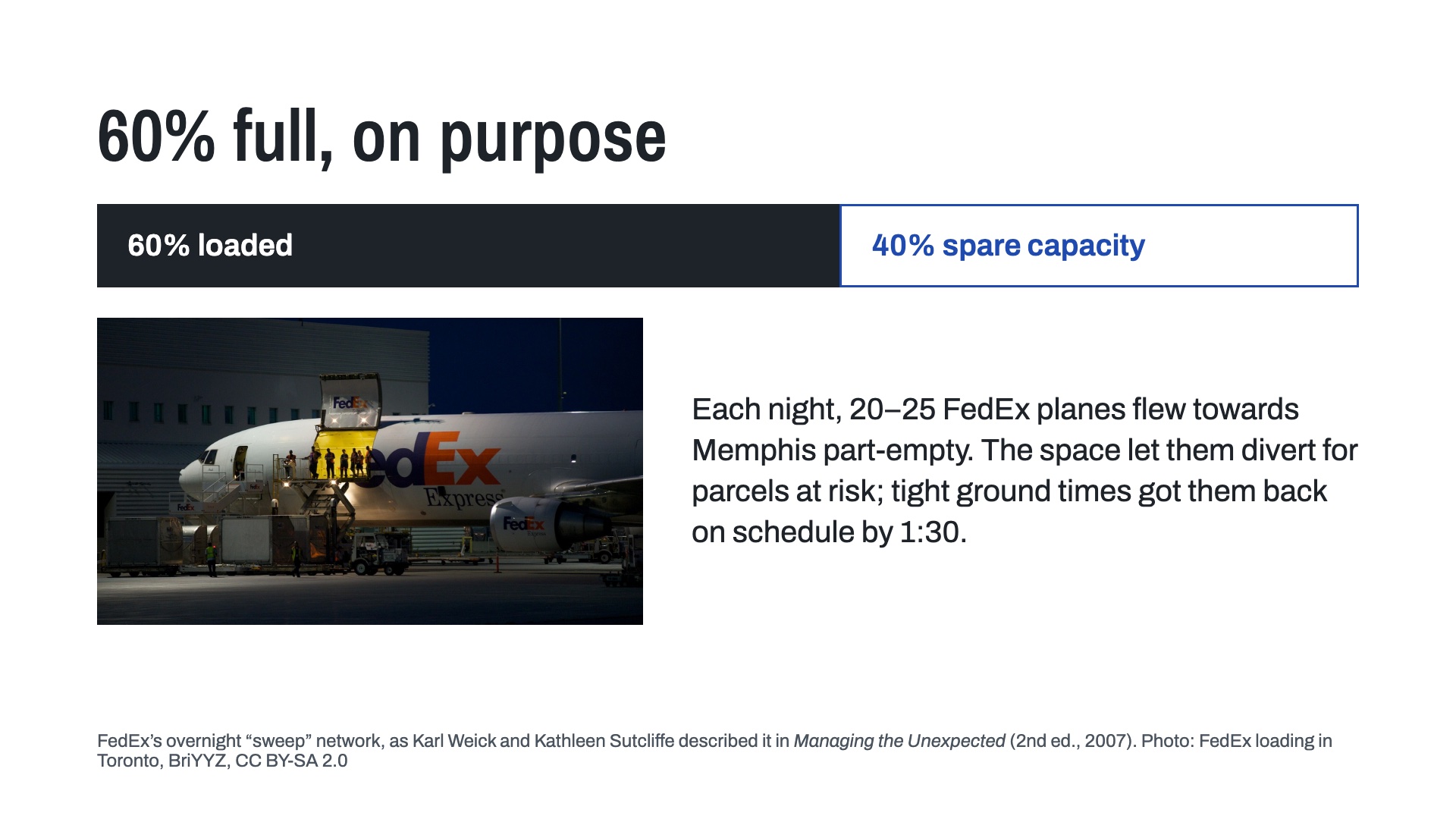
FedEx, as it ran back in 2007. Every night, 20 to 25 planes flew towards its Memphis hub only 60% full. On purpose. That empty space meant they could divert to pick up parcels at risk of running late, and still get back on schedule. The researchers who studied it said it gave the system room “to stretch without collapsing”. No heroics, just room.
On a spreadsheet, that 40% looks like waste. It’s actually what keeps the promise. It’s the same idea as the reserves behind the flood plans, and your version might be as simple as an unbooked afternoon a week.
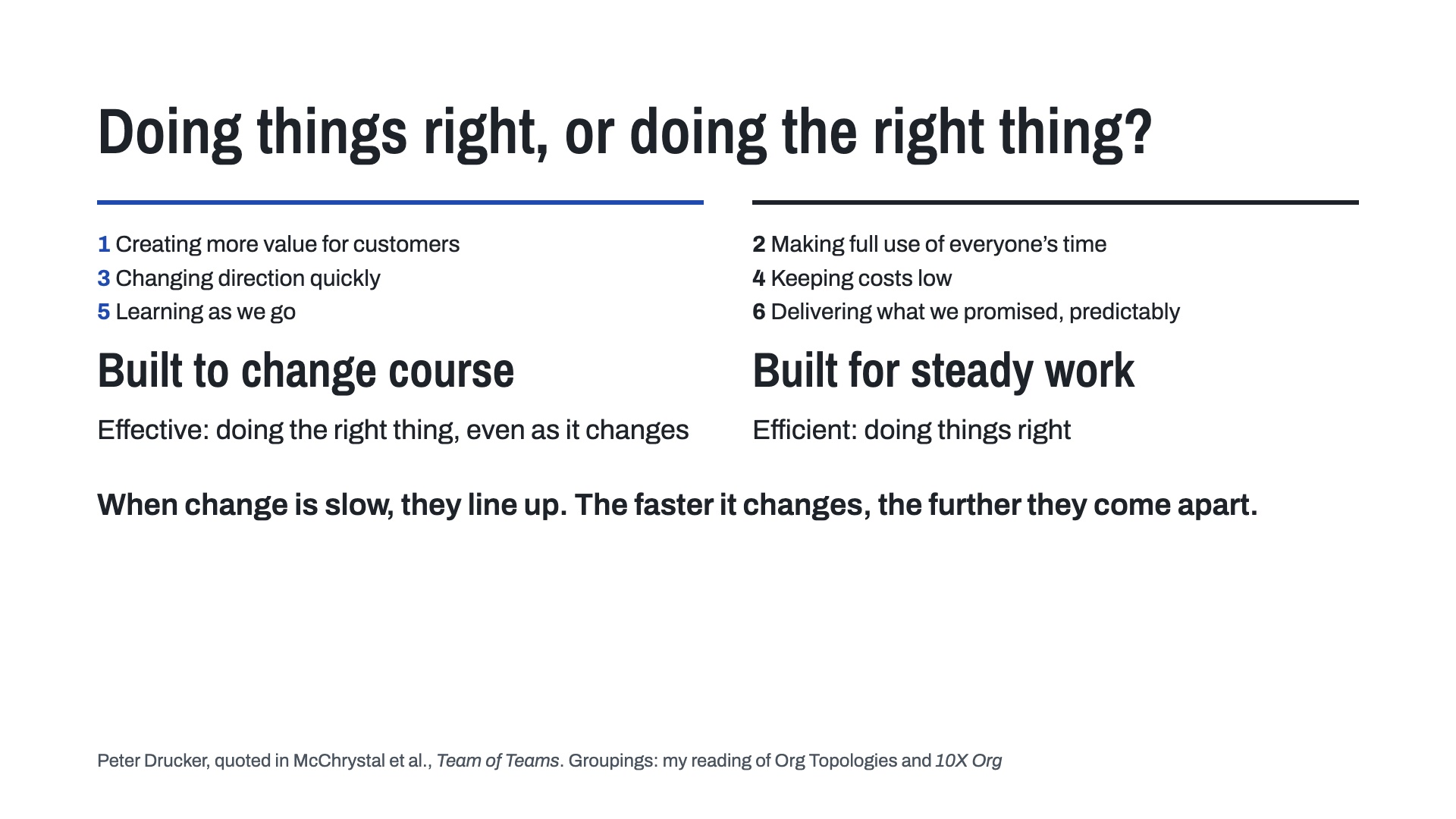
Here are the six optimising goals again. Remember your number? If it was two or three, you lean towards the evens.
The evens belong to an organisation built for steady, repeatable work: everyone busy, costs low, delivering what we promised. That kind of organisation is good at what it does, and keeping costs low can be what keeps a small business or a charity alive. But it’s built for the world it was set up in, and when that world changes a lot, it can break. The odds belong to an organisation built to change course.
Peter Drucker, the famous management thinker, had a neat way of putting the difference: efficiency is doing things right; effectiveness is doing the right thing. The world’s always changing. When it changes slowly and you know what the right thing is, being efficient and being effective line up. The faster it changes, the further they come apart, and right now it’s changing faster than ever. You can get very good at doing the wrong thing.
Neither side is wrong. It’s about which one fits the context you’re in now. Six goals on a slide can’t diagnose anyone; it’s a way to see which way you lean. And FedEx shows the two working together: the on-time promise held because spare capacity soaked up the surprises.
If yours were mostly odds, one check: does what gets rewarded where you work agree with you?
The six goals are drawn from the ten in 10X Org, which credits Rowan Bunning’s talk Optimus Prime for Transformers. The split into odds and evens is mine.
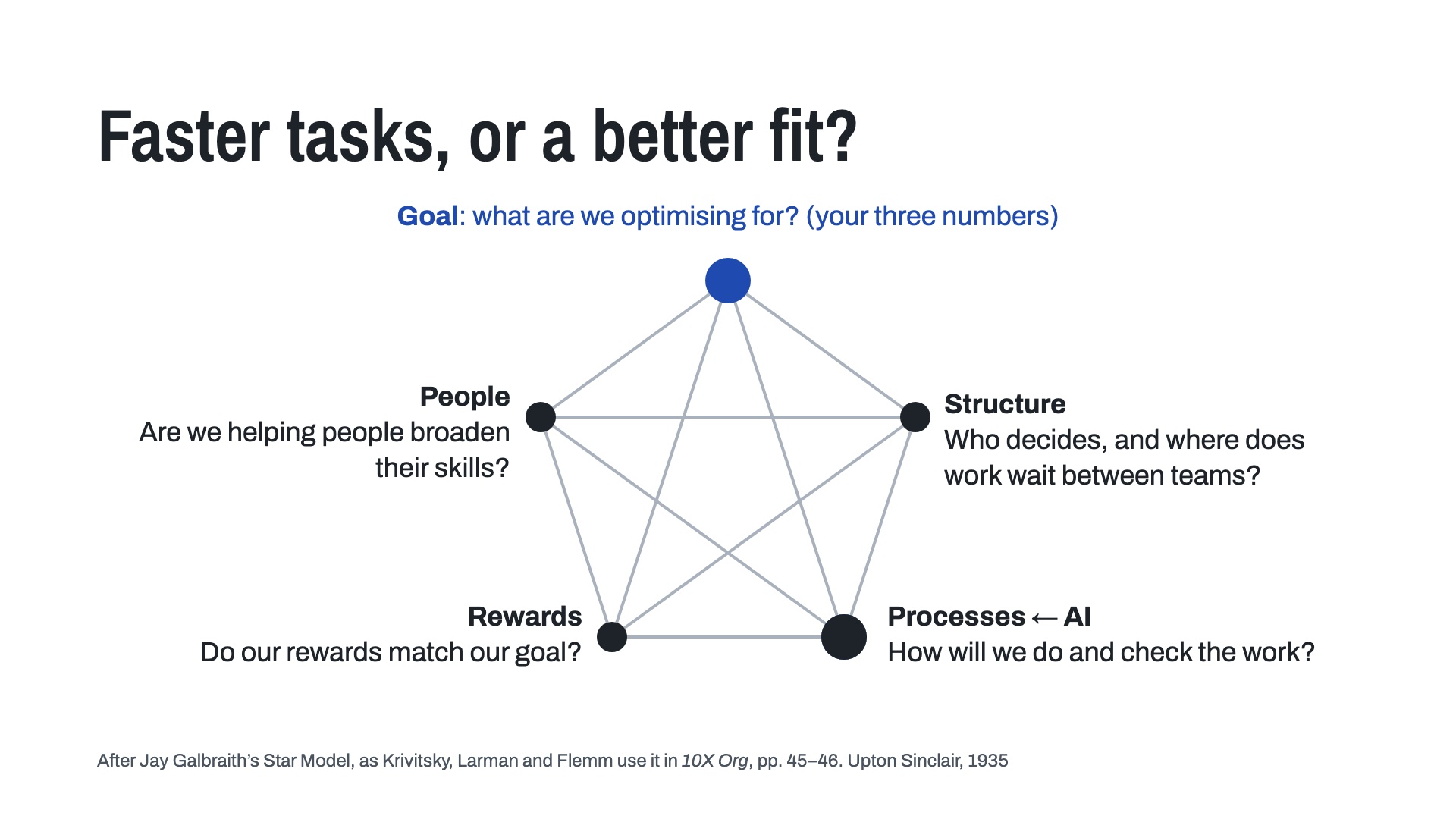
Here’s a simple model of an organisational design. One point is processes: how the work gets done, and how it gets checked. That’s where AI usually lands, as a new tool for the work. Which means it tends to speed up whatever the rest of the organisation already rewards.
At the top is the goal. Your three numbers are a quick read of that.
Structure is who decides, and how work moves between people. Remember the neighbours in the floods, coordinating themselves without waiting for permission. If your organisation has more than one person or team, look hard at where work waits between them: for a handoff, an approval, a meeting. Could you redesign things so you can drop some of the formal coordination and just let people talk to one another? (LeSS calls this Just Talk.) Often that means giving each person or team a wider scope: more of the whole job, start to finish, and the range of skills to do it, so less of the work waits on a handoff. Those are the two dimensions of the Org Topologies map: how much of the work a team owns, and how broad its skills are.
Rewards: do they match the goal? Here’s a test. If people are afraid that admitting they use AI could cost them their job, they’ll hide it. Then nobody can check it, and nobody learns from it. That’s a rewards problem, not a people problem. Upton Sinclair, the American novelist, said it best (via Craig Larman and Bas Vodde’s LeSS courses): “It is difficult to get a man to understand something, when his salary depends upon his not understanding it!”
People: AI can be a patient teacher, so people can learn beyond their speciality, and we still need expert judgement to check the work. Are we helping people broaden? And if you’ve been using AI quietly, this weekend is a good place to use it in the open.
Speeding up the processes you already have with AI, on its own, won’t get you nearly as far as changing the design of the whole organisation. And that starts at the top: the optimising goals you choose shape the rest of the design. Change them, and you’re changing your beliefs about what the organisation is for. If you run your own business or team, you can start on all five on Monday. If you don’t, or you’re a student, this weekend’s team is your organisation.
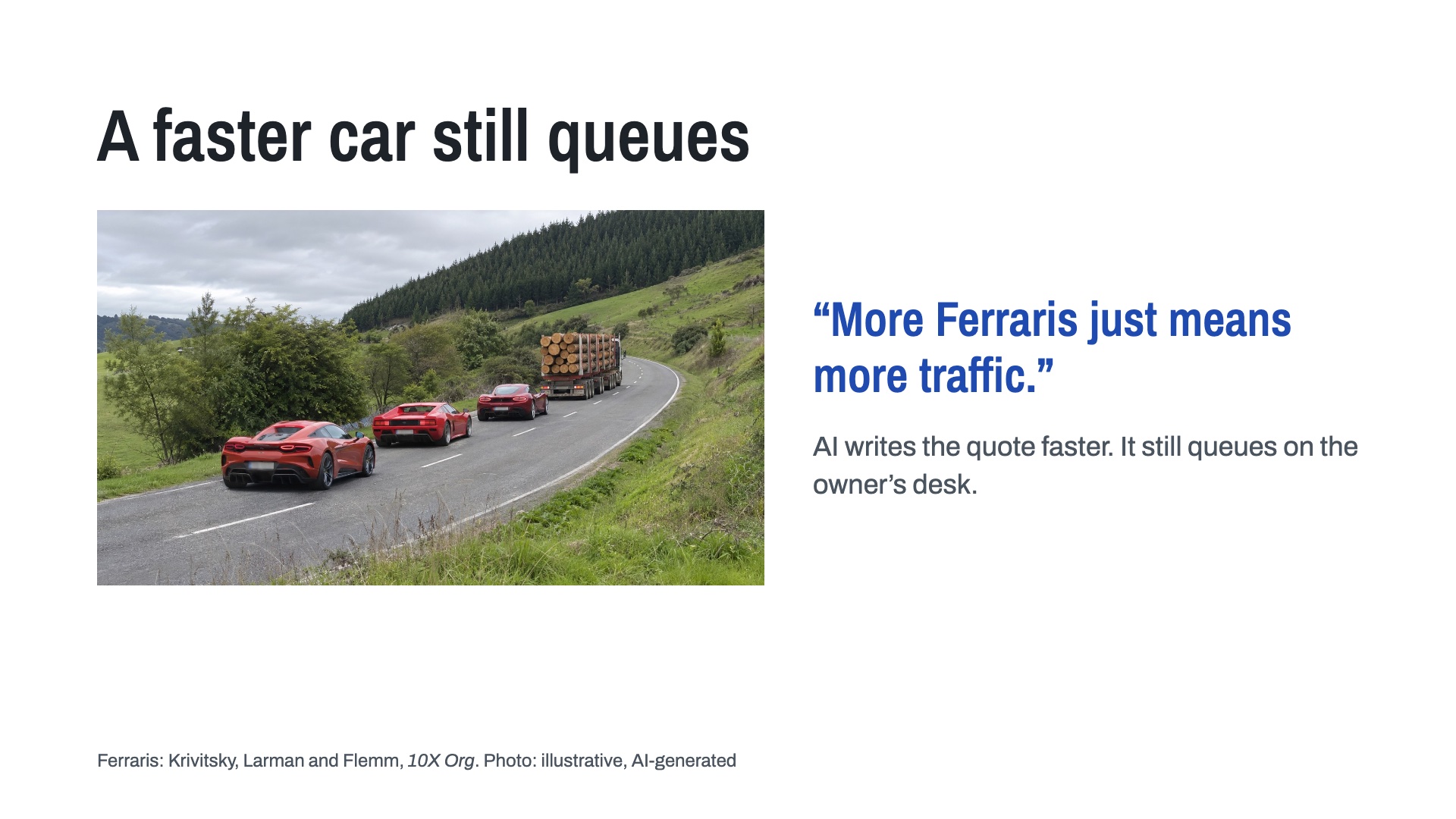
So AI saves time on the task. Whether you ever see that time depends on the road. Alexey Krivitsky, Craig Larman and Roland Flemm call this the Ferrari effect in 10X Org. Picture upgrading your Camry to a Ferrari. If it’s still stuck on a one-lane road behind a logging truck, you paid a lot of money and didn’t get there any faster. And if everyone upgrades, in their words, “More Ferraris just means more traffic.”
Making one part of your organisation faster doesn’t help if the work then waits behind something else. An everyday version: if every quote has to go through the owner, AI writes the quotes faster, and they still sit in a queue on the owner’s desk.
So you have to look at the whole system, and most of us were never trained to do that. Their advice is to change your organisation’s design before your AI, or in the book’s words, “Fix the road first.” This weekend, your team gets to practise a design that fits the real world better than most organisations manage today.
So when AI gives you an hour back, where does it go? To a cut, to a busier day, or to something that helps you deliver more and change course? Cutting costs is one way to raise net value. Delivering more is the other. And cutting costs has a floor. If you really want to cut costs, go out of business: that gets them to zero.
Eli Goldratt, the management writer, called this the difference between the cost world and the throughput world. AI as a cost-cutting tool, on its own, is a race to the bottom. Your competitors get the same tool, and the cuts take your spare capacity and your people’s goodwill with them.
Klarna, the buy-now-pay-later company, swapped a lot of its customer service for AI. In 2025 its CEO told Bloomberg the cost-cutting had gone too far: cost had been “a too predominant evaluation factor”, and quality had dropped. So they started hiring people again.
So use some savings to cut costs if that keeps you alive, and spend the rest on resilience and on delivering more: checking, learning, room for surprises. That’s Y-Nelson’s headspace.
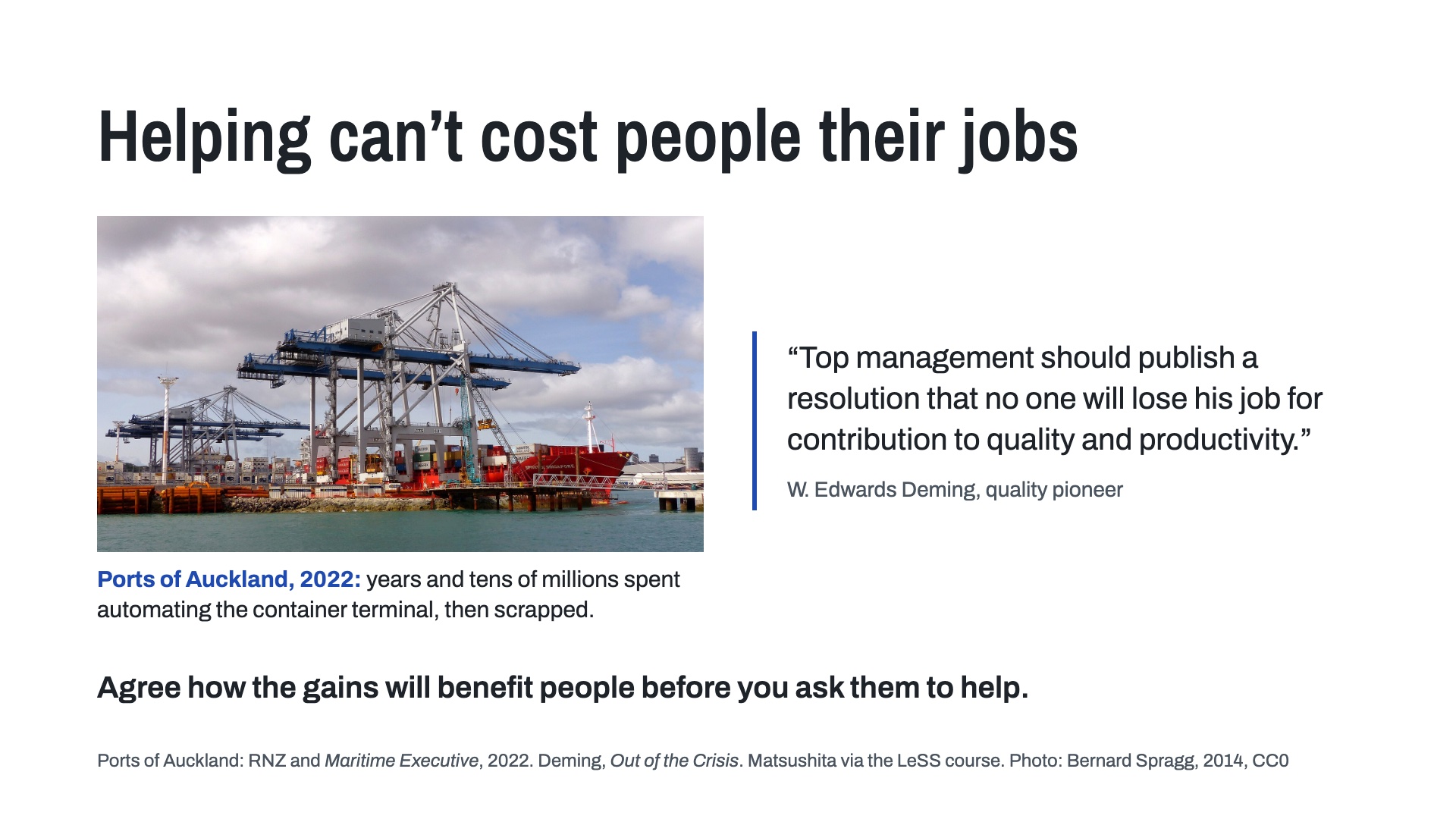
Now let’s say the jobs worry out loud, because some of you have it, and it’s reasonable. Ports of Auckland spent years and tens of millions of dollars automating its container terminal, and scrapped it in 2022. The unions had been worried about safety and job losses. The review found there’d been no resourcing or change management plan, and senior management had been left out of choosing the vendor. Change done to people, without a plan for them, tends to fail and to cost trust.
From my own years of process-improvement work: if you ask people to help make their work more efficient, and then some of them lose their jobs, you’ve won the battle and lost the war. The people who are left won’t help you again.
W. Edwards Deming, the quality pioneer, said management should promise, in public, that nobody loses their job for helping improve the work. If you employ anyone, or ever will, agree how the gains will benefit people before you ask them to help.
So here’s my challenge to leaders. Don’t spend the time you save on cutting people. Sit down with your teams and work out the strategy together, because everyone has value and insight to bring. Konosuke Matsushita, the founder of Panasonic, put it this way (also via the LeSS courses): “Only the intellects of all employees can permit a company to live with the ups and downs and the requirements of its new environment.” Keep your people, and use the time you save to deliver more value to the people you serve.
One more piece, about plans. Plan the next test, not the next year. A plan is how a team agrees what to try next and who does what. It isn’t a forecast. When things are this uncertain, you make the path by walking it, as the poet Antonio Machado put it. Dave Snowden, a complexity researcher, advises: run small experiments that are safe to fail, see what happens, do more of what works and stop what doesn’t. For a team of four this weekend, that means one cheap test at a time, not three builds at once.
Ryo Lu, head of design at Cursor, the AI coding tool, was asked in 2025 whether they keep a roadmap. His answer: “We don’t really.” The world’s changing too fast, with new models every day. He’d rather stay flexible, build foundations that last, and keep “a little ambiguous direction”.
That’s one team. But the idea travels. Think of your roadmap as a queue: everything on it is waiting. A long, detailed roadmap is a cost and a liability, not an asset. So the plan gets shorter, and it turns into a guess you test. If we try this, we expect to see that.
Same with AI. It’s confidently wrong some of the time, and you can’t tell which from the outside. So try it, and check what it gives you with real people: the ones who’d use it, and the ones it affects. AI is never a substitute for those conversations.
This weekend is a set of small experiments. Not everything will work. That’s the point.
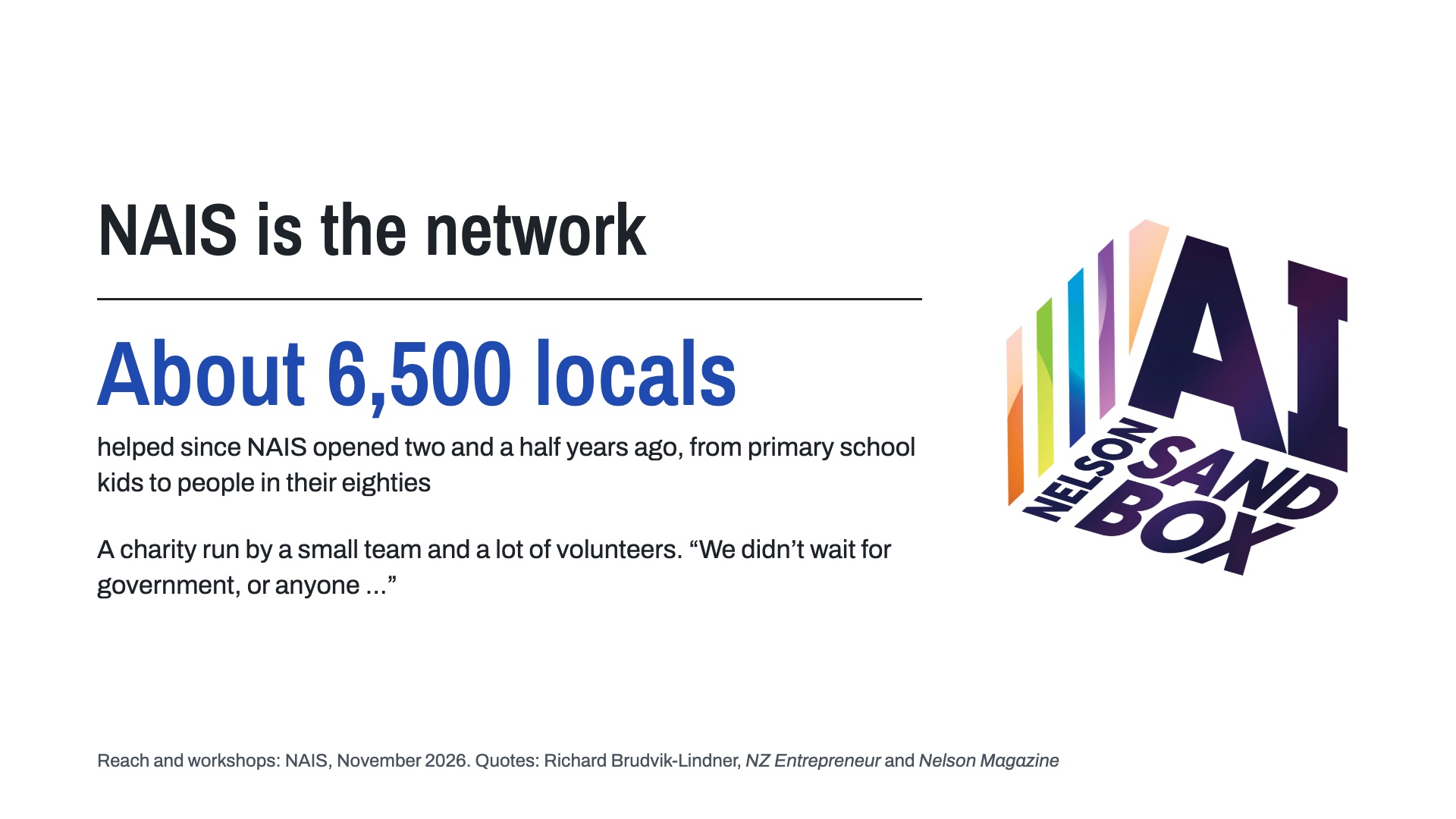
Remember who helped in the floods? Resilience lives in who you can call. And in Nelson, a lot of people call NAIS. It’s a charity, run by a small team and a lot of volunteers. When they set up their first space in 2024, they scrubbed the place up and painted it themselves. As NAIS’s Richard Brudvik-Lindner put it, “We didn’t wait for government, or anyone.”
Donella Meadows calls that kind of self-organisation the strongest form of resilience a system has. And in Richard’s words, the point is to “build capacity in our community, so AI benefits everyone, not just a select few.”
Since opening two and a half years ago, NAIS has helped about 6,500 locals, from primary school kids to people in their eighties, and more than 200 organisations have been through its workshops.
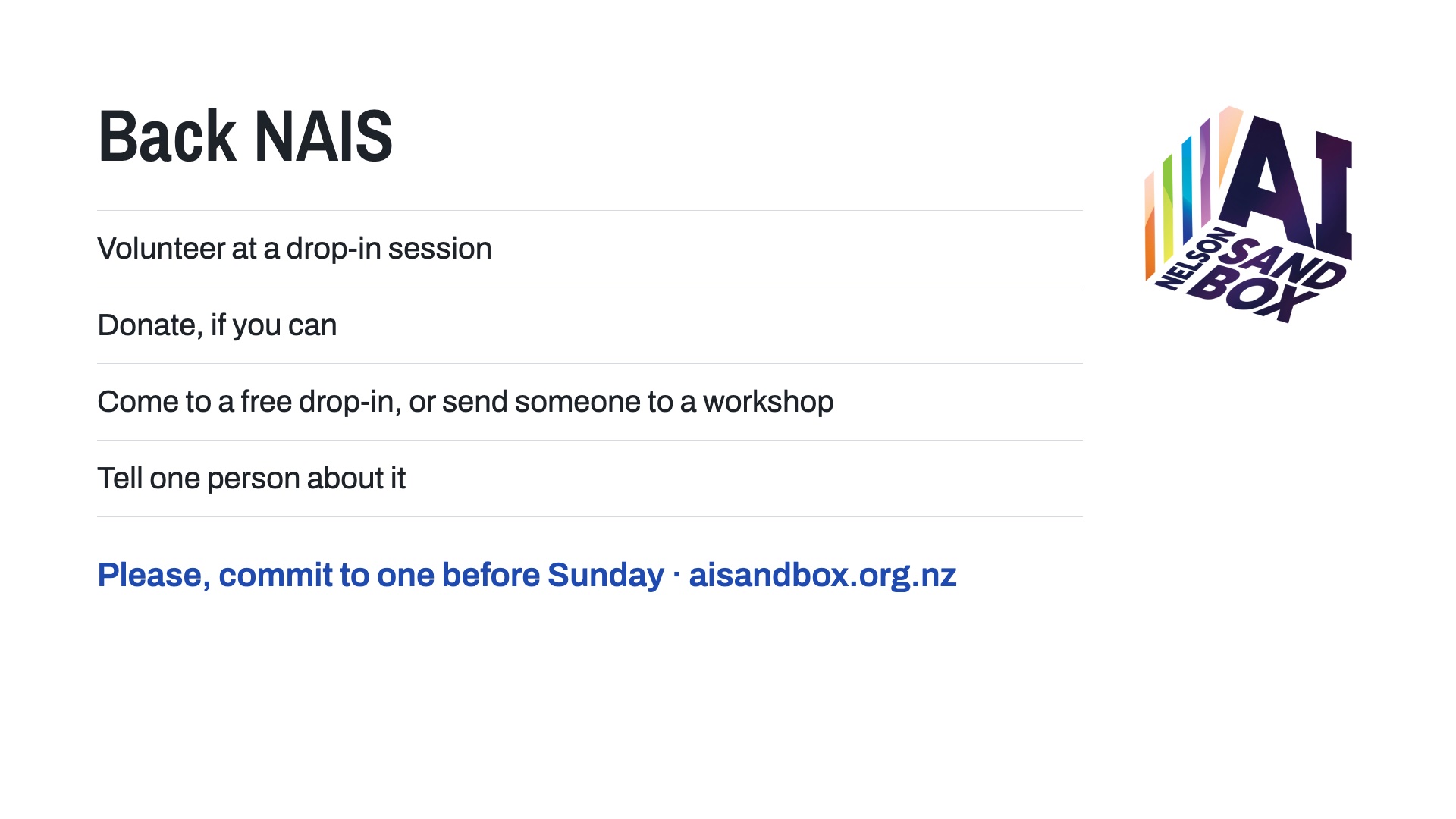
So here’s my one ask: back NAIS. Volunteer at a drop-in session. Donate, if you can. Come to a free drop-in, or send someone to a workshop. Or just tell one person about it. Please, commit to one before Sunday.
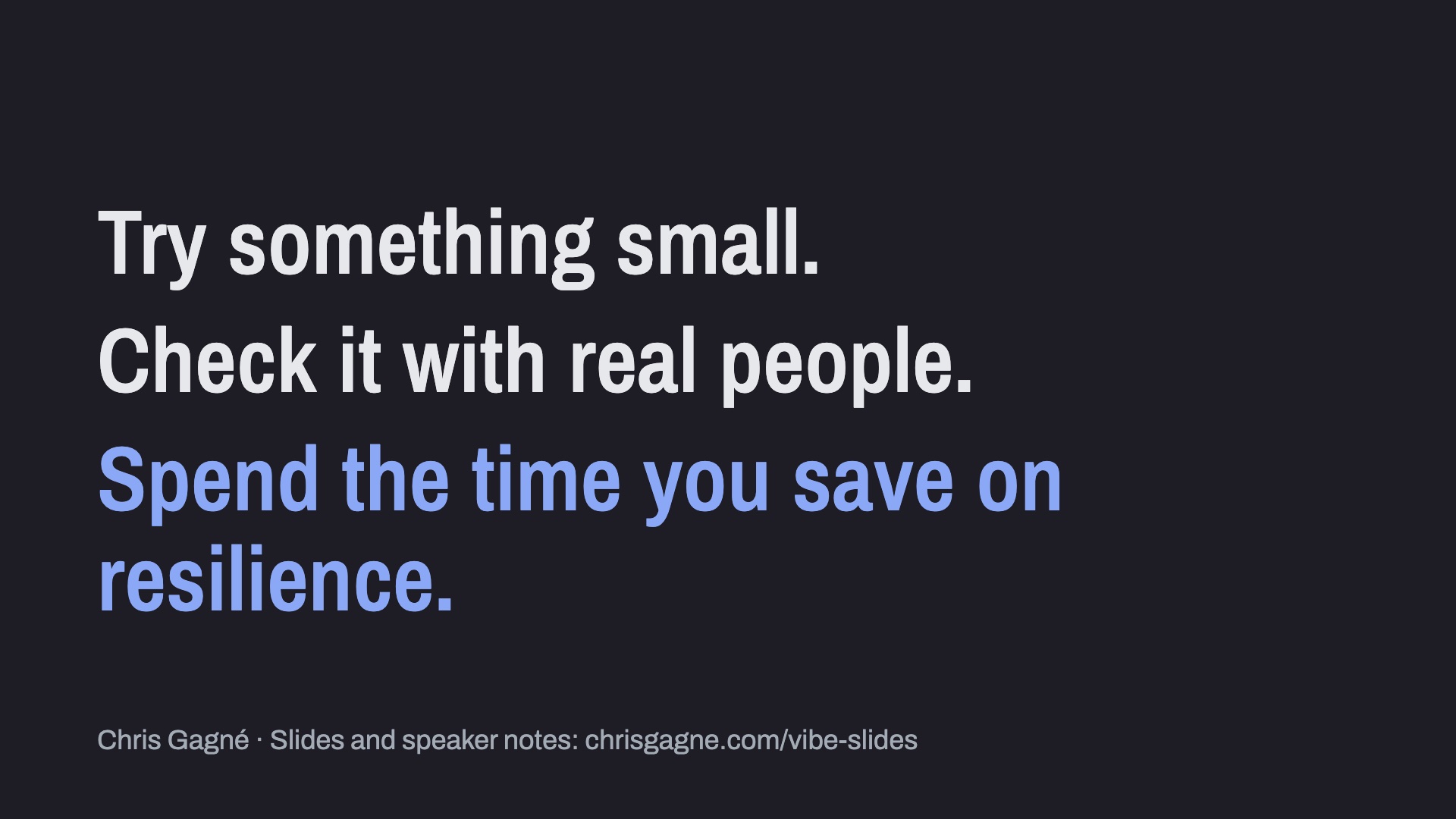
So, for the weekend. Try something small. Check it with real people: your teammates, and the people who’d actually use it. Not just the AI checking itself. And when it saves you time, spend some of it on resilience.
Thanks, everyone.
Books behind the talk
- Donella Meadows, Thinking in Systems: resilience traded for stability and productivity.
- Gene Kim and Steven Spear, Wiring the Winning Organization: Southwest in December 2022.
- Karl Weick and Kathleen Sutcliffe, Managing the Unexpected: FedEx’s planes flying 60% full.
- Stanley McChrystal and colleagues, Team of Teams: Drucker on efficiency and effectiveness.
- Jay Galbraith, Designing Organizations: the Star Model.
- Krivitsky, Larman and Flemm, 10X Org: the Star Model as they use it, and the Ferrari effect.
- Eli Goldratt, The Goal: the cost world and the throughput world.
- Dave Snowden and colleagues, Cynefin: safe-to-fail experiments.
- W. Edwards Deming, Out of the Crisis: nobody loses their job for helping improve the work.
Disclosure: I’m an Org Topologies Partner, and 10X Org is an Org Topologies book.