[May 2026] The safety frame I’m reaching for here is what Edmondson formalises as psychological safety and what Dekker grounds in just-culture. Modern Agile’s “safety as prerequisite” has matured into a richer literature on near-miss reporting, blameless inquiry, and learning-organisation discipline.
[August 2026] What the handbook shows is a company that changed the conditions rather than exhorting people to try harder inside the old ones. The line I quote here, “You just don’t see the line stop,” is the contrast Chapter 6 of Come Prepared to Die builds on, where I set NUMMI against Deming on tampering and Seddon on failure demand, and treat a Definition of Done as an andon cord.
I recently came across Mark Graban’s “Highlights from the Original 1984 NUMMI Team Member Handbook” series. Digging through the archives at Ephlin’s UAW office papers were archived at the Walter P. Reuther Library at Wayne State University in Detroit, Mark found some absolutely extraordinary gems, including this one.
Standing on the shoulders of giants, I reached out to the archivists at the library to see if I could get a copy of the full handbook. They cheerfully obliged, and rather quickly at that!
Grab the PDF and peruse for yourself. The first several pages are the most interesting, but even as you explore the rest of it pay attention to how human and reasonable it is. Mark provides an excellent commentary on several key sections, so I’ll try to avoid highlighting the same thoughts. I hope you’ll share your own findings and commentary in the comments below.
Here are some of the gems I’ve found:
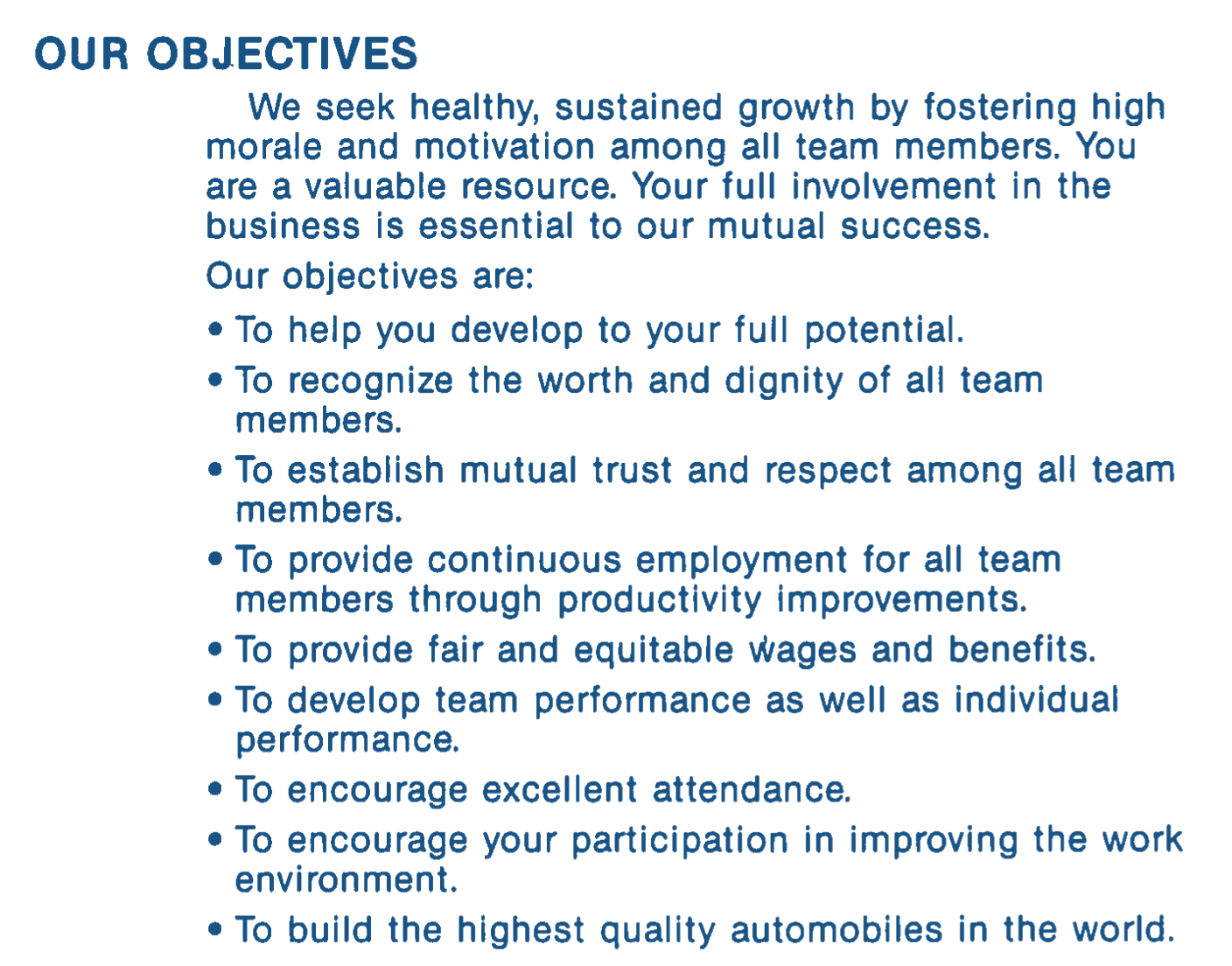
Notice that the first objective is “To help [employees] develop to [their] full potential.” In fact, these objectives start with the individual employee, progress to the company, and then ultimately end with the customer receiving the “highest quality automobiles in the world.” This is a notable inversion from the usual objectives, which usually prioritize stakeholders and customers, then the company, then—if at all—the individual employee.
This is extraordinary in two ways. First, employees are given the expectation that they are going to have a greater autonomy and influence over how other aspects of the organization operate. I’ve heard the statistic that Toyota’s 300,000 global employees make a total of one million suggestions annually, 97% of which are implemented. Secondly, note that the employee handbook is characterized as helping the employee “do [their] job better,” a far cry from the usual purpose of this kind of handbook (protecting the company’s interest).
(more…)