

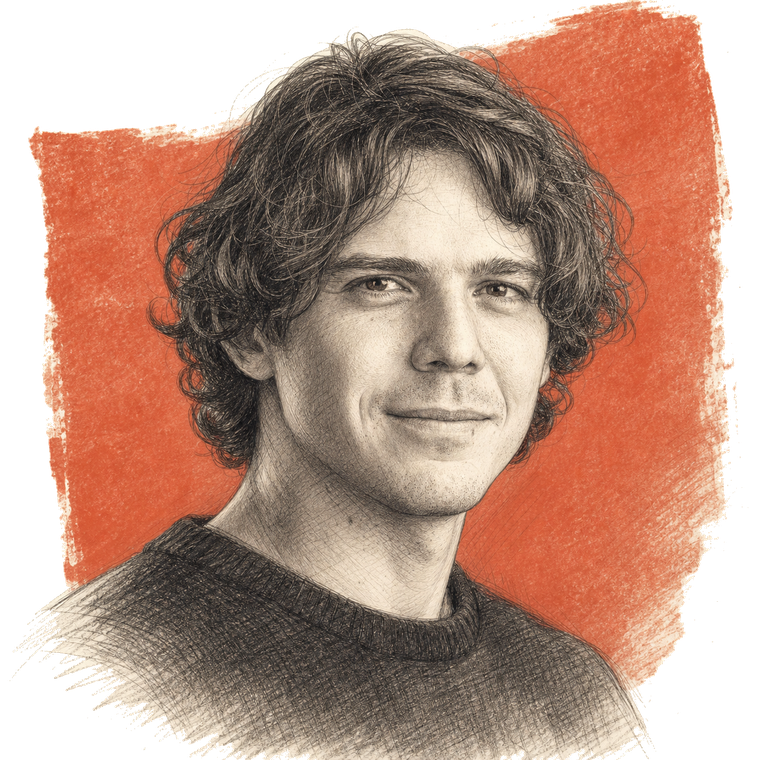
My name is Chris Gagné. I redesign how software organisations deliver, and I coach the leaders carrying the change: 20 years across product, organisational design, and coaching, on four continents. These days I work remotely from Nelson, New Zealand and travel when needed.
One person can’t personally coach dozens of teams at once, so I also use LLMs to build agentic and deterministic tools that carry the mentoring in my place. They’re one way the change outlasts me, not products I sell; each began as mentoring I gave in person. For example, AAR Maker runs the incident and post-launch reviews I used to facilitate and Delivery Intelligence shows teams and executives their flow, priority inversions, and probabilistic delivery forecasts.
About Chris Gagné
How I got here
 I started by building a company. Student of Fortune, an online tutoring service I co-founded in 2005. It drifted into eBay-for-homework right as I was heading to business school, so I sold my stake in 2009 rather than ride that further (Chegg bought the company two years later). At eBay’s StubHub I was product lead for the recommendations engine: production machine learning, 2013, with a three-person data-science team. At PagerDuty I co-invented a patented operations-benchmarking tool built on incident metrics.
Across those roles the harder constraints were usually organisational (how the work was structured, and what its leaders couldn’t yet see), so I crossed over to work on that side of the problem. I now work with Org Topologies (where I’m a Certified Consultant), Large-Scale Scrum, flow economics, Theory of Constraints, and Cynefin. At Accenture | SolutionsIQ I coached teams and their leadership at eBay, a global hospitality platform, and a global entertainment business.
I’ve been in solo practice since 2020. At Holo.Host I coached a fully distributed organisation using Large-Scale Scrum (LeSS). I then supported a healthcare startup in a critical scaling phase. Later, I spent three years advising a CPTO through Episource’s acquisition by and integration into Optum, leading five coaches across a 300-person technology organisation, during which speed-to-market and retention both improved. After portfolio-prioritisation work with publicly-traded National Research Corporation came the engagement that shapes how I work now: 15 months re-shaping a global firm’s technology operating model toward team-of-teams, more than 20 teams, as the sole coach, with self-serve AI tooling I built handling the recurring load. The same executive, a CTO or CPTO at each stop, has hired me into four companies over the last 18 years.
The coaching
 Alongside the structural work I do developmental coaching with the leaders the new operating model asks the most of. My training started with ICAgile’s facilitation and coaching courses, then Motivational Interviewing, then Co-Active. I now study and practise Alētheia with Steve March, and Radix, a somatic method; my contemplative practice predates my coaching career. Between the coach training and the contemplative work, that’s several hundred hours, itemised with dates on the vetting page. How the coaching runs (method, confidentiality rules, limits) is public at how coaching works with me.
New Zealand
 I was one of 533 fellows selected from more than 3,400 applicants for the Edmund Hillary Fellowship, New Zealand’s Global Impact Visa, the world’s first immigration programme built around positive global impact. It was named after Sir Edmund Hillary with his estate’s consent and created with the New Zealand government to bring a hand-picked global community of entrepreneurs, investors, and change-makers to build from New Zealand. It’s how I came to live in Nelson, at the top of the South Island. In 2019 I gave a talk at its New Frontiers gathering about caterpillars, the liminal goo inside the chrysalis, and what executives try to delegate that they can’t; the line I still stand behind is Deming’s “if you can’t come, send no one.” I’m a US citizen, authorised to work in New Zealand, and my mornings run 9am–5pm to 11am–5pm US Pacific depending on Daylight Saving Time. Here’s how our time zones overlap.
The book
 The pattern became a book. Come Prepared to Die: An Engineering Leader’s Field Guide to the Leadership Paradigms AI Is Exposing is serialising now, two chapters a week; the serialisation finishes in early September 2026. The book argues that AI gains keep landing inside delivery structures designed before these tools existed, so the returns fall short until the structure changes. The death in the title is the old leadership paradigm and the identity built on it.
Working together
One entry point for organisational work is a fixed-fee diagnostic. I hold a small number of standalone coaching places; how that practice runs is public. Either way, vet me first at the vetting page, then book a conversation: hi.chrisgagne.com.
I’m open to the right full-time operating or delivery-leadership seat, remote-first (US citizen, no sponsorship needed; NZ-based, keeping US-facing hours with Asia-Pacific coverage), alongside embedded engagements. If a full-time seat lands, the practice winds down in an orderly 30 days.